• ABOUT
  • BIRDING 2018
  • Birding 2019
  • BLOG POSTS
  • Butterflies 2018
  • Resources

earthstar

~ a celebration of nature

earthstar

Author Archives: sconzani

A confusion of pie crusts

10 Tuesday Oct 2023

Posted by sconzani in insects

≈ Leave a comment

Tags

aphids parasitised by wasps, Drepanosiphum platanoidis, Drepanosiphum platanoidis parasitised by Dyscritulus planiceps, Dyscritulus planiceps, parasitic wasp, parasitised aphids, Praon flavinode, Tuberculatus parasitised by Praon flavinode, Tuberculatus species

You can tell I’m no baker – I got my pie crusts confused, what should’ve been puff pastry was really a pizza base. And now you’re confused … let me explain.

Back on 19 September, I wrote about A parasitised aphid, and said that ‘The Praon genus of parasitic wasps are the only ones that create this disc-shaped attachment beneath their host’. That was wrong (and I’ve now edited that post). The Praon wasps are actually responsible for an attachment beneath their host that looks more like puff pastry. Here are examples of the two types of pie crust.
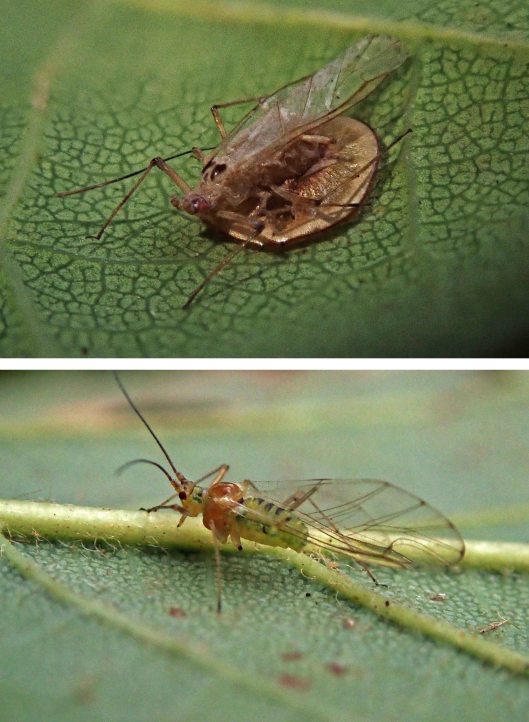
231010 Drepanosiphum platanoidis parasitised by Dyscritulus planiceps and live

First, the pizza base. The first photo above shows the aphid Drepanosiphum platanoidis, which has been parasitised by the wasp Dyscritulus planiceps. The second photo, just for comparison, shows the same species of aphid when alive.
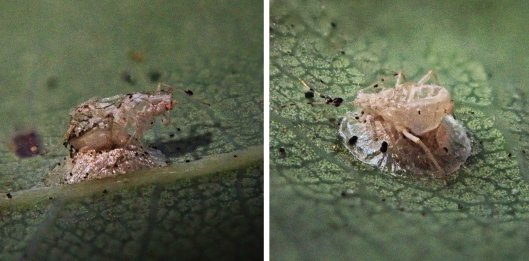
231010 Tuberculatus parasitised by Praon flavinode

Second, the puff pastry. And these two are both Tuberculatus species of aphids that have been parasitised by Praon wasps, most likely Praon flavinode (the local expert I’ve now made contact with tells me ‘There are quite a few species of Praon/Praini but flavinode will almost certainly be the species involved with Tuberculatus on oak’). What was that I said about ‘standing at the top of a very slippery slope, at the bottom of which is a chasm filled with aphids and their parasites!’ (Aphid mummies, 26 September)? Always learning!
Like Loading...

Leafmines: Lyonetia prunifoliella

09 Monday Oct 2023

Posted by sconzani in insects, leaves, trees

≈ Leave a comment

Tags

British leafmines, British moths, leaf mines, leafmines on Blackthorn, leafmining moth larvae, leafmining moths, Lyonetia prunifoliella

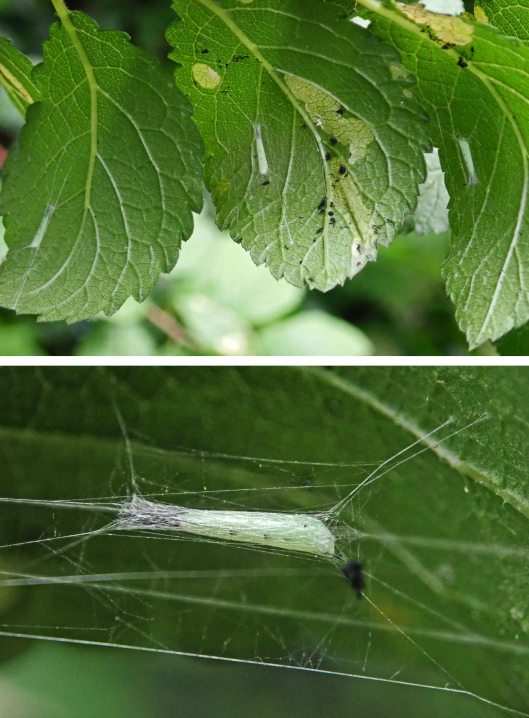
For over 100 years, the lovely little micro moth Lyonetia prunifoliella was thought to be extinct in the UK until it was rediscovered in the 2000s in southern England. It took a while to spread across the country but was found new to Wales, near Holyhead, last autumn and, soon afterwards, found here in south Wales, at Kenfig National Nature Reserve, though just one larval mine was found despite much searching by Butterfly Conservation’s senior moth ecologist George Tordoff.

231009 lyonetia prunifoliella (1)

This year, though, George says, it’s really taken off in south Wales: he’s found it in various Cardiff parks and at Lavernock Nature Reserve. When I heard this news last Sunday, 1 October, I immediately decided to go searching, focussing in particular on the suckering growth of Blackthorn (Prunus spinosa), the tree this moth appears to favour locally for its larval leafmines (though it is known to use other roseaceous trees elsewhere).

231009 lyonetia prunifoliella (2)

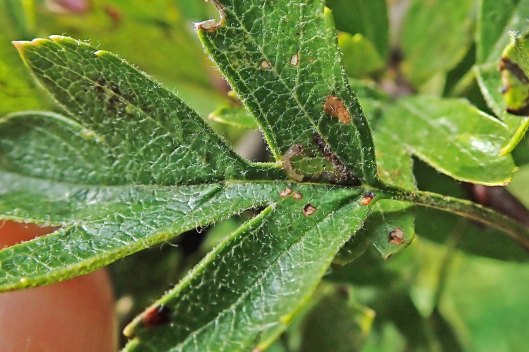
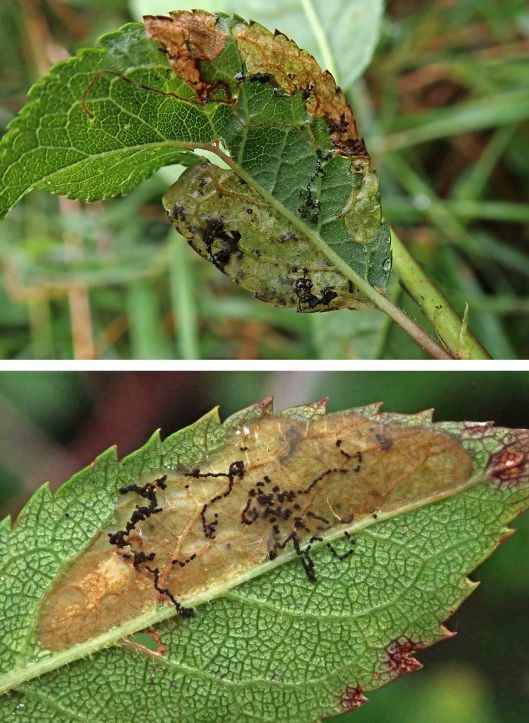
Last Monday I found Lyonetia prunifoliella mines immediately at the first place I looked, and have since found it at six locations in my surrounding area, sometimes in abundance, other times just one or two mines, despite a plentiful supply of young Blackthorn leaves. The mines are relatively easy to identify, as the larvae eject their frass from the mines in a ‘string of black pearls’, a rather poetic description from someone on Twitter but easy to remember. (The photographs above show the upper and under sides of the same leaf, with the larva apparent above and its frass ejected below.)

231009 lyonetia prunifoliella (3)

Although most mines I’ve seen have been empty (this moth overwinters as an adult), a few have held larvae, and I was particularly delighted last Thursday to find a group of five cocoons, strung like hammocks on the underside of leaves with silk produced by the larvae before they pupate. I’ve yet to see an adult moth but will definitely share that exciting moment when it happens.

Like Loading...

An aster, but which?

08 Sunday Oct 2023

Posted by sconzani in plants, wildflowers

≈ 2 Comments

Tags

Aster species, British wildflowers, Sea aster, Tripolium pannonicum

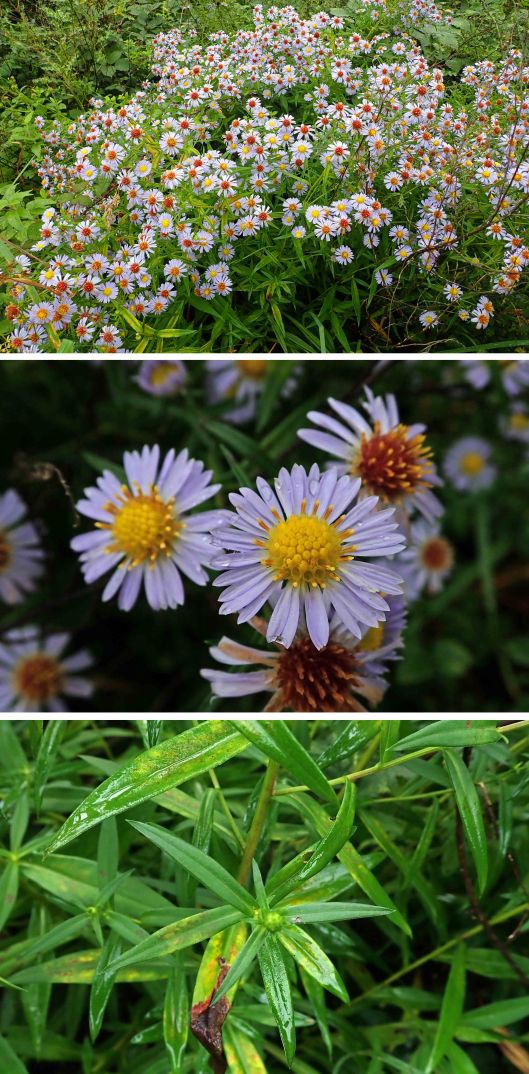
When I spotted these plants during a walk to a new place last week, I thought perhaps they were Sea asters (Tripolium pannonicum) and, indeed, they might be, but I’ve since heard how frequently other species of Aster self-seed on waste ground, which has cast doubt on my identification. These were growing in rough ground near a very busy road but quite close to the banks of a tidal creek. I’m going to have to ‘phone a friend’ but, in the meantime, if you’re familiar with Sea aster, please do venture an opinion in the comments.

231008 sea aster

Like Loading...

Harvestman: Opilio canestrinii

07 Saturday Oct 2023

Posted by sconzani in insects

≈ Leave a comment

Tags

Harvestman, Opilio canestrinii

I seem to be seeing a lot of Harvestmen this year. I’m not sure if they’re having a particular good year or if it’s just because I’m doing a lot of leaf-turning and that’s where they’re generally to be found, lurking on a leaf. With its orange coxae (think hip bones in humans – so at the top of the legs where they join the body) and a white ring around the eyes (not easy to see in this image, unfortunately), I think I’ve nailed the ID for this one: Opilio canestrinii.

231007 Harvestman Opilio canestrinii

Interestingly, the NatureSpot website reports that this harvestman is

an invader that is quickly colonising Britain. It was first seen in the UK in October 1999 beside a reservoir in the Lea Valley, Essex. The species has been expanding northwards from Italy, Austria and Switzerland. Where it has colonised Denmark and Germany, it has displaced the other two species of Opilio so this may also happen here.

Like Loading...

A Cladius on rose

06 Friday Oct 2023

Posted by sconzani in insects, plants

≈ Leave a comment

Tags

British sawflies, sawfly larvae, sawfly larvae on rose, sawfly on Field rose

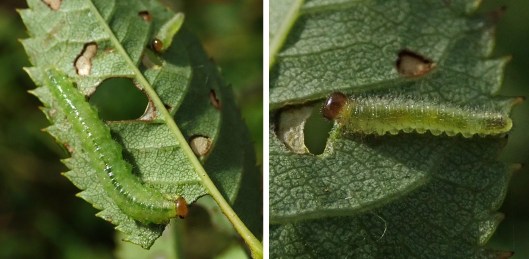
Another day, another Cladius sawfly – actually, this time, 6 sawfly larvae, all munching away on the leaves of a Field rose. I was hoping their identification would be as easy as yesterday’s Cladius ulmi, with its distinctive black-spotted face, but no!

231006 Cladius on rose (1)

This time my expert confirmed it was definitely a Cladius species and that my guess of Cladius pectinicornis was the most likely but C. pilicornis and C. compressicornis also use rose as their larval plant of choice. When I consulted The Sawflies (Symphyta) of Britain and Ireland website I found for C. pilicornis that the only larva shown on the website had a broad dark stripe down its back and the text said the larvae associated with Hawthorn, not rose, so that seemed unlikely. However, when I checked C. compressicornis, it did look to be a likely contender, with features and larval plants very similar to C. pectinicornis.

231006 Cladius on rose (2)

So, once again I have to concede that I can’t put an exact name to these very cute little sawfly larvae, but I certainly enjoyed watching them. When much in the world around us seems maddening and/or depressing, I find there’s something very calming about watching caterpillars eating and gliding about.

231006 Cladius on rose (3)

Like Loading...

A Cladius on Wych elm

05 Thursday Oct 2023

Posted by sconzani in insects, trees

≈ Leave a comment

Tags

British sawflies, Cladius sawflies, Cladius ulmi, Cladius ulmi larva, sawfly larva, sawfly on Wych elm, Wych elm

There are just seven species of Cladius sawfly found in Britain, which, you might think, would make them relatively easy to identify. Sadly, this isn’t the case, especially in their larval forms, as all their caterpillars look very similar, and even the expert I consulted said he was unsure about the larval differences.

231005 Cladius ulmi (1)

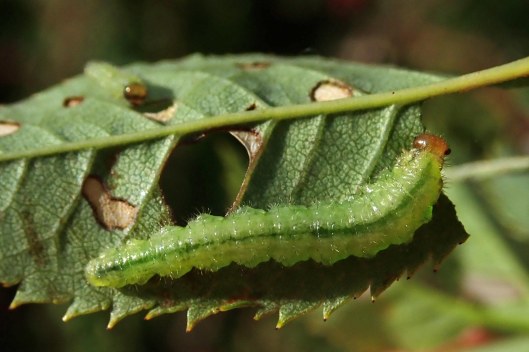
However, I seem to have struck it lucky with this particular species as The Sawflies (Symphyta) of Britain and Ireland website says: ‘They can be distinguished from the other elm feeding species, Cladius rufipes, by the presence of a black spot on the front of the face which is absent in rufipes.’ As you can clearly see in the photo above, this larva has that black spot, so meet Cladius ulmi, a sawfly species that feeds on elm, in this case Wych elm (Ulmus glabra).

231005 Cladius ulmi (2)

Like Loading...

A Cardiff Bay regular

04 Wednesday Oct 2023

Posted by sconzani in birds

≈ Leave a comment

Tags

birding, birdwatching, British birds, Cardiff Bay birding, Pied wagtail

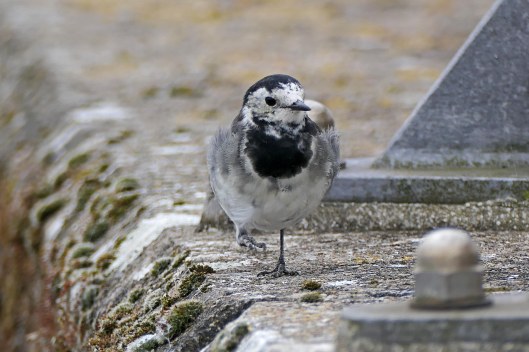
Though the numbers of Pied wagtails frequenting Cardiff Bay Barrage can vary considerably, from half a dozen to a couple of dozen depending on the time of year, there are a few permanent residents that have their own little territories. This is one that can often be seen, as here, stepping out along the tops of the concrete walls next to the sluice gates, searching around the mosses and lichens for the myriad of tiny insects that fill its tummy each day.

231004 pied wagtail

Like Loading...

A rat-tailed maggot

03 Tuesday Oct 2023

Posted by sconzani in insects

≈ 4 Comments

Tags

British hoverflies, hoverfly, hoverfly larva, hoverfly larva on Sycamore, Myathropa florea, Myathropa florea larva

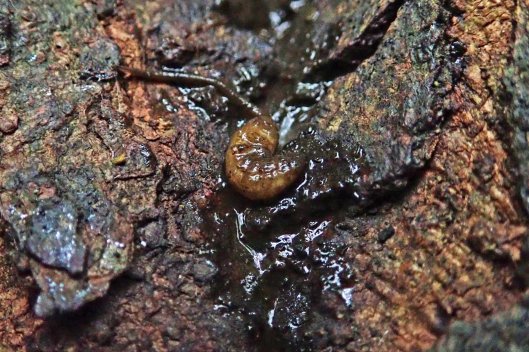
‘What fresh hell is she sharing with us now’, I sense you thinking. For me, though, this was Sunday’s star find, something I’ve wanted to find for ages. This is the larva of a Myathropa florea species of hoverfly that I found living in a sap run on a Sycamore tree. The ‘tail’ is actually its breathing tube, a bit like a long snorkel.

231003 myathropa florea larva

When I spotted it at the edge of a cleft in the Sycamore, I used a stick to move it gently out into the open a little more so I could get some photos. I expected to have to nudge it back but, as you can see in this short video, it turned itself around and slowly undulated itself back in to its home in the puddle of watery sap, leaf litter and insects. Now to find more maggots!

Like Loading...

Leafmines: Bucculatrix bechsteinella

02 Monday Oct 2023

Posted by sconzani in insects, trees

≈ Leave a comment

Tags

British leafmines, Bucculatrix bechsteinella, Hawthorn bent-wing, leafmine on Hawthorn, moth leafmines

This is another of my ‘I think it might be this but it might not be’ posts. One of the people I follow on Twitter (I refuse to call it X) has begun sharing a ‘Lepidoptera leafmines to find’ monthly post, and one of this month’s six is Bucculatrix bechsteinella, found on Hawthorn.

231002 bucculatrix bechsteinella (1)

The post warns that Bucculatrix bechsteinella (also known as Hawthorn bent-wing) ‘may be confused with those of Paraswammwerdammia nebulella, which tend to be smaller, more numerous and with irregular exits and occurring anywhere on the leaf, but those of B. bechsteinella usually occur in a vein axil.’ This description leads me to think my finds are correct but I’ll need to await verification of my records to be sure. (You can see the adult moth on the UK Moths website.)

231002 bucculatrix bechsteinella (2)

Like Loading...

Sea holly blue

01 Sunday Oct 2023

Posted by sconzani in wildflowers

≈ 3 Comments

Tags

blue flowers, blue wildflower, British wildflowers, Sea holly, seaside flora

After dazzling you with 39 different wildflowers last Sunday, today I have just one offering, but I think it is equally dazzling. There’s just something about the blue of Sea holly that I simply adore.

231001 sea holly (1)

Like Loading...
← Older posts
Newer posts →

About me

sconzani

sconzani

I'm a writer and photographer; researcher and blogger; birder and nature lover; countryside rambler and city strider; volunteer and biodiversity recorder.

View Full Profile →

Follow earthstar on WordPress.com

Enter your email address to follow this blog and receive notifications of new posts by email.

Recent blog posts

  • Bloody-nosed beetle April 6, 2026
  • Gorse and its weevil April 5, 2026
  • Chiffchaffs chiffchaffing April 4, 2026
  • Bearded tit!!! April 3, 2026
  • A Portland Bill Kestrel April 2, 2026

From the archives

COPYRIGHT

Unless otherwise acknowledged, the text and photographs on this blog are my own and are subject to international copyright. Nothing may be downloaded or copied without my permission.

Fellow Earth Stars!

  • Unknown's avatar
  • Unknown's avatar
  • Unknown's avatar
  • Unknown's avatar
  • Unknown's avatar
  • Unknown's avatar
  • Unknown's avatar
  • Unknown's avatar
  • Unknown's avatar
  • Unknown's avatar
  • Unknown's avatar
  • Unknown's avatar
  • Unknown's avatar
  • Unknown's avatar
  • Unknown's avatar
  • Unknown's avatar
  • Unknown's avatar
  • Unknown's avatar
  • Unknown's avatar
  • Unknown's avatar
  • Unknown's avatar
  • Unknown's avatar
  • Unknown's avatar
  • Unknown's avatar
  • Unknown's avatar
  • Unknown's avatar
  • Unknown's avatar
  • Unknown's avatar
  • Unknown's avatar
  • Unknown's avatar
  • Unknown's avatar
  • Unknown's avatar
  • Unknown's avatar
  • Unknown's avatar
  • Unknown's avatar
  • Unknown's avatar
  • Unknown's avatar
  • Unknown's avatar
  • Unknown's avatar
  • Unknown's avatar
  • Unknown's avatar
  • Unknown's avatar
  • Unknown's avatar
  • Unknown's avatar
  • Unknown's avatar
  • Unknown's avatar
  • Unknown's avatar
  • Unknown's avatar
  • Unknown's avatar
  • Unknown's avatar

Blog at WordPress.com.

Privacy & Cookies: This site uses cookies. By continuing to use this website, you agree to their use.
To find out more, including how to control cookies, see here: Cookie Policy
  • Subscribe Subscribed
    • earthstar
    • Join 642 other subscribers
    • Already have a WordPress.com account? Log in now.
    • earthstar
    • Subscribe Subscribed
    • Sign up
    • Log in
    • Report this content
    • View site in Reader
    • Manage subscriptions
    • Collapse this bar
 

Loading Comments...
 

You must be logged in to post a comment.

    %d