
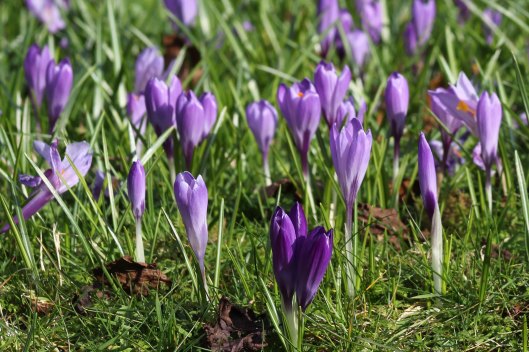
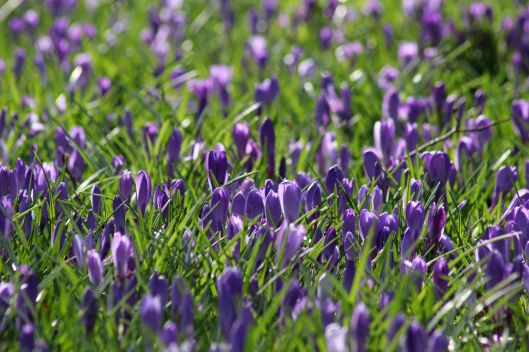
Following on from yesterday’s gorgeous crocuses for Floral Friday, here’s a little something I found bumbling about in those flowers …



24 Saturday Feb 2018
Posted in flowers, insects, nature, spring, wildflowers
Following on from yesterday’s gorgeous crocuses for Floral Friday, here’s a little something I found bumbling about in those flowers …
23 Friday Feb 2018
Posted in flowers, nature, plants, spring, wildflowers

Along these blushing borders bright with dew,
And in yon mingled wilderness of flowers,
Fair-handed Spring unbosoms every grace –
Throws out the snowdrop and the crocus first
~ James Thomson, ‘Spring’, The Seasons


16 Friday Feb 2018
Posted in flowers, nature, spring, wildflowers
Tags
#FloralFriday, British wildflowers, Ficaria verna, Lesser Celandine, Ranunculus ficaria, signs of spring

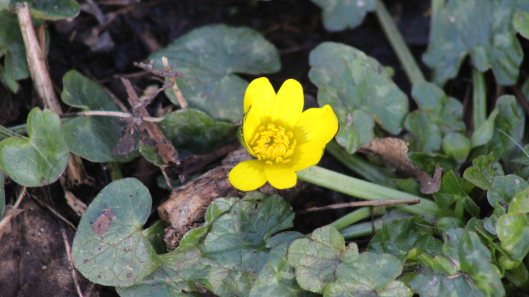
Not only was it the favourite flower of William Wordsworth (who wrote three poems about it) and considered to be a herbal remedy for haemorrhoids (due to the shape of its roots), but the pretty Lesser celandine (was Ranunculus ficaria, now Ficaria verna) is one of the first floral heralds of spring.


The flowers are supposed to appear around the same time that the Swallows arrive back in Britain (hence the name Celandine, which comes from the Greek chelidon, meaning Swallow) (flower and bird are out of sync this year, though) so we need to keep our eyes on the skies, as well as on the ground.
14 Wednesday Feb 2018
Primaveral: adjective, meaning of, relating to, or taking place in early spring (as in, for example, the primaveral blossoming of the Cherry plum tree in my photo).
According to the Oxford Dictionary, the word appeared in the English language in the early 19th century, having come possibly from the Catalan primavera, the Spanish primavera, the Portuguese primavera, or the Italian primavera, which all mean ‘springtime’. And those words probably came from the Latin prīmum vēr, meaning first or earliest spring.

09 Friday Feb 2018
Posted in flowers, nature, spring, wildflowers


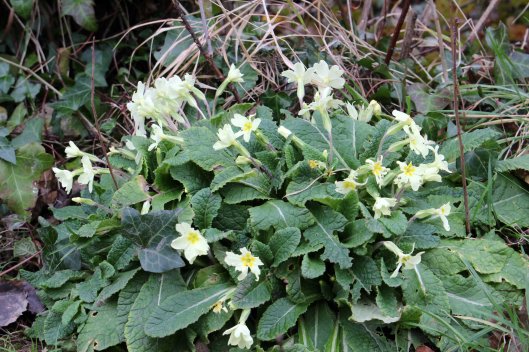
‘Ring-ting! I wish I were a Primrose,
A bright yellow Primrose blowing in the spring!
The stooping boughs above me,
The wandering bee to love me,
The fern and moss to creep across,
And the elm-tree for our king!’
~ from William Allingham, ‘Wishing, A Child’s Song’. Allingham (1824-1889) was an Irish poet and man of letters.
02 Friday Feb 2018

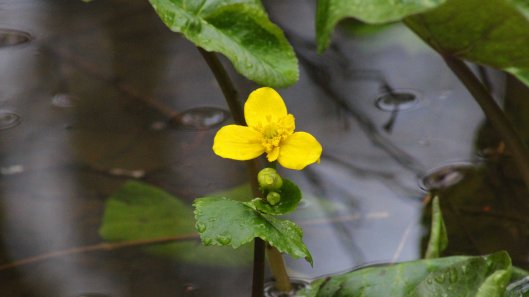
Though it’s hard to believe today, as I look out the window at yet another grey rainy day and the temperature is set to go down all day not up, here is yet another sign that spring really is just around the corner. I spotted these Marsh marigolds (Caltha palustris) blooming in a muddy pond in Cardiff’s Heath Park last week.

28 Sunday Jan 2018
Posted in flowers, nature, wildflowers, winter
It was about time I had another go at WildflowerHour’s current challenge: ‘our weekly winter challenge is #thewinter10 which is to find ten different wild flowers in bloom each week. Once you’ve found them, work out what they are, and post them for the rest of us to see.’
So, on Thursday’s walk, though I was really looking for birds, I also remembered to cast my eyes downwards for flowers. And, on one relatively short stretch along the western edge of Cardiff Bay, I found my ten: Creeping buttercup (I think). a Dandelion species, Nipplewort, Petty spurge, possibly Common mouse-ear, Red dead nettle, Groundsel, Sweet meadow grass, Gorse, and Red clover.


26 Friday Jan 2018
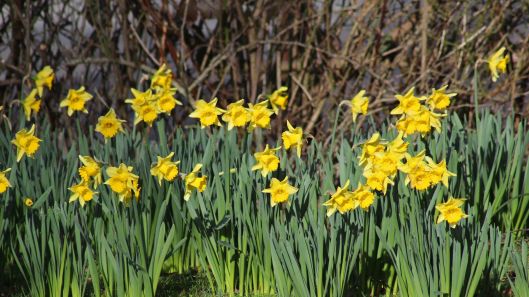
She wore her yellow sun-bonnet,
She wore her greenest gown;
She turned to the south wind
And curtsied up and down.
She turned to the sunlight
And shook her yellow head,
And whispered to her neighbour:
“Winter is dead.”
~ A.A. Milne, When We Were Very Young


21 Sunday Jan 2018
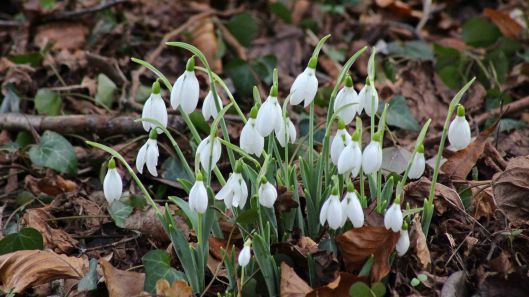
During my walk in Bute Park a few days ago, I saw my first signs of spring. And, though I love winter – as I love each of the seasons for the differences they offer – still, it is always heart-warming, when the days are short and cold and often grey, to see small signs, like these snowdrops, of the earth’s re-awakening.
19 Friday Jan 2018
Posted in flowers, nature, plants, wildflowers
Tags
British flora, British native daphne, British native flowers, Daphne laureola, Spruge laurel, winter flowers
Spurge laurel is such an uninspiring name for this lovely British native, which I was surprised and delighted to find in full flower when I was walking the south Wales coastal path at Lavernock last weekend.

Any gardener will recognise this plant as a member of the Daphne family – its scientific name is Daphne laureola – and, not only does it flower from the middle of winter through spring and into early summer, it also has a delicious honey smell. It’s evergreen and prefers to have its roots in rich, shaded soil, growing best on the edge of woodlands on chalk or limestone.


I must add one note of caution, though: everything about this plant is poisonous to humans, from the sap (which can cause a nasty skin rash) to the black berries that appear in late summer. Luckily, the berry toxins do not appear to affect birds, and there are reports of robins and greenfinches enjoying an autumn feast.


 earthstar
You must be logged in to post a comment.