• ABOUT
  • BIRDING 2018
  • Birding 2019
  • BLOG POSTS
  • Butterflies 2018
  • Resources

earthstar

~ a celebration of nature

earthstar

Category Archives: fungi

344/366 Not just any stick

09 Wednesday Dec 2020

Posted by sconzani in fungi, trees, winter

≈ 1 Comment

Tags

blue fungi, British fungi, Cobalt crust, Terana caerulea

Do you see the small stick sitting on top of the big fallen branch, in the centre left of the photo? Well, that stick was the absolute highlight of my seven-and-a-half-mile walk yesterday.
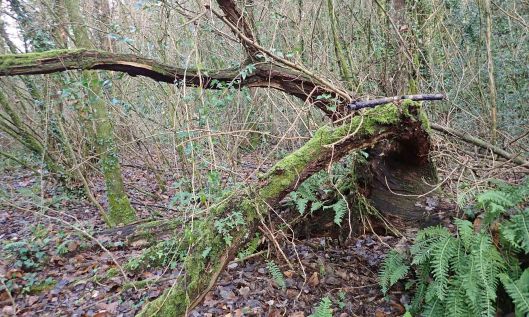
201209 cobalt crust (1)

And below you can see why. This is the fungus Cobalt crust (Terana caerulea), an incredible colour to find growing on a stick in the middle of a now mostly brown woodland.
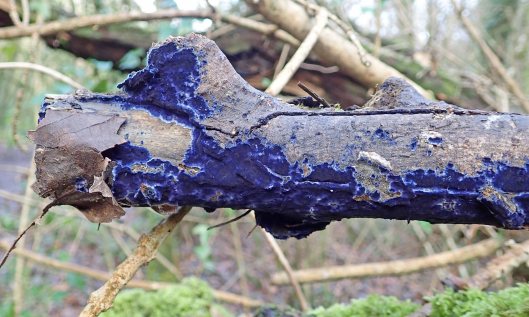
201209 cobalt crust (2)

This is the first time I’ve found Cobalt crust locally and I was/am just so excited to see it. I might just have to go back next week for another look (and, also, to get photos of the red elfcups that were just beginning to appear nearby).

201209 cobalt crust (3)

Like Loading...

339/366 The Nostoc is thriving

04 Friday Dec 2020

Posted by sconzani in fungi

≈ Leave a comment

Tags

cynobacterium, Nostoc

Rain may not be everyone’s favourite weather. It turns pathways to mud, may cause flooding in extreme weather events, and can make finding enough food difficult for many wild creatures, but one organism that positively thrives on the dampness is the cynobacterium Nostoc.

201204 nostoc (1)

Nostoc both fascinates and revolts me: fascinates because of its ability to survive in extreme conditions and its sinuous shapes, revolts because of its consistency and texture. I found this huge area of it on a walk along the coast a couple of days ago and just can’t resist sharing some photos. For more about Nostoc, see my blog Gloop, February 2018.

201204 nostoc (2)
201204 nostoc (3)
201204 nostoc (4)
201204 nostoc (5)
Like Loading...

332/366 Redlead roundhead

27 Friday Nov 2020

Posted by sconzani in autumn, fungi

≈ Leave a comment

Tags

British fungi, fungi on wood, Leratiomyces ceres, Redlead roundhead

Redlead roundhead – try saying that name several times at speed – a real tongue-twister! Its scientific name is also a bit of a mouthful: Leratiomyces ceres, the ceres epithet a reference to the red of its cap, though I’ve found they’re more of a rusty red than cerise.

This fungus is an ‘alien from Australia’ that favours wood chip, particularly on sandy soil, and it owes its spreading distribution to the way many park departments cover areas of ‘gardens’ with chippings of trees from wide and varied sources. I found this particular specimen on the Cardiff Bay Barrage, growing on bits of wood washed down the Rivers Ely and Taff during flooding events.

Like Loading...

325/366 White saddles

20 Friday Nov 2020

Posted by sconzani in autumn, fungi

≈ Leave a comment

Tags

British fungi, Helvella crispa, saddle fungi, White saddle

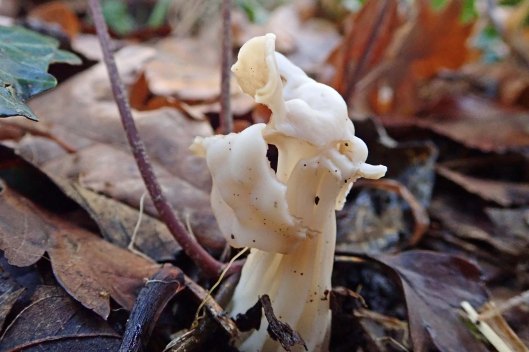
I was checking fallen leaves in a woodland clearing when I noticed something white poking through the leaves, a lucky break as it’s easy to miss these lovely little fungi. I had to clear away leaves to get these photos, but then mostly covered them up again.

201120 white saddle (1)

These are typical examples of White saddle (Helvella crispa), one of several species of ‘saddle’ fungi you can find in woodlands, these particular saddles growing most often where there are Beech trees.

201120 white saddle (2)

According to the First Nature website, ‘Helvella is an ancient term for an aromatic herb. The specific epithet crispa comes from Latin and means curled or wrinkled – a reference to the contorted cap or saddle’.

Like Loading...

324/366 Simply red

19 Thursday Nov 2020

Posted by sconzani in autumn, fungi, leaves, nature, plants

≈ Leave a comment

Tags

autumn colour, colour red, red fruit, red fungi, red leaves, red stems

Stop! Danger! With green, Christmas. Anger (seeing red). Passion (red hot). And, in Nature, red leaves, red breasts (though I’ve always thought of the Robin as more of an orange breast), red fungi, red fruit, red feathers, red eyes…. Here’s a selection of reds from my recent meanders.

201119 red (1)
201119 red (2)
201119 red (3)
201119 red (4)
201119 red (5)
201119 red (6)
201119 red (7)
201119 red (8)
201119 red (9)
201119 red (10)
201119 red (11)
201119 red (12)
Like Loading...

321/366 Springtails and slime

16 Monday Nov 2020

Posted by sconzani in fungi, insects

≈ Leave a comment

Tags

Comatricha nigra, Comatricha slime mould, Dicyrtomina saundersi, fungi on rotting wood, Neanura muscorum, slime, slime mould, springtail, Trichia persimilis, Trichia slime mould

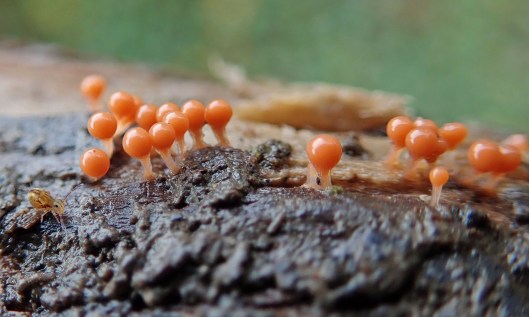
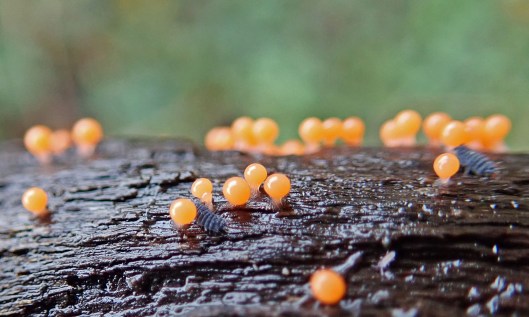
Springtails and slime, a colourful combination, currently to be found on and under many old branches and rotting logs, in a saturated woodland near you, right now!

201116 springtails and slime (1)

The orange slime is probably one of the Trichia species, possibly Trichia persimilis, and the white blobs on black sticks are one of the Comatricha species, perhaps Comatricha nigra.

201116 springtails and slime (2)

And the springtails? The brownish one with the hairy bottom is likely to be Dicyrtomina saundersi, and the blue-grey-coloured ones may be Neanura muscorum, but my photos are not good enough to make positive identifications.

201116 springtails and slime (3)

Like Loading...

318/366 Peeling oysterlings

13 Friday Nov 2020

Posted by sconzani in autumn, fungi

≈ Leave a comment

Tags

British fungi, Crepidotus mollis, oysterling fungi, Peeling oysterling

Oyster and oysterling fungi can be difficult to identify but I’m fairly sure these are Peeling oysterlings (Crepidotus mollis).

Habitat: ‘usually grouped on decayed wood of deciduous trees, especially Ash and Beech.’ Check.

201113 peeling oysterling (2)

Gills: ‘radiating outwards; greyish brown with a reddish tint and mid-brown spore print’. Check.

201113 peeling oysterling (3)

Cap: ‘flat, oyster-shaped or elongated and laterally attached to substrate’. And the clincher: ‘a peelable cap cuticle’. Check.

Information from my trusty Collins Complete Guide to British Mushrooms & Toadstools, Paul Sterry & Barry Hughes, Collins, London, 2009.

Like Loading...

311/366 The bonnets are back

06 Friday Nov 2020

Posted by sconzani in autumn, fungi

≈ 2 Comments

Tags

Bonnet fungi, Bonnet mushroom, British fungi, Grooved bonnet, Mycena polygramma

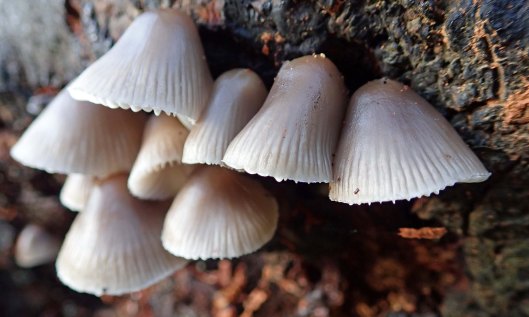
It’s almost a year since I published the post Groovy bonnets (on 27 November 2019), about a troop of Grooved bonnet fungi (Mycena polygramma) that was growing on a tree in the green space around a local church.

201106 grooved bonnets (1)

Since then, sadly, the tree they were growing on has mostly gone, blown down in one of our winter storms early this year – now, only the stump remains.

201106 grooved bonnets (2)

But the fungi were still there, living silently unseen beneath the surface, until now, when they are fruiting again.

201106 grooved bonnets (3)

And these gorgeous fungi are supporting other life – spot the millipede amongst the gills in my second photo.

201106 grooved bonnets (4)

Like Loading...

304/366 Wild word: deliquesce

30 Friday Oct 2020

Posted by sconzani in autumn, fungi, molluscs

≈ Leave a comment

Tags

British fungi, Coprinus comatus, deliquesce, deliquescence, inkcap fungus, inkcaps, Shaggy inkcap, slug, slug eating fungus

Deliquesce: verb; (of organic matter) become liquid, typically during decomposition. Mid 18th century from Latin deliquescere ‘dissolve’, from de- ‘down’ + liquescere ‘become liquid’ (Oxford Dictionary).
201030 shaggy inkcap (1)

These Shaggy inkcaps (Coprinus comatus) may look sturdy and robust but, like all inkcaps and many other species of fungi, they only last a few days, sometimes as little as 24 hours, before turning into a rather disgusting-looking liquid mush, as shown by the specimen below. If you want to read more about the how and why of that process, about the inkcaps’ ‘habit of destroying themselves with their own enzymes’, check out The Dish on Deliquescence in Coprinus Species by Jonathan Landsman on the Cornell Mushroom blog.

201030 shaggy inkcap (4)
201030 shaggy inkcap (5)

Many humans may not know that inkcaps quickly deliquesce but slugs do. This slimy beastie was digging in to a Shaggy inkcap delicacy before the fungus had a chance to digest itself.

201030 shaggy inkcap (6)

Like Loading...

297/366 Candlesnuff

23 Friday Oct 2020

Posted by sconzani in autumn, fungi, nature

≈ Leave a comment

Tags

British fungi, Candlesnuff, Candlesnuff fungus, Xylaria hypoxylon

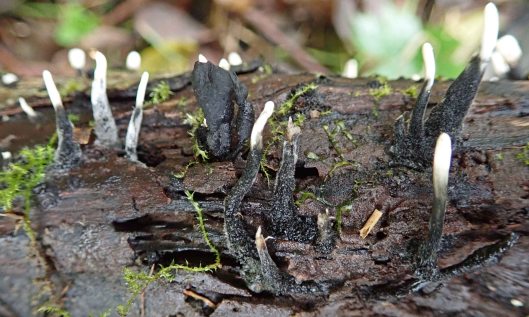
With our weather much wetter and temperatures not too cold, October should be a good month for spotting fungi but I haven’t been finding much during my daily meanders. So, it was good to spot a piece of wood with the early stages of Candlesnuff (Xylaira hypoxylon) fungi growing out of it.

201023 candlesnuff (1)

I’ve blogged about this lovely fungus before so to find out more about it, click on The right snuff, December 2016.

201023 candlesnuff (2)

Like Loading...
← Older posts
Newer posts →

About me

sconzani

sconzani

I'm a writer and photographer; researcher and blogger; birder and nature lover; countryside rambler and city strider; volunteer and biodiversity recorder.

View Full Profile →

Follow earthstar on WordPress.com

Enter your email address to follow this blog and receive notifications of new posts by email.

Recent blog posts

  • Cuttlebones March 16, 2026
  • No woodland here March 15, 2026
  • Family comes first March 14, 2026
  • Local Little egrets March 13, 2026
  • Cormorants, young and old March 12, 2026

From the archives

COPYRIGHT

Unless otherwise acknowledged, the text and photographs on this blog are my own and are subject to international copyright. Nothing may be downloaded or copied without my permission.

Fellow Earth Stars!

  • Unknown's avatar
  • Unknown's avatar
  • Unknown's avatar
  • Unknown's avatar
  • Unknown's avatar
  • Unknown's avatar
  • Unknown's avatar
  • Unknown's avatar
  • Unknown's avatar
  • Unknown's avatar
  • Unknown's avatar
  • Unknown's avatar
  • Unknown's avatar
  • Unknown's avatar
  • Unknown's avatar
  • Unknown's avatar
  • Unknown's avatar
  • Unknown's avatar
  • Unknown's avatar
  • Unknown's avatar
  • Unknown's avatar
  • Unknown's avatar
  • Unknown's avatar
  • Unknown's avatar
  • Unknown's avatar
  • Unknown's avatar
  • Unknown's avatar
  • Unknown's avatar
  • Unknown's avatar
  • Unknown's avatar
  • Unknown's avatar
  • Unknown's avatar
  • Unknown's avatar
  • Unknown's avatar
  • Unknown's avatar
  • Unknown's avatar
  • Unknown's avatar
  • Unknown's avatar
  • Unknown's avatar
  • Unknown's avatar
  • Unknown's avatar
  • Unknown's avatar
  • Unknown's avatar
  • Unknown's avatar
  • Unknown's avatar
  • Unknown's avatar
  • Unknown's avatar
  • Unknown's avatar
  • Unknown's avatar
  • Unknown's avatar

Blog at WordPress.com.

Privacy & Cookies: This site uses cookies. By continuing to use this website, you agree to their use.
To find out more, including how to control cookies, see here: Cookie Policy
  • Subscribe Subscribed
    • earthstar
    • Join 668 other subscribers
    • Already have a WordPress.com account? Log in now.
    • earthstar
    • Subscribe Subscribed
    • Sign up
    • Log in
    • Report this content
    • View site in Reader
    • Manage subscriptions
    • Collapse this bar
 

Loading Comments...
 

You must be logged in to post a comment.

    %d