• ABOUT
  • BIRDING 2018
  • Birding 2019
  • BLOG POSTS
  • Butterflies 2018
  • Resources

earthstar

~ a celebration of nature

earthstar

Category Archives: fungi

UK Fungus Day 2016

09 Sunday Oct 2016

Posted by sconzani in fungi, nature

≈ 5 Comments

Tags

#UKFD16, #UKFungusDay, fungus, Glamorgan Fungus Group, Parasol mushroom, Parc Slip Nature Reserve, UK Fungus Day

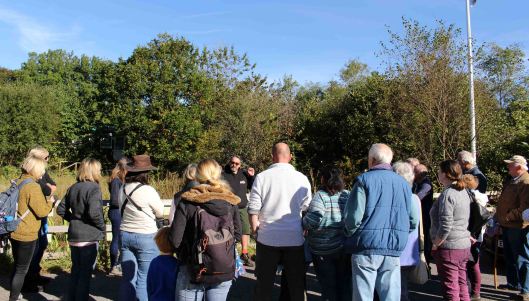
The sun shone and the people came, full of interest and enthusiasm … but where were the fungi? It had been a dry week and, as Parc Slip Nature Reserve sits on top of an old coal spoil tip, the ground doesn’t retain moisture well, so the fungi were nowhere to be found.
161009-uk-fungus-day-3

Luckily, Glamorgan Fungus Group president Mike Bright is a man of forethought and ingenuity. When he checked the site of the walk yesterday and found it virtually barren, he spent the rest of the day – six whole hours! – scouring other locations for fungi specimens and, thanks to his super-human efforts, today’s walk was a huge success. Mike led us on a wander in the woods and combined that with a ‘show and tell’ of what he’d found the previous day, and everyone was mightily impressed. I reckon he must take the prize for the best organiser for UK Fungus Day 2016, and for finding the biggest parasol mushroom!

161009-uk-fungus-day-1
161009-uk-fungus-day-2
161009-uk-fungus-day-4
161009-uk-fungus-day-5
161009-uk-fungus-day-6
161009-uk-fungus-day-7
161009-uk-fungus-day-8
161009-uk-fungus-day-9
161009-uk-fungus-day-10
Like Loading...

Fun with fungi

08 Saturday Oct 2016

Posted by sconzani in fungi, nature

≈ 2 Comments

Tags

#UKFungusDay, fungus, UK Fungus Day

Here in Britain tomorrow, Sunday 9 October, is UK Fungus Day. I’ll be joining my friends from the Glamorgan Fungus Group at the Wildlife Trust’s Parc Slip Nature Reserve for fungi fun and forays, and I hope you can all get out and enjoy some fungi spotting this Fungus Day. Check out the website for all the events that are happening throughout Britain.

161008-coprinopsis-atramentaria-common-inkcap

‘Fungi are tremendously important to human society and the planet we live on. They provide fundamental products including foods, medicines, and enzymes important to industry. They are also the unsung heroes of nearly all terrestrial ecosystems, hidden from view but inseparable from the processes that sustain life on the planet.’ ~ Kew Royal Botanic Gardens website

Like Loading...

Watch your tongue!

04 Tuesday Oct 2016

Posted by sconzani in fungi, nature, trees

≈ 7 Comments

Tags

Alder, Alder tongue, Alnus glutinosa, fungal gall, fungus, galls on alder cones, Taphrina amentorum, Taphrini alni

If you’re out walking through parks and woodlands this month, keep an eye out for these strange-looking growths on the cones of Alder trees (Alnus glutinosa). They’re caused by the fungus Taphrina alni (also known as Taphrina amentorum), common name Alder tongue, a plant pathogen that uses chemicals to persuade the trees to produce these weird and wonderful tongue-shaped galls.

161004-alder-tongue-1
161004-alder-tongue-2
161004-alder-tongue-3

Though common in Western Europe, Alder tongue only appeared in Britain in the 1940s but has now become quite common throughout the isles as spores produced by the ‘tongues’ are easily carried on the wind to other trees. Sometimes the Alder cones have just one tongue, sometimes they have several, usually all emerging from the same spot on the cone and often curling into intriguing shapes (spot the dragons in the images below!). The tongues start off green in colour but then vary from yellow and orange to pink and red (which really would look very tongue-like) before becoming brown and black as they age. They can, in fact, be seen on Alder trees throughout the year, though, for some reason, I’m seeing more of them now, in the autumn months.

161004-alder-tongue-4
161004-alder-tongue-5
Like Loading...

The coral that grows above the ground

01 Saturday Oct 2016

Posted by sconzani in autumn, fungi, nature

≈ 4 Comments

Tags

coral fungus, fungus, Ramaria stricta, Upright Coral Fungus

Once upon a time there was a coral that decided it didn’t like living under the ocean. It didn’t like living on hard unyeilding rocks; it didn’t like always having dirty sand being washed around its clean white branches by the harsh ocean waves; and it certainly didn’t like having all manner of little fishes ducking and diving around and nibbling at its extremities. So, it rebelled! It upped roots and moved to the land, to a place where it could be sheltered by beech trees and conifers, where it could spread its delicate root system through the welcoming piles of buried wood and leaf litter, where it could stretch its little branches straight up towards the sky.

161001-ramaria-stricta-1

Nah, not really! This is a coral fungus, probably Ramaria stricta, the Upright Coral fungus. It is quite common in Britain, and can also be found from late summer through the autumn months in much of Europe and in North America. It looks for all the world like the coral you find on reefs in tropical seas and oceans around the world, hence my fanciful flight of imagination earlier.

161001-ramaria-stricta-2
161001-ramaria-stricta-3
161001-ramaria-stricta-4

At the same location in October 2015

Like Loading...

Sulphur tuft

25 Sunday Sep 2016

Posted by sconzani in autumn, fungi, nature

≈ Leave a comment

Tags

fungus, Hypholoma fasciculare, Sulphur tuft

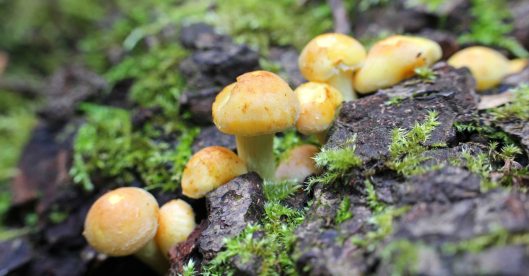
It’s fungi time! Well, strictly speaking, it’s fungi time all year round but autumn, with its rainy days and cooler night-time temperatures, always seems to be the time when fungi are most apparent, their colourful and plentiful fruiting bodies popping up wherever you look. One of the most colourful and plentiful, which can actually appear any time from April through to the time Jack Frost starts leaving his icy crust on the ground, is Sulphur tuft (Hypholoma fasciculare).

160925-sulphur-tuft-1

As you might guess from its name, its cap is usually quite a bright sulphur-yellow, though it sometimes has an orange tinge and a white band around the cap edge. It grows in large tufts or clumps, sometimes numbering several hundreds of individual mushrooms. Sulphur tuft is a wood-rotting fungus that happily devours both conifers and broadleaf hardwood trees, so can usually be seen in mixed woodland areas clustered on old stumps or bursting out of the cracks in the bark of fallen trees. As well as being very common in Britain and much of Europe, it’s also a frequent sight in North American woodlands. Sulphur tuft is poisonous so a feast for the eyes but not the belly.

160925-sulphur-tuft-2
160925-sulphur-tuft-3
160925-sulphur-tuft-4
160925-sulphur-tuft-5
160925-sulphur-tuft-6
160925-sulphur-tuft-7
160925-sulphur-tuft-8
Like Loading...

Earthstars!

24 Saturday Sep 2016

Posted by sconzani in fungi, nature

≈ 14 Comments

Tags

earthstar, Earthstar fungi, Geastrum

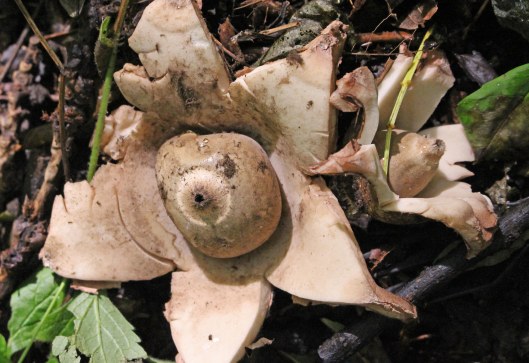
Yesterday I discovered I now have 100 followers on this blog – not a patch on those blogs that have thousands, even millions of followers, but I am utterly delighted just the same. Yesterday I also discovered these two gorgeous and very fresh Earthstar fungi (Geastrum sp.) while out wandering along an old railway cutting, now walking track, at a local nature reserve. I have blogged about Earthstars before and they are part of the reason behind the name of this blog, though my idea was also to make our Earth and all her wondrous creatures and creations the stars of my photographs and writing. I presume that you, my followers, are also charmed by the natural world around us, so I would like to dedicate this blog and these Earthstars to you. Thank you all most sincerely for your likes and your comments and for following along with me.

160924-earthstars-geastrum

Like Loading...

The Creature from the Black Stump

17 Saturday Sep 2016

Posted by sconzani in fungi, nature

≈ 5 Comments

Tags

fungus, Mycoacia uda, resupinate fungus, resupinate tooth fungus, tooth fungus

160917-mycoacia-uda

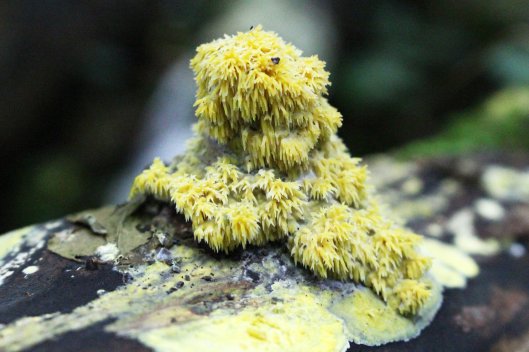
I’ve decided to name it Stumpy, this ‘creature’ that appears to be growing out of a fallen tree at one of my local nature reserves. Its scientific name is Mycoacia uda but that’s a bit of a mouthful.

Last Thursday was the first time I’d encountered one of these but, luckily, one of my Glamorgan Fungi group friends was able to identify it for me. It’s a resupinate tooth fungus and can be found growing on the fallen branches of deciduous trees in Britain, Europe and North America.

But, at night, when no one’s looking, it emerges from its fallen branch and roams the woodland eating stray dogs, howling at the moon, and searching for a mate … Just kidding!

Like Loading...

A Fungi-ful Friday

11 Sunday Sep 2016

Posted by sconzani in fungi, nature, parks

≈ 4 Comments

Tags

Cefn On, fungi foray, fungus

Fifty shades of brown, a soupçon of purple and a smattering of red – that about sums up my Friday fungi foray around Cefn On, one of my local Cardiff parks. A friend had posted a few finds from his walk there the previous day on the Glamorgan Fungi page on Facebook so it looked like a sure bet and, although I get the train up there, it’s a nice long walk back through Coed-y-Felin woods, around Llanishen Reservoir, through Nant Fawr woodland and alongside Roath Lake – about 7 miles all up but almost entirely through woods, parks and green places, so perfect!
160911-cefnon-fungi-1

After the recent rains and with temperatures still warm during the day but dropping now overnight, Cefn On was alive with fungi and I got lots of photographs. Unfortunately, fungi are notoriously difficult to identify. What does it smell like? What colour are the spores? How big / small / wide / tall was it? Was it slimy or dry? Where was it growing? These are just a few of the questions you need to ask. I do try to work out what I have found but some things are only identifiable through microscopic analysis so, these days, I mostly just enjoy looking at them and admiring their multitude of shapes and forms and habits and colours.

160911 CefnOn fungi (2)
160911 CefnOn fungi (3)
160911 CefnOn fungi (4)
160911 CefnOn fungi (5)
160911 CefnOn fungi (6)
160911 CefnOn fungi (7)
160911 CefnOn fungi (8)
160911 CefnOn fungi (9)
160911 CefnOn fungi (10)
Like Loading...

Roath Park’s Giant polypores

29 Monday Aug 2016

Posted by sconzani in fungi, nature

≈ 1 Comment

Tags

bracket fungus, Giant polypore, Meripilus giganteus, polypore fungus, Roath Park

On either side of the path to a beautiful old bridge across the brook that runs through Roath Park Pleasure Gardens there stands a tree. Both trees are huge and old and dead but both are the source of life and habitat of choice of many a beetle and bug, and a wide range of fungi. This month, first one tree and then the other has played host to magnificent large clumps of the Giant polypore, Meripilus giganteus.

160829 Giant polypore (3)
160829 Giant polypore (4)

Their Latin name is most appropriate: Meri means a part and pile means caps and, not surprisingly, giganteus means gigantic, so together we have gigantic caps made of many parts. And they are gigantic! These specimens have reached a combined width of perhaps half a metre but it is not unknown for a single cap to grow that wide. Another common name for this fungus is Black-staining polypore as the pore surface will stain dark brown or black when bruised. Giant polypores are most often found on beech trees and stumps but will also parasitise the roots of various other broadleaf trees, in Britain and much of Europe. If this looks familiar to my North American readers, it’s because a related fungus, Meripilus sumstinei, can be found on your trees.

160829 Giant polypore (1)
160829 Giant polypore (2)
160829 Giant polypore (5)
160829 Giant polypore (6)
Like Loading...

Bioblitzing Cwm Saerbren

27 Saturday Aug 2016

Posted by sconzani in birds, fungi, insects, nature, plants, wildflowers

≈ 5 Comments

Tags

bioblitz, biological diversity, biological recording, biological recording centre, Cwm Saerbren Woodland, Cwmsaerbren, SEWBReC

Each summer my local biological records centre, SEWBReC, runs a series of biological recording field days, partly to introduce members of the public to the world of biological recording, allowing them to rub shoulders with wildlife experts and learn species identification skills, and partly to record the biodiversity of particular areas. Last Thursday I went along to the field day-come-bioblitz at the Cwm Saerbren Woodland, adjacent to the small town of Treherbert at the top of the Rhondda Fawr Valley.

160827 Cwmsaerbren bioblitz (12)

This assumed unicorn was the star of the show!

Though the turnout from the locals was disappointing (not a single person!) and despite the sometimes heavy rain (a common feature up the Valleys), we had a great day. With the SEWBReC crew, a couple of guys from Natural Resources Wales, and a few of us volunteers from the Mary Gillham Archives Project, we stomped around the trails of Cwm Saerbren, recording all we saw. And, after meeting up back at the town to identify and write up our afternoon list and then filling up on hot chips from the local takeaway shop, we also got out with the bat recorder and had moth-attracting lights running to see what flying critters we might find. All up, once everything is IDed, I reckon our list will be well over 200 species. Not bad for a day’s work!

160827 Cwmsaerbren bioblitz (2)
160827 Cwmsaerbren bioblitz (1)
160827 Cwmsaerbren bioblitz (9)
160827 Cwmsaerbren bioblitz (6)
160827 Cwmsaerbren bioblitz (10)
160827 Cwmsaerbren bioblitz (7)
160827 Cwmsaerbren bioblitz (4)
160827 Cwmsaerbren bioblitz (16)
160827 Cwmsaerbren bioblitz (11)
160827 Cwmsaerbren bioblitz (15)
160827 Cwmsaerbren bioblitz (17)
160827 Cwmsaerbren bioblitz (13)
160827 Cwmsaerbren bioblitz (8)
160827 Cwmsaerbren bioblitz (5)
160827 Cwmsaerbren bioblitz (3)
Like Loading...
← Older posts
Newer posts →

About me

sconzani

sconzani

I'm a writer and photographer; researcher and blogger; birder and nature lover; countryside rambler and city strider; volunteer and biodiversity recorder.

View Full Profile →

Follow earthstar on WordPress.com

Enter your email address to follow this blog and receive notifications of new posts by email.

Recent blog posts

  • Cuttlebones March 16, 2026
  • No woodland here March 15, 2026
  • Family comes first March 14, 2026
  • Local Little egrets March 13, 2026
  • Cormorants, young and old March 12, 2026

From the archives

COPYRIGHT

Unless otherwise acknowledged, the text and photographs on this blog are my own and are subject to international copyright. Nothing may be downloaded or copied without my permission.

Fellow Earth Stars!

  • Unknown's avatar
  • Unknown's avatar
  • Unknown's avatar
  • Unknown's avatar
  • Unknown's avatar
  • Unknown's avatar
  • Unknown's avatar
  • Unknown's avatar
  • Unknown's avatar
  • Unknown's avatar
  • Unknown's avatar
  • Unknown's avatar
  • Unknown's avatar
  • Unknown's avatar
  • Unknown's avatar
  • Unknown's avatar
  • Unknown's avatar
  • Unknown's avatar
  • Unknown's avatar
  • Unknown's avatar
  • Unknown's avatar
  • Unknown's avatar
  • Unknown's avatar
  • Unknown's avatar
  • Unknown's avatar
  • Unknown's avatar
  • Unknown's avatar
  • Unknown's avatar
  • Unknown's avatar
  • Unknown's avatar
  • Unknown's avatar
  • Unknown's avatar
  • Unknown's avatar
  • Unknown's avatar
  • Unknown's avatar
  • Unknown's avatar
  • Unknown's avatar
  • Unknown's avatar
  • Unknown's avatar
  • Unknown's avatar
  • Unknown's avatar
  • Unknown's avatar
  • Unknown's avatar
  • Unknown's avatar
  • Unknown's avatar
  • Unknown's avatar
  • Unknown's avatar
  • Unknown's avatar
  • Unknown's avatar
  • Unknown's avatar

Blog at WordPress.com.

Privacy & Cookies: This site uses cookies. By continuing to use this website, you agree to their use.
To find out more, including how to control cookies, see here: Cookie Policy
  • Subscribe Subscribed
    • earthstar
    • Join 668 other subscribers
    • Already have a WordPress.com account? Log in now.
    • earthstar
    • Subscribe Subscribed
    • Sign up
    • Log in
    • Report this content
    • View site in Reader
    • Manage subscriptions
    • Collapse this bar
 

Loading Comments...
 

You must be logged in to post a comment.

    %d