• ABOUT
  • BIRDING 2018
  • Birding 2019
  • BLOG POSTS
  • Butterflies 2018
  • Resources

earthstar

~ a celebration of nature

earthstar

Category Archives: fungi

Springtail and slime

17 Friday Feb 2023

Posted by sconzani in fungi, insects, leaves

≈ Leave a comment

Tags

British springtails, Dicyrtomina ornata, insects on Sycamore, leaf litter, slime, slime mould, slime on Sycamore leaf, springtail, Sycamore leaves

My most recent leaf-diving session in my favourite slimy Sycamore leaf spot turned up these two tiny treasures. This first is a miniscule springtail with a very hairy bottom which I think is Dicyrtomina ornata. There is another very similar springtail, Dicyrtomina saundersi, but that has distinct orange patches on its antennae and I’m not seeing that in my photos of this little critter.
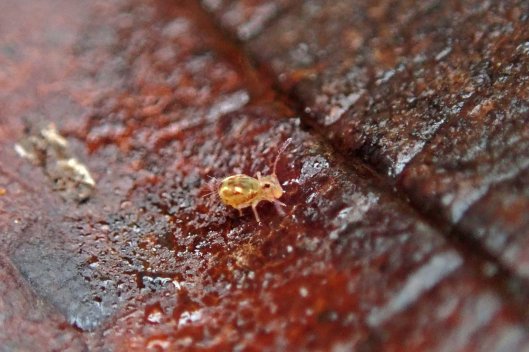
230217 springtail

The second treasure was a lovely bit of slime, which may or may not be Metatrichia floriformis. Slime moulds can be tricky to identify accurately and I’m well out of practice.
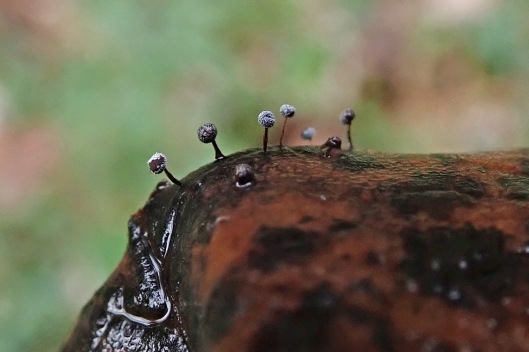
230217 slime

Like Loading...

Holly speckle

15 Wednesday Feb 2023

Posted by sconzani in fungi, plants

≈ Leave a comment

Tags

British fungi, fungus on Holly, Holly, Holly speckle, Trochila ilicina

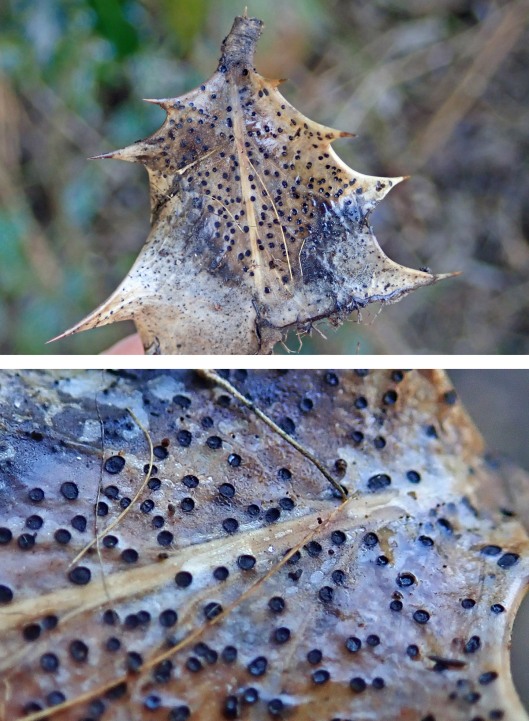
Have you ever noticed what look like little black spots on the brown fallen leaves of Holly? This is the perfectly named fungus Holly speckle (Trochila ilicina) and those spots, or speckles, are, in fact, the fungal fruiting bodies. When they first develop, they are a dark olive green but, after their lids open and the spores within are released, the speckles come to resemble tiny black craters. If you want to know more, a blog on the Woodlands.co.uk website has a very detailed description of these intriguing fungi, as well as an explanation of how their fruiting mechanism functions.

230215 holly speckle

Like Loading...

A single earthstar

10 Friday Feb 2023

Posted by sconzani in fungi

≈ Leave a comment

Tags

earthstar, Earthstar fungi

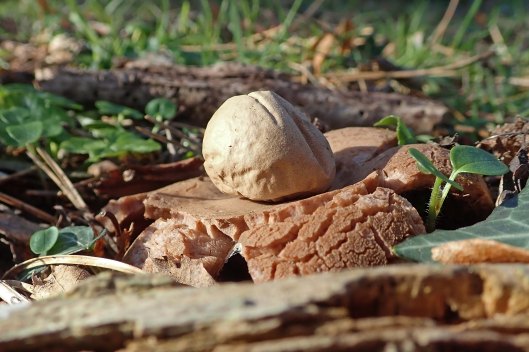
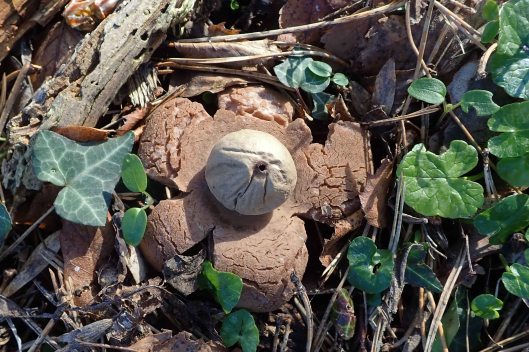
In previous years, I’ve found as many as 40 earthstar fungi in this particular location in a Cardiff cemetery; during Monday’s walk, despite a very thorough search, I found just this one. Even so, it was a welcome sight, as a visit to the cemetery late last year, when these fungi should’ve been at their peak, didn’t produce any specimens.

230210 earthstar (1)230210 earthstar (2)

Like Loading...

Golden shanks

13 Friday Jan 2023

Posted by sconzani in fungi

≈ Leave a comment

Tags

British fungi, Enoki mushroom, Flammulina velutipes, fungus, Velvet shanks

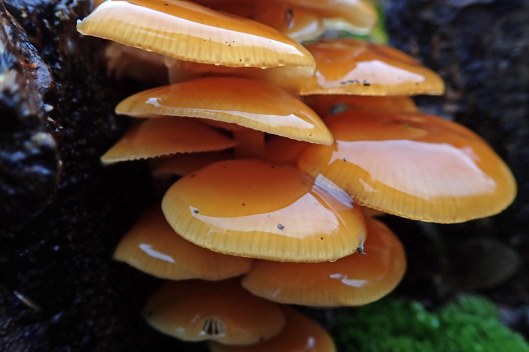
Velvet shanks (Flammulina velutipes) always look to me like they would taste delicious, like layers of crumpets dripping in runny golden honey. And, though I’ve never tried them, they are indeed edible; the commercially grown versions (also known as Enoki) can be purchased in cans and jars, very occasionally fresh in some supermarkets and many specialist food shops.

230113 velvet shanks

Like Loading...

Silverleaf

30 Friday Dec 2022

Posted by sconzani in fungi

≈ Leave a comment

Tags

British fungi, Chondrostereum purpureum, fungus, Silver leaf fungus, Silverleaf fungus

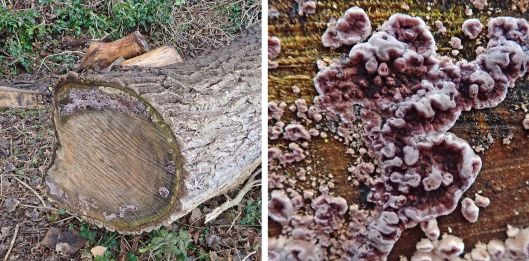
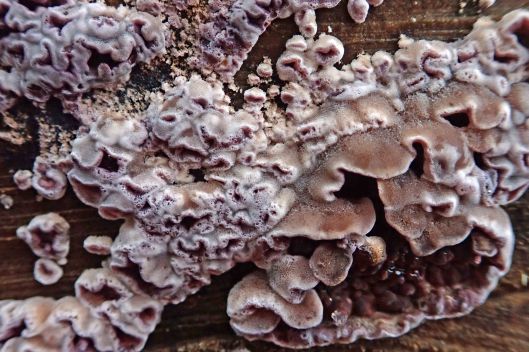
The pinkish-purple colour of this fungus makes its identification a little easier than many fungi, and is reflected in the epithet of its scientific name, Chondrostereum purpureum. Its common name, Silverleaf (or Silver leaf) fungus, comes from the damage the fungus can do as a parasite of some species of fruit trees.

221230 silverleaf fungus (1)

I’ve only ever seen it on dead wood, as in these photos, where it starts off looking like a crust spread across the surface of the sawn end of a tree, then, as it grows, develops into brackets, with a hairy upper surface and white edges.

221230 silverleaf fungus (2)

Like Loading...

On narrow-leaved willows

26 Monday Dec 2022

Posted by sconzani in fungi, insects, leaves, trees

≈ Leave a comment

Tags

Aculus tetanothrix, Euura proxima, hoverfly larva, insects on narrow-leaved willow, ladybird pupa, leafmines on narrow-leaved willow, mite galls, moth eggs, Phyllonorycter viminiella, rust on willow, sawfly galls

In early October I, and others, began a new leafmine search, for mines on narrow-leaved willows (see Leafmines: Phyllocnistis saligna, 3 October). In the months since, I’ve only found these mines in two locations, partly due to a lack of the host plants and partly, probably, because the moths have yet to spread very far (which may be because of a lack of host plants). I’ll continue the search next autumn but, in the course of my search – and this is one of the brilliant things about staring at leaves – I’ve found many other life forms that were making these leaves their home.

221226 on willow (1)

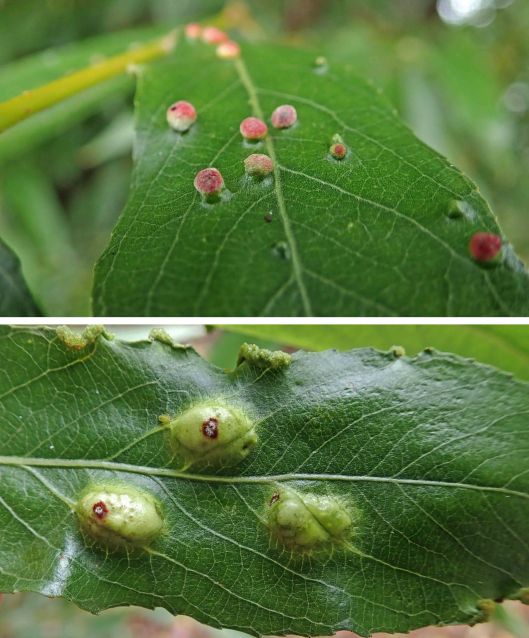
I found two types of galls: the first, above top, have been made by a species of mite, Aculus tetanothrix, and those immediately above are home to the larvae of the sawfly species, Euura proxima.

221226 on willow (2)

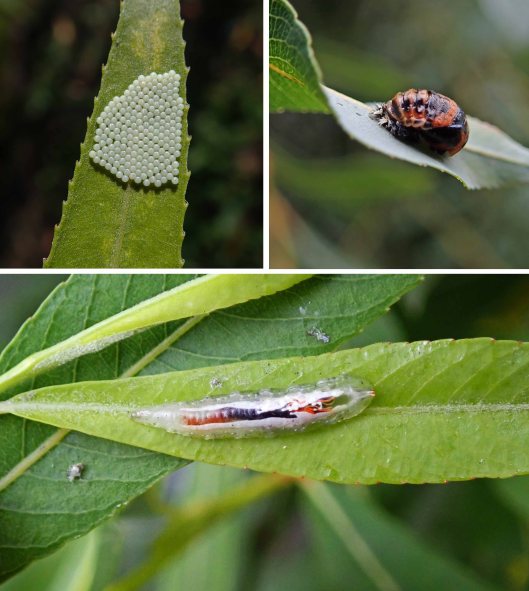
On the underside of one leaf I found this array of what I think are moth eggs and, on the right, is the pupa of a ladybird, and, below those, is a hoverfly larva.

221226 on willow (3)

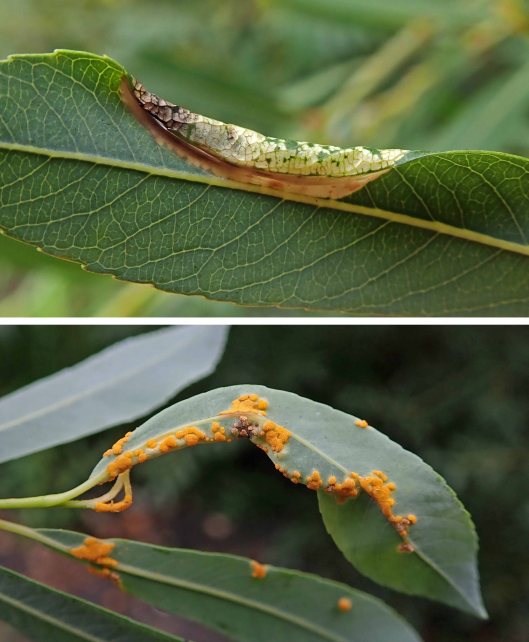
There was also a different species of leafminer, the tiny moth Phyllonorycter viminiella, and I found a rust, which might be Melampsora caprearum.

Like Loading...

Tufts of sulphur

23 Friday Dec 2022

Posted by sconzani in fungi

≈ Leave a comment

Tags

British fungi, Hypholoma fasciculare, Sulphur tuft, wood-rotting fungi

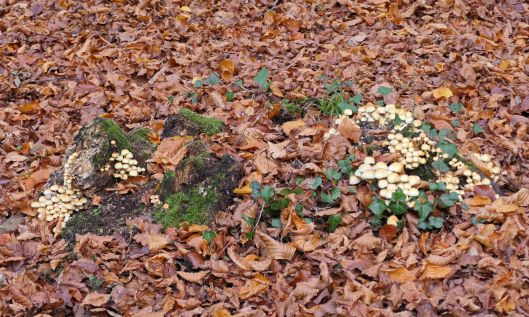
During my recent walks to marvel at the autumn colours of the Beautiful Beeches of Cwm George in Dinas Powys, I noticed that one of the Beech trees had, at some time in the past, succumbed to the ravages of time and weather and, where once a majestic giant stood tall, there was now a large, crumbling stump.

221223 sulphur tuft (1)

As well as a thick covering of fallen leaves, the greens of moss, ivy and a thin clump of grass, the stump was providing a home – and food – to fungi, a thriving colony of Sulphur tuft (Hypholoma fasciculare), one of our most common wood-rotters. I’m sure this is a fungus almost all my followers will have seen.

221223 sulphur tuft (2)

Like Loading...

Ride a White saddle

09 Friday Dec 2022

Posted by sconzani in fungi

≈ 3 Comments

Tags

British fungi, Helvella crispa, White saddle, woodland fungi

There wasn’t a horse to be seen but there were plenty of White saddles (Helvella crispa) poking through the leaf litter. I usually fiddle with the surroundings when I’m photographing fungi, clearing away the odd leaf or grass stem to provide a clearer shot but, today, I decided to show them as they really are, an integral part of this woodland ride.

221209 white saddle

Like Loading...

Earthtongues

02 Friday Dec 2022

Posted by sconzani in fungi

≈ Leave a comment

Tags

British fungi, earthtongues, Geoglossum cookeanum

Well, these were a surprise sighting from the beginning of today’s walk. They were growing on a road verge, next to a block of flats, in an area now called Penarth Marina but which was once Penarth Port, a huge area of working dockland.

221202 earthtongues (1)

This seems a bizarre place for earthtongues to be growing – the First Nature website explains that this species, which I’m fairly sure is Geoglossum cookeanum, is found ‘mainly in mossy, sandy grassland, often in dune slacks or on the edges of coastal pine forests’.

221202 earthtongues (2)

Like Loading...

A miniscule Mycena

25 Friday Nov 2022

Posted by sconzani in fungi

≈ Leave a comment

Tags

#FungiFriday, Bonnet mushroom, British fungi, Mycena fungi

Here’s a teeny tiny bonnet mushroom for this week’s #FungiFriday, about the right size for a fairy to wear, one of those miniscule Mycena species you find growing amongst the moss on a tree in a damp woodland.

221125 mycena

Like Loading...
← Older posts
Newer posts →

About me

sconzani

sconzani

I'm a writer and photographer; researcher and blogger; birder and nature lover; countryside rambler and city strider; volunteer and biodiversity recorder.

View Full Profile →

Follow earthstar on WordPress.com

Enter your email address to follow this blog and receive notifications of new posts by email.

Recent blog posts

  • No woodland here March 15, 2026
  • Family comes first March 14, 2026
  • Local Little egrets March 13, 2026
  • Cormorants, young and old March 12, 2026
  • Bay bunnies March 11, 2026

From the archives

COPYRIGHT

Unless otherwise acknowledged, the text and photographs on this blog are my own and are subject to international copyright. Nothing may be downloaded or copied without my permission.

Fellow Earth Stars!

  • Unknown's avatar
  • Unknown's avatar
  • Unknown's avatar
  • Unknown's avatar
  • Unknown's avatar
  • Unknown's avatar
  • Unknown's avatar
  • Unknown's avatar
  • Unknown's avatar
  • Unknown's avatar
  • Unknown's avatar
  • Unknown's avatar
  • Unknown's avatar
  • Unknown's avatar
  • Unknown's avatar
  • Unknown's avatar
  • Unknown's avatar
  • Unknown's avatar
  • Unknown's avatar
  • Unknown's avatar
  • Unknown's avatar
  • Unknown's avatar
  • Unknown's avatar
  • Unknown's avatar
  • Unknown's avatar
  • Unknown's avatar
  • Unknown's avatar
  • Unknown's avatar
  • Unknown's avatar
  • Unknown's avatar
  • Unknown's avatar
  • Unknown's avatar
  • Unknown's avatar
  • Unknown's avatar
  • Unknown's avatar
  • Unknown's avatar
  • Unknown's avatar
  • Unknown's avatar
  • Unknown's avatar
  • Unknown's avatar
  • Unknown's avatar
  • Unknown's avatar
  • Unknown's avatar
  • Unknown's avatar
  • Unknown's avatar
  • Unknown's avatar
  • Unknown's avatar
  • Unknown's avatar
  • Unknown's avatar
  • Unknown's avatar

Blog at WordPress.com.

Privacy & Cookies: This site uses cookies. By continuing to use this website, you agree to their use.
To find out more, including how to control cookies, see here: Cookie Policy
  • Subscribe Subscribed
    • earthstar
    • Join 668 other subscribers
    • Already have a WordPress.com account? Log in now.
    • earthstar
    • Subscribe Subscribed
    • Sign up
    • Log in
    • Report this content
    • View site in Reader
    • Manage subscriptions
    • Collapse this bar
 

Loading Comments...
 

You must be logged in to post a comment.

    %d