• ABOUT
  • BIRDING 2018
  • Birding 2019
  • BLOG POSTS
  • Butterflies 2018
  • Resources

earthstar

~ a celebration of nature

earthstar

Category Archives: geology

Fossilised ripples

30 Wednesday Aug 2023

Posted by sconzani in geology

≈ Leave a comment

Tags

fossilised beach, fossilised mud, Lilstock Formation, Penarth Group, Penarth Head

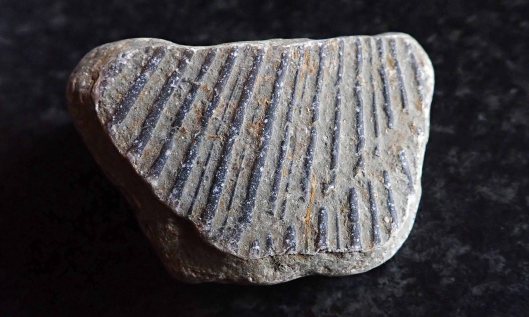
Geology fascinates me, and I am privileged to live in a geologically rich area, but it’s not a subject I know anything about so my geological blog posts on here are very few and far between. However, when a local birder posted on social media about a slab of rock he’d found on a local beach, and a local geologist later confirmed the find and shared a link explaining the rock’s origins, I just had to investigate.

230830 fossilised ripples (1)

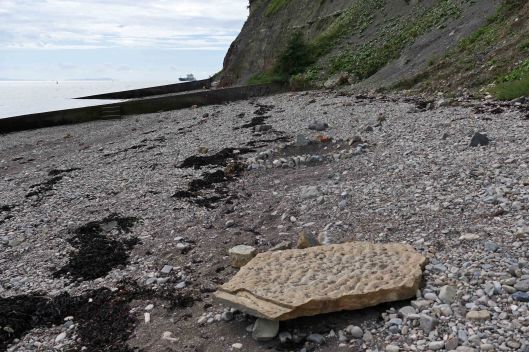
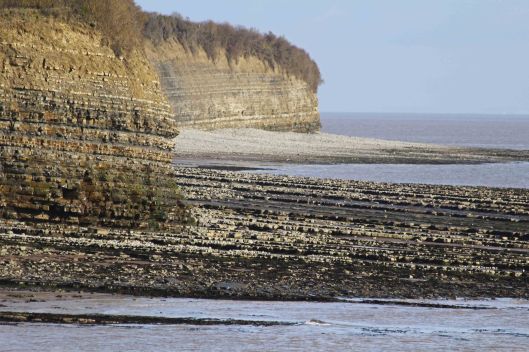
The slab of rock was lying beneath the cliff at Penarth Head on the beach shown in the photo above. And, in fact, when I went and looked, I found several similar slabs. They had fallen from the top section of the cliff, which is known as the Lilstock Formation. Rather than attempt to explain the geology of these cliffs, it seems easiest if I refer you to the blog my geologist friend showed me: ‘Geological Walk at Penarth Head‘, published on the Geologists’ Association – South Wales Group website on 27 June 2021.
230830 fossilised ripples (2)

It wasn’t easy to capture in photographs but I hope you can see the ripple effect on the surface of these slabs. This is basically an ancient fossilised beach, the ripples caused by the action of water and tides on a muddy surface millions of years ago. The fact that I could touch a surface formed so long ago is something I find quite mind-boggling.

230830 fossilised ripples (3)

Like Loading...

42/365 Strata

11 Monday Feb 2019

Posted by sconzani in 365DaysWildin2019, geology, nature, walks

≈ 4 Comments

Tags

Lavernock Point, south Wales coast, south Wales coastal path, St Mary's Well Bay, St Mary's Well Bay geology

190211 St Mary's Well Bay strata

I know nothing at all about geology so I’m not even going to attempt an explanation of what these rocks are, what the formations are called, which periods they date from. I just think they look damn cool! This photo was taken on today’s walk from Sully back to Pernarth, looking east across St Mary’s Well Bay, with Lavernock Point in the background.

Like Loading...

34/365 Beachcombing

03 Sunday Feb 2019

Posted by sconzani in 365DaysWildin2019, geology, molluscs, nature, seaside

≈ 2 Comments

Tags

#365DaysWild, beach fossick, beachcombing, fossilised seashell, fossils, Penarth Head, seashell

As part of this morning’s local meander, I went for a beachcomb at the base of the cliffs at Penarth Head – not too close to those cliffs as they’re continually shedding small stones and occasional larger boulders but it’s safe enough nearer the water’s edge when the tide’s going out. I didn’t linger long as people arrived to run their dogs, sending sand and stones everywhere. However, I did find this little beauty before they arrived – a fossilised seashell I think.

p.s. My fab Facebook friend Mark says that the only ‘Jurassic bivalve with that pattern in my books is something called Oxytoma inequivalvis’, so now we have a name. Thanks, Mark.

190203 fossil

Like Loading...

Wild words: chalk

21 Wednesday Feb 2018

Posted by sconzani in geology, nature, seaside

≈ Leave a comment

Tags

#WildWords, Birling Gap, chalk, chalk cliffs, Cuckmere Haven, limestone cliffs, Seven Sisters Country Park

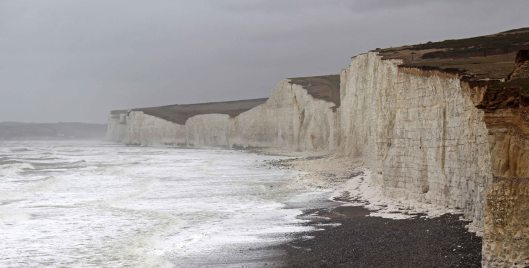
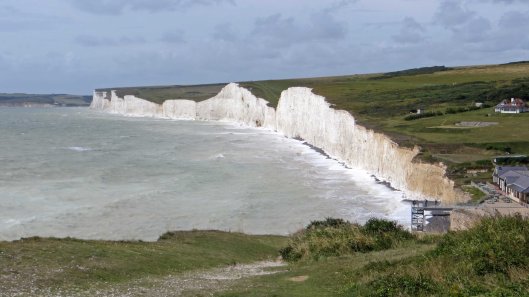
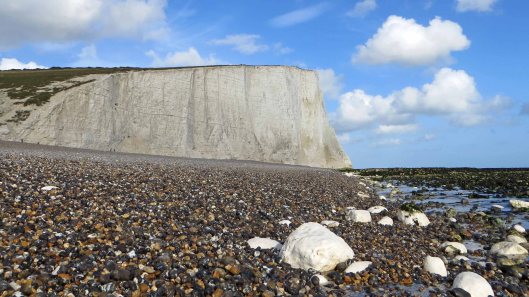
Chalk: noun; ‘a white soft earthy limestone (calcium carbonate) formed from the skeletal remains of sea creatures’, according to the Oxford Dictionary, though that seems a relatively simplistic explanation to me. I chose chalk as this week’s word as I was in East Sussex last week and had occasion twice to see the magnificent chalk cliffs known as the Seven Sisters, once at Birling Gap in a howling gale and again, at Cuckmere Haven, on a day that felt like summer had come early to southern England.

180221 chalk (1)

The Discovering Fossils website has this to say about the chalk at the Seven Sisters:

The Chalk at Seven Sisters belongs to the Upper Chalk, and was deposited during the Coniacian and Santonian stages of the Late Cretaceous epoch between 87-84 million years ago (mya). At this time Seven Sisters and much of Great Britain, along with Europe, lay beneath a relatively shallow sea around 40°N of the equator, on an equivalent latitude to the Mediterranean Sea today.

And you can read more about the fascinating process of chalk formation here.

180221 chalk (2)

Like Loading...

Fossils from the Jurassic Coast

06 Saturday Jan 2018

Posted by sconzani in geology, nature, seaside

≈ 2 Comments

Tags

ammonite, beachcombing, belemnite, Charmouth, fossil hunting, fossils, Jurassic Coast, pyrite ammonite

Yesterday a living fossil fungus, today fossicking for fossils on Dorset’s Jurassic Coast – I’m on a roll with the old stuff!

180106 Charmouth fossils (1)

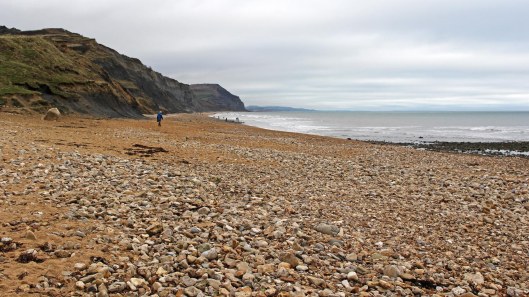
Part of one of my Christmas break days was spent at Charmouth, on England’s south coast, where my friend Sarah and I enjoyed a wonderful long beach walk, much of the time with our eyes down, searching the rocks and pebbles for fossils. Though you’re not allowed to chip away at the cliff face – and you’d be foolish to try, as it can be rather unstable and is subject to frequent mud slips, you are allowed to take fossils from the beach itself.

180106 Charmouth fossils (2)
180106 Charmouth fossils (3)

Sarah spotted one enormous fossil in a big boulder, but that was rather too big to pop in my pocket and bring home.

180106 Charmouth fossils (4)
180106 Charmouth fossils (5)

And, though it took a while to get my eye in, I did eventually find two small pieces of pyrite ammonite and another small rod-shaped rock, which looked very like the belemnite fossils being sold in the local shop. Result!

Like Loading...

Glorious mud

23 Thursday Nov 2017

Posted by sconzani in geology, nature

≈ Leave a comment

Tags

Barrage mud, Cardiff Barrage, Cardiff mud, mud

‘Mud, mud, glorious mud
Nothing quite like it for cooling the blood
So follow me follow, down to the hollow
And there let me wallow in glorious mud.’

171123 mud

I never saw Cardiff Bay before the Barrage was built in the 1990s but, from photos I’ve seen, I believe much of the foreshore was a lot like this, as much of the coastline to the east of Cardiff still is.

Like Loading...

The chalk cliffs of the Seven Sisters

23 Tuesday May 2017

Posted by sconzani in geology, nature

≈ 1 Comment

Tags

chalk, chalk cliffs, Seven Sisters, Seven Sisters Country Park

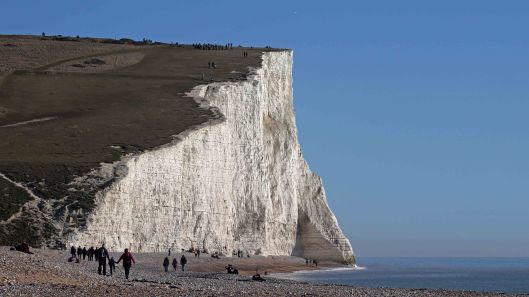
The white cliffs of Dover get all the publicity but, personally, I prefer the magnificent chalk cliffs of the Seven Sisters, near Eastbourne.

170523 Seven Sisters chalk cliffs (1)

It seems unbelievable to me that the chalk is actually the microscopic remains of plankton deposited here as much as 90 million years ago, and that the darker bands, of flint, were probably formed from the remains of sponges during those times when sponges were particularly abundant in the warm seas that once flowed here.

170523 Seven Sisters chalk cliffs (2)

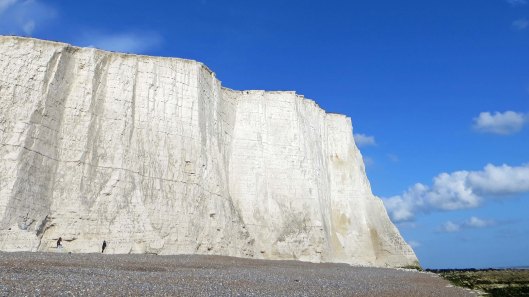
My photos were taken on two visits and from both directions (east to west, west to east), and you can see how different the cliffs look in different weather conditions. They sparkle and glisten in bright sunshine and smoulder like burnished steel on grey days.

170523 Seven Sisters chalk cliffs (3)

The chalk is soft, erodes constantly and there are frequent large slips (as you can see in the photo below) so, if you’re visiting, stay away from the cliff edge!

170523 Seven Sisters chalk cliffs (4)

Like Loading...

Craig-y-Cilau National Nature Reserve

10 Monday Apr 2017

Posted by sconzani in geology, nature, parks, walks

≈ Leave a comment

Tags

birding, birdwatching, Brecon Beacons, Craig-y-Cilau, Glamorgan Bird Club, limestone cliffs, national nature reserve, old tramway

170410 Craig Y Cilau NNR (4)

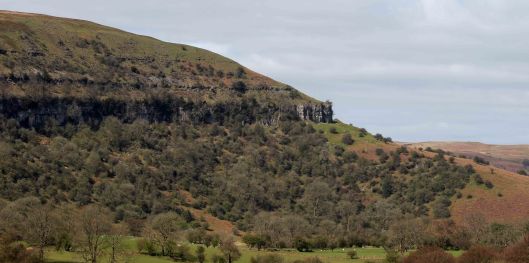
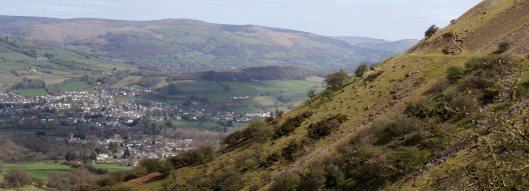
Last Wednesday I joined 19 of my fellow Glamorgan Bird Club members on a trip to the Craig-y-Cilau National Nature Reserve. Though our species list for the day totalled around 30, most birds were too distant for photographs but the location, high in the hills on the edge of the Brecon Beacons National Park, is stunning!

170410 Craig Y Cilau NNR (7)
170410 Craig Y Cilau NNR (3)
170410 Craig Y Cilau NNR (8)

The limestone cliffs here were once quarried and our path – at times rather narrow and with a steep drop to one side – followed the route of the old tramway, the signs of which could still be seen in the stones. The cliffs are riddled with caves, with a mapped system of over 400 miles of passageways, though you’d be foolhardy to enter without an experienced guide.

170410 Craig Y Cilau NNR (6)

Though the birds were somewhat elusive, we were surrounded by flourishing and sometimes rare flora, with wildflowers aplenty and some interesting fungi.

170410 Craig Y Cilau NNR (1)
170410 Craig Y Cilau NNR (5)

And the panoramic views, towards the towns of Crickhowell and Llangattock and over the surrounding countryside, were simply sensational. We didn’t get a chance to explore the whitebeam-filled woodlands or the unique raised bog so I’m already planning a return trip.

170410 Craig Y Cilau NNR (2)

Like Loading...

Wales walks: Penarth to Lavernock

01 Saturday Apr 2017

Posted by sconzani in geology, insects, lichen, nature, seaside, walks, wildflowers

≈ 8 Comments

Tags

Lavernock, nature walks, Penarth, Penarth to Lavernock, Wales Coastal Path, walks

Since moving to the seaside two months ago I have been thoroughly enjoying exploring my new surroundings and a particular favourite has been the walk from Penarth to Lavernock, a very small 1.5km section of the Wales Coastal Path.

170401 Coastal Path flora

Despite its short length, it can take me rather a long time to walk because the path is bordered with all manner of trees, shrubs and wildflowers, so my eye is constantly drawn to checking these out.

170401 Coastal Path insects (1)
170401 Coastal Path insects (2)
170401 Coastal Path insects (3)

I am fast discovering that the abundance of flora supports a wonderful array of fauna: flies and bees are flocking to the freshly opened flowers of Alexanders (Smyrnium olusatrum), recently arrived migrant Chiffchaffs (Phylloscopus collybita) are announcing their arrival with their familiar onomatopoeic song while recharging their batteries on flying insects, and various species of terrestrial snails sleep, slide and slither amongst the leaves.

170401 Coastal Path lichens (1)
170401 Coastal Path lichens (2)
170401 Coastal Path lichens (3)

There’s also a huge diversity of lichens, presumably much encouraged by the Welsh rains, the occasional wild winds, and the clean and salty seaside air.

170401 Coastal Path geology

Here and there gaps in the trees and shrubs reveal tantalising glimpses of the fascinating geology this coast is famous for (I have yet to venture down the cliffs but that will soon happen).

170401 Coastal path Flatholm

Boats and ships chug up and down the Bristol Channel; planes from Cardiff airport fly off overhead to foreign shores; the lighthouse on Flatholm beckons; and views of Penarth’s iconic pier abound.

170401 Coastal Path

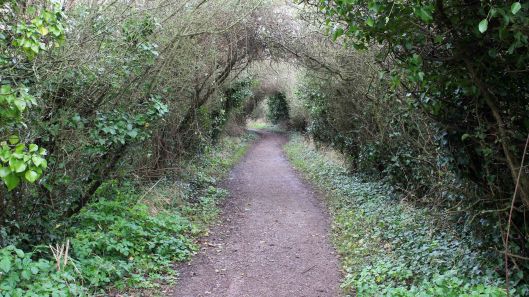
But most of all I love the places – and there are many – where the foliage closes in overhead, to create little tunnels of vegetation. I find there’s something magical about such spaces, a little like stepping through the wardrobe door to emerge in a real-life Narnia.

Like Loading...

‘The everlasting charm of fossils’

29 Wednesday Mar 2017

Posted by sconzani in geology, molluscs, nature

≈ 15 Comments

Tags

calcareous rock, cephalopods, Erfoud, fossils, Morocco, trilobites

I’ve always been fascinated by fossils and would love to find a little something special (I’m hoping my move to the south Wales coast will help fulfil this dream as there are fossils, and even dinosaur bones, in nearby cliffs) so imagine my delight when we visited a fossil exhibition, museum, factory and shop during a tour of Morocco back in 2014.

170329 Moroccan fossils (3)
170329 Moroccan fossils (4)

We were near the town of Erfoud, in southern Morocco, an area which is now extremely arid but 500 million years ago was under the ocean. Some of the creatures that inhabited that ocean – in particular, the cephalopod molluscs and trilobite anthropods – became stranded in muddy lagoons that gradually dried out and, over time, the mud and creatures were transformed into a fine-grained calcareous rock containing the perfectly preserved fossilised creatures.

170329 Moroccan fossils (1)
170329 Moroccan fossils (2)

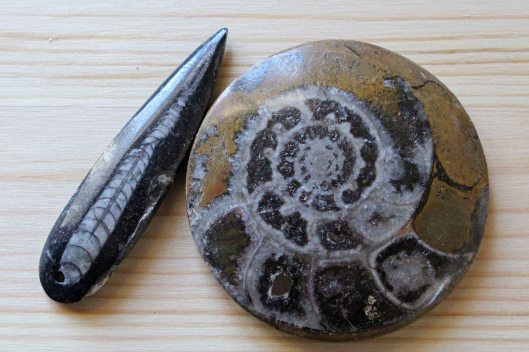
The museum-come-shop had some wonderful specimens on display and for sale, including large items like tables and lamp bases, wash basins and fountains. I couldn’t quite fit a table-top in my backpack but I did buy a couple of small trinkets, shown in the last photo included here. And if I do manage to find anything more local, I’ll definitely be posting about it!

170329 Moroccan fossils (5)
170329 Moroccan fossils (6)

170329 Moroccan fossils (7)

Like Loading...
← Older posts

About me

sconzani

sconzani

I'm a writer and photographer; researcher and blogger; birder and nature lover; countryside rambler and city strider; volunteer and biodiversity recorder.

View Full Profile →

Follow earthstar on WordPress.com

Enter your email address to follow this blog and receive notifications of new posts by email.

Recent blog posts

  • O is for Odonata December 20, 2025
  • N is for nest December 19, 2025
  • M is for mite December 18, 2025
  • L is for lepidopteran lifers December 17, 2025
  • K is for Keeled skimmers December 16, 2025

From the archives

COPYRIGHT

Unless otherwise acknowledged, the text and photographs on this blog are my own and are subject to international copyright. Nothing may be downloaded or copied without my permission.

Fellow Earth Stars!

  • Unknown's avatar
  • Unknown's avatar
  • Unknown's avatar
  • Unknown's avatar
  • Unknown's avatar
  • Unknown's avatar
  • Unknown's avatar
  • Unknown's avatar
  • Unknown's avatar
  • Unknown's avatar
  • Unknown's avatar
  • Unknown's avatar
  • Unknown's avatar
  • Unknown's avatar
  • Unknown's avatar
  • Unknown's avatar
  • Unknown's avatar
  • Unknown's avatar
  • Unknown's avatar
  • Unknown's avatar
  • Unknown's avatar
  • Unknown's avatar
  • Unknown's avatar
  • Unknown's avatar
  • Unknown's avatar
  • Unknown's avatar
  • Unknown's avatar
  • Unknown's avatar
  • Unknown's avatar
  • Unknown's avatar
  • Unknown's avatar
  • Unknown's avatar
  • Unknown's avatar
  • Unknown's avatar
  • Unknown's avatar
  • Unknown's avatar
  • Unknown's avatar
  • Unknown's avatar
  • Unknown's avatar
  • Unknown's avatar
  • Unknown's avatar
  • Unknown's avatar
  • Unknown's avatar
  • Unknown's avatar
  • Unknown's avatar
  • Unknown's avatar
  • Unknown's avatar
  • Unknown's avatar
  • Unknown's avatar
  • Unknown's avatar

Blog at WordPress.com.

Privacy & Cookies: This site uses cookies. By continuing to use this website, you agree to their use.
To find out more, including how to control cookies, see here: Cookie Policy
  • Subscribe Subscribed
    • earthstar
    • Join 667 other subscribers
    • Already have a WordPress.com account? Log in now.
    • earthstar
    • Subscribe Subscribed
    • Sign up
    • Log in
    • Report this content
    • View site in Reader
    • Manage subscriptions
    • Collapse this bar
 

Loading Comments...
 

You must be logged in to post a comment.

    %d