• ABOUT
  • BIRDING 2018
  • Birding 2019
  • BLOG POSTS
  • Butterflies 2018
  • Resources

earthstar

~ a celebration of nature

earthstar

Category Archives: insects

Leafmines: Cameraria ochridella

05 Monday Aug 2024

Posted by sconzani in insects, trees

≈ Leave a comment

Tags

British moths, Cameraria ochridella, Horse chestnut leaf-mining moth, Horse chestnut leafminer, Horse chestnut tree, leaf-mining moth larvae

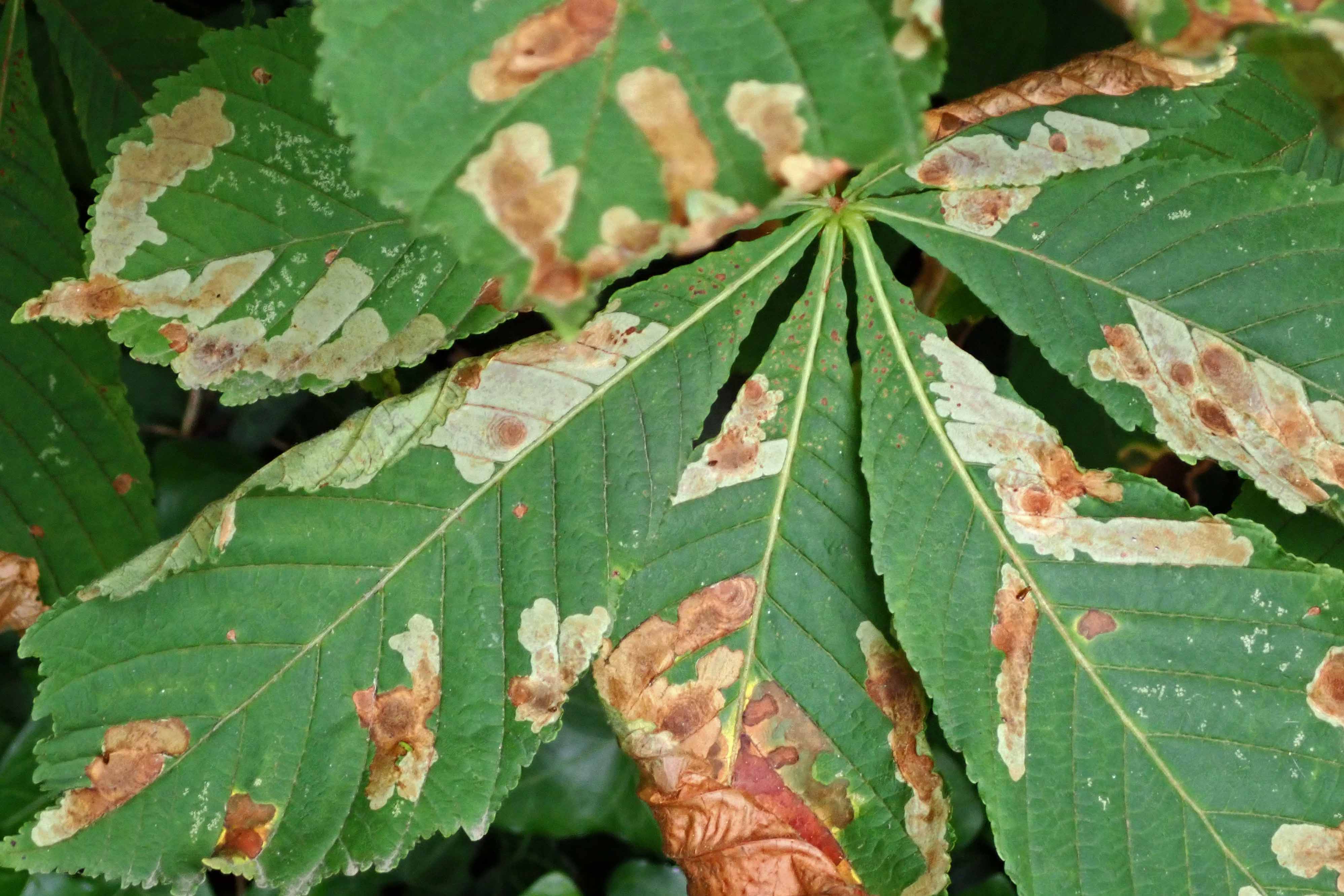
As it’s very common, I’m sure you’ve all seen this damage on the leaves of Horse chestnut trees. These are leafmines, made by the larvae of the Horse chestnut leafminer (Cameraria ochridella) (see my blog Horse chestnut leafminer, 18 July 2018).

240805 Cameraria ochridella (1)

Until last Friday, I’d only ever seen the leafmines, never the adult moth. But, as I walked past this particular Horse chestnut tree, lots of tiny creatures were flitting around its lower leaves. At first, I wasn’t sure what the creatures were – they looked like little flies. Then one of them landed on a leaf in front of me and I managed to get a closer look – a moth, not a fly, and very prettily marked too.

240805 Cameraria ochridella (2)

I must have stood watching for 15 minutes or more, waiting for a moth to settle and snapping a few quick photos before it zipped off … and again … and again. It was a good test of my patience, and I’m really glad I was in the right place at the right time to see these beautiful moths.

240805 Cameraria ochridella (3)

Like Loading...

Hoverfly: Melangyna umbellatarum

03 Saturday Aug 2024

Posted by sconzani in insects

≈ Leave a comment

Tags

British hoverflies, egg-laying hoverfly, egg-laying Melangyna umbellatarum, hoverfly eggs, Melangyna umbellatarum

My guide book, Britain’s Hoverflies (Ball and Morris, Princeton, 2015) says the Melangyna ‘is a challenging genus with several species which are very difficult to identify’, and I thought ‘Just my luck! I might as well give up now’.

240803 Melangyna umbellatarum (1)

Fortunately, I didn’t, and, as this particular species has a shiny thorax and pale, almost white abdominal markings, it proved easier than expected to identify my first ever hoverfly from this genus. This little beauty has now been confirmed as Melangyna umbellatarum, a female that was egg-laying on Hogweed in Cardiff’s Heath Park last week.

240803 Melangyna umbellatarum (2)

You may just be able to spot one of her tiny white eggs above her head in the top photo, and I was able to get a close up (photo above). This was also the first time I’d observed a hoverfly laying her eggs.

Like Loading...

Flies: Sciara species

02 Friday Aug 2024

Posted by sconzani in insects

≈ 2 Comments

Tags

British flies, flies, Fungus gnat fly species, Fungus gnats, Sciara hemerobioides, Sciara species

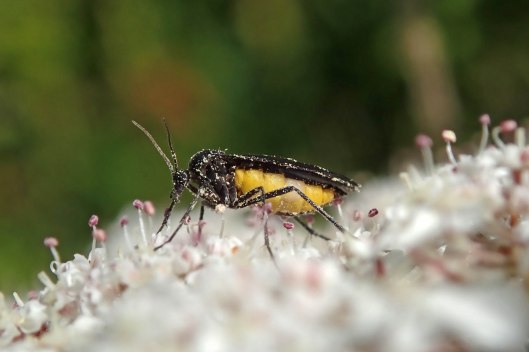
When I first noticed these little flies feasting on the nectar of Wild carrot flowers, I thought perhaps they were sawflies but, when looking at my photos on my laptop later, I realised their heads were far too small.

Turns out these are some kind of fungus gnat though, according to the NatureSpot website, there are several species with the same bright yellow abdomen. So, although these flies look very like the Sciara hemerobioides shown on that website, I’ve recorded them as Sciara species. As you may have worked out, it’s the larvae that feed on fungus, whereas the adults prefer umbellifers and other flora.

Like Loading...

The weird & wonderful world of Sawfly larvae

01 Thursday Aug 2024

Posted by sconzani in insects

≈ Leave a comment

Tags

British sawflies, Caliroa annulipes, Caliroa cerasi, Eriocampa ovata, Euura pavida, Nematus septentrionalis, sawfly larvae

I mentioned earlier in the week, in my post about the sawfly larva Heterarthrus vagans mining the leaves of Alder, that I’d found that miner while checking out leaves to see what small creatures had been munching holes in their leaves. And my recent staring at holey leaves on other trees and shrubs, in other locations, has produced a nice variety of Sawfly larvae, some that look like regular caterpillars, others like slimy slugs. I’ve linked the names to the Sawflies of Britain and Ireland website for those interested in more information on each species.

240801 Caliroa annulipes

Caliroa annulipes on Hawthorn

240801 Caliroa cerasi

Caliroa cerasi, also on Hawthorn

240801 cladius sp

An unidentified Cladius species, on Field rose

240801 eriocampa ovata

The one that looks like bird poo, Eriocampa ovata, on Alder

240801 Euura pavida

One of the bum-waggling species, Euura pavida, on Willow

240801 Nematus septentrionalis

Another bottom waggler, Nematus septentrionalis, on Birch. I love how their munching has created a heart from their leaf.

Like Loading...

New location for Purple hairstreak

30 Tuesday Jul 2024

Posted by sconzani in insects, trees

≈ Leave a comment

Tags

British butterflies, butterfly, butterfly on Oak, hairstreak butterflies, Heath Park, Oak, Purple hairstreak

Since I discovered a Purple hairstreak, a couple of years ago, at Cosmeston Lakes Country Park, where they’d never been recorded before, I’ve been convinced that these gorgeous little butterflies are more common than most people realise. It’s just that, because they’re very small and spend most of their time high up in the tops of Oak trees, nobody notices them. So, being an habitual leaf-starer anyway, I now spend 10-15 minutes at this time of year staring at Oak trees, just in case. Last week, my leaf-staring paid off once again, when I was exploring Cardiff’s Heath Park. There are lots of large old Oaks in the park so it seemed a likely location, despite there being no recorded sightings. And this was my reward – even better than I expected, as it fluttered down from the top of the tree to a lower branch and posed nicely while I got some photos.

240730 purple hairstreak

Like Loading...

Leafmines: Heterarthrus vagans

29 Monday Jul 2024

Posted by sconzani in insects, trees

≈ Leave a comment

Tags

Alder, British leafminers, Heterarthrus vagans, leaf-mining sawfly larvae, leafmines on Alder, sawfly larva

Another Monday, another leafmine. I noticed this one while checking out Alder leaves to see what small creatures had been munching holes in their leaves (more on those later this week). This blotch mine was made by the larva of sawfly Heterarthrus vagans (you can see what the adult sawfly looks like on the Sawflies website here).

240729 Heterarthrus vagans (1)

I thought initially this might have been the larva of sawfly Fenusa dohrnii – I was right about it being a sawfly but had the species wrong. Fortunately, I had held the leaf up to the light to get a slightly clearer photo of the larva within as, from looking at that, British Leafminers expert Rob was able to tell me: ‘It has a black “bow tie” … so is a Heterarthrus and as it is Alder it is Heterarthrus vagans‘. Who knew sawfly larvae wore bow ties? But it seems all the Heterarthrus species larvae have them. Very smart!

240729 Heterarthrus vagans (2)

Like Loading...

Essex, at last

27 Saturday Jul 2024

Posted by sconzani in insects

≈ Leave a comment

Tags

British butterflies, butterfly, Essex skipper

The Essexes were late arriving this summer and, as I almost frantically checked the antennae of every Small skipper I could find (not as many of them as usual either), I had begun to think I wouldn’t see one. (For context, my first sightings in previous years have been as follows: 2019 9 July, 2020 25 June, 2021 11 July, 2022 29 June, 2023 23 June.) Then, finally, on 17 July I spotted not one but two male Essex skippers involved in a little skirmish over territory in a local coastal field. And the next day one popped up most obligingly at Cosmeston Lakes Country Park. And there have been a couple more since then … so, I’m a happy butterflier once more.

240727 essex

Like Loading...

Shieldbug eggs and hatchlings

26 Friday Jul 2024

Posted by sconzani in insects

≈ Leave a comment

Tags

Common Green Shieldbug, Common green shieldbug eggs, insect eggs, Palomena prasina, shieldbug eggs, shieldbug nymphs

Recent leaf-bothering has turned up several clutches of insect eggs, usually laid on the undersides of leaves. Most I can’t identify but these are two I can. I knew this first lot were shieldbug eggs but I wasn’t sure of the species. Luckily, an entomologist who follows me on Twitter was able to tell me that this clutch was laid by a Common green shieldbug (Palomena prasina) and, due to the greyish colour of the eggs, he could also tell that they had been parasitised, probably by a species of parasitic wasp.

240726 common green shieldbug eggs parasitised

As you can see, this second clutch of eggs had fared much better, escaping the wasp’s ovipositor to produce these tiny hatchlings. Despite their reddish colouring, these are also Common green shieldbugs; the nymphs will go through several changes of colour and patterning before they assume their final adult appearance.

240726 common green shieldbug hatchlings

Like Loading...

A miscellany of moths

24 Wednesday Jul 2024

Posted by sconzani in insects

≈ Leave a comment

Tags

#MothsMatter, Alder signal, Angerona prunaria, British moths, Eucosma cana, Evergestis forficalis, Garden pebble, Hoary tortrix, Orange moth, Stathmopoda pedella

From all the leafmine blogs I post, you might well get the impression that I only ever see moths in their larval form, and often those are hidden within leaves. I don’t operate a moth trap – my living accommodation has no outside space for such things, and, though I’m sure there is some value in knowing what moths are around at any given time, I’m not convinced that artificially luring all the moths in your garden to spend the night confined inside a trap is actually a good thing. Still, I do occasionally spot day-flying moths or momentarily disturb roosting night-flying moths during my walks. So, here are a few recent finds (for each species I’ve added links to the UK Moths website in case you want to learn more about them).

240724 Eucosma cana

Eucosma cana, also known as Hoary tortrix or Hoary bell, found on thistle in a local meadow.

240724 garden pebble Stathmopoda pedella

On the left, Evergestis forficalis, common name Garden pebble, spotted in its distinctive resting posture in vegetation by a local path.
On the right, Stathmopoda pedella, another moth with a unique method of sitting, this one found on an Alder leaf, which presumably is why its common names are Alder signal or Alder signaller.

240724 orange moth

Angerona prunaria or Orange moth. Not a common moth locally so I was fortunate that it fluttered up from vegetation during my recent visit to Slade Wood.

Like Loading...

Flying ant day

23 Tuesday Jul 2024

Posted by sconzani in insects

≈ Leave a comment

Tags

ant nuptials, Black garden ant, flying ant, flying ant day, Lasius niger

The large numbers of screeching gulls swirling in the sky above alerted me to a hot day phenomenon – we were experiencing a ‘flying ant day’, and this wasn’t just happening where I lived – the same scene was being played out across the UK, though flying ant days can happen any day from June to September, depending on local weather conditions.

In our case, the 25º Celsius temperatures had triggered the emergence of thousands and thousands of Black garden ants (Lasius niger), both with wings and without, which were now streaming from cracks in the pavements and holes in adjacent grassy areas.

These ants are drones (small winged males) and princesses (much larger, winged virgin queens), emerging to mate and form new colonies. (You can read all about their fascinating life cycle on the Natural History Museum website.)

240723 flying ant day (1)

Most fly almost immediately up into the air, so as to disperse as far as possible from their original location, thus preventing inbreeding. One landed on the back of my neck, which is why I happened to get a shot of it between my fingers. It was released unharmed but not all the ants get to enjoy their nuptials – some get caught in spiders’ webs, many get squashed by passing pedestrians and cars, but by far the greatest numbers of casualties are caused by feasting birds, particularly gulls and, locally, the hungry Swifts that harvest the ants to feed their growing young.

240723 flying ant day (2)

Like Loading...
← Older posts
Newer posts →

About me

sconzani

sconzani

I'm a writer and photographer; researcher and blogger; birder and nature lover; countryside rambler and city strider; volunteer and biodiversity recorder.

View Full Profile →

Follow earthstar on WordPress.com

Enter your email address to follow this blog and receive notifications of new posts by email.

Recent blog posts

  • My first moth of the year February 18, 2026
  • Three Common sandpipers February 17, 2026
  • Beetle: Athous bicolor February 16, 2026
  • Crocus flower power February 15, 2026
  • Delightful doves February 14, 2026

From the archives

COPYRIGHT

Unless otherwise acknowledged, the text and photographs on this blog are my own and are subject to international copyright. Nothing may be downloaded or copied without my permission.

Fellow Earth Stars!

  • Unknown's avatar
  • Unknown's avatar
  • Unknown's avatar
  • Unknown's avatar
  • Unknown's avatar
  • Unknown's avatar
  • Unknown's avatar
  • Unknown's avatar
  • Unknown's avatar
  • Unknown's avatar
  • Unknown's avatar
  • Unknown's avatar
  • Unknown's avatar
  • Unknown's avatar
  • Unknown's avatar
  • Unknown's avatar
  • Unknown's avatar
  • Unknown's avatar
  • Unknown's avatar
  • Unknown's avatar
  • Unknown's avatar
  • Unknown's avatar
  • Unknown's avatar
  • Unknown's avatar
  • Unknown's avatar
  • Unknown's avatar
  • Unknown's avatar
  • Unknown's avatar
  • Unknown's avatar
  • Unknown's avatar
  • Unknown's avatar
  • Unknown's avatar
  • Unknown's avatar
  • Unknown's avatar
  • Unknown's avatar
  • Unknown's avatar
  • Unknown's avatar
  • Unknown's avatar
  • Unknown's avatar
  • Unknown's avatar
  • Unknown's avatar
  • Unknown's avatar
  • Unknown's avatar
  • Unknown's avatar
  • Unknown's avatar
  • Unknown's avatar
  • Unknown's avatar
  • Unknown's avatar
  • Unknown's avatar
  • Unknown's avatar

Blog at WordPress.com.

Privacy & Cookies: This site uses cookies. By continuing to use this website, you agree to their use.
To find out more, including how to control cookies, see here: Cookie Policy
  • Subscribe Subscribed
    • earthstar
    • Join 670 other subscribers
    • Already have a WordPress.com account? Log in now.
    • earthstar
    • Subscribe Subscribed
    • Sign up
    • Log in
    • Report this content
    • View site in Reader
    • Manage subscriptions
    • Collapse this bar
 

Loading Comments...
 

You must be logged in to post a comment.

    %d