• ABOUT
  • BIRDING 2018
  • Birding 2019
  • BLOG POSTS
  • Butterflies 2018
  • Resources

earthstar

~ a celebration of nature

earthstar

Category Archives: insects

Greenbottle

18 Monday Mar 2024

Posted by sconzani in insects, spring

≈ Leave a comment

Tags

British flies, Greenbottle, Greenbottle fly, Lucilia sericata, Lucilia species

I was enjoying seeing a few flies and hoverflies out and about in the sunny sheltered spots during yesterday’s local meander but this little one, in particular, caught my eye with its iridescent green shimmer. It’s one of the so-called Greenbottle flies, a species of Lucilia, and is most likely the commonest of those species, Lucilia sericata, as it seems to have the correct identifying features. The Naturespot website entry lists these as a ‘pale basicosta and a single anterodorsal bristle on the mid tibia’, which may make you say ‘What???’ out loud, as I did, but fortunately they include photos to illustrate what this gobbledygook – er, scientific anatomical description refers to.

240318 greenbottle

Like Loading...

A bumblebee and its mimic

11 Monday Mar 2024

Posted by sconzani in insects, spring

≈ Leave a comment

Tags

Blackthorn blossom, Bombus terrestris, British bumblebees, British hoverflies, Buff-tailed bumblebee, Criorhina ranunculi, Large bearfly

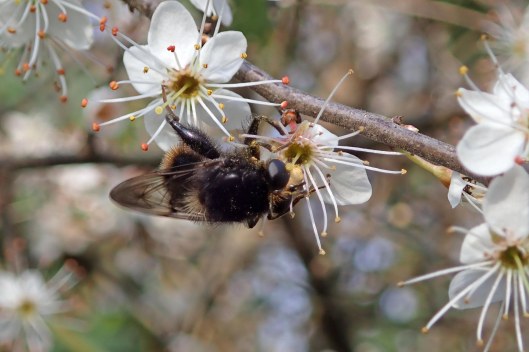
Though there was a cold nor’easterly wind blowing, occasional sunny periods brought out a few insects during my visit to Cardiff’s Grangemoor Park last Friday, and I was lucky enough to spot a couple of Buff-tailed bumblebee (Bombus terrestris) queens feeding on Blackthorn blossom.

240311 buff-tailed bumblebee

Even better, on one tree I found one of Britain’s larger hoverflies, one that mimics bumblebees, a Large bearfly (Criorhina ranunculi), one that can often be seen in early Spring on the blossom of willows, Blackthorn and Wild cherry. This hoverfly’s tail end can be white, orange or red in colour (this one’s was reddish); to see these variations, and his superb images of this hoverfly, check out Steven Falk’s Flikr album.

240311 Criorhina ranunculi

Like Loading...

Weevil number 3

04 Monday Mar 2024

Posted by sconzani in insects

≈ 4 Comments

Tags

British insects, British weevils, weevil

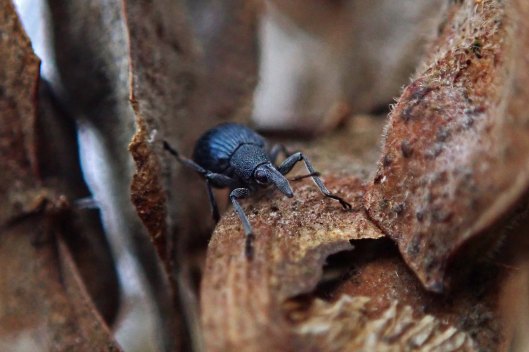
For some unknown reason, the insects I’m seeing most often so far this year are weevils (there was An early weevil, on 16 February, and Weevil: Dorytomus taeniatus last week, on 28 February).

240304 weevil (1)

I’ve seen today’s weevil species at two different locations so far, and I’m thinking you’ll be able to guess what type of weevil it is from the plant it’s on. So, how about giving it a try? Name the weevil!

240304 weevil (2)

Like Loading...

Weevil: Dorytomus taeniatus

28 Wednesday Feb 2024

Posted by sconzani in insects

≈ Leave a comment

Tags

British weevils, Dorytomus taeniatus, insects inside willow catkins, weevil, weevil in willow catkin, willow catkins

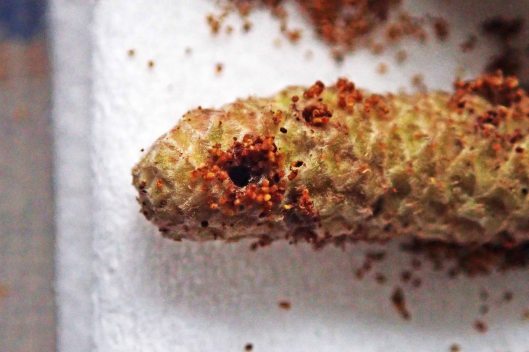
This was the other new-to-me species I found during last Wednesday’s walk (see also Monday’s post about the Ghost slug), or rather, these were – three tiny weevils, which, I think, must be Dorytomus taeniatus.

carrying a raindrop on its tiny back

The reason I think that is partly because they fit the description I found on the Nature Spot website: a ‘small weevil with a mottled dark and light brown appearance’, and partly because these weevils develop inside willow catkins, which is where I found them. One was even sheltering or, perhaps, not yet emerged from inside one of the catkins. My photos are not very clear, sorry – I’m going to look for more of these when/if the weather improves.

240228 Dorytomus taeniatus (2)

Like Loading...

Casebearer: Luffia lapidella

19 Monday Feb 2024

Posted by sconzani in insects, lichen

≈ 3 Comments

Tags

British moths, casebearer, casebearing moth larvae, lichen-eating moth larva, Luffia lapidella

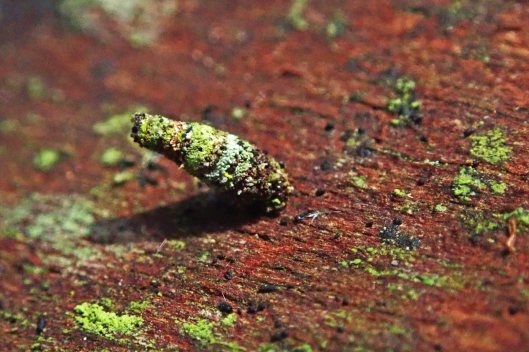
I found this very pretty lichen-covered casebearer on fallen bark during a recent visit to Cardiff’s Cathays Cemetery (this year I’ve been doing some voluntary genealogical research, which has led to a few recent cemetery visits – not that I need a lot of urging, as this cemetery is huge, an arboretum and a SSSI). By sheer coincidence, a moth ecologist I follow on social media posted a photo the very next day of a casebearer that looked very like what I’d seen. When I asked, George confirmed my find as the larva of the moth Luffia lapidella, also known as Ramshorn Bagworm, Virgin Smoke, Grey Bagworm, and Luffia ferchaultella.

240219 Luffia lapidella

As well as covering its case in colourful lichen, the larva also eats lichen, so can be found in the damp places where lichen thrives, like tree trunks and branches, fence posts and even rocks. You can read more on the Naturespot website here.

Like Loading...

An early weevil

16 Friday Feb 2024

Posted by sconzani in insects, winter

≈ Leave a comment

Tags

Ash keys, British weevils, weevil, weevil sitting on Ash keys, winter weevil

I can’t remember what led me to check the few bundles of dried Ash keys still hanging from a short tree alongside the path I walked this morning but I’m very glad I did because I found this stunning little weevil lurking amongst the keys. I’m sure this is the earliest date I’ve ever seen a weevil, more evidence if it were needed of how mild this winter has been.

240216 weevil

Like Loading...

Catkin miner: Epinotia tenerana

13 Tuesday Feb 2024

Posted by sconzani in insects, trees

≈ Leave a comment

Tags

British moths, catkin miners, Epinotia tenerana, Hazel, larvae in Hazel catkins, moth larvae in catkins, Nut Bud moth

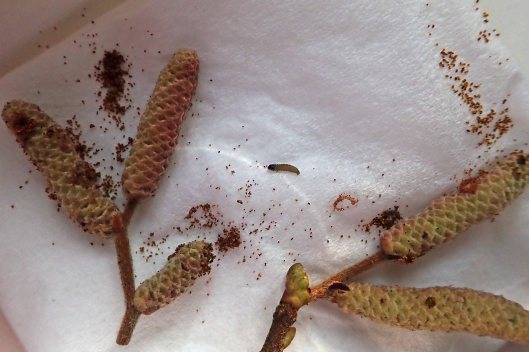
Much excitement last Sunday! I sent this tweet to Rob, who runs the British Leafminers website:

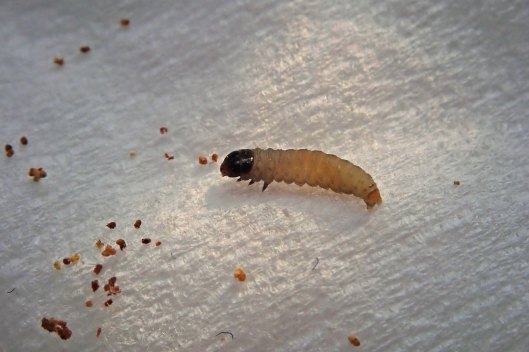
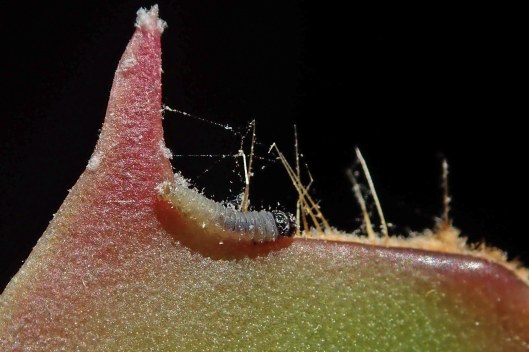
I’ve got larvae emerging from Hazel catkins!!! The lid of the container was slightly ajar & one’s done a runner, first to a cactus, now on a succulent on my kitchen window. The other’s still in the container. Might these be Epinotia tenerana?

240213 Epinotia tenerana (1)

Rob kindly confirmed my identification of these little critters as the larvae of the Nut Bud moth (Epinotia tenerana). Though these are obviously not leafminers, it was, in fact, Rob who inspired me to collect these catkins in the first place. In a tweet a couple of weeks ago, he also recommended harvesting catkins from Birch, native Alder and Italian alder, and putting them in containers to see what might emerge from them. He wasn’t specific about what to expect but I was intrigued so went a’harvesting.

240213 Epinotia tenerana (2)

If I had the right equipment and more space, I would try to rear these larvae. If you want to try this for yourself, you can read more about this moth and find instructions on the UK Moths website.

240213 Epinotia tenerana (3)

Unfortunately, there’s no sign of anything in my other containers so I might try collecting catkins from different locations and trying again.

240213 Epinotia tenerana (4)

Like Loading...

My, what long legs you have

08 Thursday Feb 2024

Posted by sconzani in insects, nature, winter

≈ Leave a comment

Tags

British craneflies, cranefly, Tipula pagana, winter insects

This little critter was hanging on to a house wall I passed yesterday. I’m fairly sure it’s a cranefly species and it might be Tipula pagana. However, although I’ve lightened it a lot, my photo doesn’t show the identifying features well enough and, according to what I’ve read, it shouldn’t be out and about at this time of year. It was certainly nice to see an insect at last, as, understandably, they are all hiding away at the moment.

Like Loading...

Alexanders rust and springtails

02 Friday Feb 2024

Posted by sconzani in insects, plants, wildflowers, winter

≈ Leave a comment

Tags

Alexanders, Alexanders rust, Collembola, Puccinia smyrnii, Smyrnium olusatrum, springtail, springtail feeding on Alexanders rust, springtails on Alexanders

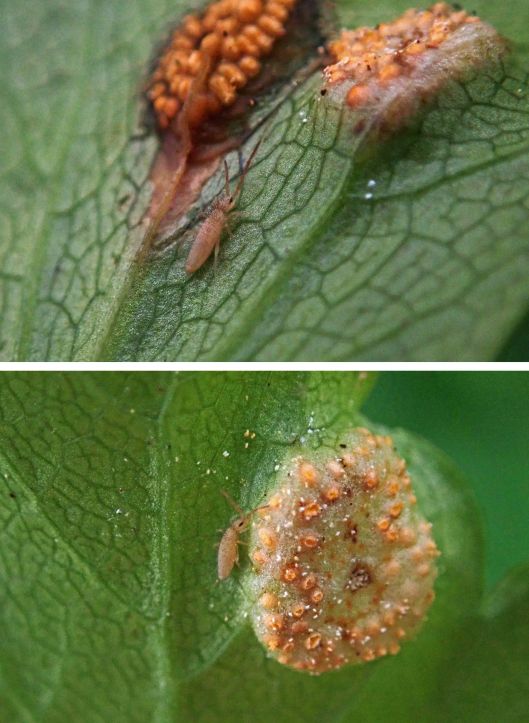
One of the most abundant plants along the South Wales Coastal Path, even in the depths of winter, is Alexanders (Smyrnium olusatrum), and, almost as soon as it breaks ground, it seems to have rust on its stems and leaves. This rust, Alexanders rust (Puccinia smyrnii), is only ever found on this plant species, and when I was examining the rust recently, I noticed it was providing a meal for some tiny springtails. I’m not sure which springtail species these are – they can be tricky to identify, but many species are known to snack on fungi, fungal spores, mould and bacteria so I guess they find the rust spores a tasty meal.

240202 springtail eating alexanders rust

Like Loading...

Hiding in the Ivy berries

31 Wednesday Jan 2024

Posted by sconzani in insects, winter

≈ Leave a comment

Tags

ivy berries, Red-legged shieldbug, winter insects, winter invertebrates

It’s been a bit of struggle finding invertebrates this month – everything’s tucked away out of the cold and the rain – so I was very pleased to see this Red-legged shieldbug trying to hide in this little clump of Ivy berries. If it’s not careful a hungry bird will have a crunchy treat when it comes feeding on the berries.

Like Loading...
← Older posts
Newer posts →

About me

sconzani

sconzani

I'm a writer and photographer; researcher and blogger; birder and nature lover; countryside rambler and city strider; volunteer and biodiversity recorder.

View Full Profile →

Follow earthstar on WordPress.com

Enter your email address to follow this blog and receive notifications of new posts by email.

Recent blog posts

  • Bearded tit!!! April 3, 2026
  • A Portland Bill Kestrel April 2, 2026
  • A proliferation of Peacocks April 1, 2026
  • Little owl March 31, 2026
  • Distant seabirds March 30, 2026

From the archives

COPYRIGHT

Unless otherwise acknowledged, the text and photographs on this blog are my own and are subject to international copyright. Nothing may be downloaded or copied without my permission.

Fellow Earth Stars!

  • Unknown's avatar
  • Unknown's avatar
  • Unknown's avatar
  • Unknown's avatar
  • Unknown's avatar
  • Unknown's avatar
  • Unknown's avatar
  • Unknown's avatar
  • Unknown's avatar
  • Unknown's avatar
  • Unknown's avatar
  • Unknown's avatar
  • Unknown's avatar
  • Unknown's avatar
  • Unknown's avatar
  • Unknown's avatar
  • Unknown's avatar
  • Unknown's avatar
  • Unknown's avatar
  • Unknown's avatar
  • Unknown's avatar
  • Unknown's avatar
  • Unknown's avatar
  • Unknown's avatar
  • Unknown's avatar
  • Unknown's avatar
  • Unknown's avatar
  • Unknown's avatar
  • Unknown's avatar
  • Unknown's avatar
  • Unknown's avatar
  • Unknown's avatar
  • Unknown's avatar
  • Unknown's avatar
  • Unknown's avatar
  • Unknown's avatar
  • Unknown's avatar
  • Unknown's avatar
  • Unknown's avatar
  • Unknown's avatar
  • Unknown's avatar
  • Unknown's avatar
  • Unknown's avatar
  • Unknown's avatar
  • Unknown's avatar
  • Unknown's avatar
  • Unknown's avatar
  • Unknown's avatar
  • Unknown's avatar
  • Unknown's avatar

Blog at WordPress.com.

Privacy & Cookies: This site uses cookies. By continuing to use this website, you agree to their use.
To find out more, including how to control cookies, see here: Cookie Policy
  • Subscribe Subscribed
    • earthstar
    • Join 642 other subscribers
    • Already have a WordPress.com account? Log in now.
    • earthstar
    • Subscribe Subscribed
    • Sign up
    • Log in
    • Report this content
    • View site in Reader
    • Manage subscriptions
    • Collapse this bar
 

Loading Comments...
 

You must be logged in to post a comment.

    %d