• ABOUT
  • BIRDING 2018
  • Birding 2019
  • BLOG POSTS
  • Butterflies 2018
  • Resources

earthstar

~ a celebration of nature

earthstar

Category Archives: insects

Leafmines: Coleophora peribenanderi

18 Monday Oct 2021

Posted by sconzani in autumn, insects, plants

≈ 2 Comments

Tags

British leafminers, British moths, case-bearing moths, Coleophora peribenanderi, leaf-mining larvae, leaf-mining moth, moth larvae on thistles, Pale Thistle case-bearer

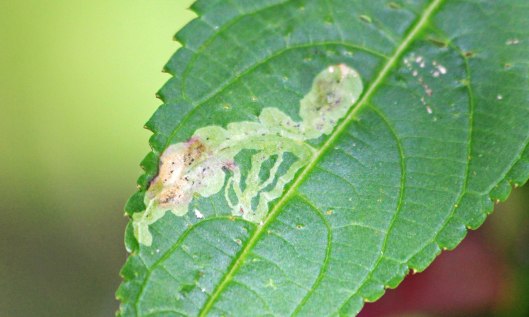
Searching for leafmines on thistles is not for the faint-hearted, writes she with multi-punctured fingers. But it has been worth every drop of blood to find these mines (and I must be a masochist, as, having found them in one place, I then went determinedly searching in other locations – two successes so far, which I’m rather pleased about as there are very few records in south Wales).

211018 Coleophora peribenanderi (1)

The larvae of the moth Coleophora peribenanderi, also known as the Pale Thistle case-bearer (you can see the adult on UK Moths here), builds itself a tube-like case to live in and ventures out of said case to munch happily on the leaves of whichever species of thistle its mother laid her eggs on (in the three I’ve found so far, Creeping thistle). The marks this feeding makes on the plant’s leaves are quite distinctive but, to clinch the identification, you need to look under the leaf and find the case.

211018 Coleophora peribenanderi (2)

Interestingly, the larva feeds up for a couple of months, from July to September, then suspends its development (the scientific word is diapause, a new one for me) through the winter until either feeding up a bit more in April or passing straight to pupation in May. Fascinating stuff!
Like Loading...

Busy buzzing

14 Thursday Oct 2021

Posted by sconzani in autumn, insects

≈ Leave a comment

Tags

bees on Ivy flowers, British bees, Colletes hederae, Ivy bee

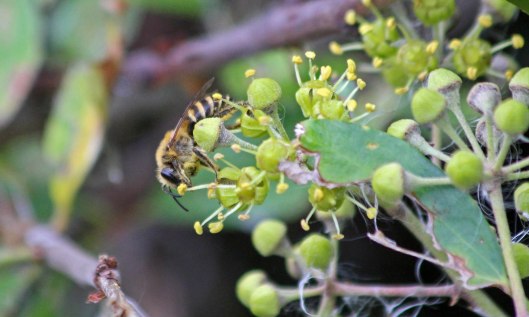
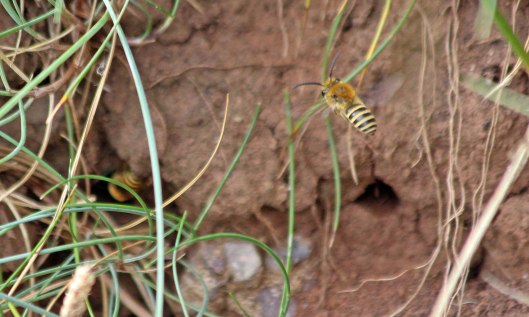
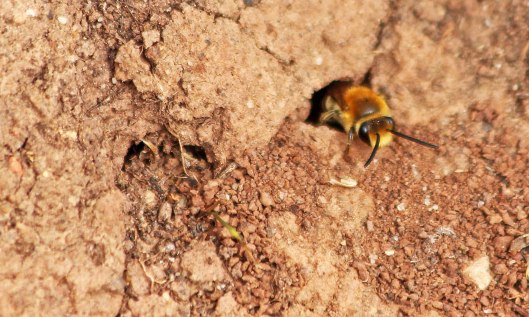
Every year I look out for them. Every year I share photos of them, and 2021 is no exception. Here, then, are some of this year’s cohort of Ivy bees, at their burrows and feasting on Ivy flowers.

211014 ivy bees (1)211014 ivy bees (2)211014 ivy bees (3)211014 ivy bees (4)

Like Loading...

In Sycamore seeds

12 Tuesday Oct 2021

Posted by sconzani in insects, trees

≈ Leave a comment

Tags

British moths, Moth larvae in Sycamore seeds, moth mines in Sycamore seeds, Pammene aurita larva, Pammene regiana larva, Sycamore seeds

This is the sequel to yesterday’s post …

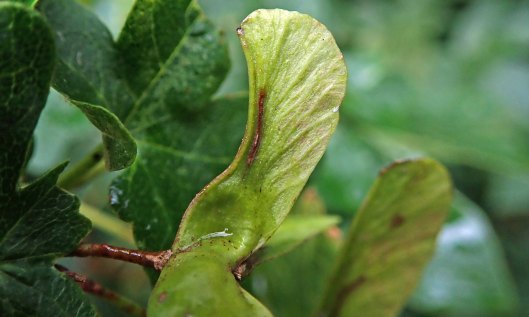
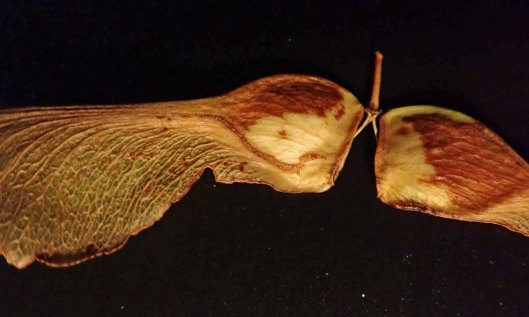
30 September: While I was searching for the larval mines of the moth Ectoedemia decentella on the few Sycamore seeds I could reach, I found one seed with a hole in it. Thinking it might be relevant, I brought it home and later posted a photo and query on Twitter. Butterfly Conservation senior moth ecologist George replied that this is ‘the exit hole made by a tortrix [moth] larva – likely Pammene aurita, though Pammene regiana also feeds on Sycamore seeds’. Then followed a discussion, prompted by George, between he and 3 other moth-ers about whether Pammene regiana makes an exit hole like this. No one knew for sure.

211012 pammene larval mine (1)

1 October: The next morning, when I picked up the little group of three joined seeds, I noticed what looked like frass sitting below. I mentioned this on Twitter and was advised to put the seeds on tissue in a jar in case the larva was still inside.

211012 pammene larval mine (2)

2 October: My tweet: ‘Exciting news: we have a larva! Not from the original hole. I put that seed, with 2 attached, in a jar, and a larva has emerged from one of the other seeds. It’s currently doing a circuit of the tissue – hoping it will pupate.’ It wasn’t until later, when I was looking at the photos I had taken, that I realised the photo above shows where that larva had begun to eat its way out of the seed (indicated by the yellow arrow).

211012 pammene larval mine (3)211012 pammene larval mine (4)

3 October: The larva pupated. I haven’t been able to get a good image as it’s under the tissue and seems partly stuck to the glass jar. And I realised that I’ll now need to wait until at least next May, maybe later to see which moth emerges. What’s that about patience being a virtue?!

211012 pammene larval mine (5)

Like Loading...

Moth mines in Acer seeds

11 Monday Oct 2021

Posted by sconzani in insects, trees

≈ Leave a comment

Tags

British moths, Ectoedemia sericopeza, Etainia louisella, larval mines of moths, Mines in Field maple seeds, mines in Norway maple seeds, moth mines in Acer seeds, moth mines in samaras

On 29 September, SEWBReC (the South East Wales Biodiversity Records Centre) posted the following tweet:

Calling keen members of #TeamLeafmine. [The county moth recorder] is hoping for Glamorgan records of seed miners of Acer species this year: Etainia louisella on Field Maple / Ectoedemia sericopeza on Norway Maple / Ectoedemia decentella on Sycamore.

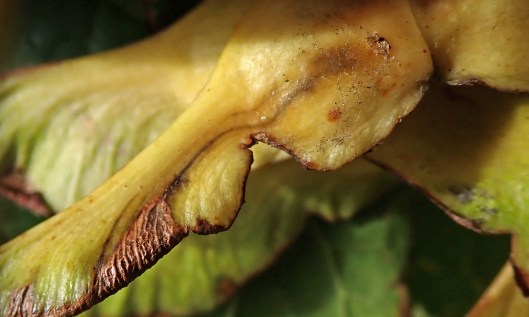
Being a keen member of Team Leafmine, I had to take up the challenge. Field maples are quite common locally so the mines in their seeds have been the easiest to find, though they’re by no means common. I’ve managed to find them in two locations so far.

211011 Ectoedemia louisella on Field maple (1)OLYMPUS DIGITAL CAMERA

There are not so many Norway maples in my area – they’re not native, of course, and seem mostly to have been planted in parks, in housing developments, along roadside verges. So far, I’ve found Ectoedemia sericopeza mines on Norway maples at two sites.

OLYMPUS DIGITAL CAMERA211011 Ectoedemia sericopeza on norway maple (2)

As for the mines in Sycamore seeds, well, I quickly realised that most of the local trees are quite tall so the seeds are unreachable. And trees planted in parks and gardens often have their lower branches trimmed off, which also doesn’t help. The solution I’ve found is to search through seeds once they’re fallen off the trees, though they are then very brown, often dirty and sometimes damaged so the mines are not easy to spot. I’ve failed in this search so far but I have found something else in Sycamore seeds … more on that tomorrow.

Like Loading...

Moth hot spot

06 Wednesday Oct 2021

Posted by sconzani in insects

≈ Leave a comment

Tags

British moths, Large ranunculus, moths, Mottled umber, Peppered moth, Small dusty wave, Winter moth

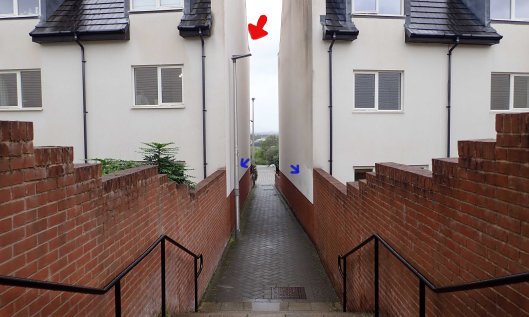
As I’ve mentioned before, my living situation doesn’t lend itself to having a moth trap but there is a local site where I often see moths if I’m out walking in the early mornings. As you can see from the photo below, a streetlight (red arrow) sits above a footpath between two blocks of terraced houses. The light attracts the moths, which then sometimes shelter on the walls (blue arrows) during the day.

211006 mothing spot

As well as the Early grey and Early thorn found back in 2018, I’ve since discovered several more beautiful moths on these walls. The first three, seen last year, are Mottled umber (Erannis defoliaria), the Peppered moth (Biston betularia), and the Winter moth (Operophtera brumata) – you might remember I blogged about the larva of this last moth earlier in the year (Caterpillar in a tent, May 2021).

211006 1 Mottled umber
211006 2 Peppered
211006 3 winter moth

These next two are more recent sightings, both spotted in the past month. The first is Small dusty wave (Idaea seriata), the second Large ranunculus (Polymixis flavicincta).

211006 4 Small Dusty Wave211006 5 Large Ranunculus

Like Loading...

Leafmines: Stigmella plagicolella

04 Monday Oct 2021

Posted by sconzani in insects, leaves

≈ Leave a comment

Tags

British leaf mines, leaf-mining larvae, leaf-mining moth, leaf-mining moth larvae, leafminers, leafmines on Blackthorn, Stigmella plagicolella

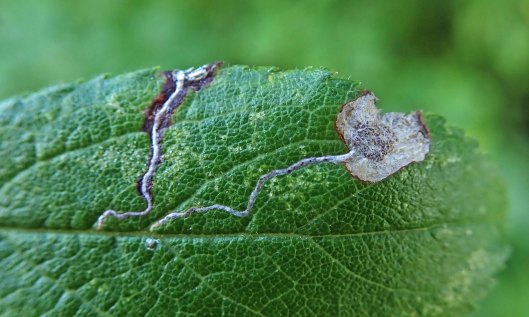
Rob Edmunds, one of the people behind the British Leafminers website, labelled these leafmines ‘tadpoles’ and, as you can see, it’s a very apt description. They are also tiny, as these mines appear on Blackthorn or Sloe (Prunus spinosa), the leaves of which are only 2 – 4cms long.

211004 Stigmella plagicolella (1)

The adults of the moth Stigmella plagicolella, also known as the Scrubland Pigmy, are active twice each year, firstly in May and June, and then again in August, so their larval mines can be seen soon after those periods, in July and then again during September and October. So, this is a mine to look out for when all you gin drinkers out there are collecting the fruit to make Sloe gin.

211004 Stigmella plagicolella (2)
211004 Stigmella plagicolella (3)
Like Loading...

Pillars of the insect community

30 Thursday Sep 2021

Posted by sconzani in insects

≈ 8 Comments

Tags

British insects, moth caterpillars, moth larvae, mystery caterpillars, mystery larvae, sawfly caterpillars, sawfly larvae

To showcase their diversity, in colour, size, shape, pattern, habits and hairiness, I’ve been gathering photos of these (cater)pillars of the insect community, the larvae of moths, sawflies, and some mysteries, which could be one of these … or something other. Here they are:

210930 moth 5-spot burnet
210930 moth drinker
210930 moth maiden's blush

Moths: 5-spot burnet (Zygaena trifolii), Drinker (Euthrix potatoria), and the delightfully named Maiden’s blush (Cyclophora punctaria).

210930 sawfly Allantus sp
210930 sawfly Eriocampa ovata

Sawflies: a possible Allantus species (its identity cannot be confirmed as it was on the wrong plant), and the fluffy looking Eriocampa ovata.

210930 mystery (1)
210930 mystery (2)
210930 mystery (3)
210930 mystery (4)

Mysteries: if you can ID any of these, please leave a comment below. Thanks!

Like Loading...

The lacewing lifecycle

29 Wednesday Sep 2021

Posted by sconzani in insects

≈ Leave a comment

Tags

Green lacewing, Lacewing, lacewing eggs, lacewing larva

Last week I found two things I couldn’t identify and it turns out that they’re related. I’ve seen adult lacewings many times and always paused to admire their intricately patterned, delicate wings, the way their subtle colouring contrasts with their metallic eyes, and their hunger for aphids (they are used for biological pest control).

210929 lacewing adult
210929 lacewing eggs

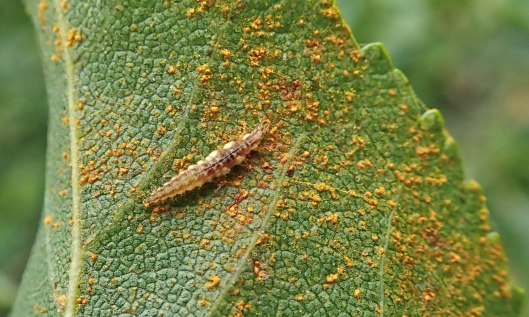
Last week, for the first time, I found some of their eggs, which, amazingly, dangle from the undersides of leaves on individual short silk strings. And, on a different day, under another leaf, I found what I initially thought was a hoverfly larva but later discovered was a lacewing larva. What intriguing creatures they are!

210929 lacewing larva

Like Loading...

Craneflies

28 Tuesday Sep 2021

Posted by sconzani in autumn, insects

≈ Leave a comment

Tags

crane fly, craneflies

In recent weeks, craneflies have been getting a lot of bad press in some of the more environmentally ignorant media, with stories of ‘plagues of insects’ being used to attract readers, followers, and social media clicks. When you consider the current state of our planet, our climate emergency and biodiversity crisis, I believe this is highly irresponsible behaviour. I can’t do much to counter or challenge these media but I can blog in support of craneflies.

210928 craneflies (1)

Not only are they harmless, but craneflies are also an important part of a healthy ecosystem, as they provide food at this time of year for birds, bats and other creatures. I had low-flying Swallows criss-crossing behind me the other day as my walk across a local field caused craneflies to flit up from the long grass – unfortunate for the craneflies, but essential nourishment for the migrating birds. If you’d like more information on these much-maligned insects, the Cranefly Recording Scheme, on the Dipterists website, provides a wealth of resources to assist.

210928 craneflies (2)

Like Loading...

Leafmines: on Himalayan balsam

27 Monday Sep 2021

Posted by sconzani in flowers, insects

≈ Leave a comment

Tags

British leafmines, leaf-mining fly, leaf-mining fly larvae, leafmine on Himalayan balsam, leafmine on Indian balsam, leafminer, leafmines, Phytoliriomyza melampyga

Here’s a leafmine I hope you don’t find but you probably will, and easily. So, why do I hope you don’t? Because this mine is found on plants of the Impatiens species, including the highly invasive plant Himalayan balsam (or Indian balsam, as it’s officially known; i.e. Impatiens grandulifera).

210927 himalayan balsam

The leafminer is the larva of Phytoliriomyza melampyga, which creates an initial narrow twisting gallery that then widens into a variable whitish blotch. The larva’s frass can easily be seen within the mine. The adult fly is actually rather cute, with mostly yellow, a bit of black colouring. (You can see a short video of it on Wikipedia.)

210927 Phytoliriomyza melampyga

The NBN Atlas is currently showing just 192 records for this species in Britain, though, like most flies, it’s probably under-recorded.

Like Loading...
← Older posts
Newer posts →

About me

sconzani

sconzani

I'm a writer and photographer; researcher and blogger; birder and nature lover; countryside rambler and city strider; volunteer and biodiversity recorder.

View Full Profile →

Follow earthstar on WordPress.com

Enter your email address to follow this blog and receive notifications of new posts by email.

Recent blog posts

  • Alder flies April 9, 2026
  • Lily beetle April 8, 2026
  • First bee-flies April 7, 2026
  • Bloody-nosed beetle April 6, 2026
  • Gorse and its weevil April 5, 2026

From the archives

COPYRIGHT

Unless otherwise acknowledged, the text and photographs on this blog are my own and are subject to international copyright. Nothing may be downloaded or copied without my permission.

Fellow Earth Stars!

  • Unknown's avatar
  • Unknown's avatar
  • Unknown's avatar
  • Unknown's avatar
  • Unknown's avatar
  • Unknown's avatar
  • Unknown's avatar
  • Unknown's avatar
  • Unknown's avatar
  • Unknown's avatar
  • Unknown's avatar
  • Unknown's avatar
  • Unknown's avatar
  • Unknown's avatar
  • Unknown's avatar
  • Unknown's avatar
  • Unknown's avatar
  • Unknown's avatar
  • Unknown's avatar
  • Unknown's avatar
  • Unknown's avatar
  • Unknown's avatar
  • Unknown's avatar
  • Unknown's avatar
  • Unknown's avatar
  • Unknown's avatar
  • Unknown's avatar
  • Unknown's avatar
  • Unknown's avatar
  • Unknown's avatar
  • Unknown's avatar
  • Unknown's avatar
  • Unknown's avatar
  • Unknown's avatar
  • Unknown's avatar
  • Unknown's avatar
  • Unknown's avatar
  • Unknown's avatar
  • Unknown's avatar
  • Unknown's avatar
  • Unknown's avatar
  • Unknown's avatar
  • Unknown's avatar
  • Unknown's avatar
  • Unknown's avatar
  • Unknown's avatar
  • Unknown's avatar
  • Unknown's avatar
  • Unknown's avatar
  • Unknown's avatar

Blog at WordPress.com.

Privacy & Cookies: This site uses cookies. By continuing to use this website, you agree to their use.
To find out more, including how to control cookies, see here: Cookie Policy
  • Subscribe Subscribed
    • earthstar
    • Join 642 other subscribers
    • Already have a WordPress.com account? Log in now.
    • earthstar
    • Subscribe Subscribed
    • Sign up
    • Log in
    • Report this content
    • View site in Reader
    • Manage subscriptions
    • Collapse this bar
 

Loading Comments...
 

You must be logged in to post a comment.

    %d