• ABOUT
  • BIRDING 2018
  • Birding 2019
  • BLOG POSTS
  • Butterflies 2018
  • Resources

earthstar

~ a celebration of nature

earthstar

Category Archives: lichen

Bryophytes and lichens

11 Monday Dec 2017

Posted by sconzani in lichen, nature, parks, trees, winter

≈ 2 Comments

Tags

bryophytes, Cosmeston, Cosmeston Lakes Country Park, lichen on trees, lichens, mosses, mosses on trees

Over the summer months my eye has been distracted by all the little creatures that move – butterflies and moths, dragonflies and beetles, and all manner of other insects – but now that it’s winter and those creatures have mostly disappeared (you’ll notice one crept in to one of my photos!), my eye is again drawn to the more static beauty that surrounds me. Take, for example, this small grove of trees at Cosmeston Lakes Country Park.
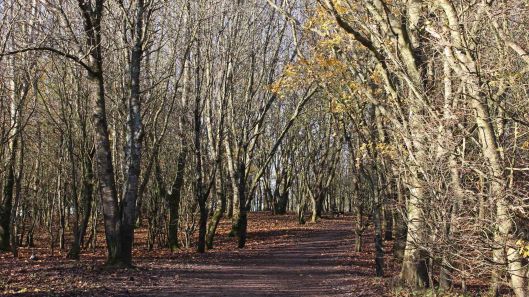
171211 lichens and bryophytes (1)

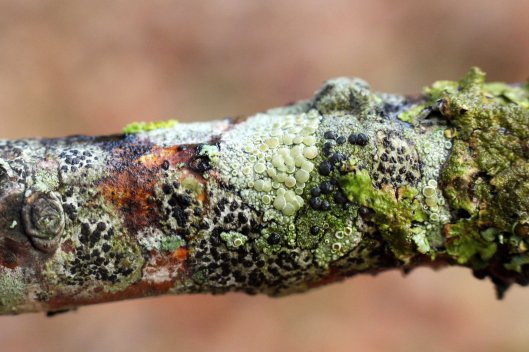
I spent perhaps an hour here the other day, looking in wonder at the incredible variety of tiny lichens and bryophytes to be found on the tree trunks. I haven’t tried to identify these but I’m determined to return to them over the coming months to see which I can put names to and find out more about. For now, I just want to share their beauty.

171211 lichens and bryophytes (2)
171211 lichens and bryophytes (3)
171211 lichens and bryophytes (4)
171211 lichens and bryophytes (5)
171211 lichens and bryophytes (6)
171211 lichens and bryophytes (7)
171211 lichens and bryophytes (8)
171211 lichens and bryophytes (9)
171211 lichens and bryophytes (10)


Like Loading...

Physcia aipolia, the lichen

03 Monday Apr 2017

Posted by sconzani in lichen, nature

≈ 3 Comments

Tags

British lichens, Hoary Rosette lichen, lichen, Physcia aipolia

170403 Physcia aipolia (3)

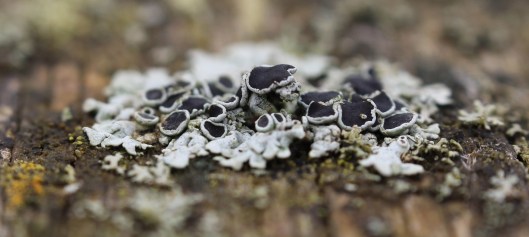
Americans call it the Hoary Rosette lichen but the Brits don’t appear to have a common name for this pretty little lichen, Physcia aipolia. I found it flourishing on wooden fence railings alongside the local coastal path so it obviously thrives in an exposed and salt-windswept location. Officially, it is usually found on the well-lit (I presume that’s sunlit rather than under lamp-posts) nutrient-rich wood of all manner of trees, their twigs and bark.

170403 Physcia aipolia (2)
170403 Physcia aipolia (4)

Its thallus (a plant body that doesn’t have stems, leaves, roots or veins) is foliose (has a lobed, leaf-like shape) and its apothecia (the cup-shaped fruiting bodies) have white rims, with dark brown or black centres. Physcia aipolia is widespread and common in Britain, though it does seem to prefer the slightly warmer and perhaps wetter climes of the south and west.

170403 Physcia aipolia (1)

Like Loading...

Wales walks: Penarth to Lavernock

01 Saturday Apr 2017

Posted by sconzani in geology, insects, lichen, nature, seaside, walks, wildflowers

≈ 8 Comments

Tags

Lavernock, nature walks, Penarth, Penarth to Lavernock, Wales Coastal Path, walks

Since moving to the seaside two months ago I have been thoroughly enjoying exploring my new surroundings and a particular favourite has been the walk from Penarth to Lavernock, a very small 1.5km section of the Wales Coastal Path.

170401 Coastal Path flora

Despite its short length, it can take me rather a long time to walk because the path is bordered with all manner of trees, shrubs and wildflowers, so my eye is constantly drawn to checking these out.

170401 Coastal Path insects (1)
170401 Coastal Path insects (2)
170401 Coastal Path insects (3)

I am fast discovering that the abundance of flora supports a wonderful array of fauna: flies and bees are flocking to the freshly opened flowers of Alexanders (Smyrnium olusatrum), recently arrived migrant Chiffchaffs (Phylloscopus collybita) are announcing their arrival with their familiar onomatopoeic song while recharging their batteries on flying insects, and various species of terrestrial snails sleep, slide and slither amongst the leaves.

170401 Coastal Path lichens (1)
170401 Coastal Path lichens (2)
170401 Coastal Path lichens (3)

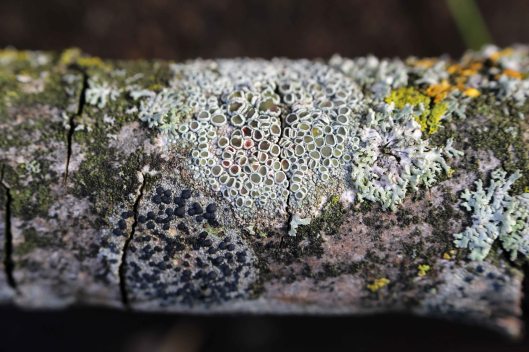
There’s also a huge diversity of lichens, presumably much encouraged by the Welsh rains, the occasional wild winds, and the clean and salty seaside air.

170401 Coastal Path geology

Here and there gaps in the trees and shrubs reveal tantalising glimpses of the fascinating geology this coast is famous for (I have yet to venture down the cliffs but that will soon happen).

170401 Coastal path Flatholm

Boats and ships chug up and down the Bristol Channel; planes from Cardiff airport fly off overhead to foreign shores; the lighthouse on Flatholm beckons; and views of Penarth’s iconic pier abound.

170401 Coastal Path

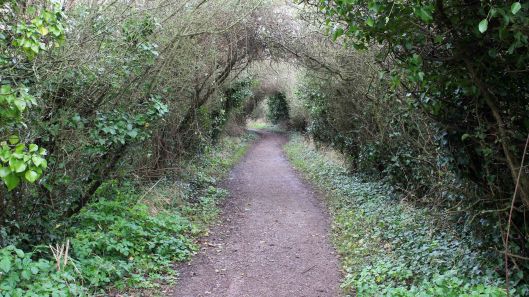
But most of all I love the places – and there are many – where the foliage closes in overhead, to create little tunnels of vegetation. I find there’s something magical about such spaces, a little like stepping through the wardrobe door to emerge in a real-life Narnia.

Like Loading...

Grangemoor Park: a first look

11 Saturday Mar 2017

Posted by sconzani in fungi, insects, lichen, nature, parks, spring, wildflowers

≈ 4 Comments

Tags

biodiversity, Cardiff parks, Grangemoor Park, old rubbish tip, Penarth Moors, River Ely, signs of spring

I had my first wander around Grangemoor Park yesterday and I’ll definitely be going back, though perhaps when it’s a little drier underfoot. With an extensive area of grass and scrub that rises up to two central mounds (from which you get quite good 360-degree views over Cardiff), this land wasn’t always a park. You have only to look at old maps to see that, once upon a time, the River Ely meandered through Penarth Moors here but, once the river was realigned, the hollows thus created were used as one of Cardiff’s rubbish tips. When the tip was full, Cardiff Council had a load of underground drains built, as well as ventilation pipes to allow the methane to escape, covered the lot with tons of clay – hence the very soggy ground, edged it all around with a solid stone wall, and changed its designation to a park in 2000.

170311 Grangemoor (1)
170311 Grangemoor (2)
170311 Grangemoor (3)
170311 Grangemoor (4)
170311 Grangemoor (5)
170311 Grangemoor (6)

That may sound like a sad history but, according to locals, the park now hosts quite a broad range of flora and fauna, and I certainly saw many of the stirrings of Spring. There were bumblebees and flies, a butterfly and a ladybird, masses of primroses almost hidden under bushes, golden coltsfoot and dandelions in bloom all around and horsetail pushing through everywhere, as well as incredibly vibrant lichens and a healthy growth of Oak curtain crust fungi. I will be going back!

170311 Grangemoor (7)
170311 Grangemoor (8)
170311 Grangemoor (9)
170311 Grangemoor (10)
170311 Grangemoor (11)
170311 Grangemoor (12)
Like Loading...

Likin’ the lichen

28 Tuesday Feb 2017

Posted by sconzani in lichen, nature

≈ 8 Comments

Tags

Colours in Nature, lichen, textures in Nature

I haven’t been finding much fungi lately, partly because of my house move (taking up my foraying time and I’m also still exploring my new environment) and partly, I guess, because of the weather (we seem to swing from unseasonably mild and spring-like one day to bitterly cold and hailing the next so the fungi, if they’re smart, will be biding their time before sending out fruiting bodies). What I am seeing a ton of though is lichen, covering the trunks of trees, camouflaging slabs of concrete, coating old lamp posts, carpeting the tops of stone walls. The complexity of their structures, the multiplicity of their designs and the variegation in their colours are wondrous to behold.

170228-lichen-1
170228-lichen-2
170228-lichen-3
170228-lichen-4
170228-lichen-5
170228-lichen-6
Like Loading...

Cornwall: Churchyard lichens

05 Thursday Jan 2017

Posted by sconzani in lichen, nature

≈ 10 Comments

Tags

churchyard lichens, lichen on gravestones, old gravestones, St Just's Churchyard, St Just-in-Roseland

My Christmas holiday was spent exploring Cornwall with a friend, so I thought I’d share a few of the natural delights I saw along the way. On our first day we visited a charming old church at St Just-in-Roseland, an ancient place where St Just the Martyr has been honoured since around 550AD.

170105-st-just-churchyard-lichens-1
170105-st-just-churchyard-lichens-2
170105-st-just-churchyard-lichens-4
170105-st-just-churchyard-lichens-5

The present church, dating from the 1260s, is surrounded by a large graveyard set in a semi-tropical garden. I was particularly taken with the quantity and colours of the magnificent mosses and luxuriant lichens, and with this lovely verse about aging gracefully.

170105-st-just-churchyard-lichens-3

Like Loading...

The beauty in the details

03 Saturday Dec 2016

Posted by sconzani in lichen, nature

≈ 11 Comments

Tags

beauty of small things, nature quote

151203-lichen-1

‘In all things of nature there is something of the marvellous.’ ~ Aristotle
 151203-lichen-2

‘The beauty of the natural world lies in the details.’ ~ Natalie Angier
 151203-lichen-3

‘A multitude of small delights constitutes happiness.’ ~ Charles Baudelaire

Like Loading...

The food of reindeer

07 Monday Nov 2016

Posted by sconzani in lichen, nature

≈ 13 Comments

Tags

caribou food, Cladonia, cup lichen, reindeer food

From my reading I’ve discovered that these cup lichen – Cladonia, by name – are what reindeer and caribou like to eat most. Well, I did see a jolly looking man wearing a bright red jacket walk past just before I took these photos, but I doubt there’s enough Cladonia in my local park to keep Santa’s sleigh-pullers going for more than a kilometre of their round-the-world trip in December, so I don’t think he was Father Christmas looking for potential refuelling stops!

161107-cladonia-1

I don’t know exactly which species of Cladonia I’ve found (and I haven’t yet waded through the 42-page key I downloaded!) and it seems you need a certain level of scientific vocabulary to determine this anyway (the first 5 pages of the key are devoted to a glossary of terms!) but I love the common names many of them have: Pixie cup lichen and Red-fruited pixie cup, Lipstick powderhorn, Trumpet lichen and Felt horn lichen, Dragon lichen, Wand lichen and British soldiers. The references to the colour red and to lipstick are due to the red-coloured fruit that appear on top of their goblet-shaped stalks (podetia). Unfortunately, there is only the merest hint of red in the photo above but, if I do manage to see them in full fruiting display, I’ll post another blog to show you.

161107-cladonia-2
161107-cladonia-3

161107-cladonia-4

Like Loading...

That yellow lichen in the graveyard

18 Friday Mar 2016

Posted by sconzani in lichen, nature

≈ 4 Comments

Tags

Caloplaca flavescens, graveyard lichen, headstone lichen, yellow lichen

If you go for a wander through your local cemetery, this is one of the most common lichen you will see on old limestone headstones and grave monuments. Growing up to 10cm (4 inches) across and coming in vibrant shades of yellow and orange, the crust lichen Caloplaca flavescens is easy to spot.

160318 caloplaca flavescens (5)

The outer part of the thallus (that’s lichen for body!) has lobes and, at least in the beginning, the pattern in its centre can look a little like white dried-out mud (or, as one website described it, ‘crazy paving’) but that part later seems to disappear, leaving a single outer ring, or a series of thin arcs, that look to me almost like the outline of a rose in flower. If you look very closely, you can sometimes see the fruiting bodies (known as apothecia). These are a darker orange, disc-shaped, and tiny (up to 1.5mm across) – you might need your specs to see them.

160318 caloplaca flavescens (6)

Of course, you don’t just see this lichen in graveyards. It can be found on any calcareous rocks and walls, particularly those where birds have frequently been perching, as this lichen finds nourishment in nutrient-rich bird poo!

160318 caloplaca flavescens (1)
160318 caloplaca flavescens (2)
160318 caloplaca flavescens (3)
160318 caloplaca flavescens (4)
Like Loading...

Secret writing on trees

22 Monday Feb 2016

Posted by sconzani in lichen, nature, nature photography

≈ Leave a comment

Tags

fungi, Graphis scripta, lichenised fungi

One way to get kids interested in lichen is to ask them to find the secret writing on woodland trees. The ‘writing’ is made by a lichen, Graphis scripta, which forms long narrow wiggledy black fruiting bodies (apothecia) on its pale smooth crust.

160219 graphis scripta (1)

Not surprisingly, this lichen’s common names include script lichen, secret writing lichen, pencil-mark lichen, or hieroglyphics lichen. It is very common on smooth-barked deciduous trees, their twigs and branches, and can be found around the world – does the writing change its language depending on location, I wonder?

160219 graphis scripta

Lichens are very sensitive to air quality and, as they are able to accumulate and retain heavy metals, they are often used as a tool to monitor heavy metal pollutants in the atmosphere. Graphis scripta has been utilised in this way by scientists studying air pollution in the Indian city of Bangalore.

Like Loading...
← Older posts
Newer posts →

About me

sconzani

sconzani

I'm a writer and photographer; researcher and blogger; birder and nature lover; countryside rambler and city strider; volunteer and biodiversity recorder.

View Full Profile →

Follow earthstar on WordPress.com

Enter your email address to follow this blog and receive notifications of new posts by email.

Recent blog posts

  • N is for nest December 19, 2025
  • M is for mite December 18, 2025
  • L is for lepidopteran lifers December 17, 2025
  • K is for Keeled skimmers December 16, 2025
  • J is for Jersey tiger December 15, 2025

From the archives

COPYRIGHT

Unless otherwise acknowledged, the text and photographs on this blog are my own and are subject to international copyright. Nothing may be downloaded or copied without my permission.

Fellow Earth Stars!

  • Unknown's avatar
  • Unknown's avatar
  • Unknown's avatar
  • Unknown's avatar
  • Unknown's avatar
  • Unknown's avatar
  • Unknown's avatar
  • Unknown's avatar
  • Unknown's avatar
  • Unknown's avatar
  • Unknown's avatar
  • Unknown's avatar
  • Unknown's avatar
  • Unknown's avatar
  • Unknown's avatar
  • Unknown's avatar
  • Unknown's avatar
  • Unknown's avatar
  • Unknown's avatar
  • Unknown's avatar
  • Unknown's avatar
  • Unknown's avatar
  • Unknown's avatar
  • Unknown's avatar
  • Unknown's avatar
  • Unknown's avatar
  • Unknown's avatar
  • Unknown's avatar
  • Unknown's avatar
  • Unknown's avatar
  • Unknown's avatar
  • Unknown's avatar
  • Unknown's avatar
  • Unknown's avatar
  • Unknown's avatar
  • Unknown's avatar
  • Unknown's avatar
  • Unknown's avatar
  • Unknown's avatar
  • Unknown's avatar
  • Unknown's avatar
  • Unknown's avatar
  • Unknown's avatar
  • Unknown's avatar
  • Unknown's avatar
  • Unknown's avatar
  • Unknown's avatar
  • Unknown's avatar
  • Unknown's avatar
  • Unknown's avatar

Blog at WordPress.com.

Privacy & Cookies: This site uses cookies. By continuing to use this website, you agree to their use.
To find out more, including how to control cookies, see here: Cookie Policy
  • Subscribe Subscribed
    • earthstar
    • Join 667 other subscribers
    • Already have a WordPress.com account? Log in now.
    • earthstar
    • Subscribe Subscribed
    • Sign up
    • Log in
    • Report this content
    • View site in Reader
    • Manage subscriptions
    • Collapse this bar
 

Loading Comments...
 

You must be logged in to post a comment.

    %d