Tags
design in nature, natural design, patterns, patterns in nature, skin patterns, symmetry in nature
‘At some point in life, the world’s beauty becomes enough.’ ~ Toni Morrison



16 Sunday Apr 2017
Posted in nature, nature photography
Tags
design in nature, natural design, patterns, patterns in nature, skin patterns, symmetry in nature
‘At some point in life, the world’s beauty becomes enough.’ ~ Toni Morrison
22 Wednesday Mar 2017
Posted in geology, nature, nature photography
Tags
Maras, Peru, Salineras, Salineras de Maras, salt, salt mining, salt pans

Last week I showed you the largest salt flats in the world in Bolivia. This week we’re still in South America but have moved north to Peru, to Salineras de Maras in the Andean Mountains about 40 kilometres from Cusco, where salt has been mined for hundreds of years.
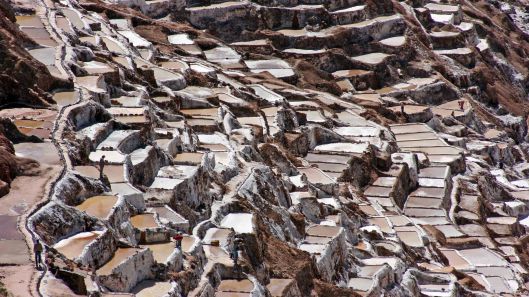
The earliest salt pans are thought to have been constructed by the Wari civilisation, but it was their successors, the Incas, who recognised the commercial opportunities of salt-mining and increased the extent of the pans, which now cover much of a steep gorge that runs down in to the Sacred Valley. The salty water bubbles to the surface in a small spring from ancient salt lakes now buried deep below the earth’s surface, and is ingeniously conveyed down the mountainside via a meandering maze of irrigation channels. People from the local community work constantly to maintain these channels and to ensure just the right amount of water is allowed into each pan before the pan is closed off and allowed to dry out. The sun’s heat evaporates the water, leaving behind a thick coating of salt, which is harvested for sale – and then the whole process starts all over again.


Salineras de Maras is very near the intriguing Inca site of Moray and the wonderful market town of Chincero, so combining a visit to all three makes for a thoroughly enjoyable and interesting day’s excursion from Cusco. Or, if you want to spend a little more time getting a feel for your surroundings, try the hike from Moray through Maras and the salt pans down to the Sacred Valley. It’s well worth the effort.


20 Monday Mar 2017
Posted in insects, nature, nature photography
Tags
British beetles, Oedemera, Oedemera (Oncomera) femoralis, Oedemera femoralis, Swollen-thighed beetle, Thick-legged beetle, Thick-legged flower beetle
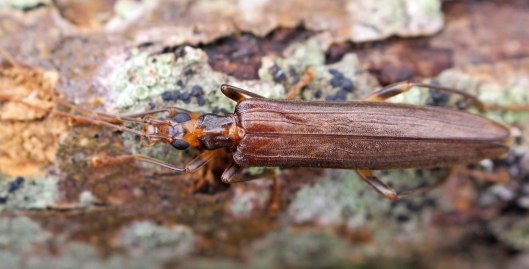
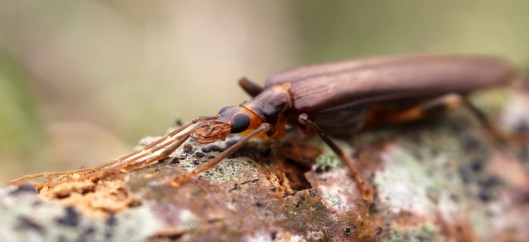
From the kingdom of Animalia, the phylum of Arthropoda, the class Insecta, the order Coleoptera, the family Oedemeridae and the genus Oedemera, may I present my first beetle sighting of 2017 – and a new beetle for me to boot – a stunning example of the species Oedemera (Oncomera) femoralis. There are only 4 species of Oedemera in Britain (here’s another) and only 1 – this one – in the subgenera Oncomera. In layman’s words, she is one of the thick-legged (some people say swollen-thighed) flower beetles and I know it’s a female precisely because she does not have those swollen thighs.


I was lucky to find her as her species is nocturnal, feeding at night on the pollen and nectar of ivy and willow. During the day, they lurk under twigs and branches, which is how I found her, by picking up twigs and branches looking at lichen and searching for slime moulds. These insects grow to between 13 and 20mm long, and can be found in the more southerly counties of England and Wales, though they are not often recorded – there are just 278 recorded sightings in the NBN database (see map above), of which 65 are in Wales. I count myself amongst those fortunate to have seen such a beautiful little creature!
If you’re an insect geek (and I do not use that word disparagingly), you can see the full details of this species on the website of the Watford Coleoptera Group.
17 Friday Mar 2017
Tags
Goethe's Theory of Colours, green, green feathers, green leaves, green plants, green trees, psychology of colours
Happy St Patrick’s Day! It seemed appropriate to honour St Paddy and those from the Emerald Isle with a blast of green today. I think Goethe got the feel of green exactly right in his Theory of Colours:
The eye experiences a distinctly grateful impression from this colour. If the two elementary colours [blue and yellow] are mixed in perfect equality so that neither predominates, the eye and the mind repose on the result of this junction as upon a simple colour. The beholder has neither the wish nor the power to imagine a state beyond it. Hence for rooms to live in constantly, the green colour is most generally selected.
And this is why walking in a forest of green trees, sitting on a grassy lawn, or strolling in a garden all make us feel happy. Now, where did I put that paintbrush?


27 Tuesday Dec 2016
Posted in nature, nature photography
‘Look deep into nature, and then you will understand everything better.’
~ Albert Einstein


20 Monday Jun 2016
Posted in insects, nature, nature photography
Tags
Brimstone moth, Burnet companion, Cathays Cemetery, Cinnabar moth, Euclidia glyphica, moth, Opisthograptis luteolata, Tyria jacobaeae
The day I did my biodiversity hunt at Cathays Cemetery was a bumper day for moths, with three new species spotted.


The first was this beautiful Brimstone (Opisthograptis luteolata), not to be confused with the butterfly of the same name, though both are a mellow buttery yellow. I was flat out on the grass photographing this when a group of young school children passed by. ‘Teacher, what’s that lady doing?’ ‘I don’t know, David’, came the reply, as the teacher quickly ushered her charges past the mad lady lying down in the cemetery!


The Cinnabar moth (Tyria jacobaeae) is a colourful character. It starts out life as a bright orange and black caterpillar, then transforms into a bright red and black moth – it gets its name from the bright red mineral mercury sulphide, also known as cinnabar. The caterpillars can be cannibalistic when their food source is scarce and, though I never saw them there, these moths were introduced to New Zealand in an attempt to control the invasive ragwort plant on which their caterpillars feed.


Last but certainly not least, as I saw several of these in one small area, was the Burnet companion (Euclidia glyphica). It apparently gets its common name from the fact that it’s often seen in the company of Burnet moths – not on this day! I make no excuses for showing its bottom, as the colour of its underside is a rich orange, almost more attractive than its top. Though they were mostly skittish, one very obligingly remained still long enough to get a head-on shot, which I love.
31 Tuesday May 2016
Posted in nature, nature photography
Tags
dragonfly, Four-spotted Chaser, Four-spotted skimmer, Kenfig National Nature Reserve, Libellula quadrimaculata
Last Saturday, at Kenfig National Nature Reserve, on a fungi foray with my friends from the Glamorgan Fungi Club, I saw my first dragonflies for the year, not one but two separate sightings of the Four-spotted Chaser (Libellula quadrimaculata), and what magnificent creatures they were!
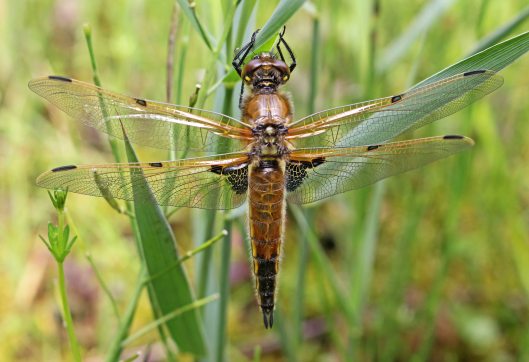
Even if you don’t love dragonflies for the sheer beauty of their aeronautical design, which has remained unchanged for nigh on 300 million years (!), you’ve got to love them for the fact that the adults snack on mosquitoes, gnats and midges. Four-spotted chasers can usually be found from April to September around areas of standing water, typically ponds and small lakes, particularly those with lush vegetation. The males aggressively defend their territories, often favouring a prominent reed or stick near the water’s edge from which to launch their sorties against intruders and their foraging flights. Interesting fact: this dragonfly is the state insect of Alaska, where it’s known as the Four-spotted skimmer.

25 Wednesday May 2016
Posted in birds, nature, nature photography
Tags
American bald eagle, American birds, Bald eagle, birding, birdwatching, Haliaeetus leucocephalus, United States national bird
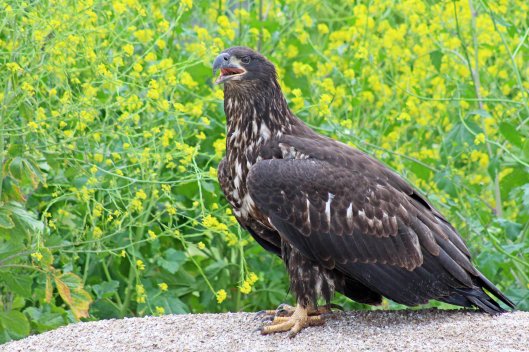
On the very first day of my 2015 visit to the USA, I was privileged to see these magnificent birds, and, over the following week, spent several hours watching them with my friend Trudey.


In 1782 the American Bald Eagle (Haliaeetus leucocephalus) became the official bird emblem of the United States because of its majestic beauty, great strength, long life, and because it’s native to North America. It appears on the Great Seal of the United States, is stamped on the reverse of several American coins, and its image can be found in a multitude of locations, situations and media throughout the United States.
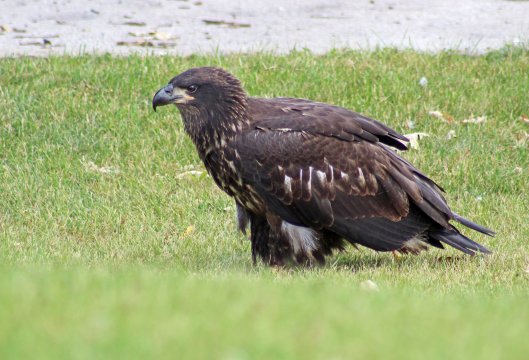
Trudey had been following this particular family from the time the three eaglets were born, about a week apart, in March. By the time I arrived, in mid July, the birds had fledged so were no longer on the nest. Luckily for us though, they were still spending most of their time in the immediate vicinity, in a park alongside the Fox River, in Wisconsin.
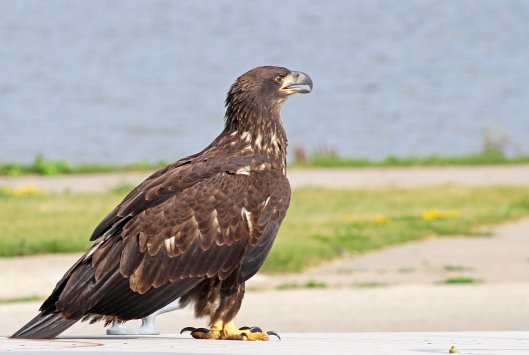
You can read more about these incredible birds on the Cornell Lab of Ornithology website.
18 Wednesday May 2016
Posted in birds, nature, nature photography
For world wildlife Wednesday this week, I thought I’d go back to my roots and show you one of my favourite New Zealand birds.

Called the parson bird by the early European immigrants to New Zealand, presumably because the white tufts of feathers at the front of its neck resemble a priest’s clerical collar, the Tui (Prosthemadera novaeseelandiae) is anything but pious. In fact, it has a habit of imbibing so much nectar from blossoming trees that it becomes quite intoxicated and sings uproariously. Its song is one of its most endearing qualities, highly variable, pleasingly melodic but also including a comprehensive vocabulary of clicks, creaks, cackles and groans.


Beautifully plumaged in shades ranging from iridescent greens and blues through dark browns to an inky black, the Tui has quite a distinctive flight pattern, with louder flapping than most other birds due to its relatively short wide wings. Chances are, then, that if you visit New Zealand, you’ll hear the tui before you see it.


10 Tuesday May 2016
Posted in leaves, nature, nature photography
Tags
Scattered showers peppered the afternoon but I needed some fresh air and exercise so on went the rain jacket and off I went for a stroll around my local park. Here’s what I saw…. Isn’t Mother Nature amazing?


 earthstar
You must be logged in to post a comment.