• ABOUT
  • BIRDING 2018
  • Birding 2019
  • BLOG POSTS
  • Butterflies 2018
  • Resources

earthstar

~ a celebration of nature

earthstar

Category Archives: nature

National Dragonfly Week: Blue-tailed Damselfly

28 Thursday Jul 2016

Posted by sconzani in insects, nature

≈ 2 Comments

Tags

Blue-tailed damselfly, damselflies, damselfly, exuvia, Ischnura elegans, National Dragonfly Week 2016

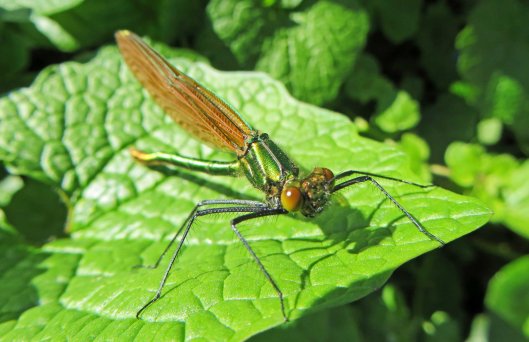
Let’s continue National Dragonfly Week today with a delightful damselfly, the little Blue-tailed (Ischnura elegans), another very common damselfly that can be seen flying throughout Britain from May through to September. Though there is also a Scarce blue-tailed damselfly, it is, well, scarce, so chances are if you see a dark-coloured damsel with that distinctive all-blue segment towards the end of its body, it will be the Blue-tailed damselfly. The females are a little more tricky, as their abdomens and tail spots can be different colours – pink, violet, pale green, pale brown – depending on their type and state of maturity.

160728 blue-tailed (1)

160728 blue-tailed (2)

I don’t have any female photos so thought I would show you, instead, earlier stages in a damselfly’s lifecycle. The eggs the females lay in their local pond, lake, or slow-moving stream or river hatch into nymphs that live in that water, preying on other larvae and small insects. After as little as six months or as long as two years, and having gone through a series of skin moults as their bodies grow in size, the nymphs leave the water and climb a plant stem, branch or tree trunk, where they undergo the ultimate change, emerging from their final skin to fly as an adult.

160728 damsel exuvia
160728 damsel new

As you can see above, they are often very pale when they emerge as it takes them a while to colour up. You can often find the discarded skin cases (known as exuvia) near watery places – I found a tree alongside my local lake that was covered in them.
Like Loading...

Burying its head in the sand?

27 Wednesday Jul 2016

Posted by sconzani in birds, nature

≈ 8 Comments

Tags

burying your head in the sand, ostrich, Serengeti National Park, Tanzania

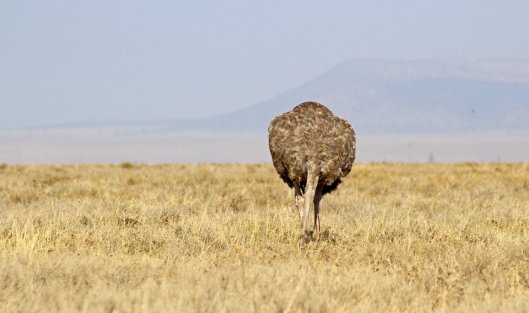
For world wildlife Wednesday this week we have the ostrich, a bird with a reputation for refusing to confront or even acknowledge problems, a reputation that has, over the years, been the subject of many jokes, much derision and a myriad of witty comments.

160727 ostrich (1)

‘Any fool can turn a blind eye but who knows what the ostrich sees in the sand.’ ~ Samuel Beckett, in Murphy

‘The ostrich burying its head in the sand does at any rate wish to convey the impression that its head is the most important part of it.’ ~ Katherine Mansfield

160727 ostrich (2)
160727 ostrich (3)

Of course, ostriches don’t actually bury their heads in the sand or any other substance – they simply lower their heads when feeding and also as part of their complicated mating ritual. The male lowers his head, flaps his wings rather excitedly, and pokes the ground with his bill to try to impress the female, repeating this pattern several times. Eventually, the female will run in a circle around the male and drop to the ground, which is the signal that she’s ready for him. I’m not sure that the female in my photos was very impressed with her male’s wing-flapping, and we didn’t stay long enough to see whether his energetic display proved successful.
160727 ostrich (5)
160727 ostrich (4)
Like Loading...

National Dragonfly Week: Banded Demoiselle

26 Tuesday Jul 2016

Posted by sconzani in insects, nature

≈ 10 Comments

Tags

Banded Demoiselle, Calopteryx splendens, damselflies, damselfy, National Dragonfly Week 2016

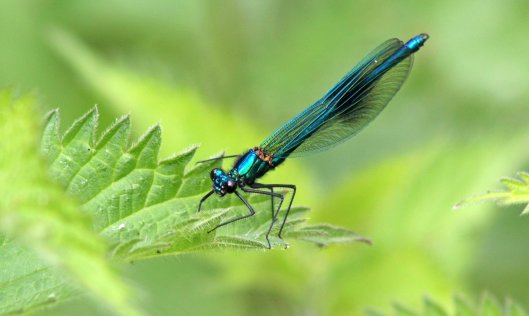
On the first day of National Dragonfly Week I showed you the Beautiful Demoiselle; today we have the other damselfly in the Demoiselle species, the only damselflies in Britain to have coloured wings. This is the Banded Demoiselle (Calopteryx splendens), and you can see immediately from the bands of colour on the males’ wings how it got its common name.

160726 Banded demoiselle male (1)

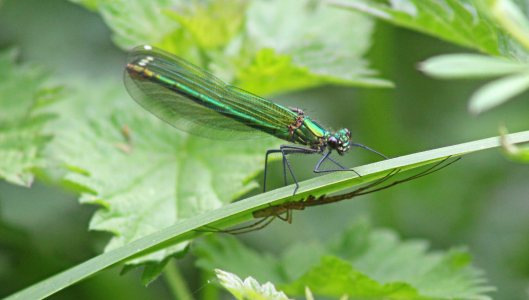
These damselflies are simply gorgeous, the male (above) a stunning metallic blue and the female (below) an equally spectacular metallic green. Common in Wales and all but the northernmost counties of England, they can be seen flying around lakes and ponds and along canals and slow-moving rivers and streams, from late April to early September. Banded Demoiselles are quite sensitive to pollution so their presence is a good sign that the local water source is clean.

160726 Banded demoiselle fem (3)

I wonder if this female knew about the spider, or the spider knew about the damselfly?

The male is territorial and also a bit of a show-off. He performs a delightful display of aeronautic dance moves in his attempts to impress the females – the damselfly version of Patrick Swayze in Dirty Dancing!

160726 Banded demoiselle fem (1)
160726 Banded demoiselle fem (2)
160726 Banded demoiselle male (2)
Like Loading...

National Dragonfly Week: The Common Darter

25 Monday Jul 2016

Posted by sconzani in insects, nature

≈ 3 Comments

Tags

Common Darter, dragonflies, dragonfly, National Dragonfly Week 2016, Sympetrum striolatum

Did you know that the dragonfly is one of the fastest flying insects in the world? The Smithsonian says that, with a speed of 56 kms (35 miles) per hour, it is actually the fastest but other sources say the Horsefly is faster – no wonder I can never escape being bitten by those nasty but beautiful flies! Dragonflies also have amazing manoeuvrability, hovering like helicopters, dive-bombing their prey, and even flying backwards.

160725 (1) Common darter male

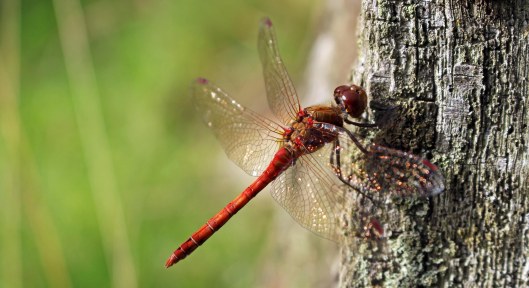
For day three of our celebration of dragon and damselflies, let me introduce you to one of these incredibly speedy dive-bombing hoverers, the Common Darter (Sympetrum striolatum). As their name suggests they are exceedingly common in England and Wales, though they shy away with the colder climes further north, and, yes, they do dart, particularly when pursuing insects to eat. They can appear quite similar to Ruddy Darters, but those dragonflies have a ‘waisted’ abdomen and black legs whereas the Commons have yellow-striped legs.

160725 (2) Common darter imm male

My photos are only of males – they are lighter in colour when immature – and show them in very typical positions, perched on logs, fences, twigs, wires and farm gates while they keep an eye out for passing insects. Though they need the water of ponds, canals, lakes, even ditches to lay their eggs in, they can often be seen away from water. They are not territorial so they do, apparently, assemble in quite large numbers, with ‘groups of several hundred in a single field’ having been recorded and ‘lines of insects … seen along the top of field gates’. Oh to see such a sight!

160725 (3) Common darter male
160725 (4) Common darter imm male
Like Loading...

National Dragonfly Week: Large Red damsel

24 Sunday Jul 2016

Posted by sconzani in insects, nature

≈ 5 Comments

Tags

damselflies, damselfly, Large Red damselfly, National Dragonfly Week 2016, Pyrrhosoma nymphula

For day two of National Dragonfly Week we have another damselfly, the Large Red (Pyrrhosoma nymphula). Of the 20 species of damselfly found in Britain, there are only two that are red and the other, the Small Red, is rare and confined to specific heathland areas, so the chances are that if you see a mainly red damselfly (the females have varying amounts of red and black on their abdomens), it is the Large Red. If only all damselfly identification were so easy!

160724 Large red (1)

The Large Red is one of the first damselflies to appear each spring, flying from early to mid April through to September, and can be found throughout Britain wherever there’s fresh water – ponds, canals, lakes, boggy areas and slow-moving rivers (not fast) – with some vegetation around for it to perch on.

160724 Large red (2)

Mr Large Red can be quite aggressive, buzzing other males foolish enough to invade his territory. When they mate, the male clamps on to the female just behind her head, as you can see in my photo above, and she would normally then bend her body around to attach to his reproductive organs, thus forming the ‘mating wheel’. Maybe this female just wasn’t that into him!

160724 Large red (3)
160724 Large red (4)
Like Loading...

National Dragonfly Week: Beautiful Demoiselle

23 Saturday Jul 2016

Posted by sconzani in insects, nature

≈ 6 Comments

Tags

Beautiful Demoiselle, British Dragonfly Society, Calopteryx Virgo, damselfly, dragonflies, dragonfly, National Dragonfly Week 2016

Back at the end of April I wrote about my first dragonfly sighting of the year – only it turned out to be a damselfly, not a dragonfly, and I blogged about my first lesson in telling the two families apart. That gorgeous creature was a female of the very aptly named Beautiful Demoiselle (Calopteryx Virgo) species. Since then I’ve been lucky enough to see many more Beautiful Demoiselles, including the equally handsome metallic blue-green male of the species. I’ve also seen many other types of damselflies and some, though not as many, dragonflies (the 4-spotted chaser featured in one blog, and the Broad-bodied chaser in another).

160723 damsel Beautiful Demoiselle female

You may not know it but today is the first day of National Dragonfly Week 2016, which this year runs from Saturday 23rd to Sunday 31st July. It’s the brainchild of the British Dragonfly Society, which exists to record dragonfly numbers and to educate people about dragonflies and their habitats in order to aid with their conservation. The society and other wildlife groups will be holding events throughout the week to raise awareness of damsel and dragonflies – you can see more on the BDS website – and I will be highlighting a different species each day this week as my own way of celebrating these heavenly creatures.

160723 damsel Beautiful Demoiselle male

Like Loading...

Flowers on Friday

22 Friday Jul 2016

Posted by sconzani in flowers, nature

≈ 12 Comments

Tags

Bute Park, Field scabious, poppy, wildflowers

We have a mixture of genuinely wild and cultivated wildflowers today, a selection from those I saw on my afternoon walk around Cardiff’s magnificent Bute Park, from the vibrant red of the poppy to the bluey-purples of the Field scabious that were abuzz with bees. Here’s wishing you all a flower-full weekend!

160722 flowers (7)
160722 flowers (3)
160722 flowers (9)
160722 flowers (11)
160722 flowers (6)
160722 flowers (4)
160722 flowers (1)
160722 flowers (5)
160722 flowers (2)
160722 flowers (8)
160722 flowers (10)
Like Loading...

Innominate flies

21 Thursday Jul 2016

Posted by sconzani in insects, nature

≈ 4 Comments

Tags

diptera, flies, fly, fly quotations, quotes about flies

Flies may not be everybody’s favourite mini-beasties but they come in amazing colours and patterns, and you might be surprised how many famous people have mentioned them in their quotations.

160720 flies (1)

‘A closed mouth catches no flies.’ ~ Miguel de Cervantes

160720 flies (2)

‘As flies to wanton boys, are we to the gods; they kill us for their sport.’ ~ William Shakespeare

160720 flies (3)

‘Laws are spider webs through which the big flies pass and the little ones get caught.’ ~ Honore de Balzac

160720 flies (4)

‘A spoonful of honey will catch more flies than a gallon of vinegar.’ ~ Benjamin Franklin

160720 flies (5)

‘Flies, worms, and flowers exceed me still.’ ~ Isaac Watts

Like Loading...

The slippery tale of the eel and the cormorant

20 Wednesday Jul 2016

Posted by sconzani in birds, fish, nature

≈ 15 Comments

Tags

Cormorant, eel, struggle between cormorant and eel

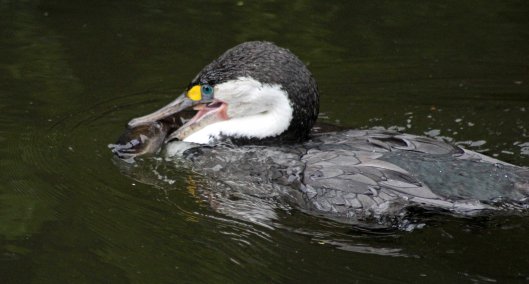
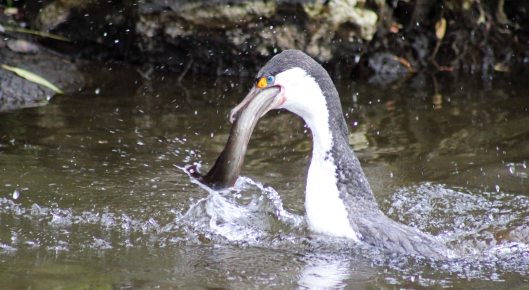
Once upon a time there was a very lazy cormorant that lived on a big lake in a large city. It often couldn’t be bothered looking for food and on this particular day it hadn’t eaten anything for a few days so its tummy was rumbling. It looked around the lake to see what might make the most delicious lunch for the least amount of effort.

160719 eel cormorant (1)

Just at that very moment a huge eel came slithering past and the cormorant thought, ‘Aha! What a tasty lunch that would be, and that eel is so big I wouldn’t have to eat again for several days.’ The cormorant grabbed the eel with its long strong beak and opened its mouth as wide as it possibly could – and, if you’ve ever seen a cormorant open its mouth, you’ll know that’s pretty wide!

160719 eel cormorant (2)

Down, down, down its throat slithered the eel.

160719 eel cormorant (3)

But the cormorant’s tummy wasn’t big enough to fit such an enormous meal and, of course, the eel didn’t want to die. It had a lot more lake-slithering to do. So, it wiggled and wriggled and slid back out of the cormorant’s mouth.

160719 eel cormorant (4)

Of course, the cormorant didn’t want to let such a lovely big lunch get away, so it tried again. Gulp, gulp, gulp, down went the eel. Wiggle, wriggle, wiggle, out slid the eel.

160719 eel cormorant (5)

It was a mighty struggle between two very determined opponents and it went on for at least half an hour but, eventually, because the comorant was so lazy and hadn’t eaten for a few days, it ran out of energy. Off swam the eel, relieved and happy to have escaped the cormorant’s lunch menu!

160719 eel cormorant (6)

Like Loading...

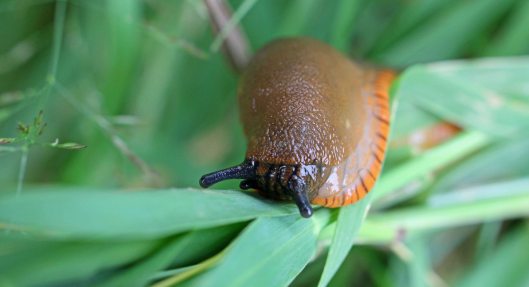
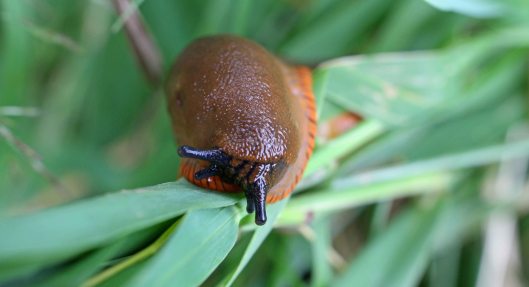
A Large red slug

19 Tuesday Jul 2016

Posted by sconzani in nature, slugs

≈ 9 Comments

Tags

Arion rufus, Chocolate arion, European red slug, Large red slug, mollusc, Red slug

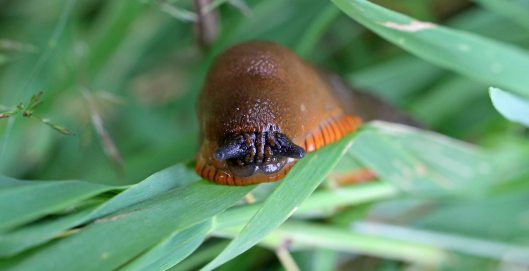
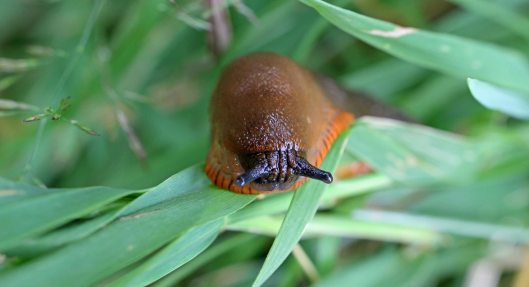
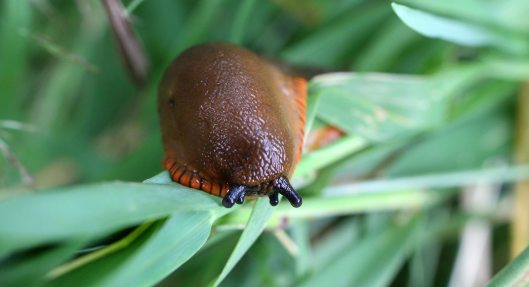
Gardeners will look at these pictures and want to squash this not-so-little critter or, if they’re feeling kindly, drown it in beer – what a way to die! – whereas when I found this slug, I thought ‘Wo, what a wonderful looking creature you are!’

160718 large red slug (1)

Having been a gardener and lost many a cherished seedling to the ravages of my slug’s cousins, I can certainly sympathise with their need to destroy all slugs.

160718 large red slug (2)

And, perhaps if I still had a garden, I might have been tempted. But even then, I don’t know. I mean it’s just so cute.

160718 large red slug (3)

Look at that pretty orange-and-black-striped skirt! Look at that dimpled brow!

160718 large red slug (4)

And when it began to poke out its little tendrils / eyes and waved them at me, I was lost.

160718 large red slug (5)

This is probably Arion rufus, commonly known as the Red slug, the Large red slug, the Chocolate arion or the European red slug.

160718 large red slug (6)

Like Loading...
← Older posts
Newer posts →

About me

sconzani

sconzani

I'm a writer and photographer; researcher and blogger; birder and nature lover; countryside rambler and city strider; volunteer and biodiversity recorder.

View Full Profile →

Follow earthstar on WordPress.com

Enter your email address to follow this blog and receive notifications of new posts by email.

Recent blog posts

  • Nesting material April 28, 2026
  • Lifer: Box bug April 27, 2026
  • Peak Wild garlic April 26, 2026
  • First damsels of 2026 April 25, 2026
  • NFY: Green-veined white April 24, 2026

From the archives

COPYRIGHT

Unless otherwise acknowledged, the text and photographs on this blog are my own and are subject to international copyright. Nothing may be downloaded or copied without my permission.

Fellow Earth Stars!

  • Unknown's avatar
  • Unknown's avatar
  • Unknown's avatar
  • Unknown's avatar
  • Unknown's avatar
  • Unknown's avatar
  • Unknown's avatar
  • Unknown's avatar
  • Unknown's avatar
  • Unknown's avatar
  • Unknown's avatar
  • Unknown's avatar
  • Unknown's avatar
  • Unknown's avatar
  • Unknown's avatar
  • Unknown's avatar
  • Unknown's avatar
  • Unknown's avatar
  • Unknown's avatar
  • Unknown's avatar
  • Unknown's avatar
  • Unknown's avatar
  • Unknown's avatar
  • Unknown's avatar
  • Unknown's avatar
  • Unknown's avatar
  • Unknown's avatar
  • Unknown's avatar
  • Unknown's avatar
  • Unknown's avatar
  • Unknown's avatar
  • Unknown's avatar
  • Unknown's avatar
  • Unknown's avatar
  • Unknown's avatar
  • Unknown's avatar
  • Unknown's avatar
  • Unknown's avatar
  • Unknown's avatar
  • Unknown's avatar
  • Unknown's avatar
  • Unknown's avatar
  • Unknown's avatar
  • Unknown's avatar
  • Unknown's avatar
  • Unknown's avatar
  • Unknown's avatar
  • Unknown's avatar
  • Unknown's avatar
  • Unknown's avatar

Blog at WordPress.com.

Privacy & Cookies: This site uses cookies. By continuing to use this website, you agree to their use.
To find out more, including how to control cookies, see here: Cookie Policy
  • Subscribe Subscribed
    • earthstar
    • Join 642 other subscribers
    • Already have a WordPress.com account? Log in now.
    • earthstar
    • Subscribe Subscribed
    • Sign up
    • Log in
    • Report this content
    • View site in Reader
    • Manage subscriptions
    • Collapse this bar

Loading Comments...

You must be logged in to post a comment.

    %d