• ABOUT
  • BIRDING 2018
  • Birding 2019
  • BLOG POSTS
  • Butterflies 2018
  • Resources

earthstar

~ a celebration of nature

earthstar

Category Archives: nature

‘Blue velvet on a stick’

29 Monday Feb 2016

Posted by sconzani in fungi, nature

≈ 7 Comments

Tags

Cobalt crust, fungus, Terana caerulea

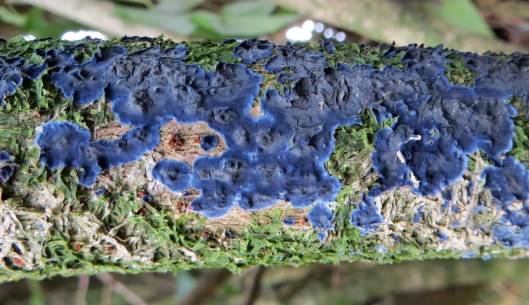
Although this stunning fungus is apparently found in my native New Zealand – as well as in much of Europe, North America and some countries in Asia, I had never seen it until a few weeks ago. This is the appropriately named Cobalt crust (Terana caerulea), a fungus many books and websites report as a rare sight in England and Wales yet many of my fungi friends have seen it. We assume it is not actually rare but rather rarely reported or, perhaps, not recognised, as it is often to be found lurking on the undersides of fallen branches and dead trees, and it turns almost black when past its best.
Terana caerulea Cobalt crust (1)

When it’s young and fresh, its vibrant cobalt colour is instantly recognisable and a real highlight of any woodland wander. With a soft, almost waxy feel when moist, it’s no wonder it’s been described as ‘blue velvet on a stick’. As its name implies, this fungus is a member of the corticiord group of fungi – that’s crust fungi in layman’s terms, a fungus that adheres to something, rather than growing on a stem like a normal mushroom.

Terana caerulea Cobalt Crust (2)

Like Loading...

Great Crested Grebe

28 Sunday Feb 2016

Posted by sconzani in birds, nature, nature photography, spring

≈ 5 Comments

Tags

birding, birds, birdwatching, British birds, Great Crested Grebe

160228 great crested grebe (1)

I’m always delighted to witness the mating display of the Great Crested Grebe (Podiceps cristatus). They make a rather noisy but thoroughly entertaining exhibition of head shaking and neck swaying and bill touching that is a joy to watch, especially with their vibrant neck plumage highlighting their every move. It comes as no surprise that those pretty plumes were once prized by early Victorian milliners to decorate their more extravagant creations. That usage, and the fact that the fine soft feathering on the bird’s body was also valued for costume adornment, meant the Great Crested Grebe was one of Britain’s rarest breeding species by the mid-1800s.

160228 great crested grebe (2)

Luckily, laws were enacted to protect Britain’s water birds but their recovery can also be attributed to mankind’s activities – and not in the way you might imagine. The massive increases in both road building and house building following the Second World War required enormous amounts of gravel, and the grebe was one of the birds that benefitted from the gravel pits once they had been abandoned and filled with water. It’s a fitting testament to how well nature can recover from man’s interference in the landscape.

160228 great crested grebe (3)

The highlight of today’s long walk was to witness a grebe sitting on a nest. It seems very early in the year and the nest was in rather an exposed position so I do hope the bird doesn’t get disturbed. It was wonderful and, indeed, a huge privilege to see the results of all that head shaking and neck swaying!

Like Loading...

Walk like an Egyptian

27 Saturday Feb 2016

Posted by sconzani in birds, nature, nature photography

≈ 5 Comments

Tags

African birds, Alopochen aegypticus, birding, birds, birdwatching, British birds, Egyptian Goose, Serengeti National Park, Tanzania

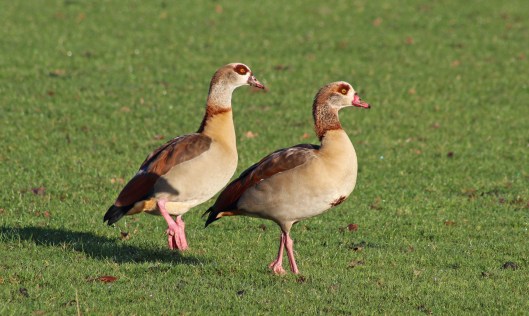
It might look like a goose and be called a goose but the Egyptian Goose (Alopochen aegypticus) is not really a goose at all. It’s more closely related to the Shelduck and occasionally shares that duck’s habit of nesting in a burrow or hole in the ground, though it has also been known to build a nest as high as 80 feet above the ground in a tree. The bird was introduced to Britain as an ornamental wildfowl species, for the king’s collection of birds in St James’s Park in London in 1678, but has since established itself in the wild, though it does still have a penchant for the grounds of large halls and estates, with their perfect habitat combination of old woodland and extensive areas of water.

160227 egyptian goose (2)

My first photo here was taken at just such a place, the wonderful Tatton Park Estate, near Knutsford in Cheshire. But the second photo was taken in the Serengeti National Park in Tanzania. Although it’s called an Egyptian Goose, it is actually native to Africa south of the Sahara and the Nile Valley, but it was considered sacred by the ancient Egyptians, which I presume is how it got its common name.

160227 egyptian goose (1)

Like Loading...

Coltsfoot for your cough?

26 Friday Feb 2016

Posted by sconzani in nature, nature photography, wildflowers

≈ 4 Comments

Tags

Coltsfoot, spring, spring flowers

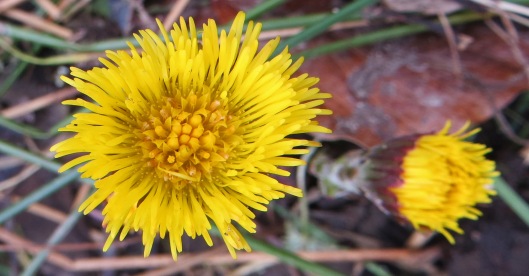
I saw my first coltsfoot in bloom this week. Though it looks a little like a dandelion, coltsfoot (Tussilago farfara) is actually a member of the sunflower family. It is favoured by herbalists as its leaves and flowers apparently make an effective cough remedy – the scientific name tussilago comes from the Latin tussis, which means cough, and ago, which means to act on. However, coltsfoot has been found to cause problems with the liver so long-term constant use is probably not wise.

coltsfoot (7)

This is another wildflower with a multitude of common names including, not surprisingly, coughwort, but also tash plant, ass’s foot, bull’s foot, foal’s foot, foalswort, and horse foot. Apparently, all those references to ‘foot’ result from the fact that the leaves are a similar shape to animal hooves, though I haven’t yet seen the leaves myself – they don’t appear until the flower has set its seed.

coltfoot (2)

In Britain, there is also a confection called Coltsfoot Rock, made exclusively by Stockley’s Sweets, in Oswaldtwistle, in Lancashire. Though its exact recipe is secret, this rock candy is flavoured using the leaves of coltsfoot. I wonder if any of my readers can tell us what it tastes like.

coltsfoot (5)
coltsfoot (8)
Like Loading...

Ancient oak in Brynna Woods

25 Thursday Feb 2016

Posted by sconzani in nature, nature photography, trees

≈ 6 Comments

Tags

Ancient Oak, ancient tree, Brynna Woods

160225 brynna ancient oak (4)

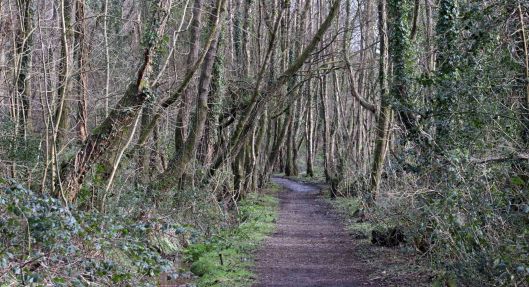
Brynna Woods was once a busy coal-mining area, with up to three shafts operating and as many as 400 men toiling underground, a tramway trundling away coal and spoil, coke ovens carbonising coal, and an engine house belching out smoke. Fortunately for today’s visitors, those processes had all ceased by 1934 and the woodland has been allowed to regenerate, becoming a tranquil area for walking and wildlife watching.

160225 brynna ancient oak (2)
160225 brynna ancient oak (3)

Adjacent to the main trail in the woods there sits an old man of the forest, the aptly named Ancient Oak. Its actually age is the subject of much speculation – some say it’s 400 years old, I read in a Cardiff Naturalists’ newsletter that it’s 300, and was told by a local that it’s more likely 250 years old. And there is also speculation about whether it is one single tree or two trees that have grown together. Certainly, when you look at its trunk, you can see where the two-tree theory arose as there is a dark line of vertical bark seemingly separating the two halves of the tree. Whatever the truth, it is a stately representative of nature’s majesty that deserves to be cherished and admired and protected for future generations to enjoy.

160225 brynna ancient oak (1)

Like Loading...

The lovely Lesser Celandine

24 Wednesday Feb 2016

Posted by sconzani in nature, nature photography, plants, wildflowers

≈ 4 Comments

Tags

Lesser Celandine, Ranunculus ficaria, William Wordsworth

160224 lesser celandine (3)

Everyone associates poet extraordinaire William Wordsworth with daffodils – ‘I wandered lonely as a cloud …’ – but Wordsworth’s favourite flower was, in fact, the Lesser Celandine (Ranunculus ficaria), as witnessed by the bloom carved on his memorial plaque at the Church of St Oswald in Grasmere. As I wandered through woodlands and along river banks today, feeling not the slightest bit lonely, I saw a lot of this pretty flower. Along with the primroses and daffodils, it’s another of the yellow wildflowers that is both charming and uplifting at this time of year.

160224 lesser celandine (1)

I’m not sure what ailments Wordsworth suffered from but perhaps he favoured the Lesser Celandine because it has long been considered a treatment for haemorrhoids, hence its old English name of Pilewort. According to the Ancient Greek physician Galen, sniffing a mixture of the juice of the roots with honey was also good for clearing the head of ‘foul and filthy humours’, though I wouldn’t recommend sniffing anything that also cured piles!

160224 lesser celandine (2)

Like Loading...

White- & brown-headed black-headed gulls

23 Tuesday Feb 2016

Posted by sconzani in birds, nature, nature photography

≈ 4 Comments

Tags

birding, birds, birdwatching, black-headed gulls, British birds

160223 black headed gull

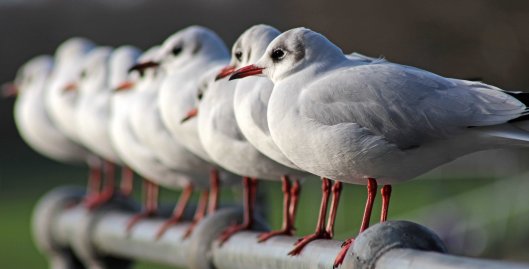
The scientific name for the black-headed gull is Chroicocephalus ridibundus: Chroicocephalus is a combination of the Greek choria meaning colour and cephalus meaning head, and ridibundus is derived from the Latin ridere which means laugh. So, its head colour is laughable?

Well, someone was certainly having a laugh when they named it the black-headed gull. In the summertime – or, to be more precise, during the breeding season, its head may look black but is actually a dark chocolate brown. At the end of the breeding season, the feathers moult, leaving the bird’s head almost completely white, except for two small dark patches behind the eyes on either side of its head.

Along with many other things in the natural world, these gulls are confused by this year’s mild winter weather and have begun their change to breeding plumage. These photos, taken over the last couple of weeks, show that change.

160223 black headed gull (1)
160223 black headed gull (2)
160223 black headed gull (3)
160223 black headed gull (4)
160223 black headed gull (5)
160223 black headed gull (6)
160223 black headed gull (7)
160223 black headed gull (8)
160223 black headed gull (9)
160223 black headed gull (10)
Like Loading...

Secret writing on trees

22 Monday Feb 2016

Posted by sconzani in lichen, nature, nature photography

≈ Leave a comment

Tags

fungi, Graphis scripta, lichenised fungi

One way to get kids interested in lichen is to ask them to find the secret writing on woodland trees. The ‘writing’ is made by a lichen, Graphis scripta, which forms long narrow wiggledy black fruiting bodies (apothecia) on its pale smooth crust.

160219 graphis scripta (1)

Not surprisingly, this lichen’s common names include script lichen, secret writing lichen, pencil-mark lichen, or hieroglyphics lichen. It is very common on smooth-barked deciduous trees, their twigs and branches, and can be found around the world – does the writing change its language depending on location, I wonder?

160219 graphis scripta

Lichens are very sensitive to air quality and, as they are able to accumulate and retain heavy metals, they are often used as a tool to monitor heavy metal pollutants in the atmosphere. Graphis scripta has been utilised in this way by scientists studying air pollution in the Indian city of Bangalore.

Like Loading...

Leucism in birds

21 Sunday Feb 2016

Posted by sconzani in birds, nature, nature photography

≈ 8 Comments

Tags

birding, birds, birdwatching, blackbird, British birds, crow, jackdaw, leucism, leucistic jackdaw

Little did I realise that I was stepping into a definition minefield when, after finding an oddly coloured jackdaw earlier this week, I decided to find out more about leucism. The word is a relatively new one – it isn’t, for example, included in the online Oxford Dictionary, and scientists seem to disagree about its actual meaning and about what causes the condition.

160221 leucism crow

a leucistic crow. It had more white patches not visible in this photo.

One source says the plumage of leucistic birds is pale or washed out though the normal pattern and colour is discernible, another reports that the cells of the affected plumage lack the ability to produce melanin and the lack of melanin produces white feathers, and yet another states that leucism is caused by a reduction in several types of pigment, not just melanin. The researchers at Cornell Lab of Ornithology even devoted a whole web page to citing the literature of disagreement.

160221 leucism blackbird

Leucism is very common in blackbirds. This bird only has very small white patches.

So, rightly or wrongly and very simply, I’m defining my leucistic birds as those whose feathers would normally be black or some other colour but are actually white (but they’re not albino, as they have their normal eye colour). And here they are …

160221 leucism jackdaw (2)

The star of the show – a beautiful leucistic jackdaw

160221 leucism jackdaw (1)

Like Loading...

‘Camellias shining bright’

20 Saturday Feb 2016

Posted by sconzani in flowers, nature, nature photography

≈ 4 Comments

Tags

Bute Park, camellia, Honoré de Balzac, The Camellia

160220 camellia (4)

‘The Camellia’ by Honoré de Balzac
~ from an English translation of his novel Eugénie Grandet

In Nature’s poem flowers have each their word
The rose of love and beauty sings alone;
The violet’s soul exhales in tenderest tone;
The lily’s one pure simple note is heard.
The cold Camellia only, stiff and white,
Rose without perfume, lily without grace,
When chilling winter shows his icy face,
Blooms for a world that vainly seeks delight.
Yet, in a theatre, or ball-room light,
With alabaster petals opening fair,
I gladly see Camellias shining bright
Above some stately woman’s raven hair,
Whose noble form fulfils the heart’s desire,
Like Grecian marbles warmed by Phidian fire.

160220 camellia (3)

These are just a small selection of the many lovely varieties of camellia blooming in Bute Park here in Cardiff. Unlike the ‘stiff and white’ camellia of de Balzac’s poem, their wonderfully delicate hues range from the purest white through to a deep blushing pink. They have such beautiful flowers that it’s easy to see why the camellia is considered a symbol of good luck and used as an offering to the gods during Chinese New Year celebrations.

160220 camellia (2)160220 camellia (5)160220 camellia (1)

Like Loading...
← Older posts
Newer posts →

About me

sconzani

sconzani

I'm a writer and photographer; researcher and blogger; birder and nature lover; countryside rambler and city strider; volunteer and biodiversity recorder.

View Full Profile →

Follow earthstar on WordPress.com

Enter your email address to follow this blog and receive notifications of new posts by email.

Recent blog posts

  • Blood bees April 29, 2026
  • Nesting material April 28, 2026
  • Lifer: Box bug April 27, 2026
  • Peak Wild garlic April 26, 2026
  • First damsels of 2026 April 25, 2026

From the archives

COPYRIGHT

Unless otherwise acknowledged, the text and photographs on this blog are my own and are subject to international copyright. Nothing may be downloaded or copied without my permission.

Fellow Earth Stars!

  • Unknown's avatar
  • Unknown's avatar
  • Unknown's avatar
  • Unknown's avatar
  • Unknown's avatar
  • Unknown's avatar
  • Unknown's avatar
  • Unknown's avatar
  • Unknown's avatar
  • Unknown's avatar
  • Unknown's avatar
  • Unknown's avatar
  • Unknown's avatar
  • Unknown's avatar
  • Unknown's avatar
  • Unknown's avatar
  • Unknown's avatar
  • Unknown's avatar
  • Unknown's avatar
  • Unknown's avatar
  • Unknown's avatar
  • Unknown's avatar
  • Unknown's avatar
  • Unknown's avatar
  • Unknown's avatar
  • Unknown's avatar
  • Unknown's avatar
  • Unknown's avatar
  • Unknown's avatar
  • Unknown's avatar
  • Unknown's avatar
  • Unknown's avatar
  • Unknown's avatar
  • Unknown's avatar
  • Unknown's avatar
  • Unknown's avatar
  • Unknown's avatar
  • Unknown's avatar
  • Unknown's avatar
  • Unknown's avatar
  • Unknown's avatar
  • Unknown's avatar
  • Unknown's avatar
  • Unknown's avatar
  • Unknown's avatar
  • Unknown's avatar
  • Unknown's avatar
  • Unknown's avatar
  • Unknown's avatar
  • Unknown's avatar

Blog at WordPress.com.

Privacy & Cookies: This site uses cookies. By continuing to use this website, you agree to their use.
To find out more, including how to control cookies, see here: Cookie Policy
  • Subscribe Subscribed
    • earthstar
    • Join 642 other subscribers
    • Already have a WordPress.com account? Log in now.
    • earthstar
    • Subscribe Subscribed
    • Sign up
    • Log in
    • Report this content
    • View site in Reader
    • Manage subscriptions
    • Collapse this bar

Loading Comments...

You must be logged in to post a comment.

    %d