• ABOUT
  • BIRDING 2018
  • Birding 2019
  • BLOG POSTS
  • Butterflies 2018
  • Resources

earthstar

~ a celebration of nature

earthstar

Category Archives: nature

Slater, woodlouse or chiggy pig?

10 Sunday Jan 2016

Posted by sconzani in insects, nature, nature photography

≈ Leave a comment

Tags

cemetery, crustaceans, insects, slater, woodlouse

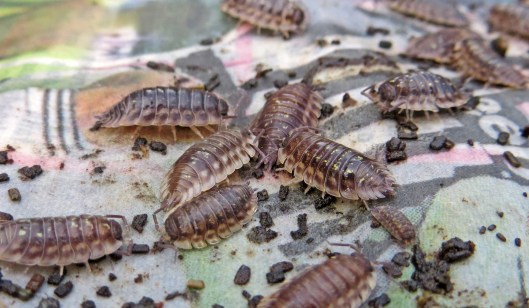
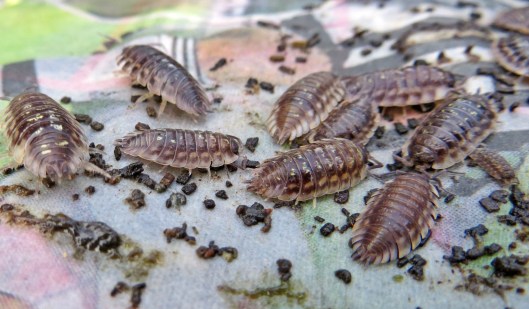
As I was walking through my local cemetery today, I spotted a very thick, very wet newspaper lying on a fallen tree and I simply couldn’t resist taking a peek underneath. These are what I found, Common shiny woodlice (Oniscus asellus), one of the 45 (yes, 45!) native or naturalised species of woodlice in Britain.
160110 woodlice (1)

Did you know:

  • A woodlouse has fourteen jointed limbs, and breathes using lungs in its rear legs.
  • Although it’s a crustacean (like the oh-so-tasty lobsters and crabs), a woodlouse tastes like strong urine. I wonder who the crazy person was who discovered that interesting fact!
  • Just like earthworms, woodlice are good for the garden because they produce compost, aerate the soil and help control pests.
  • Woodlice prefer damp places because they lose a lot of moisture through excretion (plenty of evidence of that to be seen in my photos!).
  • In New Zealand it’s called a slater; in Reading, England it’s a cheeselog; in Devon it’s a chiggy pig; and in Cornwall it goes by the name of gramersow. Do you have a special name for this little critter? Let me know in the comments below.
160110 woodlice (2)

Like Loading...

The cute little tufties

09 Saturday Jan 2016

Posted by sconzani in birds, nature, nature photography

≈ 1 Comment

Tags

birding, birds, birdwatching, British birds, Tufted duck

160109 tuffted duck (3)

Every time I walk around my local lake these charming little ducks delight me as they dive to feed on the roots, seeds and buds of aquatic plants, clams and snails, aquatic insects and sometimes amphibians and small fish. Until 150 years ago, they were only winter visitors but the resident population of the Tufted Duck (Aythya fuligula) expanded rapidly during the late 19th and early 20th centuries due to the colonisation of British waterways by the small freshwater bivalve, the Zebra Mussel.
 160109 tuffted duck (2)

I particularly love their floppy little top-knot and it’s easy to see how they got their common name but, like most British birds, they’ve gained a wide variety of other vernacular names: black curre, black poker, black topping duck, black wigeon, doucker, douver, crested diver and magpie diver. Those last two seem particularly appropriate given their tufts and colours. However, though the males may look black and white, when you see them in the sunlight you soon realise their plumage has a range of colours, from brown and green to purple. And, personally, I think there’s something slightly demonic about that bright yellow eye, particularly in the male, where the colour contrast is greater.

160109 tuffted duck (1)

Like Loading...

Old Man’s Beard

08 Friday Jan 2016

Posted by sconzani in nature, nature photography, plants

≈ Leave a comment

Tags

clematis vitalba, Old Man's Beard, seeds, Traveller's joy, winter garden

If I were still living in New Zealand, I would be horrified to see this plant, Clematis vitalba. It’s a British native that was introduced as a garden plant but it very quickly escaped into forest areas where, in the temperate climate, its vigorous growth quickly smothers native plants. Unsurprisingly, it has been outlawed and is listed on the National Pest Plant Accord.

160108 clematis vitalba old mans beard (1)

Here in Britain, though, I can enjoy the silky plumed seed heads that make such a pretty show at this time of year. It’s easy to see how they led to its common name of Old Man’s Beard, but this clematis has many other vernacular names, including traveller’s joy, virgin’s bower, ladies’ bower, love vine, and traveller’s ivy. In the south-east of England it is also known as Boy’s Bacca and Shepherd’s Delight because poorer country folk once used the dry stems as a tobacco substitute.

160108 clematis vitalba old mans beard (2)

In France, its common name is herbe aux gueux, the beggar’s herb because, in times past, beggars would make use of its toxic sap to purposefully irritate their skin in order to provoke sympathetic donations from passers by. All parts of this clematis are poisonous so look but don’t touch!

Like Loading...

The Jelly ear

07 Thursday Jan 2016

Posted by sconzani in fungi, nature, nature photography

≈ 1 Comment

Tags

fungi, fungus, Jelly ear

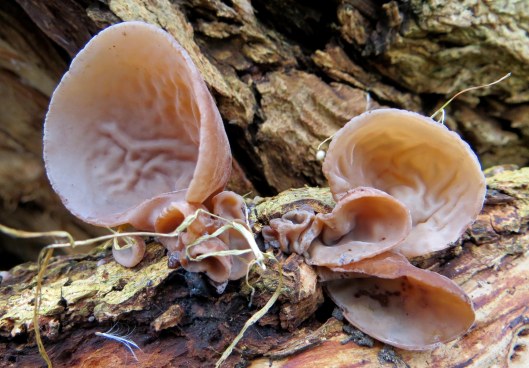
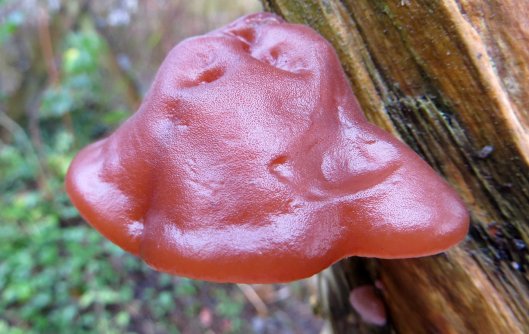
Who needs 3-D printers to produce replacement human body parts when you could use a fungus instead? Not exactly a practical solution to gaining a new ear I admit but, you have to agree, this fungus is definitely the right shape, if not the ideal colour or texture.

Auricularia auricula-judae Jelly Ear

The Jelly ear (Latin name Auricularia auricular-judae) can be rather gelatinous, hence its common name. It is a very common and easily recognisable fungus that grows on standing and fallen dead broadleaf trees, in parks and gardens and forest areas. It can reach up to 100mm across, though its shape becomes more contorted and undulating as it ages. In my native New Zealand, the Jelly ear was of considerable economic importance around the turn of the 20th century when large quantities were exported to China for food.

Auricularia auricula-judae Jelly Ear (1)

Jelly ears can often be found growing on the elder tree and it seems the fungus got its original common name of Judas’s Ear from the belief that Judas Iscariot hung himself from an elder tree. Over time, the epithet Judas’s Ear changed to Jew’s Ear, though in these days of political correctness, that epithet is rarely used.

160107 jelly ear (2)

Like Loading...

The early bird

06 Wednesday Jan 2016

Posted by sconzani in birds, nature, nature photography

≈ 4 Comments

Tags

birding, birds, birdwatching, British birds, proverb, Song thrush, thrush, worm

… catches the worm!

160106 song thrush (1)160106 song thrush (2)160106 song thrush (3)160106 song thrush (4)

Like Loading...

It’s ivy berry time

05 Tuesday Jan 2016

Posted by sconzani in birds, insects, nature, nature photography, winter

≈ Leave a comment

Tags

berries, birds, ivy, winter

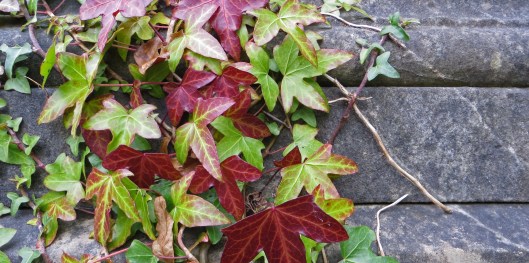
Though its roots can creep between gaps in stonework causing severe damage to ancient ruins, stone walls, grave monuments and the like, ivy (Hedera helix, also known as English ivy, common ivy or just plain ivy) is of great importance to wildlife. Not only does it provide shelter and nesting places for insects, birds, bats and other beasties, it is also an important food source.

english ivy 1

Ivy’s flowering period begins in August and continues right through to November, sometimes later, and the flowers produce plentiful quantities of nectar and pollen. Over 70 species of nectar-loving insects feast on the flowers, including wasps and bumblebees, Red admiral, Small tortoiseshell and Peacock butterflies.

English ivy

Once the berries begin to ripen, they turn a deep purple-black colour, and provide an important winter source of food when most other berries are finished. At this time, the ivy becomes a favourite snacking place for lots of berry-eating birds, blackbirds and thrushes in particular, but also starlings and jays, finches and wood pigeons.

english ivy 2

Like Loading...

Elfcups and Fairies’ baths

04 Monday Jan 2016

Posted by sconzani in fungi, nature, nature photography

≈ 10 Comments

Tags

Elfcups, fungi, fungus, winter

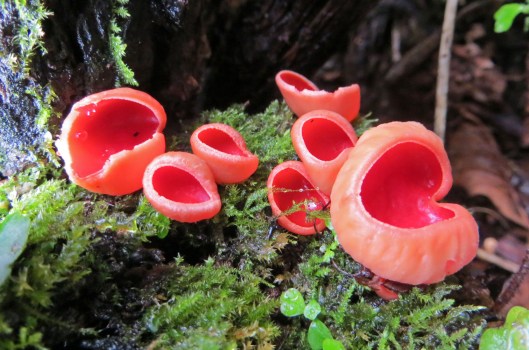
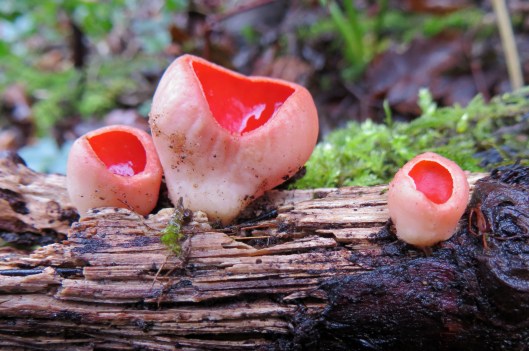
Just as the Scarlet waxcaps are the jewels of the autumn meadows so the Elfcups are the jewels of the wet winter woodlands. Though they’re tiny (no more than 7cm across) and frequently half buried in moss, their eye-catching bright red colour makes them easy to spot in the damp shady places where they live on dead wood, particularly beech, hazel, hawthorn, willow and elm.

160104 elfcups (3)

Two Elfcups can be found in Britain – the Scarlet Elfcup (Sarcoscypha austriaca) and the Ruby Elfcup (Sarcoscypha coccinea). They are so similar in outward appearance that a microscope is required to distinguish between them and, even then, it’s not easy. With a goblet-shaped cup and short stem when young, which flattens into a cup shape as they mature, it’s not difficult to see where they got the name Elfcup, nor their other common name of Fairies’ Baths.

160104 elfcups (1)

In fact, that ‘bath’ is where the spores can be found. These fungi don’t drop their spores from gills like regular mushrooms; instead, they fire spores from structures called asci, a bit like a cannon fires cannon balls and, apparently, they make a tiny puffing sound when that happens. So, listen closely next time you see them.

160104 elfcups (2)

Like Loading...

Pochard perfection

03 Sunday Jan 2016

Posted by sconzani in birds, nature, nature photography

≈ 3 Comments

Tags

birding, birds, birdwatching, British birds, Pochard

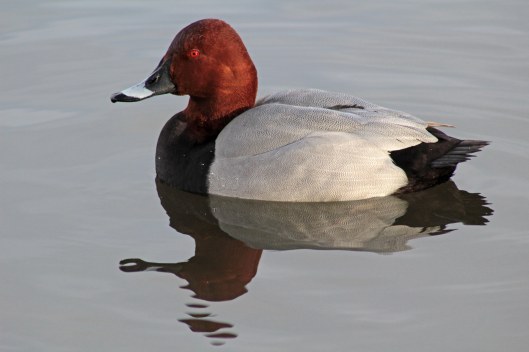
As soon as I spotted his bright chestnut-coloured head I knew this was a Pochard (Aythya ferina). Though this was a first-ever sighting for me today, on Roath Park lake in Cardiff, his colouring was unmistakable, and what a handsome chap he was. The origin of his name is, apparently, something of a mystery – and its pronunciation arguable! – though he’s attracted a very long list of common names, including doucker, dun bird, dun poker, poker, red-headed wigeon, smee duck, well plum, whinyard, and, my favourite, red-eyed poker.

160103 pochard (2)

The Pochard has only been a British resident for about 200 years and, even now, the majority of birds come here primarily during the winter months, to escape the bitterly cold conditions in Russia and eastern Europe.

160103 pochard (3)

My new friend was amusing me with diving demonstrations – he dives for food, which could include anything from submerged plant life and seeds to small fish, snails and insects. I didn’t spot any females around today but I’m a regular visitor to the lake so will certainly be looking out for Mrs Pochard and hoping to see this beautiful creature again.

160103 pochard (1)

Like Loading...

Cedar of Lebanon

02 Saturday Jan 2016

Posted by sconzani in nature, trees

≈ 4 Comments

Tags

Cedar of Lebanon, cemetery, trees

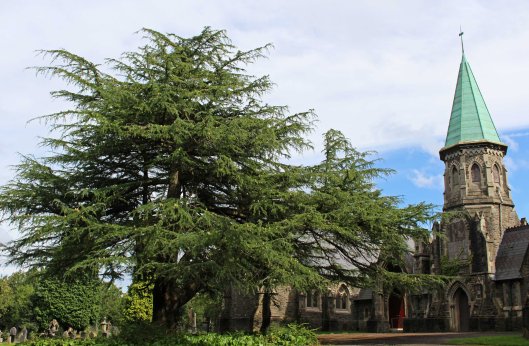
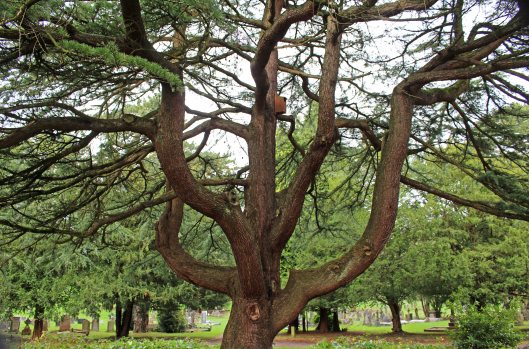
According to the guide’s commentary during a recent heritage walk around Cathays Cemetery in Cardiff, this magnificent Cedar of Lebanon (Cedrus libani) was planted when the cemetery first opened in 1859 so it is now more than 156 years old. It is, however, a mere teenager when you consider these cedars can survive for more than 1000 years!

160102 cathays cemetery cedar (1)

As the name implies, the Cedar of Lebanon (also known as the Atlas cedar and Deodar cedar) is native to Lebanon, the eastern Mediterranean coast and parts of Asia Minor, where it has long had a special significance to the local people. Its resin was used by the ancient Egyptians in their mummification process; the Phoenicians used its timber for building ships, palaces and temples; and its wood was burned by Jews to celebrate the New Year. Nowadays, the tree features as the national emblem of Lebanon, adorning both its flag and its coat of arms.

160102 cathays cemetery cedar (2)

In Britain, the Cedar of Lebanon was popular as a feature tree in the plantings surrounding stately homes and mansions from the mid-18th century onwards, as well as in later Victorian parks and cemeteries, like Cathays.

Like Loading...

The waxcap of the meadows

01 Friday Jan 2016

Posted by sconzani in fungi, nature, nature photography

≈ Leave a comment

Tags

fungi, fungus, meadow waxcap, waxcap

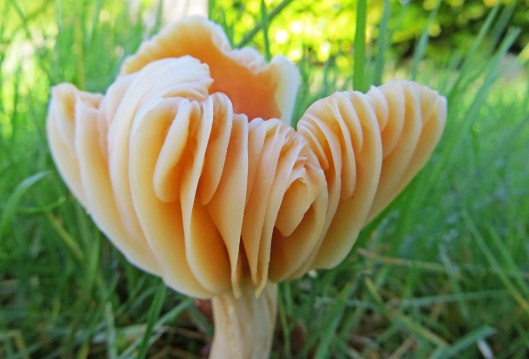
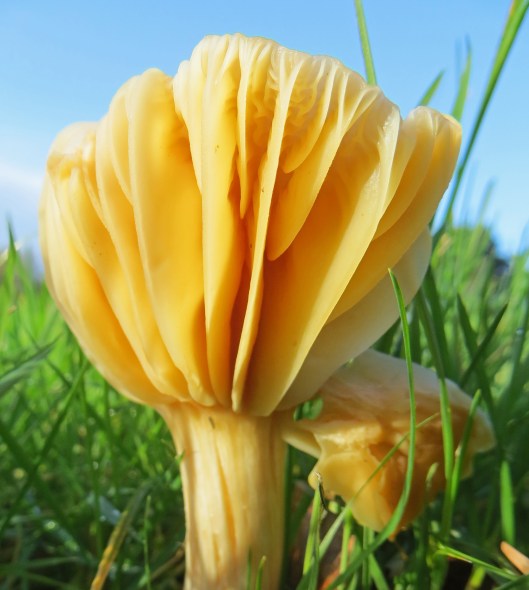
Though a very pretty and quite delicate shade of apricot, the Meadow waxcap is one of the less colourful waxcaps. Yet what it lacks in vibrancy it more than makes up for in the sculptural elegance of its shape, even more so as it ages. From a straight robust stem, its gills soar skywards, like a sharp-edged version of the fluting on a Greek temple column, and the edge of its cap undulates like the rolling of the ocean waves.

151231 meadow waxcap (2)

Hygrocybe (‘watery head’) pratensis (‘of meadows’) is one of the larger mushrooms in the waxcap family and is also more tolerant of fertilisers than most, so is a relatively common find in Britain and Europe on mown grassland and cropped pastures where the soil tends towards the acidic. It can also be found growing in woodland areas in northern Asia, in Australia and New Zealand, and in both South and North America – in the latter, it is more commonly known as the butter meadowcap or the salmon waxy cap.

151231 meadow waxcap (1)

Like Loading...
← Older posts
Newer posts →

About me

sconzani

sconzani

I'm a writer and photographer; researcher and blogger; birder and nature lover; countryside rambler and city strider; volunteer and biodiversity recorder.

View Full Profile →

Follow earthstar on WordPress.com

Enter your email address to follow this blog and receive notifications of new posts by email.

Recent blog posts

  • Blood bees April 29, 2026
  • Nesting material April 28, 2026
  • Lifer: Box bug April 27, 2026
  • Peak Wild garlic April 26, 2026
  • First damsels of 2026 April 25, 2026

From the archives

COPYRIGHT

Unless otherwise acknowledged, the text and photographs on this blog are my own and are subject to international copyright. Nothing may be downloaded or copied without my permission.

Fellow Earth Stars!

  • Unknown's avatar
  • Unknown's avatar
  • Unknown's avatar
  • Unknown's avatar
  • Unknown's avatar
  • Unknown's avatar
  • Unknown's avatar
  • Unknown's avatar
  • Unknown's avatar
  • Unknown's avatar
  • Unknown's avatar
  • Unknown's avatar
  • Unknown's avatar
  • Unknown's avatar
  • Unknown's avatar
  • Unknown's avatar
  • Unknown's avatar
  • Unknown's avatar
  • Unknown's avatar
  • Unknown's avatar
  • Unknown's avatar
  • Unknown's avatar
  • Unknown's avatar
  • Unknown's avatar
  • Unknown's avatar
  • Unknown's avatar
  • Unknown's avatar
  • Unknown's avatar
  • Unknown's avatar
  • Unknown's avatar
  • Unknown's avatar
  • Unknown's avatar
  • Unknown's avatar
  • Unknown's avatar
  • Unknown's avatar
  • Unknown's avatar
  • Unknown's avatar
  • Unknown's avatar
  • Unknown's avatar
  • Unknown's avatar
  • Unknown's avatar
  • Unknown's avatar
  • Unknown's avatar
  • Unknown's avatar
  • Unknown's avatar
  • Unknown's avatar
  • Unknown's avatar
  • Unknown's avatar
  • Unknown's avatar
  • Unknown's avatar

Blog at WordPress.com.

Privacy & Cookies: This site uses cookies. By continuing to use this website, you agree to their use.
To find out more, including how to control cookies, see here: Cookie Policy
  • Subscribe Subscribed
    • earthstar
    • Join 642 other subscribers
    • Already have a WordPress.com account? Log in now.
    • earthstar
    • Subscribe Subscribed
    • Sign up
    • Log in
    • Report this content
    • View site in Reader
    • Manage subscriptions
    • Collapse this bar

Loading Comments...

You must be logged in to post a comment.

    %d