• ABOUT
  • BIRDING 2018
  • Birding 2019
  • BLOG POSTS
  • Butterflies 2018
  • Resources

earthstar

~ a celebration of nature

earthstar

Category Archives: nature

Conversations with robins: 1

20 Wednesday Jan 2016

Posted by sconzani in birds, nature, nature photography

≈ 8 Comments

Tags

birding, birds, birdwatching, British birds, robin

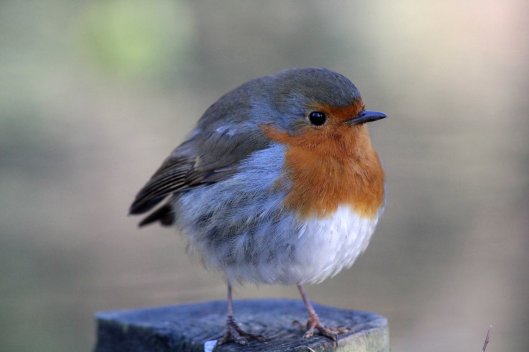
Forest Farm Nature Reserve, a very chilly day after a heavy frost …
robin1

Me: ‘Hello, robin. You look like you’re feeling the cold today.’
Robin: ‘Yes, I could do with some food.’

robin2

Me: ‘What a little cutie, you are.’
Robin: ‘I’d look even cuter with food.’

robin3

Me: ‘I’m sorry I don’t have any food for you today.’
Robin: ‘I’ll sing if you give me food.’
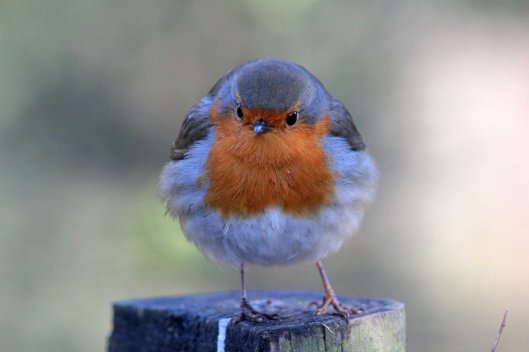
robin4

Me: ‘You’re posing so nicely. Thank you for the photos.’
Robin: ‘You can pay me in food.’

robin5

Me: ‘You’re making me feel guilty that I don’t have anything for you.’
Robin: ‘Lady, FOOD!’

robin6

Me: ‘I do have a muesli bar for my lunch. Maybe you’d like some of that?’
Robin: ‘At last! Where is it?’

robin7

Me: ‘There you go. Just a few crumbs to warm you up.’
Robin: ‘Bit miserly but better than nothing.’

robin8

Me: ‘Gotta go. Nice to talk to you.’
Robin: ‘Tra la la la la!’
Like Loading...

Tales of Turkey tails

19 Tuesday Jan 2016

Posted by sconzani in fungi, nature, nature photography

≈ 2 Comments

Tags

fungi, fungus, Trametes versicolour, Turkey tail

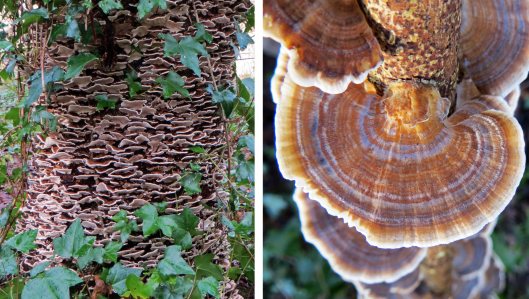
The Turkey tail (Trametes versicolour) is surely the multi-storey condominium of the fungus world. This is one of a huge range of bracket fungi and, as the name suggests, bracket fungi resemble shelves or brackets growing from the sides of tree trunks, branches and logs in forests and woodlands (or condominiums, with large balconies, ranging down the sides of cliffs, if you have an imagination like mine).

160119 Trametes versicolour Turkey Tail (1)

Turkey tail brackets range in size from 20 to 100mm wide and display concentric zones of colour in shades of beige, yellow, orange, brown and even blue. The common name of Turkey tail originated in North America, as these bands of colour apparently resemble the multi-hued tail of their wild turkey, and this is an extremely variable fungus so no two groupings have the same colour patterns (see slideshow below).

Not only lovely to look at, the Turkey tail is also useful medicinally. Asian people have long extolled the virtues of Turkey tail tea, and science has now proven that this fungus contains polysaccharides, derivatives of which have proven effective both in boosting the body’s immune systems in the fight against cancer and in the actual treatment of certain types of cancer.

This slideshow requires JavaScript.

Like Loading...

Trouble and strife

18 Monday Jan 2016

Posted by sconzani in birds, nature, nature photography

≈ 3 Comments

Tags

birding, birds, birdwatching, British birds, Canada goose

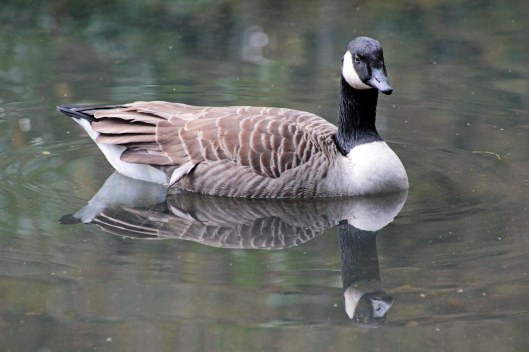
It may officially be called the Canada goose (Branta canadensis) but this bird should probably be called the Global goose as it seems to have made itself at home in many countries around the world. It was originally introduced to English parklands around 1665, specifically for King Charles II to add to his wildfowl collection in St James’s Park in London, but these birds have since gone forth and multiplied to such an extent that they are frequently considered a nuisance. As well as being aggressive pursuers of the bread so many people dispense freely in parks (watch out for nips!), they also have the digestive capacity to process three times as much grass as the average sheep and the more alarming ability to poop every four minutes!

160118 canada goose (1)

The Canada geese at my local lake can be as entertaining as any television soap opera. This morning another male tried to muscle in on this chap’s female so, firstly, he chased the other male away (love the tongue!), then he returned to honk sternly at his wife as if she had been the cause of the trouble (note her submissive posture), and then they both glared at the other male. What a hoot!

160118 canada goose (2)
160118 canada goose (3)
160118 canada goose (4)
Like Loading...

From Goose barnacle to Barnacle goose?

17 Sunday Jan 2016

Posted by sconzani in birds, nature, nature photography

≈ Leave a comment

Tags

Barnacle goose, birding, birds, birdwatching, British birds, Goose barnacle

Who could possibly believe that the Barnacle goose (Branta leucopsis) originated from driftwood? That was the ancient legend, that these geese were produced from the timber of fir trees that had been tossed about in the sea. The barnacle molluscs that can frequently be seen hanging from ships’ hulls were believed to be the birds’ ‘eggs’ and were named after the geese. This may seem crazy nowadays but the legend explained why these geese disappeared for months every year and were never seen breeding. The truth, of course, is that Barnacle geese usually migrate to foreign breeding grounds but our medieval ancestors weren’t to know that.

160117 barnacle goose (1)

Barnacle geese from the Arctic tundra over-winter in the north and west of Britain in huge numbers, with as many as 40,000 birds from Svalbard in Norway flocking to the Solway Firth and equally large numbers overwintering in the Scottish Hebrides and in Ireland. The geese in my photographs, however, live permanently at Roath Park Lake in Cardiff. They are friendly little birds and are happy to approach humans, pleading for food by making a noise that sounds a bit like a dog barking, though they are happiest eating leaves, roots and seeds.

160117 barnacle goose (2)
160117 barnacle goose (4)
160117 barnacle goose (3)
Like Loading...

‘It would puzzle a monkey to climb that tree’

16 Saturday Jan 2016

Posted by sconzani in leaves, nature, nature photography, trees

≈ 2 Comments

Tags

Argentinian tree, Chilean tree, Monkey puzzle

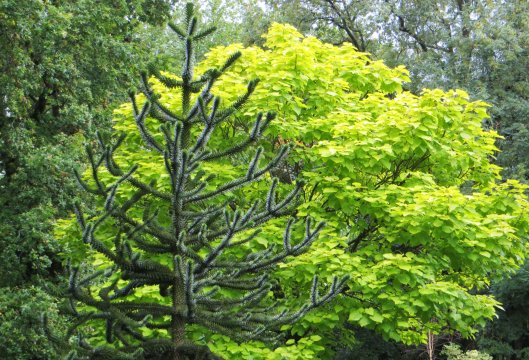
An 18th-century dignitary reputedly said that it would puzzle a monkey to climb this tree, hence its common name the Monkey puzzle (Araucaria araucana). Whether or not that’s true, it makes a good story, and the tree’s sharp branches and spiky leaves would certainly make its climbing by any creature almost impossible.

160116 monkeypuzzle

The Monkey puzzle’s shape stands out well against the vibrant Lime tree

An evergreen conifer that is native to Argentina and Chile, the Monkey puzzle was introduced to Britain in 1795 by Archibald Menzies, one of a generation of naval officers and plant collectors who brought back all manner of flora and fauna from their global voyages. One of Menzies’ Monkey puzzles survived at Kew for almost a hundred years, until it died in 1892, and the Monkey puzzle was a popular planting in Victorian parks and gardens because of its unique appearance.

160116 monkeypuzzle (2)

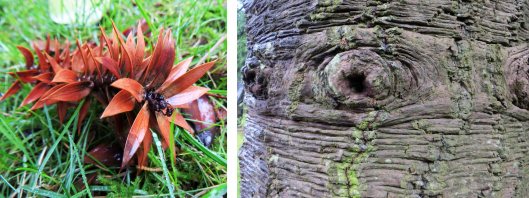
The dead branch shows the spiny leaves, and the bark is also quite unique

In Chile, the tree is now a protected species, its population having been severely threatened by human activity, especially the burning of native forests for conversion to agricultural use. The Amerindian tribe, the Araucanos (from whom the tree gets its scientific name), consider the tree sacred, and their assistance and indigenous knowledge are helping to protect the tree for the future.

Like Loading...

A jay’s search for food

15 Friday Jan 2016

Posted by sconzani in birds, nature, nature photography

≈ 6 Comments

Tags

birding, birds, birdwatching, British birds, Eurasian jay, Jay

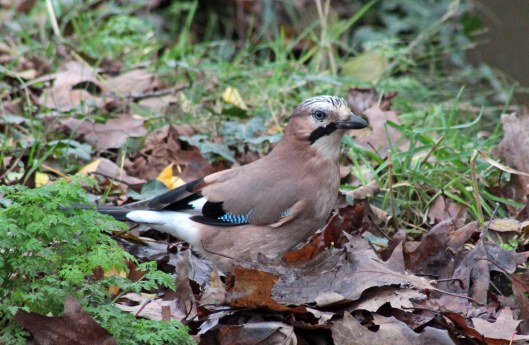
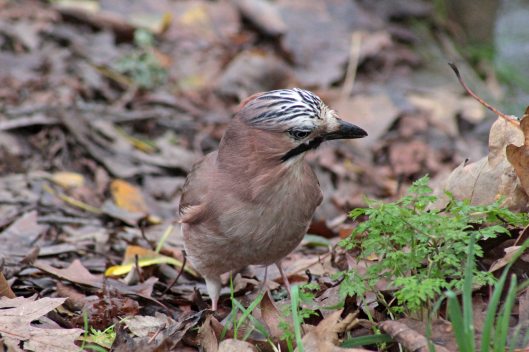
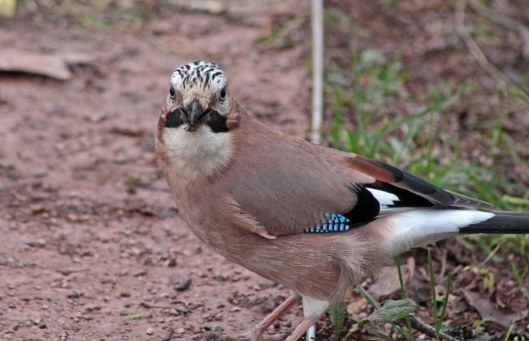
Though a shy bird by nature, the Eurasian Jay’s colouring is anything but. With a vivid blue patch on its wings, a body of dusky pink, pretty little black-and-white stripes atop its head and what looks remarkably like a black moustache, this bird is chic. No surprise then that ‘jay’ was once used, sneeringly, to describe a flashy dresser. Like most members of the crow family, the jay (Garrulus glandarius) can be loud and noisy, and an excellent mimic. As well as copying other birds, they’ve been known to imitate the sounds of cats, dogs and even telephones.

IMG_9302

One recent afternoon I spent the most delightful 10 minutes watching this jay search for food. Most thoroughly, it picked up leaves in its beak and flung them out of the way. It then turned its head first to one side then the other to see if it had unearthed anything interesting. And, finally, success! I’m not sure what it found – some kind of seed perhaps – but the triumphant jay gulped it down whole and then looked directly at me, with a very satisfied look on its face, before flying off, no doubt to repeat the same process all over again.

IMG_9321IMG_9334IMG_9350IMG_9353

Like Loading...

Split gill fungi

14 Thursday Jan 2016

Posted by sconzani in fungi, nature, nature photography

≈ Leave a comment

Tags

fungi, fungus, Schizophyllum commune, Split Gill

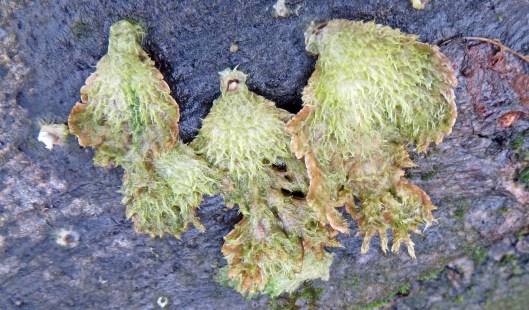
Ten days ago I was out on a fungi foray with friends when we came across this mysterious organism. Was it a lichen? Was it a fern? Was it some other kind of plant? Although we were searching for fungi, we had no idea this was one! Consultations with experts and two return visits later, I can confirm we had found the Split Gill fungus (also known as Schizophyllum commune), one of the most widely distributed mushrooms on earth. It can be found on every continent except Antarctica (no trees).

160114 Schizophyllum commune Split Gill (3)

Although its tough rubbery consistency looks totally unappetising, the Split Gill is a favourite food in many parts of the world, particularly in the tropics where the heat and humidity affect it less than more fleshy mushrooms. In the Congo it is eaten after much boiling and the addition of peanuts; in north-east India it’s a favourite ingredient in pancakes; and in Thailand, where the Split Gill is also valued for its medicinal properties, it’s used to make a hot spicy curry. If you do decide to cook up a feast, please be very careful as the Split Gill can cause disease in humans with immune deficiency issues.

160114 Schizophyllum commune Split Gill (2)

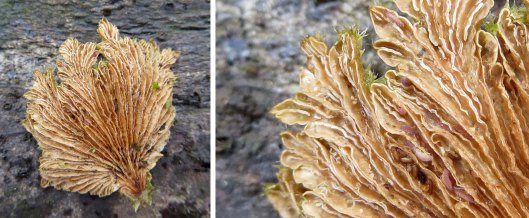
The underside, with a close up showing lots of tiny creatures amongst the gills

160114 Schizophyllum commune Split Gill

Like Loading...

Coot warfare

13 Wednesday Jan 2016

Posted by sconzani in birds, nature, nature photography

≈ 2 Comments

Tags

birding, birds, birdwatching, British birds, Coot, coots fighting

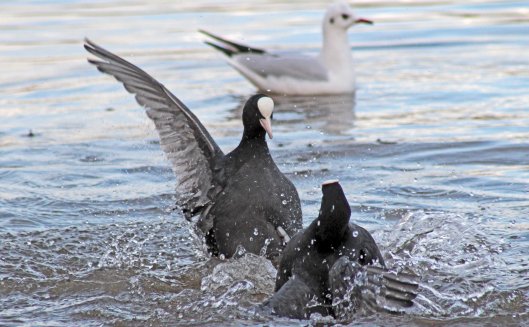
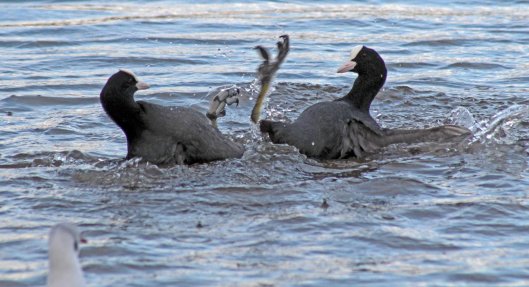
In yesterday’s blog I posted pretty photos of placid coots but these birds also have a dark side. They are ornery critters, constantly bickering and frequently aggressive for no apparent reason. Not only do they suddenly swim threateningly towards each other, they often fight quite violently.

This sequence of photos was taken a few days ago at my local lake. The fight began between two birds, then a third joined in, and then a fourth. The gull, it seems, was just enjoying the show!

160113 coot warfare (1)

160113 coot warfare (2)

160113 coot warfare (3)

160113 coot warfare (4)

160113 coot warfare (5)

Like Loading...

Silly as a coot

12 Tuesday Jan 2016

Posted by sconzani in birds, nature, nature photography

≈ Leave a comment

Tags

birding, birds, birdwatching, British birds, Coot

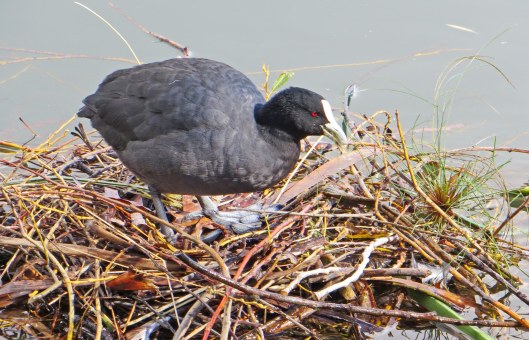
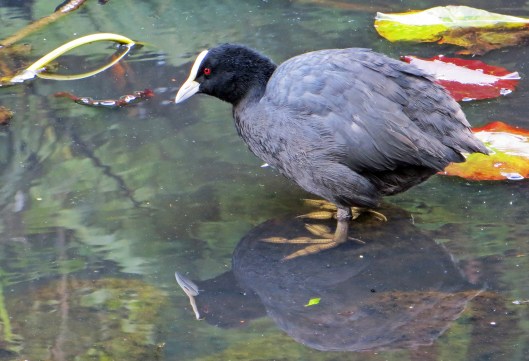
The Common coot (Fulica atra) is considered a game bird in Britain, with the same hunting season as the moorhen, though I would certainly never be tempted to kill one. Maybe it’s something to do with birds and water, but these are very entertaining to watch. The bird’s captivating silliness is probably where the idiom ‘silly coot’, used to describe a foolish person, originated. And the coot’s white head shield is the source of another common expression ‘to be as bald as a coot’, though bald here does not, in fact, mean hairless; an alternate definition of bald is ‘marked or streaked with white’.

160112 coot (1)

Although I’m a New Zealander, the coot is very familiar to me as it was introduced to New Zealand in 1958 and, like most immigrants, has made itself right at home. I am constantly fascinated by its bizarre lobed feet, a cross between the long toes of wading birds and the webbed feet of swimming birds like ducks. Coots are mostly vegetarians, though they do also consume snails and insect larvae, and will readily join the line up at the local lake when humans are dishing out food to the ducks, geese and swans.

160112 coot (2)

Like Loading...

Paper, bark or both?

11 Monday Jan 2016

Posted by sconzani in nature, nature photography, trees

≈ 3 Comments

Tags

bark, cemetery, Paper birch, parks

During a recent walk through the cemetery after a particularly stormy night, I noticed paper strewn around amongst the graves and was angrily muttering to myself about disgusting humans when I realised it wasn’t paper but bark. The Paper birch (Latin name: Betula papyrifera; other common names: white birch and canoe birch) has quite striking white, sometimes pinkish, bark that peels to reveal a pale orange bark underneath.

160111 paper birch bark (2)

The Paper birch was introduced to Europe in the mid 18th century and is still a popular ornamental addition to parklands and large gardens, but it is native to North America, where its oil-rich bark has been used by the indigenous peoples to make various items, from cartons and boxes to canoes and tepees. As the bark will even ignite well when wet, it is a useful fire starter, and it also has medicinal uses, as a poultice on wounds, as a cast for broken bones and for treating respiratory problems. More recently, it has been used to make ice-block sticks and toothpicks, and strips of bark are used to make handicrafts and to decorate floral arrangements. I think I’ll be picking up all that ‘paper’ and bringing it home next time!

160111 paper birch bark (1)

Like Loading...
← Older posts
Newer posts →

About me

sconzani

sconzani

I'm a writer and photographer; researcher and blogger; birder and nature lover; countryside rambler and city strider; volunteer and biodiversity recorder.

View Full Profile →

Follow earthstar on WordPress.com

Enter your email address to follow this blog and receive notifications of new posts by email.

Recent blog posts

  • Blood bees April 29, 2026
  • Nesting material April 28, 2026
  • Lifer: Box bug April 27, 2026
  • Peak Wild garlic April 26, 2026
  • First damsels of 2026 April 25, 2026

From the archives

COPYRIGHT

Unless otherwise acknowledged, the text and photographs on this blog are my own and are subject to international copyright. Nothing may be downloaded or copied without my permission.

Fellow Earth Stars!

  • Unknown's avatar
  • Unknown's avatar
  • Unknown's avatar
  • Unknown's avatar
  • Unknown's avatar
  • Unknown's avatar
  • Unknown's avatar
  • Unknown's avatar
  • Unknown's avatar
  • Unknown's avatar
  • Unknown's avatar
  • Unknown's avatar
  • Unknown's avatar
  • Unknown's avatar
  • Unknown's avatar
  • Unknown's avatar
  • Unknown's avatar
  • Unknown's avatar
  • Unknown's avatar
  • Unknown's avatar
  • Unknown's avatar
  • Unknown's avatar
  • Unknown's avatar
  • Unknown's avatar
  • Unknown's avatar
  • Unknown's avatar
  • Unknown's avatar
  • Unknown's avatar
  • Unknown's avatar
  • Unknown's avatar
  • Unknown's avatar
  • Unknown's avatar
  • Unknown's avatar
  • Unknown's avatar
  • Unknown's avatar
  • Unknown's avatar
  • Unknown's avatar
  • Unknown's avatar
  • Unknown's avatar
  • Unknown's avatar
  • Unknown's avatar
  • Unknown's avatar
  • Unknown's avatar
  • Unknown's avatar
  • Unknown's avatar
  • Unknown's avatar
  • Unknown's avatar
  • Unknown's avatar
  • Unknown's avatar
  • Unknown's avatar

Blog at WordPress.com.

Privacy & Cookies: This site uses cookies. By continuing to use this website, you agree to their use.
To find out more, including how to control cookies, see here: Cookie Policy
  • Subscribe Subscribed
    • earthstar
    • Join 642 other subscribers
    • Already have a WordPress.com account? Log in now.
    • earthstar
    • Subscribe Subscribed
    • Sign up
    • Log in
    • Report this content
    • View site in Reader
    • Manage subscriptions
    • Collapse this bar

Loading Comments...

You must be logged in to post a comment.

    %d