• ABOUT
  • BIRDING 2018
  • Birding 2019
  • BLOG POSTS
  • Butterflies 2018
  • Resources

earthstar

~ a celebration of nature

earthstar

Category Archives: nature

On the bramble

26 Wednesday Dec 2018

Posted by sconzani in fungi, insects, nature, plants, walks, wildflowers

≈ 4 Comments

Tags

bramble, Grooved bonnet, leafhopper, leafmine on bramble, Mycena fungi, Penarth to Lavernock coastal path, south Wales coastal path, Stigmella aurella, Wales Coastal Path

I took myself on a meander along the south Wales coastal path from Penarth to Lavernock and back again today. The weather was still quite gloomy, as it’s been for several days now, but at least there was no rain. I often have this trail to myself but not today – every man, woman, child and their dog had obviously decided this was a good way to walk off their festive feasting. As I had made it today’s mission to look for the little, I got a lot of strange looks, and I heard one or two ‘What was that lady doing?’ comments after people had passed. To their credit a couple of folk were brave enough to ask me directly but their eyes glazed over when I began to extol the beauty of the many leafhoppers I was seeing.

181226 on the bramble (1)

I saw lots of lovely things but thought, for the purposes of this blog, I’d focus on the Bramble (Rubus fruticosus agg.), which grows in abundance along the coastal path and, with this year’s mild weather, is still very green, and even flowering in places.

181226 on the bramble (2)

I haven’t yet had a chance to identify my finds but I think I have photos of three different species of leafhoppers (though it’s possible number 3 is just a yellower version of number 1). I was amazed to see so many of these little critters still flying and hopping around the bushes, though the winter has been very mild here so far and I think some species over-winter as adults.

181226 on the bramble (3)181226 on the bramble (4)181226 on the bramble (5)

I also spotted a couple of other tiny mini-beasties lurking amongst the leaves. I’m not sure what these are.

181226 on the bramble (6)
181226 on the bramble (7)

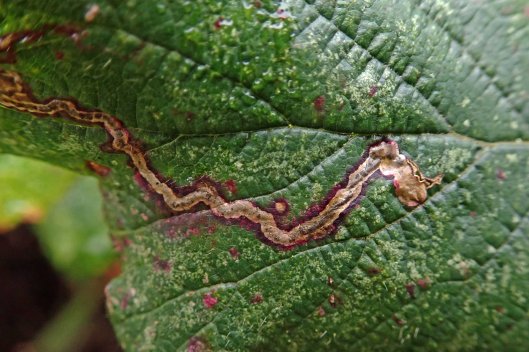
Lots of the leaves had leaf mines, though their makers have now left the leaves. I think most of the mines I saw would have been made by the larvae of Stigmella aurella, a moth.
181226 on the bramble (8)

And my last find was on an old, decaying Bramble branch, where these beautiful little bonnet fungi were growing. Though you can’t see the details in this photo, the caps were striated and the stems grooved so I think these might be Grooved bonnets (Mycena polygramma).

181226 on the bramble (9)

Like Loading...

Yuletide Greetings

25 Tuesday Dec 2018

Posted by sconzani in birds, nature

≈ 6 Comments

Tags

British robin, robin, Robin Redbreast

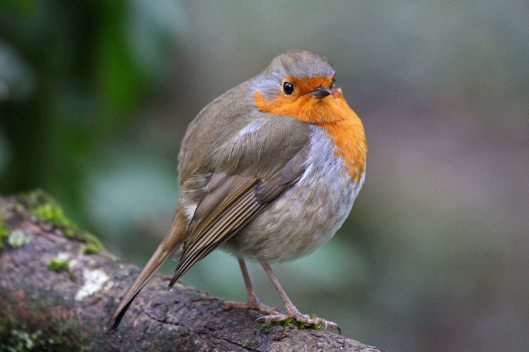
Season’s Greetings to all my followers!
May your Yuletide be filled with much good cheer.  

181225 Yuletide greetings

Like Loading...

Christmas baubles

24 Monday Dec 2018

Posted by sconzani in nature, plants, winter

≈ 2 Comments

Tags

berries, fruit, hips, Nature's decorations, winter colour

Here are more of the beautiful ‘Christmas decorations’ currently adorning the otherwise-dreary December countryside, courtesy of Ma Nature, and some of these are even edible, by birds and animals if not necessarily by humans.

181222 christmas baubles (1)
181222 christmas baubles (2)
181222 christmas baubles (3)
181222 christmas baubles (4)
181222 christmas baubles (5)
181222 christmas baubles (6)
Like Loading...

Winter 21!

23 Sunday Dec 2018

Posted by sconzani in flowers, nature, plants, wildflowers

≈ 2 Comments

Tags

#WildflowerHour, #winter10, blooming wildflowers, British flora, wildflowers, winter flowers, winter-blooming wildflowers

Well, I have to say I’m really rather pleased, and surprised, with this week’s blooming wildflower finds. I certainly didn’t expect to find Dove’s-foot crane’s-bill (Geranium molle) still flowering at Christmastime, and the Mallow and Red dead nettle were also nice surprises. So, this week I don’t just have Winter 10 for Wildflowerhour, I have Winter 21.


Dandelion species
Dandelion species
Daisy
Daisy
Germander speedwell
Germander speedwell
Ivy-leaved crowfoot
Ivy-leaved crowfoot
Common ragwort
Common ragwort
Dove's-foot crane's-bill
Dove’s-foot crane’s-bill
Common knpaweed
Common knpaweed
Buttercup species
Buttercup species
Shepherd's purse
Shepherd’s purse
Bramble species
Bramble species
Red dead nettle
Red dead nettle
Gorse species
Gorse species
Sow thistle
Sow thistle
Mallow species
Mallow species
Red clover
Red clover
Winter heliotrope
Winter heliotrope
Red valerian
Red valerian
Large bindweed
Large bindweed
Thistle species
Thistle species
Spurge species
Spurge species
Yarrow
Yarrow
Like Loading...

Black-necked grebe

22 Saturday Dec 2018

Posted by sconzani in birds, nature

≈ 4 Comments

Tags

birding, birdwatching, Black-necked grebe, British birds, British grebes, Cardiff Bay, Cardiff Bay birds, grebe, Podiceps nigricollis

There are five species of grebe you can reasonably expect to see in Britain: the Great crested and the Little grebes are relatively common here in south Wales, while the Slavonian, the Red-necked and the Black-necked are rarer visitors. Yet, I’ve been lucky enough to see all five this year and all within 30 miles of home – in fact, except for the Slavonian at Kenfig National Nature Reserve, the other four were within walking distance of home, and one of these lovely rarities is currently visiting Cardiff Bay.

181222 CardiffBay (1)

This handsome little water bird is a Black-necked grebe (Podiceps nigricollis). Its generic name Podiceps is a combination of two Latin words, podicis, meaning vent or anus, and pes, meaning foot. This has nothing to do with the bird’s bottom – cute though that certainly is – but is, rather, a reference to the fact that its legs are attached to its body at the extreme back end. The epithet nigricollis is Latin for black-necked (niger means black and collis means neck).

181222 CardiffBay (2)

This is a bird that switches from freshwater to saline habitats throughout the year, favouring freshwater lakes throughout Europe in which to breed, then moving to saline waterways to undergo its moult, before migrating to winter in the coastal estuaries of the south-western Palearctic and eastern parts of Africa. According to the RSPB website, an average of 130 birds opt to spend their winter in Britain.

181222 CardiffBay (3)

This is the second Black-necked grebe to spend some time in Cardiff Bay in 2018: another – or perhaps the same – bird was here for a couple of weeks in September. Although I did see that grebe, I didn’t get very good views of it, whereas this latest visitor has been treating birders to relatively close views from the Cardiff Bay Barrage in recent days, usually in the company of Tufted ducks and Coots.

181222 CardiffBay (4)

It’s a small bird – only about 12 inches long and, from the way it appears to bob about on top of the water, it must be as light as a feather. In its searches for the aquatic insects, small fish and crustaceans that make up its diet, it dives frequently, staying underway for several minutes at a time and sometimes reappearing a considerable distance from where it originally disappeared.

181222 CardiffBay (5)

Some of the local birding community, me included, are hoping this little grebe will stay around until at least the dawn of 2019, as it would certainly be a treat to have this on our bird lists on the first day of the new year.

Like Loading...

Fungi Friday: Turkey tails

21 Friday Dec 2018

Posted by sconzani in fungi, nature

≈ 2 Comments

Tags

#FungiFriday, British fungi, fungi, fungus, Trametes versicolor, Turkey tail, Turkeytail

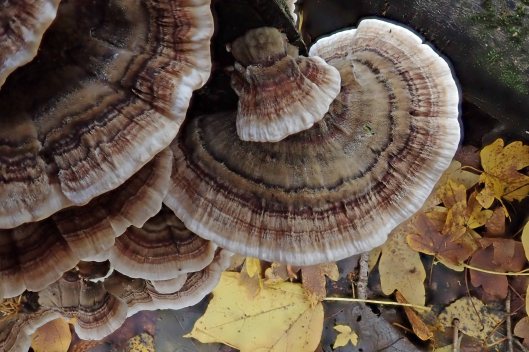
I’ve been collecting these images of Turkey tail fungi (Trametes versicolor) for the past couple of months, thinking they would be appropriate for the last Fungi Friday before Christmas seeing as how a lot of people eat turkey for their Christmas dinner.
So, merry feasting … but not on these!

181221 turkey tails (1)

181221 turkey tails (2)
181221 turkey tails (3)
181221 turkey tails (4)
181221 turkey tails (5)
181221 turkey tails (6)
181221 turkey tails (7)
Like Loading...

Winter sunshine

20 Thursday Dec 2018

Posted by sconzani in lichen, nature

≈ 4 Comments

Tags

glowing lichen, landscape of lichen, lichen glowing like sunshine, lichen landscape, yellow lichen

Okay, it’s not real sun-in-the-sky-type sunshine. But these miniature landscapes of lichen can be found atop almost every old fence post and they seem to exude sunshine on even the greyest of winter days.

OLYMPUS DIGITAL CAMERAOLYMPUS DIGITAL CAMERA

Like Loading...

Second time lucky

19 Wednesday Dec 2018

Posted by sconzani in birds, nature, winter

≈ 2 Comments

Tags

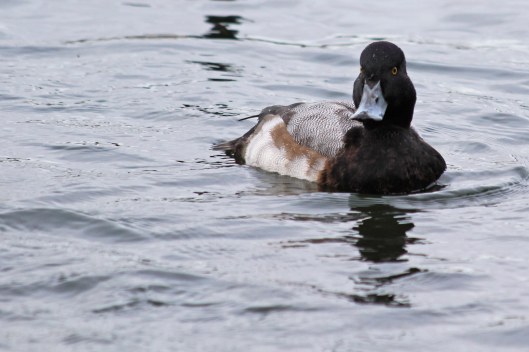
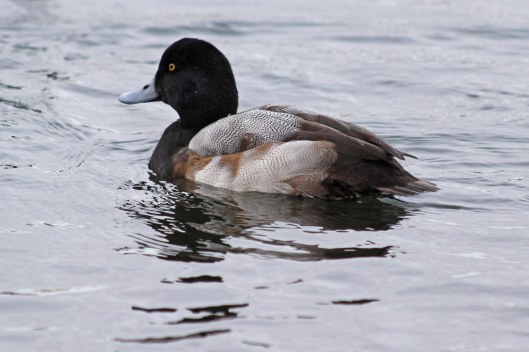
1st-winter drake Scaup, Aythya marila, birding, birdwatching, British birds, Cosmeston, Cosmeston Lakes Country Park, Greater scaup, juvenile Scaup, Scaup

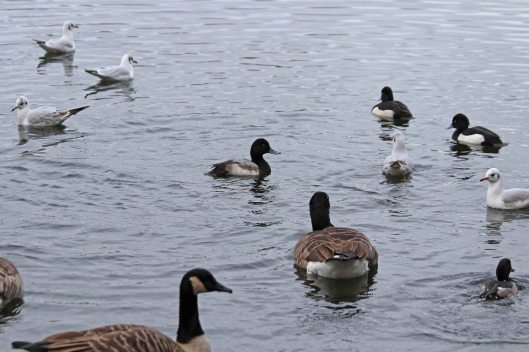
On Sunday I went to Cosmeston Lakes Country Park to look for the Scaup that has, since 13 December, been enjoying the delights of the lakes and the company of the huge number of Tufted ducks currently resident there. I had a wonderful mooch about but couldn’t find the Scaup (though I did spot a Hawfinch, a rare visitor, and was very pleased with that).

181219 scaup (1)

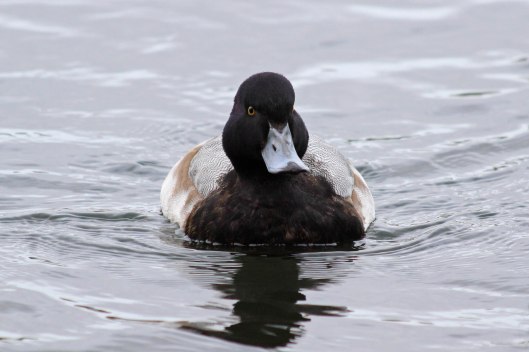
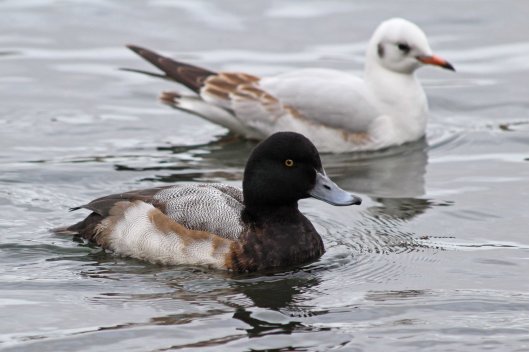
So, I went back again on Monday, partly to look again for that Hawfinch but also for the Scaup. And I was lucky with both birds, with another very fleeting, distant view of the finch but superb close views of the Scaup, which came to feed on the seed I always carry with me in the winter.

181219 scaup (3)181219 scaup (5)

This is a drake Scaup – actually a Greater scaup (Aythya marila), which is usually just known as Scaup, as the Lesser scaup is so rarely seen, and a first-winter bird, as it doesn’t yet have its adult plumage – the brown colouring you can see on this bird will disappear as it develops into an adult.

181219 scaup (6)181219 scaup (7)

In south Wales, the Scaup is an uncommon winter visitor and passage migrant, which, according to the latest Glamorgan Bird Report, enjoyed a ‘welcome increase of records and numbers’ in the 2017 first winter period (i.e. between January and mid April). Let’s hope the increasing number of sightings of this handsome little duck continues.

181219 scaup (8)181219 scaup (9)

Like Loading...

Slime balls

18 Tuesday Dec 2018

Posted by sconzani in nature

≈ Leave a comment

Tags

Heath Park, orange slime mould, slime, slime mould

Who needs artificial Christmas decorations when Mother Nature provides her own … and they’re biodegradable … and they’re available all year round (in the right conditions) … and they’re free!

181218 slime balls

Like Loading...

Two Harvestmen

17 Monday Dec 2018

Posted by sconzani in insects, nature, spiders

≈ 17 Comments

Tags

British insects, British invertebrates, Harvestman, Harvestmen, Opiliones species

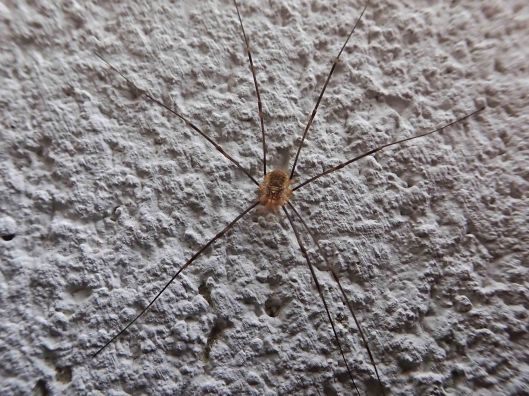
I found these two mini-beasties lurking on the outside of my building the other day. They may look like spiders but they’re not really – they’re Harvestmen (Opiliones species). Unlike true spiders, Harvestmen can’t spin webs and their bodies have only one segment, not two. They’re completely harmless – no venom – and, I think, rather prehistoric looking.

181217 harvestmen (1)

And I just discovered this very interesting but slightly creepy snippet of information about them on the UK Safari website:

When attacked, harvestmen are able to shed a leg as a defensive trick. Even after the leg becomes detached from the body it continues to jump and flick about. This distracts the predator while the harvestman makes its escape. They are able to shed up to four legs in this way, but they need to retain at least one of the sensory legs to survive.

181217 harvestmen (2)

Like Loading...
← Older posts
Newer posts →

About me

sconzani

sconzani

I'm a writer and photographer; researcher and blogger; birder and nature lover; countryside rambler and city strider; volunteer and biodiversity recorder.

View Full Profile →

Follow earthstar on WordPress.com

Enter your email address to follow this blog and receive notifications of new posts by email.

Recent blog posts

  • Recent Reed buntings April 17, 2026
  • Tiny but feisty April 16, 2026
  • NFY: Large and Small whites April 15, 2026
  • A loveliness of ladybirds April 14, 2026
  • Hairy-footed flower bees April 13, 2026

From the archives

COPYRIGHT

Unless otherwise acknowledged, the text and photographs on this blog are my own and are subject to international copyright. Nothing may be downloaded or copied without my permission.

Fellow Earth Stars!

  • Unknown's avatar
  • Unknown's avatar
  • Unknown's avatar
  • Unknown's avatar
  • Unknown's avatar
  • Unknown's avatar
  • Unknown's avatar
  • Unknown's avatar
  • Unknown's avatar
  • Unknown's avatar
  • Unknown's avatar
  • Unknown's avatar
  • Unknown's avatar
  • Unknown's avatar
  • Unknown's avatar
  • Unknown's avatar
  • Unknown's avatar
  • Unknown's avatar
  • Unknown's avatar
  • Unknown's avatar
  • Unknown's avatar
  • Unknown's avatar
  • Unknown's avatar
  • Unknown's avatar
  • Unknown's avatar
  • Unknown's avatar
  • Unknown's avatar
  • Unknown's avatar
  • Unknown's avatar
  • Unknown's avatar
  • Unknown's avatar
  • Unknown's avatar
  • Unknown's avatar
  • Unknown's avatar
  • Unknown's avatar
  • Unknown's avatar
  • Unknown's avatar
  • Unknown's avatar
  • Unknown's avatar
  • Unknown's avatar
  • Unknown's avatar
  • Unknown's avatar
  • Unknown's avatar
  • Unknown's avatar
  • Unknown's avatar
  • Unknown's avatar
  • Unknown's avatar
  • Unknown's avatar
  • Unknown's avatar
  • Unknown's avatar

Blog at WordPress.com.

Privacy & Cookies: This site uses cookies. By continuing to use this website, you agree to their use.
To find out more, including how to control cookies, see here: Cookie Policy
  • Subscribe Subscribed
    • earthstar
    • Join 642 other subscribers
    • Already have a WordPress.com account? Log in now.
    • earthstar
    • Subscribe Subscribed
    • Sign up
    • Log in
    • Report this content
    • View site in Reader
    • Manage subscriptions
    • Collapse this bar
 

Loading Comments...
 

You must be logged in to post a comment.

    %d