• ABOUT
  • BIRDING 2018
  • Birding 2019
  • BLOG POSTS
  • Butterflies 2018
  • Resources

earthstar

~ a celebration of nature

earthstar

Category Archives: plants

Signs of spring: snowdrops

21 Sunday Jan 2018

Posted by sconzani in flowers, nature, plants, seasons, spring, wildflowers

≈ 6 Comments

Tags

Bute Park, signs of spring, snowdrop, spring flowers

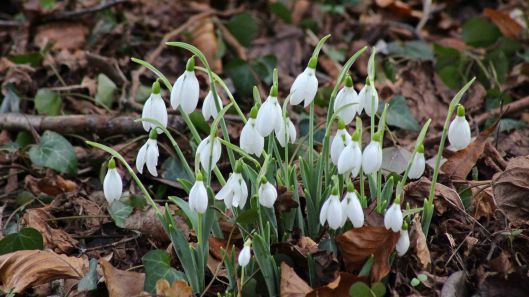
During my walk in Bute Park a few days ago, I saw my first signs of spring. And, though I love winter – as I love each of the seasons for the differences they offer – still, it is always heart-warming, when the days are short and cold and often grey, to see small signs, like these snowdrops, of the earth’s re-awakening.

180121 snowdrops

Like Loading...

Spurge laurel

19 Friday Jan 2018

Posted by sconzani in flowers, nature, plants, wildflowers

≈ 2 Comments

Tags

British flora, British native daphne, British native flowers, Daphne laureola, Spruge laurel, winter flowers

Spurge laurel is such an uninspiring name for this lovely British native, which I was surprised and delighted to find in full flower when I was walking the south Wales coastal path at Lavernock last weekend.

180119 Spurge laurel (2)

Any gardener will recognise this plant as a member of the Daphne family – its scientific name is Daphne laureola – and, not only does it flower from the middle of winter through spring and into early summer, it also has a delicious honey smell. It’s evergreen and prefers to have its roots in rich, shaded soil, growing best on the edge of woodlands on chalk or limestone.

180119 Spurge laurel (4)
180119 Spurge laurel (1)

I must add one note of caution, though: everything about this plant is poisonous to humans, from the sap (which can cause a nasty skin rash) to the black berries that appear in late summer. Luckily, the berry toxins do not appear to affect birds, and there are reports of robins and greenfinches enjoying an autumn feast.

180119 Spurge laurel (3)
180119 Spurge laurel (5)
Like Loading...

Leaf mine in Hart’s tongue

16 Tuesday Jan 2018

Posted by sconzani in insects, nature, plants

≈ 3 Comments

Tags

Agromyzidae, Chromatomyia scolopendri, Hart's tongue, leaf mine on Hart's tongue, leafminers, leafmines

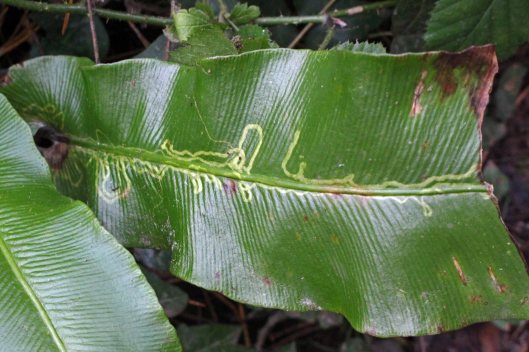
After my recent introductory post on leafminers, I thought I’d get the ball rolling with an example of a leaf mine I have actually been able to identify, as, fortunately for me, it is the only creature that creates a linear mine on the leaves of Hart’s tongue fern (Asplenium scolopendrium). The mines in my photographs were created by the larvae of a tiny fly, Chromatomyia scolopendri.

180116 Chromatomyia scolopendri (1)

As you can see, the larvae tends to mine along the midrib of the leaf but occasionally veers out towards the exterior before doubling back again. The mine is narrow and can be up to 10cms long, though I didn’t actually measure these ones. The larvae can be active any time from early spring through to autumn and they usually pupate in these mines.

180116 Chromatomyia scolopendri (2)

I found the mines on Christmas Eve, when I was on holiday in Somerset – they were at Ham Hill Country Park, near Yeovil. I’m not sure how common the little Chromatomyia scolopendri fly is, as there are 72 records showing in the Welsh Aderyn biodiversity database but only 38 records for the whole of Britain in the NBN Atlas (so where are all the Welsh records?). It’s also likely that leaf mines are under-recorded so the species may well be more common than these records suggest. Now that I know what to look for, I’ll be keeping an eye out for this one on my walks around south Wales.

Like Loading...

Leafmines 101

13 Saturday Jan 2018

Posted by sconzani in insects, leaves, nature, plants, trees

≈ 5 Comments

Tags

British insects, homes of insect larvae, insect larvae in leaves, leaf mine, leafmine, leafminer, mines on leaves

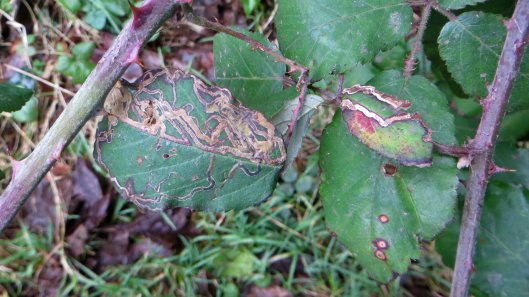
Leafmines and their miners are a subject I started to look at last summer but I quickly discovered that, in order to identify the miner, you had to know the plant they were mining, so I needed to improve my botanical knowledge before I could go much further. That effort has begun, and is ongoing, so I will start to look again at the miners in the coming months.

180113 leafmines (1)
180113 leafmines (2)

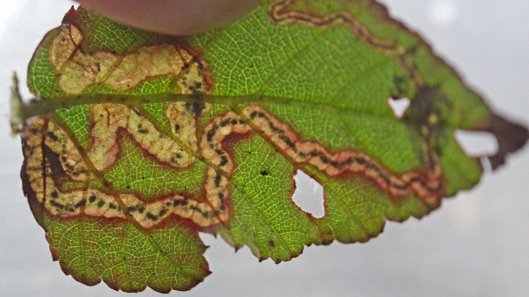
Firstly though, in case you don’t know, leafmines are made by the larvae of various insects. The mines are their homes and their larders – as well as providing them with some degree of protection from predators, the larvae eat the tissue of the leaves they live within, thus creating their mines. The larvae can be the immature stages of various species of flies, sawflies or moths, and, apparently, some beetles also mine leaves.

180113 leafmines (3)
180113 leafmines (4)

If you look at a mine, you will often see a tiny hole at one end, which means the creature that made it has left the premises, to pupate or to being life as an adult. Sometimes, you can still see the larva within, and you can often also see the pooh (known as frass) it has left behind as it eats and tunnels.

180113 leafmines (5)
180113 leafmines (6)

The shapes of the mines can vary considerably, from long meandering or straight lines to roundish blotches, and these shapes, plus the placement of the mine within the leaf (some occupy just the upper or lower surface, some go right through) and the identity of the plant, are the main ways to determine which creature has made the mine.

**p.s. Since posting this, I’ve been told what I thought was a leaf mine on ivy (the photo on the right in the middle) is actually caused by a fungus, possibly Phoma hedericola, the most common leaf spot of ivy. I can see these leafmines are going to be even more tricky than I anticipated!

Like Loading...

Winter heliotrope

12 Friday Jan 2018

Posted by sconzani in flowers, nature, parks, plants

≈ Leave a comment

Tags

Alexandra Park, Dingle Park, non-native invasive plant, Petasites fragrans, Winter heliotrope, winter-flowering plant

Officially, Winter heliotrope (Petasites fragrans) is a non-native invasive; unofficially, I think it’s got a rather lovely flower, which is particularly nice to see in the dead of winter, and its vanilla smell is divine.

180112 winter heliotrope (4)

According to Mabey’s Flora Britannica, it was brought to Britain as a garden plant in 1806, and the GB non-native species secretariat website states that it was first recorded in 1835 – presumably they mean the first record of it straying outside the bounds of the gardens where it had been planted. Though native to the Mediterranean and North Africa, it’s made itself at home in Britain, where it favours roadside verges, woodland margins and rough grassland. It seems very adaptable: in my local area, it favours sloping banks, a sunny slope in Dingle Park and a very wet and shady, steeply sloping streamside in Alexandra Park.

180112 winter heliotrope (1)
180112 winter heliotrope (2)
180112 winter heliotrope (3)

It can be difficult to get rid of because it grows very readily from the smallest discarded stem, sending its ‘roots’ (actually underground stems called rhizomes) spreading horizontally in all directions. Sneaky!

180112 winter heliotrope (5)

Like Loading...

New Year Plant Hunt

02 Tuesday Jan 2018

Posted by sconzani in flowers, nature, plants, winter

≈ Leave a comment

Tags

#NewYearPlantHunt, British wildflowers, BSBI, New Year Plant Hunt, wildflowers in bloom, winter-blooming wildflowers

Did you do the New Year Plant Hunt?

180102 New Year Plant Hunt (1)
180102 New Year Plant Hunt (2)
180102 New Year Plant Hunt (3)

 
Running from Saturday 30 December until today, Tuesday 2 January, this was the BSBI’s (Botanical Society of Britain and Ireland) seventh annual plant hunt event. The idea is to spend three hours on one of those days (or every day, if you’re as keen as Hoary mustard), in one location (or several, if you like to roam like Ivy), trying to find as many wild or naturalised plants that are flowering as you can. You then share your finds on social media and, most importantly, you also need to send your records in to the BSBI team so they can analyse the results (full details on their website here).

180102 New Year Plant Hunt (4)
180102 New Year Plant Hunt (5)
180102 New Year Plant Hunt (6)

On the last day of 2017 I took myself off on a wander around Penarth township and marina – basically, within the square kilometre that is ST1872 – and was delighted to find 15 different wild plants in bloom. The Field scabious was a particular highlight!

180102 New Year Plant Hunt (7)
180102 New Year Plant Hunt (8)
180102 New Year Plant Hunt (9)
180102 New Year Plant Hunt (10)
180102 New Year Plant Hunt (11)
180102 New Year Plant Hunt (12)
180102 New Year Plant Hunt (13)
180102 New Year Plant Hunt (14)
180102 New Year Plant Hunt (15)
Like Loading...

The Winter Seventeen

29 Friday Dec 2017

Posted by sconzani in flowers, nature, plants, wildflowers, winter

≈ Leave a comment

Tags

#TheWinterTen, #WildflowerHour, British wildflowers, Ham Hill, Wildflower Hour, wildflowers, winter wildflowers

171229 Ham Hill

Back in early November I blogged about Wildflower Hour’s winter challenge encouraging us all to try to find ten wildflowers still in bloom each week of winter. Well, I’ve been on holiday in Somerset over Christmas and, when my friend Sarah and I were out walking at Ham Hill on Christmas Eve, we took the challenge and were amazed to find not ten but seventeen wildflowers in bloom. Here (with apologies for the blurry pics – the wind was howling – and the lack of accurate names – I didn’t take my guide book on holiday) they are: ragwort, red campion, white dead nettle, hogweed, bramble, dog’s mercury, possible one of the Hawk’s-beard family, chamomile, cow parsley, ivy, a species of thistle and another of grass, wild parsnip, a variety of speedwell, the ever-reliable daisy, yarrow, and the equally reliable gorse.

p.s. Ham Hill is a fascinating place to explore if you’re ever in that vicinity and I’m already planning another walk there when I visit Sarah again in the summer.

171229 Ham Hill wildflowers (1)
171229 Ham Hill wildflowers (2)
171229 Ham Hill wildflowers (3)
171229 Ham Hill wildflowers (4)
171229 Ham Hill wildflowers (5)
171229 Ham Hill wildflowers (6)
171229 Ham Hill wildflowers (7)
171229 Ham Hill wildflowers (8)
171229 Ham Hill wildflowers (9)
171229 Ham Hill wildflowers (10)
171229 Ham Hill wildflowers (11)
171229 Ham Hill wildflowers (12)
171229 Ham Hill wildflowers (13)
171229 Ham Hill wildflowers (14)
171229 Ham Hill wildflowers (15)
171229 Ham Hill wildflowers (16)

171229 Ham Hill wildflowers (17)

Like Loading...

Hebe and bumble

22 Friday Dec 2017

Posted by sconzani in flowers, nature, plants, winter

≈ Leave a comment

Tags

Buff-tailed bumblebee, bumblebee, Goddess Hebe, Hebe, Hebe plants

I always have a little smile to myself when I see a Hebe because, of course, it’s a New Zealand native plant and reminds me of my homeland (though I was surprised to read today that they’re also native to South America, the Falkland Islands and one island in French Polynesia).

171222 Hebe (2)
171222 Hebe (1)

They’re tough plants. The two species shown here were photographed in 0° Celsius, in between hail showers, yet they show no signs of being affected by the Welsh winter and, in fact, are providing much-needed food for the few bees (that’s a Buff-tailed bumblebee in my photo) and other insects that are still out and about. As well as the cold, they’re also very tolerant of salty sea air so they’re a good plant for coastal gardens like those here in Penarth.

171222 Hebe (6)
171222 Hebe (7)
171222 Hebe (8)

In case you didn’t know, the plant is named after the Greek goddess Hebe, daughter of chief god Zeus and his wife Hera. Hebe was barista on Mt Olympus, serving ambrosia and nectar to all the other gods and goddesses, until she married Heracles and became a stay-at-home mum to their two kids.

171222 Hebe (4)
171222 Hebe (5)
171222 Hebe (3)
Like Loading...

Cotoneaster

10 Sunday Dec 2017

Posted by sconzani in nature, plants

≈ 17 Comments

Tags

Cotoneaster, invasive non-native, invasive plant

Am I the only person who used to pronounce this word wrongly: coton-easter instead of cot-own-e-aster?

cotoneaster (2)

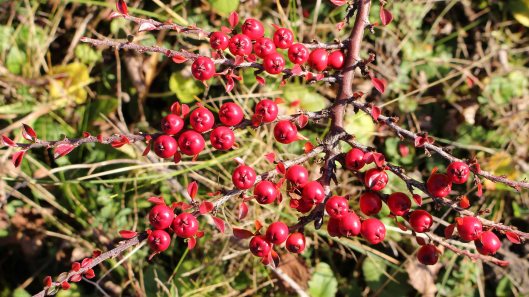
Now that I’ve got the pronunciation right, I want to have a moan about the plant itself. Don’t get me wrong – with those charming, heart-shaped leaves and luscious red berries, it’s very attractive … when it’s in a garden. The problem is that birds find its berries luscious and attractive too, and they eat them, and they fly away, and they poop. And a few months later, up pops another Cotoneaster plant but not always where it’s wanted. (There are Cotoneaster plants by the score at Cosmeston Lakes Country Park, where I regularly go walking.)

cotoneaster (1)
cotoneaster (3)

So, now, because it has a habit of spreading easily, damaging native vegetation, and is difficult to get rid of, the Cotoneaster has been classified as a ‘non-native invasive’ on Schedule 9 of the Wildlife and Countryside Act in England and Wales making it an offence to plant or otherwise cause to grow these species in the wild. And it’s going to take a lot of back-breaking effort by someone to get rid of all the plants growing where they’re not wanted.

cotoneaster (4)

Like Loading...

The bending reed

03 Sunday Dec 2017

Posted by sconzani in nature, plants

≈ Leave a comment

Tags

Aesop's fable, British flora, common reed, quotes about reeds, reed, sayings about reeds, The reed and the oak

‘The little reed, bending to the force of the wind, soon stood upright again when the storm had passed over.’ ~ Aesop, from ‘The Oak and the Reed’, Fable 127 of Aesop’s Fables

171203 reeds (5)

A quick google and a read of the article on Wikipedia about Aesop’s fable revealed that the comparison between the flexible reed and the strong but inflexible oak is a very old one. Confucius is credited with the saying, ‘The green reed that bends in the wind is stronger than the mighty oak that breaks in a storm’, and Geoffrey Chaucer wrote ‘A reed before the wind lives on, while mighty oaks do fall’ in Troilus and Criseyde. It’s a thought-provoking idea but, personally, what appealed to me most about these reeds was the beauty of their form, whether standing tall and upright or swaying in the breeze.

171203 reeds (1)

171203 reeds (3)
171203 reeds (4)

171203 reeds (2)

Like Loading...
← Older posts
Newer posts →

About me

sconzani

sconzani

I'm a writer and photographer; researcher and blogger; birder and nature lover; countryside rambler and city strider; volunteer and biodiversity recorder.

View Full Profile →

Follow earthstar on WordPress.com

Enter your email address to follow this blog and receive notifications of new posts by email.

Recent blog posts

  • A huddle of 7-spots March 18, 2026
  • Busy Blue tits March 17, 2026
  • Cuttlebones March 16, 2026
  • No woodland here March 15, 2026
  • Family comes first March 14, 2026

From the archives

COPYRIGHT

Unless otherwise acknowledged, the text and photographs on this blog are my own and are subject to international copyright. Nothing may be downloaded or copied without my permission.

Fellow Earth Stars!

  • Unknown's avatar
  • Unknown's avatar
  • Unknown's avatar
  • Unknown's avatar
  • Unknown's avatar
  • Unknown's avatar
  • Unknown's avatar
  • Unknown's avatar
  • Unknown's avatar
  • Unknown's avatar
  • Unknown's avatar
  • Unknown's avatar
  • Unknown's avatar
  • Unknown's avatar
  • Unknown's avatar
  • Unknown's avatar
  • Unknown's avatar
  • Unknown's avatar
  • Unknown's avatar
  • Unknown's avatar
  • Unknown's avatar
  • Unknown's avatar
  • Unknown's avatar
  • Unknown's avatar
  • Unknown's avatar
  • Unknown's avatar
  • Unknown's avatar
  • Unknown's avatar
  • Unknown's avatar
  • Unknown's avatar
  • Unknown's avatar
  • Unknown's avatar
  • Unknown's avatar
  • Unknown's avatar
  • Unknown's avatar
  • Unknown's avatar
  • Unknown's avatar
  • Unknown's avatar
  • Unknown's avatar
  • Unknown's avatar
  • Unknown's avatar
  • Unknown's avatar
  • Unknown's avatar
  • Unknown's avatar
  • Unknown's avatar
  • Unknown's avatar
  • Unknown's avatar
  • Unknown's avatar
  • Unknown's avatar
  • Unknown's avatar

Blog at WordPress.com.

Privacy & Cookies: This site uses cookies. By continuing to use this website, you agree to their use.
To find out more, including how to control cookies, see here: Cookie Policy
  • Subscribe Subscribed
    • earthstar
    • Join 668 other subscribers
    • Already have a WordPress.com account? Log in now.
    • earthstar
    • Subscribe Subscribed
    • Sign up
    • Log in
    • Report this content
    • View site in Reader
    • Manage subscriptions
    • Collapse this bar
 

Loading Comments...
 

You must be logged in to post a comment.

    %d