• ABOUT
  • BIRDING 2018
  • Birding 2019
  • BLOG POSTS
  • Butterflies 2018
  • Resources

earthstar

~ a celebration of nature

earthstar

Category Archives: plants

Broom leaf-beetle

03 Monday Jul 2023

Posted by sconzani in insects, plants

≈ Leave a comment

Tags

beetle larva, Broom leaf-beetle, Broom leaf-beetle larva, Common broom, Gonioctena olivacea, insect on Broom

I spent an hour going through my guidebooks on British caterpillars and butterfly life cycles but couldn’t find a match for this little critter, found on a stem of Common broom (Cytisus scoparius) growing on the side of the Aberbargoed spoil tip. So, I put a query on Twitter, tagged a couple of friendly experts, and within five minutes I had an answer. It wasn’t a Lepidoptera larva at all – this is the larva of the Broom leaf-beetle (Gonioctena olivacea) (click on this link to the UK Beetles website to read more). Of course, now I’m going to have to go back to see if I can find the adult beetle, which is apparently active between April and late summer, and which I’ve never seen.
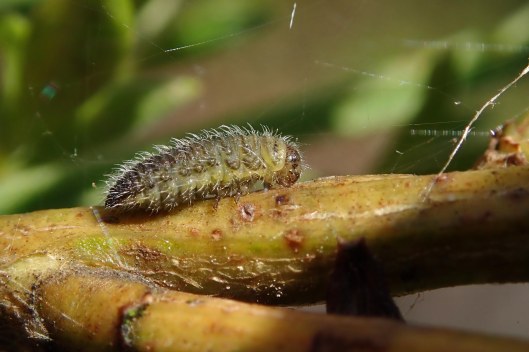
230703 Broom leaf-beetle larva

Like Loading...

Lady’s-mantle

02 Sunday Jul 2023

Posted by sconzani in flowers, plants, wildflowers

≈ Leave a comment

Tags

Alchemilla, British wildflowers, Lady's-mantle, wildflowers, yellow flowers

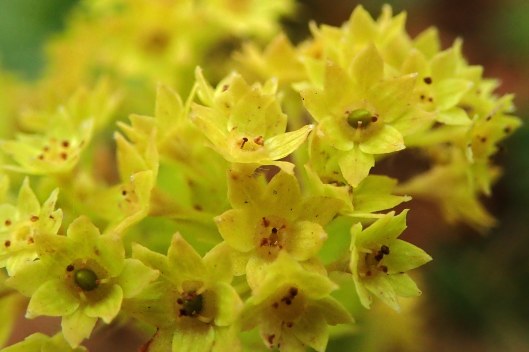
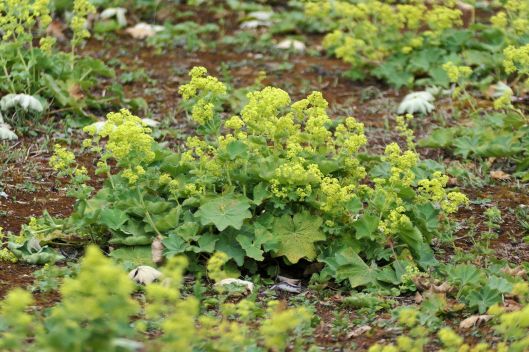
Lady’s-mantle is one of those plants that’s difficult to determine to exact species. The large Garden lady’s-mantle (Alchemilla mollis) has escaped its original garden setting and become naturalised in many places, and, just to increase identification difficulties, some species have hybridised with others. It’s a plant I’ve found growing in a variety of places: in grassland at the local country park, along a nearby woodland ride, on a former coal spoil tip and, below, in a former quarry.

230702 Lady's-mantle (1)

Richard Mabey provides some interesting information about this plant in Flora Britannica:

The often nine-lobed leaves of lady’s-mantle, like cloaks or umbrellas, fold up overnight and catch the dew on their soft hairs. Plant-dew was highly valued by early herbalists … and this made Alchemilla prized as a simple [sic], prescribed for wounds, infertility, and impotence. The alchemists also required the purest dew for turning base metal into gold – hence the name Alchemilla, ‘little alchemist’. Such a powerful and magical herb was bound to be christianised, and some time in the Middle Ages it was named Our Lady’s Mantle, and eventually lady’s-mantle.

230702 Lady's-mantle (2)

Like Loading...

Leafmines: Mompha terminella

26 Monday Jun 2023

Posted by sconzani in insects, plants, wildflowers

≈ Leave a comment

Tags

British moths, Enchanter's nightshade, leafmines on Enchanter's nightshade, leafmining moths, Mompha terminella, moth larvae in leaf mines

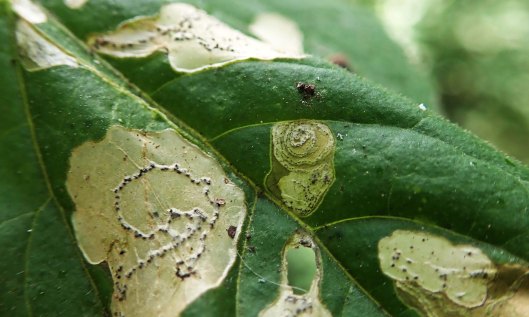
Just look at all these leafmines on Enchanter’s nightshade (Circaea lutetiana); you can hardly see the leaves for the mines.

230626 mompha terminella (1)

Back in July 2021, I blogged about these mines, made by the larvae of the tiny moth Mompha langiella, in Leafmines: Enchanter’s nightshade but, when I was looking at these nightshade plants on Wednesday, I noticed one that looked different – the mine started as a spiralling gallery before widening out into a blotch. This was later confirmed as the larval mine of Mompha terminella, another tiny moth whose adult form can be seen on the UK Moths website. The mines are usually seen between August and September but, as with many things this year, this larva was active much earlier than usual.

230626 mompha terminella (3)

Like Loading...

Wild words : extrafloral nectary

03 Wednesday May 2023

Posted by sconzani in insects, plants

≈ Leave a comment

Tags

Bracken, extrafloral nectaries, nectaries on Bracken, nectary, Pteridium aquilinum

Nectary: noun, biology; ‘a nectar-secreting glandular organ in a flower (floral) or on a leaf or stem (extrafloral)’ (Oxford Dictionary).

230503 extrafloral nectaries (1)

Like most people, I knew that most flowers produce nectar as a reward to attract pollinators but I’ve only recently learned that many plants produce nectar through extrafloral nectaries, as the definition explains, on their leaves or stems. I read that these particular nectaries can be found on many species of fern, and I’ve finally found some examples on the stems of Bracken (Pteridium aquilinum) that has just begun to sprout locally. The nectaries are the small smooth pale lumps on the back of the stipe, and, in Bracken, their purpose is apparently to attract ants that will then defend the fern against the insects that might eat it, like some species of bug and fly, and the larvae of various moths, amongst others.

230503 bracken and ant

ant leaving nectary on Bracken

However, I also found a journal article, referenced below, which reported that the ants actually had ‘no significant effect on bracken-specific herbivores’ so, in this case, the plant may be producing nectar for nothing.

Reference: ‘Bracken, Ants and Extrafloral Nectaries. I. the Components of the System’, J. H. Lawton and P. A. Heads, Journal of Animal Ecology, vol. 53, no. 3, October 1984, pp. 995-1014. I do not have access to Jstor so was only able to read the information contained in the article summary.

230503 common froghopper nymphs

Common froghopper nymphs on Bracken

Like Loading...

Rue-leaved saxifrage

09 Sunday Apr 2023

Posted by sconzani in plants, spring, wildflowers

≈ Leave a comment

Tags

British wildflowers, Rue-leaved saxifrage, Saxifraga tridactylites

Another week, another new plant – I’m on a roll!

230409 rue-leaved saxifrage (1)

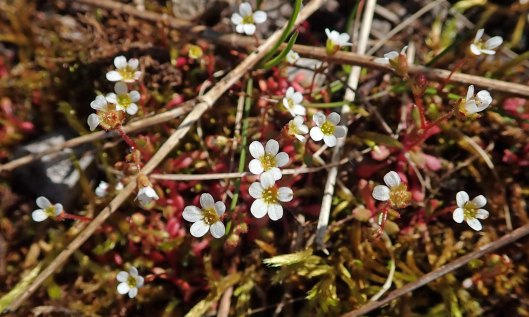
This hairy little annual, with the sweet white flowers, is Rue-leaved saxifrage (Saxifraga tridactylites). Its three-lobed leaves (hence the tridactyl in its name) are quite distinctive and are often tinged with red, as are the plant’s stems.

230409 rue-leaved saxifrage (2)

In Flora Britannica, Richard Mabey writes that this saxifrage is widespread but declining, though the book is now 25 years old so I’m not sure if that is still the case. Certainly, it’s not a plant I’ve come across before in my meanderings and these few were growing on the much-overgrown route of a former railway line so could originally have been carried this way by a train.

230409 rue-leaved saxifrage (3)

Like Loading...

Good Friday Grass

07 Friday Apr 2023

Posted by sconzani in plants

≈ Leave a comment

Tags

British grasses, British rushes, Field wood-rush, Good Friday grass, Luzula campestris, Sweep's brooms

I wasn’t aware of the alternate common names for Field wood-rush (Luzula campestris) until I saw someone tweet about it earlier this week, saying it was flowering a little early this year.

230407 field wood-rush (1)

Turns out, this little grass, found wherever short grass grows – so in fields and downs, even in the lawn around your house, usually comes in to flower around Easter so has earned the name Good Friday grass.

230407 field wood-rush (2)

Flora Britannica also lists the vernacular name Sweep’s brooms, which apparently comes from its ‘dark, brush-like flowers’. Whatever you want to call it, it’s a pretty little thing.

230407 field wood-rush (3)

Like Loading...

American winter-cress

02 Sunday Apr 2023

Posted by sconzani in plants, spring, wildflowers

≈ Leave a comment

Tags

American winter-cress, Barbarea verna, British wildflowers, Grangemoor Park, Spring colour, wild salad plant

One of my local green spaces, Grangemoor Park, in Cardiff, an old landfill site, has been much churned up over the past year due to the need for repairs to its drainage system. Seeing the amount of damage done to the park, the huge numbers of trees cut down, the wide gravel paths laid down where once were wildflowers and scrub, has been very depressing but I’m hoping Nature will quickly repair the human damage. In the meantime, trying to be positive, I’ve been keeping an eye on the disturbed ground for any botanical surprises. And this is one!

230402 american winter-cress (1)

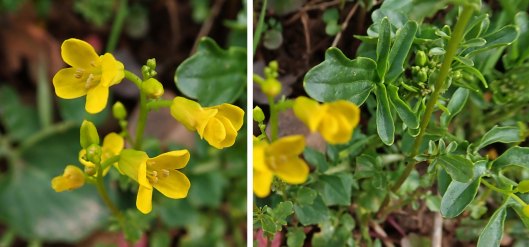
I’m 99% sure that this lovely little treasure is American winter-cress (Barbarea verna), a new plant for me. I’ve had a botanist confirm my identification but with one proviso. She thought ‘Yes I think it looks like it is B. verna as opposed to B. intermedia. If you should happen to see it again when it is in fruit, it should have long (over 4cm) curved fruits, whereas intermedia has shorter (less than 4cm) straight fruits.’ Needless to say, I will be checking the fruits in due course.

230402 american winter-cress (2)

In Flora Britannica, Richard Mabey writes that Barbarea verna has proven to be ‘popular and successful as a vegetable. Originally from south-west Europe, it has been introduced as a cultivated vegetable not just to the United States and northern Europe, but to South America and Australasia. It has become widely naturalised in all these places.’ I will be tempted, once it has grown, to harvest some of the leaves, which can be used like ‘rocket’ in a salad, though it is growing in the perfect spot for passing canines to anoint so will have to be washed very thoroughly.

230402 american winter-cress (3)

Like Loading...

Holly speckle

15 Wednesday Feb 2023

Posted by sconzani in fungi, plants

≈ Leave a comment

Tags

British fungi, fungus on Holly, Holly, Holly speckle, Trochila ilicina

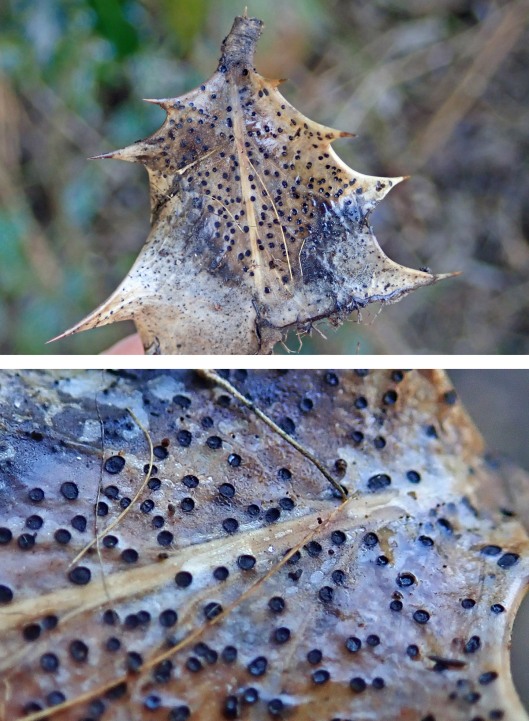
Have you ever noticed what look like little black spots on the brown fallen leaves of Holly? This is the perfectly named fungus Holly speckle (Trochila ilicina) and those spots, or speckles, are, in fact, the fungal fruiting bodies. When they first develop, they are a dark olive green but, after their lids open and the spores within are released, the speckles come to resemble tiny black craters. If you want to know more, a blog on the Woodlands.co.uk website has a very detailed description of these intriguing fungi, as well as an explanation of how their fruiting mechanism functions.

230215 holly speckle

Like Loading...

Leafmines: Phyllonorycter ulicicolella

13 Monday Feb 2023

Posted by sconzani in insects, plants

≈ 2 Comments

Tags

British leafminers, leafmines, leafmines on Gorse, leafmining moth larvae, moth larva, Phyllonorycter ulicicolella

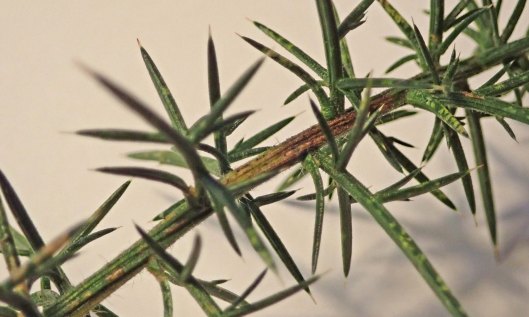
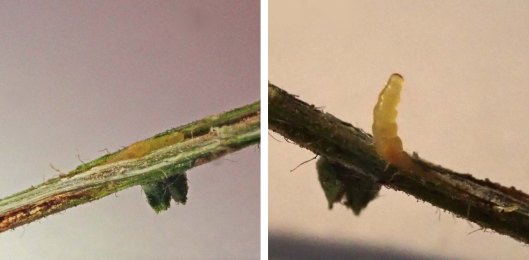
I have a new leafminer to share at last, the moth Phyllonorycter ulicicolella, which mines the stems and spines of Gorse plants. The British Leafminers website notes that this mine is rarely found, and I can certainly believe that. I’d had a look before at a few Gorse bushes but not found any mines, until a posting on Twitter by local Butterfly Conservation senior moth ecologist George led me to make a more serious effort. For me, finding new leafmines is often a matter of getting my eye in – once I’ve seen something, I find it much easier to find again. George directed me to a local Gorse bush where he’d recently found some mines – I didn’t actually check that bush but knew there were other bushes that had recently been flailed further along the same road, and bingo! The mine and larva pictured here came from a cut branch lying on the ground.

230213 phyllonorycter ulicicolella (1)

The larva is incredibly tiny – about 3mm when fully grown – so it was difficult to get clear photos. According to the UK Moths website, where you can see images of the attractive adult, this moth is ‘nationally scarce’, and can be ‘found in heathland and grassland in southern England and also northwest England’. I guess they need to update that now to include south Wales, thanks to George’s efforts in finding it locally, in various parts of Cardiff and the nearby town of Barry. I will also be continuing my search for the mines in my area.

230213 phyllonorycter ulicicolella (2)

Like Loading...

Fern Friday: Hart’s-tongue

27 Friday Jan 2023

Posted by sconzani in plants

≈ Leave a comment

Tags

Asplenium scolopendrium, British ferns, fern, Fern Friday, Hart's tongue

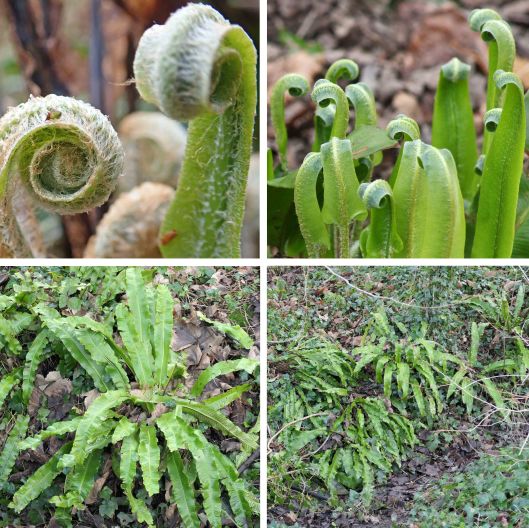
Perhaps, when I began these Fern Friday blogs, I should have started with the fern with the most basic shape, the one with the long simple leaf shaped, apparently, like the tongue of a deer (commonly called a hart in former days), the Hart’s-tongue fern (Asplenium scolopendrium). As it grows everywhere in Britain except in the colder far northern regions, and can be found draping stone walls, in woodland, under hedgerows, in roadside ditches, I’m sure this fern will be familiar to most of you.

230127 hart's-tongue fern

Hart’s-tongue has featured on this blog before, in particular because its glossy leaves provide a home to several species of leafminers, including these two Leafmines: Psychoides filicivora 3 January 2022 and Leafmines: Chromatomyia scolopendri 1 March 2021.

Like Loading...
← Older posts
Newer posts →

About me

sconzani

sconzani

I'm a writer and photographer; researcher and blogger; birder and nature lover; countryside rambler and city strider; volunteer and biodiversity recorder.

View Full Profile →

Follow earthstar on WordPress.com

Enter your email address to follow this blog and receive notifications of new posts by email.

Recent blog posts

  • Busy Blue tits March 17, 2026
  • Cuttlebones March 16, 2026
  • No woodland here March 15, 2026
  • Family comes first March 14, 2026
  • Local Little egrets March 13, 2026

From the archives

COPYRIGHT

Unless otherwise acknowledged, the text and photographs on this blog are my own and are subject to international copyright. Nothing may be downloaded or copied without my permission.

Fellow Earth Stars!

  • Unknown's avatar
  • Unknown's avatar
  • Unknown's avatar
  • Unknown's avatar
  • Unknown's avatar
  • Unknown's avatar
  • Unknown's avatar
  • Unknown's avatar
  • Unknown's avatar
  • Unknown's avatar
  • Unknown's avatar
  • Unknown's avatar
  • Unknown's avatar
  • Unknown's avatar
  • Unknown's avatar
  • Unknown's avatar
  • Unknown's avatar
  • Unknown's avatar
  • Unknown's avatar
  • Unknown's avatar
  • Unknown's avatar
  • Unknown's avatar
  • Unknown's avatar
  • Unknown's avatar
  • Unknown's avatar
  • Unknown's avatar
  • Unknown's avatar
  • Unknown's avatar
  • Unknown's avatar
  • Unknown's avatar
  • Unknown's avatar
  • Unknown's avatar
  • Unknown's avatar
  • Unknown's avatar
  • Unknown's avatar
  • Unknown's avatar
  • Unknown's avatar
  • Unknown's avatar
  • Unknown's avatar
  • Unknown's avatar
  • Unknown's avatar
  • Unknown's avatar
  • Unknown's avatar
  • Unknown's avatar
  • Unknown's avatar
  • Unknown's avatar
  • Unknown's avatar
  • Unknown's avatar
  • Unknown's avatar
  • Unknown's avatar

Blog at WordPress.com.

Privacy & Cookies: This site uses cookies. By continuing to use this website, you agree to their use.
To find out more, including how to control cookies, see here: Cookie Policy
  • Subscribe Subscribed
    • earthstar
    • Join 668 other subscribers
    • Already have a WordPress.com account? Log in now.
    • earthstar
    • Subscribe Subscribed
    • Sign up
    • Log in
    • Report this content
    • View site in Reader
    • Manage subscriptions
    • Collapse this bar
 

Loading Comments...
 

You must be logged in to post a comment.

    %d