• ABOUT
  • BIRDING 2018
  • Birding 2019
  • BLOG POSTS
  • Butterflies 2018
  • Resources

earthstar

~ a celebration of nature

earthstar

Category Archives: spiders

Spider: Segestria florentina

21 Wednesday May 2025

Posted by sconzani in spiders

≈ 2 Comments

Tags

British spiders, Segestria florentina, tube web spider, tube-dwelling spider

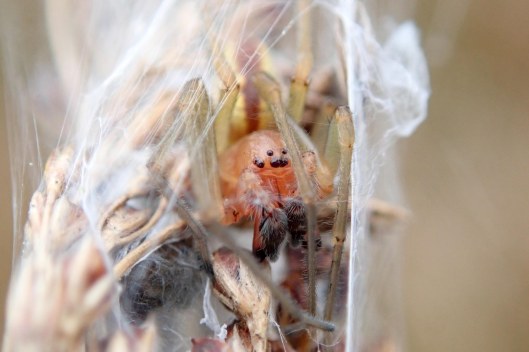
With this year’s focus on identifying spiders, I’m getting better at being close to them but this large beast did give me pause. Fortunately, it wasn’t in my house or any other enclosed space; I spotted it sitting on an external house wall as I walked along a street. After consulting a local with good spider knowledge, I can confirm this is the tube web spider Segestria florentina, though its chelicerae (fanged mouthparts) are not the shiny green colour described in my guide book. Perhaps that was just due to the light conditions when I photographed it.

Segestria florentina usually lives in a tube-shaped web, tucked in a hole in a wall or amongst rocks, speeding out to grab its prey when it passes the hole. You definitely wouldn’t want to poke your finger in its hole, as it does have a venomous bite, though apparently it’s not dangerous, and the spider’s only found in the south of the UK. If you want to know more, the iNaturalist website has a good article and excellent photos.

Like Loading...

Spiders: Philodromus species

06 Tuesday May 2025

Posted by sconzani in spiders

≈ Leave a comment

Tags

British spiders, Philodromidae, Philodromus spiders, running crab spiders

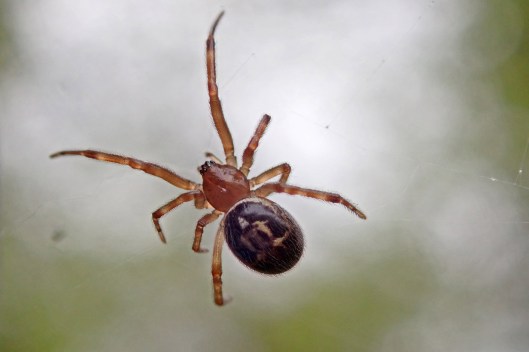
When I got my new guide book*, I very naively assumed it would help me identify all the spiders I saw. I should have known from tackling all the other types of creatures I’ve been trying to put names to that nothing is ever that easy.

These three spiders are a case in point. They all belong to the Philodromidae, the running crab spiders, of which, in Britain, there are 17 eight-eyed species in four genera.

Though they share a similar crab-like body structure, the three shown here all look quite different to my eye, and I thought I would be able to identify them but no! Highlighted in red in my book are those words I never like to read: ‘Microscopic examination of the genitalia is necessary to confirm identification of all species in these genera.’

* Lawrence Bee, Geoff Oxford and Helen Smith, Britain’s Spiders: a field guide, 2nd ed., Princeton University Press, Princeton, 2020.

Like Loading...

Spider: Larinioides cornutus

07 Monday Apr 2025

Posted by sconzani in spiders

≈ Leave a comment

Tags

British spiders, Larinioides cornutus, spider on Gorse

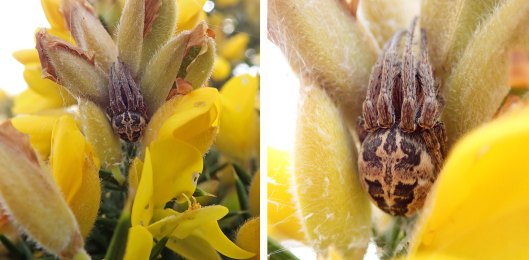
I was looking for weevils when I spotted these two spiders on the same Gorse bush at the Cardiff Bay Wetlands Reserve recently. (This was a bit freaky: I need both distance and reading glasses but don’t like bifocals so, when I’m out walking, I have to push my distance specs down my nose and get my head close to small things to see with my unspectacled eyes.)

I initially thought these two spiders were Agalematea redii but quickly realised I was wrong about the first one I found. It is, in fact, Larinioides cornutus, a species that prefers living on vegetation in damp places but can also be found on built structures in those areas. It’s common in the south of Britain, becoming less so the further north you travel. The Spider and Harvestman Recording Scheme website has a map and lots of interesting information.

And, though it looks different to my untrained eye, it turns out that the second spider is also Larinioides cornutus. The very helpful British Spiders social media person on Bluesky explained: ‘The second looks like Larinioides cornutus as well. Although the alpha form of Agelenatea redii has quite similar patterning, it has a noticeably smaller and rounder abdomen – one of those things that’s obvious when you meet it!’ I’m hoping I meet it a little more distantly than I did with the two shown here!

Like Loading...

Spider: Zygiella x-notata

31 Monday Mar 2025

Posted by sconzani in spiders

≈ Leave a comment

Tags

British spiders, Missing sector orb weaver, Silver-sided sector spider, Zygiella x-notata

I mentioned in a post last week (Spider: Steatoda nobilis, 25 March) that I’d had confirmation of my identification of two recent spider finds on my local park railings; this is the second of those spiders, Zygiella x-notata, also known as the Silver-sided sector spider.

Though I didn’t see it, this orb weaver is most well known for a singular feature of its web – for some unknown reason it always misses out one sector when constructing its circular web (you can see a photo of this on Wikipedia here), and so another of its common names is Missing sector orb weaver.

According to my guide book, these spiders are often found in places occupied by humans, so houses, sheds, and other types of building, as well as amongst vegetation in urban areas, and they are widespread around the world. The individual I found was too busy consuming its prey to be concerned with web building but I will look out for that distinctive web during future checks of the park railings.

Like Loading...

Spider: Steatoda nobilis

25 Tuesday Mar 2025

Posted by sconzani in spiders

≈ Leave a comment

Tags

British spiders, False widow spider, Noble false widow, Steatoda nobilis

I was delighted yesterday to get an email verifying my two most recent spider finds. Both were fairly commonplace spiders but it’s nice to have confirmation that I’m making positive progress in being able to identify my finds, and to feel that I am paying back in the form of new records the book grant I received from my local biodiversity records centre to buy my spider guide book.

So, meet Steatoda nobilis, otherwise known as the False widow spider (or, sometimes, the Noble false widow). According to the Spider and Harvestman Recording Scheme website, it’s not a British native, and is presumed to have been an accidental introduction – maybe it hitched a ride with someone returning from holiday in Europe or in a lorry full of imported goods. From the first report of its presence near Torquay back in 1879, it has become naturalised across much of southern Britain, and appears to be spreading further north. I found mine on the local park railings but Steatoda nobilis is most common around buildings, including houses and garages and sheds and even public toilets. And, yes, it has been known to bite humans but don’t believe the negative publicity you might have seen in the media – like most creatures, this spider is more likely to avoid contact with humans if at all possible.

Like Loading...

Zebra spider

08 Saturday Mar 2025

Posted by sconzani in spiders

≈ Leave a comment

Tags

British spiders, Salticus scenicus, Zebra spider

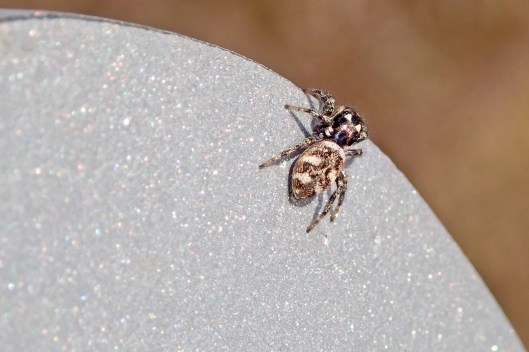
I almost squashed this cute little Zebra spider (Salticus scenicus) as I leant on the railings of a lookout to scan for birds in Cardiff Bay this morning. There were no unusual birds to be seen so the spider was an even more welcome sight.

My new guide book tells me there are three species of Salticus in the UK and all three have black-and-white stripes that are quite variable so, in theory, ‘microscopic examination of the genitalia is necessary to confirm identification’. However, the maps in the book also show that Salticus scenicus is the only species found in my area so I’m fairly sure this is the correct identification.

Like Loading...

Spider: Platnickina tincta

21 Friday Feb 2025

Posted by sconzani in spiders

≈ Leave a comment

Tags

arachnids, British arachnids, British spiders, Platnickina tincta

My local records centre SEWBReC, the South East Wales Biodiversity Records Centre, likes to support local recorders like me and has recently, very generously, given me a book grant, with which I’ve purchased guide books to help me identify spiders, craneflies and, yet to come when it’s published in October, a book about flies.

Now, I feel duty bound to look more closely at these creatures (of course, that’s why I chose these books), and this week I found a spider I’d never seen before. At first, I thought this tiny spider, just 2.5-3.5mm in length, was a Spitting spider but the size, location and daytime sighting didn’t fit – Spitting spiders are slightly larger, night time roamers and favour indoor locations, particularly museums for some reason. So, I posted some photos on social media, and got an almost instant answer from SEWBReC’s partner organisation Cofnod, the local environmental records centre for north Wales.

My spider is almost certainly an adult male Platnickina tincta, a species that’s usually found low down in shrubs and tree branches. It’s a bit of an opportunist it seems, feeding on other small spiders and stealing their prey from their webs. It’s uncommon in Wales; the Spider and Harvestman Recording Scheme website shows the distribution in Britain, where this species is abundant in the southeast but increasingly scarce as we track north and west.

Like Loading...

Red velvet mite

05 Saturday Oct 2024

Posted by sconzani in spiders

≈ Leave a comment

Tags

British spiders, Red velvet mite, Trombidiidae, velvet mite

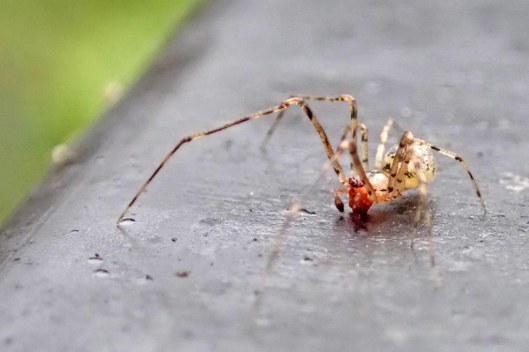
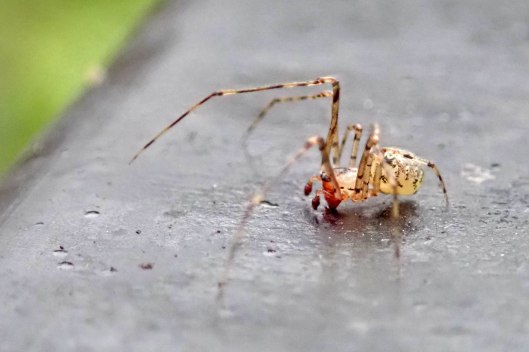
It’s amazing how many different creatures you can find when you look at the undersides of leaves: aphids, ladybirds, leafhoppers, craneflies, more aphids, barkflies, galls, leafmines, all kinds of weird and wonderful insect larvae, and lots of varieties of tiny spiders … like this little guy. Although its name is Red velvet mite (there are several and I don’t know which exact species this one is), it has eight legs, so is actually an arachnid. Being bright red makes these wee spiders very obvious and, with its covering of miniscule hairs, it really does look quite velvety.

241005 velvet mite

Like Loading...

The spider and the Speckled wood

13 Tuesday Aug 2024

Posted by sconzani in insects, spiders

≈ 2 Comments

Tags

British butterflies, British spiders, Crab spider, crab spider kills Speckled wood, Speckled wood, White crab spider

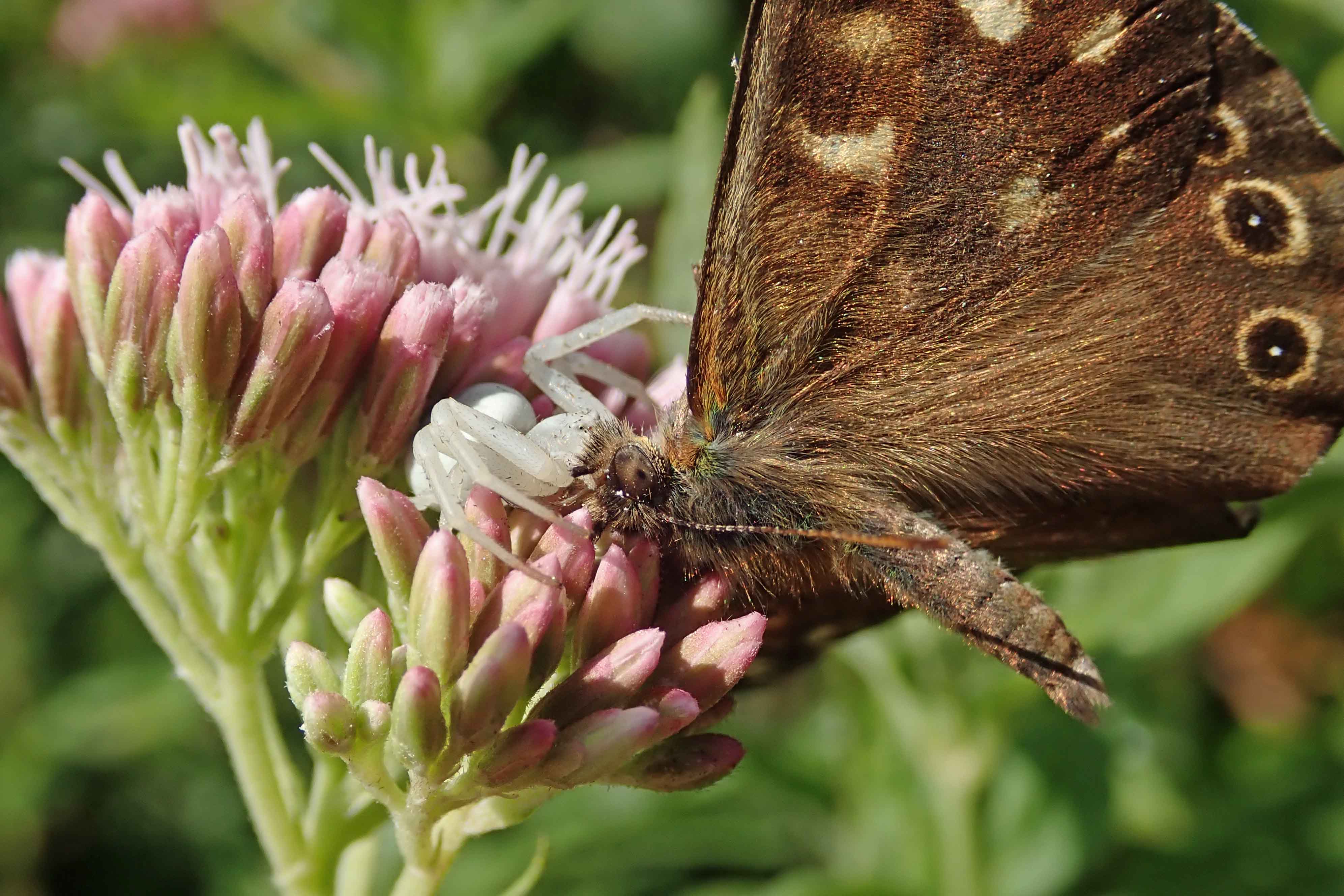
Me: ‘What on earth is that Speckled wood doing?’

240813 crab spider and speckled wood (1)

Speckled wood: ‘ . . . ‘
Crab spider: ‘Yum! Lunch!’

240813 crab spider and speckled wood (2)

Like Loading...

Cricket bat spider

18 Tuesday Jun 2024

Posted by sconzani in spiders

≈ Leave a comment

Tags

British spiders, Cricket bat spider, Mangora acalypha

I think you can easily see how this little arachnid got its common name of Cricket bat spider – the black shape on its abdomen does look very similar to a cricket bat and, to my eye, the three lines on the base of its abdomen also resemble the stumps, though that may just be my fanciful imagination.

240618 Cricket Bat spider

This is Mangora acalypha, which the Spider and Harvestman Recording Scheme website reports is mostly found in southern Wales and England, mostly on gorse bushes but also on other shrubs. These were the first two I’d ever seen and were on Creeping thistle and Common fleabane, in a field that once was farmed but is now re-wilding (though, sadly, the Welsh government has plans to build 500 houses in this location). You can read more details about this species and see a map of its distribution on the SHRS website.

Like Loading...
← Older posts
Newer posts →

About me

sconzani

sconzani

I'm a writer and photographer; researcher and blogger; birder and nature lover; countryside rambler and city strider; volunteer and biodiversity recorder.

View Full Profile →

Follow earthstar on WordPress.com

Enter your email address to follow this blog and receive notifications of new posts by email.

Recent blog posts

  • Red in beak and claw January 9, 2026
  • Who’s watching who? January 8, 2026
  • Springtail: Orchesella cincta January 7, 2026
  • A good year for Redwings January 6, 2026
  • Bug: Anthocoris nemorum January 5, 2026

From the archives

COPYRIGHT

Unless otherwise acknowledged, the text and photographs on this blog are my own and are subject to international copyright. Nothing may be downloaded or copied without my permission.

Fellow Earth Stars!

  • Unknown's avatar
  • Unknown's avatar
  • Unknown's avatar
  • Unknown's avatar
  • Unknown's avatar
  • Unknown's avatar
  • Unknown's avatar
  • Unknown's avatar
  • Unknown's avatar
  • Unknown's avatar
  • Unknown's avatar
  • Unknown's avatar
  • Unknown's avatar
  • Unknown's avatar
  • Unknown's avatar
  • Unknown's avatar
  • Unknown's avatar
  • Unknown's avatar
  • Unknown's avatar
  • Unknown's avatar
  • Unknown's avatar
  • Unknown's avatar
  • Unknown's avatar
  • Unknown's avatar
  • Unknown's avatar
  • Unknown's avatar
  • Unknown's avatar
  • Unknown's avatar
  • Unknown's avatar
  • Unknown's avatar
  • Unknown's avatar
  • Unknown's avatar
  • Unknown's avatar
  • Unknown's avatar
  • Unknown's avatar
  • Unknown's avatar
  • Unknown's avatar
  • Unknown's avatar
  • Unknown's avatar
  • Unknown's avatar
  • Unknown's avatar
  • Unknown's avatar
  • Unknown's avatar
  • Unknown's avatar
  • Unknown's avatar
  • Unknown's avatar
  • Unknown's avatar
  • Unknown's avatar
  • Unknown's avatar
  • Unknown's avatar

Blog at WordPress.com.

Privacy & Cookies: This site uses cookies. By continuing to use this website, you agree to their use.
To find out more, including how to control cookies, see here: Cookie Policy
  • Subscribe Subscribed
    • earthstar
    • Join 669 other subscribers
    • Already have a WordPress.com account? Log in now.
    • earthstar
    • Subscribe Subscribed
    • Sign up
    • Log in
    • Report this content
    • View site in Reader
    • Manage subscriptions
    • Collapse this bar
 

Loading Comments...
 

You must be logged in to post a comment.

    %d