My first sighting of Blackthorn blossom for 2021 has happened a bit later than last year – is that because the flowers are later or my lack of attention? I can’t tell but whichever, it’s another sign that spring is on its way!


16 Tuesday Feb 2021
My first sighting of Blackthorn blossom for 2021 has happened a bit later than last year – is that because the flowers are later or my lack of attention? I can’t tell but whichever, it’s another sign that spring is on its way!
24 Sunday Jan 2021
Holly flowers are tiny, tucked away in the crooks of branches, inconspicuous behind the mass of glossy evergreen leaves. And that’s my excuse for not having noticed them until quite recently.

I’ve since read that Holly (Ilex aquifolium) is dioecious, which, if you’ve been following this blog for a while, you might remember from my March 2020 post, Wild word : dioecious, means that Holly’s male and female flowers occur on separate trees. I think the flowers I found are male, as the female flowers have small green spheres in their centres, which, if pollinated, would grow in to the red berries we all associate with the Holly tree.


21 Thursday Jan 2021
Posted in trees
They call them pussy willows,
But there’s not a cat to see,
Except the little furry toes
That stick out on the tree.
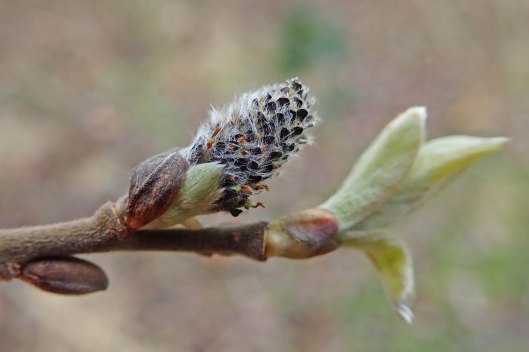
I think that very long ago
When I was just born new,
There must have been whole pussy cats,
Where just the toes stick through.


And every spring it worries me,
I cannot ever find
Those willow cats that ran away
And left their toes behind.
~ ‘The Willow Cats’, Margaret Widdemer (1884-1978), American poet, novelist, and Pulitzer Prize winner
12 Tuesday Jan 2021
These two fungi, found on Ash keys, were last week’s record of the week at my local biodiversity records centre, SEWBReC – not my record, that of another local recorder – but seeing this on Twitter last Friday reminded me to check the next Ash trees I saw. That opportunity came on Sunday’s walk and I found the fungi on just the second tree I passed by.

The two fungi are Diaporthe samaricola (the small black dots on the seed part of the key, on the left below) and Neosetophoma samarorum (the much smaller, black speckles on the wing part of the key, on the right in my photo). Both fungi are under-recorded in my area, so I’ll now be checking all the Ash keys I find.

01 Friday Jan 2021
Posted in trees
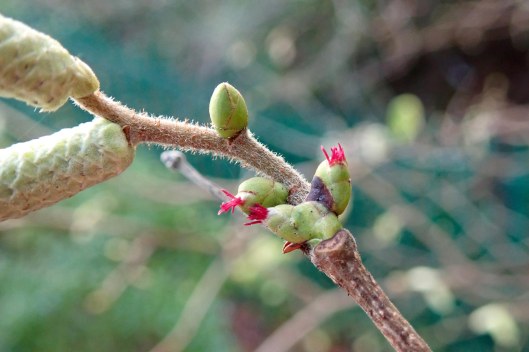
A new day, a new year, new life, new hope! One of the first things I noticed during today’s long New Year’s Day walk was these Hazel flowers, the tiny pink female flower and, nearby, the long droopy male catkin. And it made me feel hopeful. Though we humans enter 2021 beset by the devastation and grief of a global pandemic, the looming disasters of climate change and environmental destruction, and, in the UK, the self-inflicted damage of Brexit, yet Nature continues its cycles of life, shining a little glimmer of light in the darkness and gloom. Let’s cling to that light and let it inspire us to make 2021 a greener, more environmentally friendly year, for the future of our planet and ourselves.
18 Friday Dec 2020
Back in December 2016, I blogged about Alder brackets (Fungi Friday: Alder bracket) and showed then the gorgeous golden globules of liquid that ooze out of them when they’re young. Today’s Alder brackets (scientific name Inonotus radiatus), found in the woodland at Cosmeston Lakes Country Park, have a longer history.
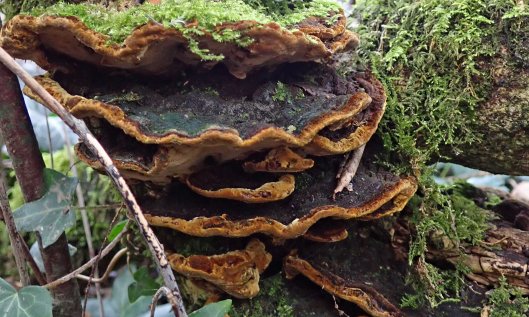
There is certainly some newer growth amongst these brackets but most have been on this Alder tree a long time, as you can tell from the luxuriant growth of moss on the top bracket of the tier.


15 Tuesday Dec 2020
Tags
Alder, birding, birdwatching, British birds, Carduelis spinus, Grangemoor Park, Siskin, Siskin feeding on Alder cones
Siskin (Carduelis spinus) are not finches I see very often so, when I heard their high-pitched whistles at Grangemoor Park last Saturday, I immediately looked up to try to spot them.

And there they were, perhaps six birds, feeding on Alder cones, high above me. There were other trees in my sightline and the light was shocking so it wasn’t easy to watch or photograph them.

Still, I lingered on the muddy path for 20 minutes or so, enjoying their upside-down feeding techniques, listening to their noisy interaction, enjoying the fleeting glints of yellow when the sun lit their feathers. What a treat!

10 Thursday Dec 2020
At first I thought this incredibly tiny creature was the early instar of a shield bug but, when I couldn’t find any pictures that resembled it on the British Bugs website, I turned to Twitter for help. Luckily, a botanist I know, Karen, had seen something similar posted recently in a Facebook group and very quickly supplied me with a name, Crypturaphis grassii, the Italian Alder aphid, so named because it’s only ever found on Italian Alder trees (Alnus cordata).
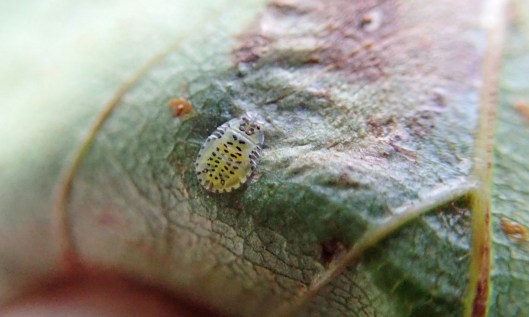
I found online a report published in 2011, on the first records of this species in Cornwall, which provides some interesting detail about these aphids. Apparently, Crypturaphis grassii is ‘native to southern Italy and Corsica and [was] first recorded in the UK in 1998’. Intrigued, I returned to the tree I’d found my first specimen on and found many more of these creatures, with variations in colour and markings. The report explains that:
Viviparous individuals [those able to birth live young] are yellowish-green to yellowish-brown, with brown spots extending along the dorsal surface, around the edge of the abdomen and on the head. Compound eyes are reddish in colour. … Immature apterae [wingless individuals] are similar but smaller, paler and lacking in dark spots, more translucent and slightly more elongate in shape. Oviparous apterae [wingless individuals that are able to lay eggs] are similar in size and shape to viviparous apterae but are brown in colour, with transverse darker abdominal stripes, rather than spots.
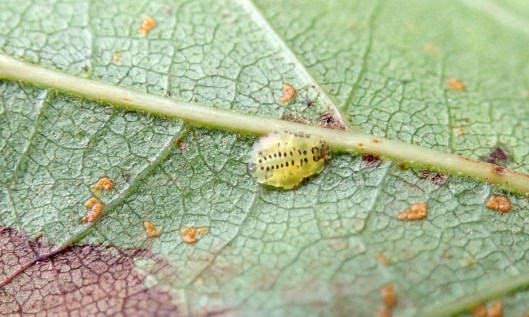


The Italian Alder, on which the aphid feeds, was ‘commonly planted as a roadside, waterside and/or windbreak species’ during the 1980s, and, by 2011 when the report was published, the aphids had already spread widely throughout Britain, including having established colonies in the Vale of Glamorgan, which is where I found the aphids in my photographs.

Citation: Luker, Sally. (2011). CRYPTURAPHIS GRASSII (STERNORRYNCHA: APHIDIDAE): FIRST RECORDS FOR CORNWALL. British Journal of Entomology and Natural History. 24. 205.
09 Wednesday Dec 2020
Do you see the small stick sitting on top of the big fallen branch, in the centre left of the photo? Well, that stick was the absolute highlight of my seven-and-a-half-mile walk yesterday.
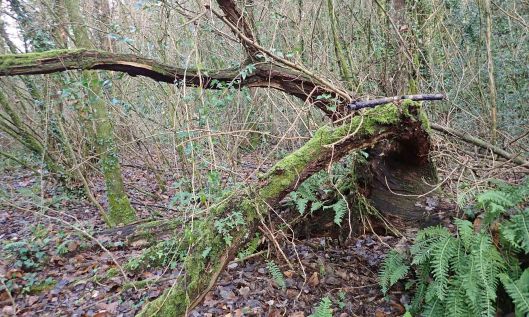
And below you can see why. This is the fungus Cobalt crust (Terana caerulea), an incredible colour to find growing on a stick in the middle of a now mostly brown woodland.
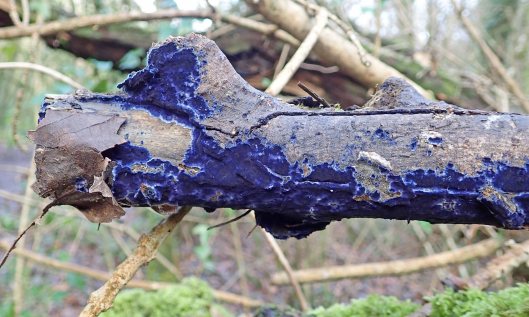
This is the first time I’ve found Cobalt crust locally and I was/am just so excited to see it. I might just have to go back next week for another look (and, also, to get photos of the red elfcups that were just beginning to appear nearby).

30 Monday Nov 2020
In his ‘Ode to a Nightingale’, Keats wrote of a ‘light-winged Dryad of the trees’ singing of summer in ‘some melodious plot of beechen green’. The beechen green has now become beechen gold and brown, but I can still imagine Dryads singing of the beauty of mighty Beech trees, in all their autumnal finery, and even performing paeans in praise of their statuesque forms once those golden leaves have fallen.


 earthstar
You must be logged in to post a comment.