‘I am rich today with autumn’s gold.’ ~ Gladys Harp



02 Thursday Nov 2017
‘I am rich today with autumn’s gold.’ ~ Gladys Harp
28 Saturday Oct 2017
Tags
Andricus kollari, gall wasps, galls on oak trees, hymenoptera in Oak marble galls, hymenoptera living in galls, Marble gall, oak galls, oak tree
Back in August, as part of a mini-series on some of the galls to be found on Oak trees, I posted about the Marble galls caused by the incredibly tiny wasp, Andricus kollari. Although most of the galls I’ve found have had tiny holes in them, meaning the wasps had already pupated and flown, a couple of weeks ago I found a couple with no holes. So, my curiosity got the better of me and I brought them home to see what might eventuate.
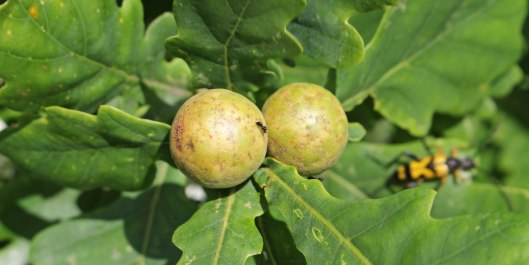
Note the tiny creature sitting on the gall.
Today, when I looked in the jar I’d put them in, I was so excited to see a tiny creature had appeared. Now, I initially thought this must be A. kollari, the gall-maker, but I was wrong … and, looking at images online, I don’t think I’m the only one who’s ever been fooled by this. However, with the help of friends who questioned and strangers who know much more than me, I’ve discovered there are at least 29 (twenty-nine!!) species of hymenoptera (bees, wasp, ants and sawflies) that might live within an Oak marble gall.


Though some of these critters simply use the gall for shelter, it seems that, for others, the gall tissue is a good source of nutrients, while still others are parasites whose larvae kill some or all of the larvae of the original gall-making wasp. Without detailed microscopic examination, I’m not able to determine which species this tiny wasp is but I thought you might like to see this little video of it performing its ablutions earlier. I have now released it back in the area where I found it so let’s hope it survives.
18 Wednesday Oct 2017
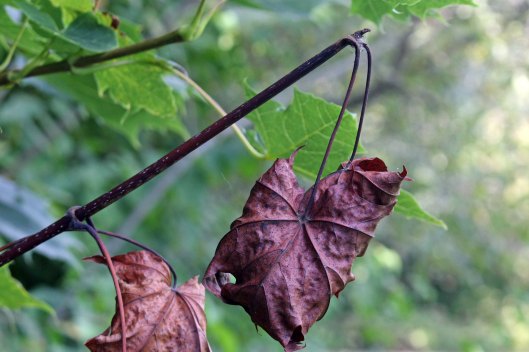
Thanks in part to following favourite author Robert Macfarlane (@RobGMacfarlane) on Twitter (he tweets a daily word) and in part to working through naturalist extraordinaire Dr Mary Gillham’s archives, I’ve been learning a lot of new words so I thought I would share the occasional one here. To start the stone rolling, we have marcescent, an adjective, which the Oxford Dictionary defines as ‘withering but remaining attached to the stem’. This is particularly noticeable during autumn and winter, as the leaves of some trees wilt and fade but remained attached to their branches. Some palms continuously retain a marcescent ‘skirt’ of dried fronds, and the term is, apparently, also used to refer to those species of fungi that can dry out but subsequently be rehydrated and continue to shed spores.
14 Saturday Oct 2017
Tags
autumn colour, autumn fruit, autumn seeds, Euonymus europaea, fruit, orange seeds, pink fruit, seeds, Spindle
I’m still pretty useless at identifying native British trees: I can get most of the more common big species, like Oak and Ash and Beech, but I probably couldn’t identify a Spindle if you paid me … except at this time of year. Because in the autumn, the Spindle (Euonymus europaea) lights up in psychedelic colours that remind me of a dress I had in the ’70s (yes, I am that old!).

The Spindle (so named because its wood was used to make the spindles used to hold wool and in spinning) has fruits that are hot pink. And not only that … when those fruits open up, the seed inside is bright orange. It’s such an outrageous colour combination that it makes me wonder why it’s so very bright … and I haven’t found the answer. I thought perhaps the orange was a way to attract birds and many websites say the seeds are eaten by small birds like Robins and Tits but, when I google images, I can’t find any showing birds actually eating them. The other alternative is that the colour is a ‘don’t touch me I’m poisonous’ warning – and certainly the fruits are poisonous to humans but to birds? If anyone has any information about this eye-popping colour combination, I’d love to hear it. Meantime, put on your shades and check out these psychedelics, man.


03 Tuesday Oct 2017
Tags
Cecidomyia salicis-folii, gall flies, gall midges, gall on Salix caprea, gall on willow, galls, Iteomyia capraea
Today’s and tomorrow’s galls are not on the gall-beleaguered Oak tree and, for a change, they are not caused by wasps, as so many galls seem to be. These two galls are caused by tiny members of the enormous order of flies, the Diptera.
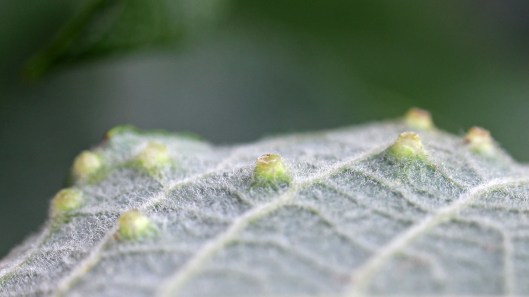
Today’s is Iteomyia capraea (sometimes known as Cecidomyia salicis-folii) (Cecidomyiidae is the family name for gall midges or gall flies). I think I would need better specs to actually see the midge that laid its eggs on this Goat willow (Salix caprea) leaf as it’s only 2-3mm long. Indeed, the galls themselves were pretty small (5-8mm), as you can see from the leafy picture below. When they hatch, the larvae of the midge feed within the leaf tissue causing the willow to develop a gall, sometimes on the midrib of the leaf, sometimes on a thick side vein. I’ve read one report that the larvae are white, another that they are an orange-red colour but I didn’t open up any of the galls for a look at the larva inside so I can’t confirm either report.


I’ve not been able to discover much about Iteomyia capraea. There are only 215 records showing in the NBN (National Biodiversity Network) database for the whole of Britain, 45 of which are in Wales, but I think that is more a reflection on the under-recording of galls that the rarity of the midge itself. Apparently, the species only breeds a single generation per year and they hibernate over winter in the soil underneath their host tree.
02 Monday Oct 2017
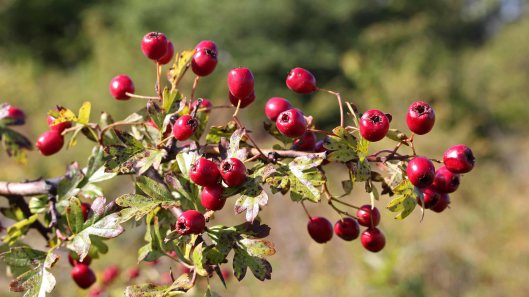
‘Autumn is the mellower season, and what we lose in flowers we more than gain in fruits.’ ~ Samuel Butler, though in this case it’s more about what all the birds and mini-beasts gain in fruits.


18 Monday Sep 2017
Tags
Andricus aries, gall wasps, galls on oak trees, Neuroterus numismalis, oak galls, oak tree, Ram’s-horn gall wasp, Silk button gall wasp
I can’t resist just one more post about oak galls, because I’ve just this week found one that’s not commonly recorded. So, today we have one that’s uncommon and one that’s very common. Let’s start with the former.
First identified in eastern Europe in 1859, the Ram’s-horn gall wasp, Andricus aries, has slowly been heading westwards and finally reached Britain in 1997. Since that first sighting in Berkshire, it has spread over much of southern England and into Wales. Though there are only a few records in the Aderyn database of Welsh biological records, two of my friends have also found Ram’s-horn galls in the past week so I suspect it’s more common that records suggest.


Like other gall-inducing wasps, Andricus aries lays its eggs on various species of oak and its larvae cause the oak to produce a gall, in this case with an elongated, sometimes spiralling shape, hence aries and its common name Ram’s-horn. Not much is yet known about this wasp, so if you see the gall, please do record it.
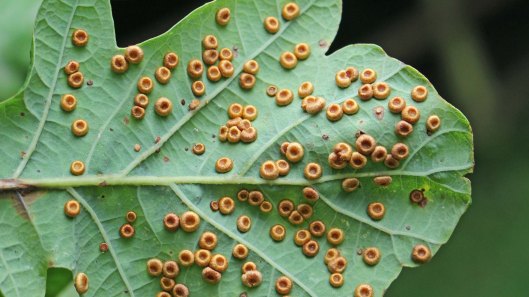
My second gall today is one many people will have seen, I’m sure, as its beautifully crafted silk-like button-shaped galls are very common on the undersides of oak leaves during the summer months. This gall contains the agamic generation (females needing no males to reproduce) of the Silk button gall wasp, Neuroterus numismalis. The galls fall to the ground in autumn and the larvae within pupate over the winter months. When the all-female wasps emerge in springtime, they lay their eggs on the edges of oak leaves and on the male catkins, where their larvae cause a different blister-shaped gall – that’s another one for me to seek out next spring. It is the female and male wasps of this second, sexual generation produced in the Blister gall that go on to mate and lay the eggs that result in the silk buttons. And so the cycle continues …


09 Saturday Sep 2017
Tags
gall wasps, galls on oak trees, Neuroterus albipes, Neuroterus anthracinus, Oak gall wasps, oak galls, oak tree, Oyster gall, Smotth spangle gall
I know you’re all just dying to find out more about oak galls, right? RIGHT? I also know that I covered spangles in a previous post (see Currants & spangles here) but there are two different spangle galls to be found on the much be-galled oak tree: one is the hairy Common spangle and this is the second, the Smooth spangle gall.
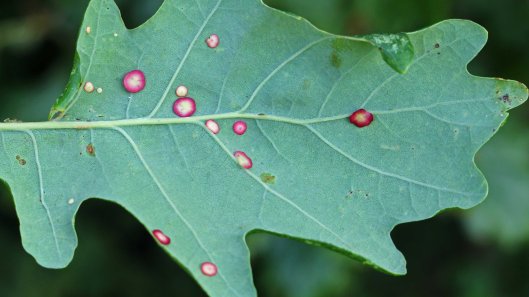
This pretty little gall comes in combinations of pink and yellowish-green. It’s the work of Neuroterus albipes, a tiny wasp that you will probably never see, and inside each colourful saucer is a single larva that you will also probably never see. The galls drop to the ground in autumn and the larvae pupate over winter then female-only wasps hatch out in Spring to lay eggs that cause the entirely different Schenck’s gall (not one I’ve yet seen), from which male and female wasp hatch in the summertime. And so the cycle begins again.


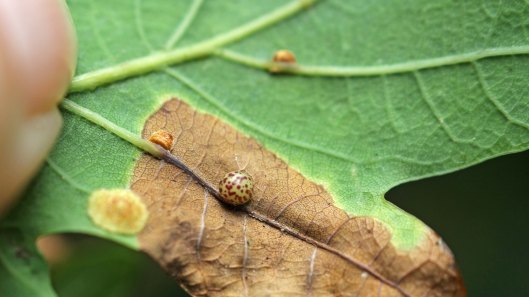
This second gall, the Oyster gall, is also caused by a tiny wasp that has two distinct generations and forms two different galls. The wasp is Neuroterus anthracinus and the Oyster gall also contains the agamic generation of wasps (i.e. the females that need no males to fertilise their eggs). As you can see, these galls form on the veins on the undersides of oak leaves – once they’ve fallen to the ground, you can still see the two brown flaps of tissue where they were attached to the veins.


Once again, the sexual generation of wasps hatch in the Spring to mate and lay their eggs, this time in the buds of the oak tree, hence the name of the gall they produce: the April-bud gall. That’s another I need to look out for come the Spring.
24 Thursday Aug 2017
Tags
Andricus kollari, Biorhiza pallida, gall wasps, galls on oak trees, Marble galls, Oak apple galls, Oak apples, oak galls, Oak marbles, oak tree
Though there are many more galls to be found on oak trees than the six I have covered in this and my previous two posts (knoppers and artichokes, and currants and spangles), I’ll make this the last lot for now. Otherwise, it might be just too galling for words!

So, to finish off this mini series, today we have Marble and Apple galls. Let’s start with the Marble galls and another tiny wasp, Andricus kollari, which lays its eggs on the twigs of any species of oak. This causes small perfectly round spheres to develop on these twigs. The spheres start off green but brown with age and will often remain on the twigs for a year or more. You can tell that the wasp has fled its larval home when you see tiny holes in the sphere. And although these do look just like brown marbles, I’m not sure you could use them to play the once-popular childhood game – they’re a little too light to shoot with.


And so to Oak apples. With their basic green colour and pink tinges, these do resemble immature apples but their surface texture and spongy feel are all wrong. The wasp Biorhiza pallida is the culprit this time, and these ‘apples’ contain several larvae, not just one.


Like many such wasps, both the Marble gall wasp and the Apple gall wasp have a sexual and an agamic (asexual) reproduction cycle. I have not seen the sexual galls produced by Andricus kollari which, interestingly, are produced only on Turkey oak (Quercus cerris) – the Marble galls are produced by the agamic (all female, no mating required) generation. Oak apple galls are produced by the sexual generation of Biorhiza pallida: the agamic generation lay their eggs on the roots of oak trees, so I haven’t seen those yet either.

I find the whole concept of two different types of reproduction and, indeed, the way these wasps can cause such galls to form very intriguing!
23 Wednesday Aug 2017
Tags
Andricus foecundatrix, Andriscus quercuscalicis, Artichoke gall, galls caused by wasps, galls on oak trees, Knopper gall, oak galls, Oak hop gall, oak tree, Pedunculate Oak, Quercus petraea, Quercus robur, Sessile oak
Following quickly on from yesterday’s oak galls, part 1, we have oak attack, part 2, a sorry tale of knoppers and artichokes – and, no, you can’t eat them!


First the knoppers, which are caused by Andriscus quercuscalicis, a wasp with chemical weapons. The wasp lays its eggs in buds on oak trees and the larvae, when they hatch, secrete a chemical that causes the developing acorn to distort into a knobbly lump, thus forming a home for themselves. The galls are structurally interesting but not so good for the oak tree, as the acorn is no longer a viable seed for the tree and I presume the knopper gall also makes the acorn unsuitable as food for wildlife as well. Apparently, this wasp only arrived in Britain in the 1960s but its spread has been rapid, with the galls now found throughout Wales and England and in southern Scotland, though only on the Pedunculate oak (Quercus robur).


Artichoke galls – also known as hop galls due to their resemblance to flower of the hop plant – are also the result of chemical distortion by a wasp. This time it’s Andricus foecundatrix that does the damage. Using its sharp ovipositor, it lays its eggs in the leaf buds of both the Pedunculate oak and the Sessile oak (Quercus petraea). Like yesterday’s Spangle-causing wasp, Andricus foecundatrix also has both a sexual and an asexual generation. The asexual wasp hatches from her artichoke home in the springtime and lays her eggs in oak catkins, causing a small oval-shaped gall to develop – I don’t yet have any photos of these galls but you can see images here.
 earthstar
You must be logged in to post a comment.