• ABOUT
  • BIRDING 2018
  • Birding 2019
  • BLOG POSTS
  • Butterflies 2018
  • Resources

earthstar

~ a celebration of nature

earthstar

Category Archives: trees

Juniper shieldbug

03 Tuesday Jun 2025

Posted by sconzani in insects, trees

≈ Leave a comment

Tags

British shieldbugs, Cyphostethus tristriatus, Juniper shieldbug, shieldbug on Juniper, shieldbug on Lawson's cypress

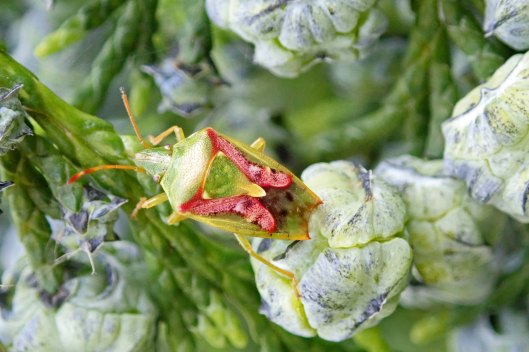
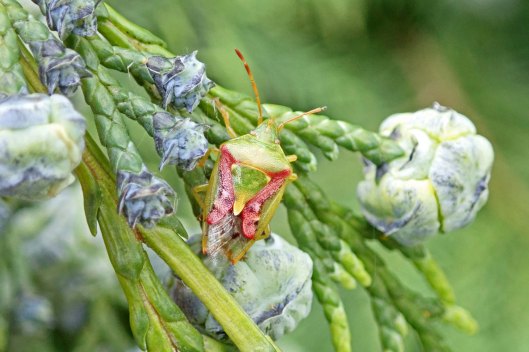
This is a bug I never thought I’d see locally as I don’t know any locations where Juniper trees grow. Fortunately for me, and as stated on the British Bugs website, the Juniper shieldbug (Cyphostethus tristriatus) has started living on Lawson’s cypress (Chamaecyparis lawsoniana) as well as its traditional host tree, the Juniper (Juniperus communis) for which it is named. And Lawson’s cypress is a popular planting in gardens and parks, which is where this tree was growing, alongside a path that runs around a local recreation ground.

British Bugs explains that adult Juniper shieldbugs, with the beautiful reddish-pink markings on their backs, can be seen all year round, though they tend not to be too active during the coldest winter months, like most of us. The nymphs that hatch from mid to late Spring feed on Juniper and Cypress berries and, like all shieldbugs, they go through a series of instars before reaching adulthood. The website has excellent, illustrated downloadable charts of the various stages of most shieldbug species for easy identification if you happen to spot a nymph and, now that I know where this Juniper shieldbug lives, I’ll have to go back and look for more, adults and nymphs.

Like Loading...

Galls: Macrodiplosis pustularis

02 Monday Jun 2025

Posted by sconzani in insects, trees

≈ Leave a comment

Tags

British galls, Cecidomyiidae, folded leaf lobes on Oak leaves, gall midges, galls on Oak leaves, insects on Oak, Macrodiplosis pustularis

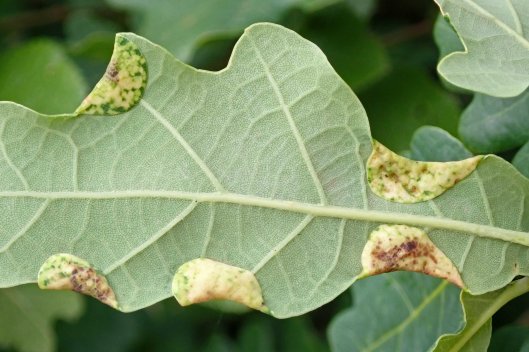
In my ignorance, when I first saw these folded-over leaf lobes on an Oak tree in a local park, I thought they had been created by leaf-mining moth larvae. Fortunately, there are much smarter people around than me and, when I posted some photos on social media, one of them popped up and told me what these really were: galls made by the larvae of the gall midge, Macrodiplosis pustularis.

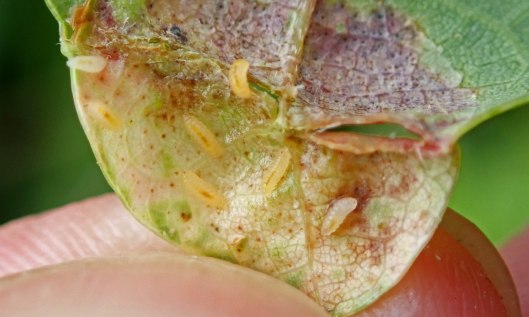
Of course, once I knew that I had to return to the spot and pull up a couple of the folds to see the tiny larvae. The numbers inside can vary, apparently, from one to six or more. They are white when young but change to an orange colour as they develop.

The fold of the leaf is both a means of protection for the vulnerable larvae and also a food larder; they eat the leaf from the inside. Eventually, the larvae will drop from their leaf shelters, pupate and remain in the soil until the following Spring, when the whole process begins again.

Like Loading...

Leafmines: Orchestes alni

28 Monday Apr 2025

Posted by sconzani in insects, trees

≈ Leave a comment

Tags

British leafmines, British weevils, leaf-mining weevil larvae, leafmines on Wych elm, Orchestes alni, weevil leafmines, weevils on Elm species

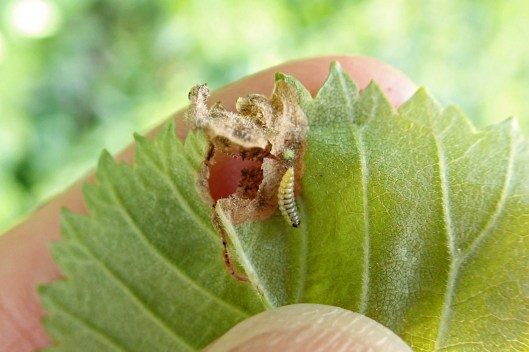
It seems, from my online research, that some of my North American readers may consider today’s creature a pest (see, for example, this web page from The Morton Arboretum in Illinois) but, here in Britain, sightings are few and far between; my find was the first in my local 10km area since 1916, and only 20 records are showing in the Welsh biodiversity database.

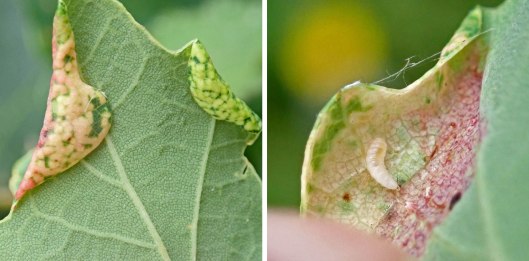
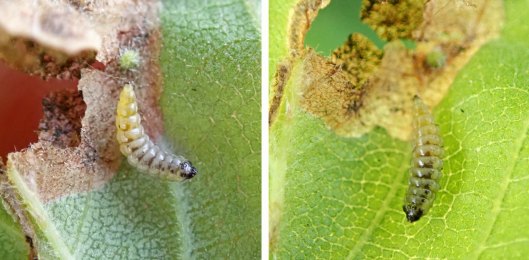
Making a change from the usual moth and fly larvae leafminers, today’s mines were made by the larvae of a weevil, Orchestes alni, also known as the European elm flea weevil. The adult female weevil lays her eggs inside the midrib of a leaf on one of the Elm species, in this case on Wych elm (Ulmus glabra); you might just be able to make out the scar in the midrib of the underside of the leaf, shown in the photo on the right above. Once hatched, the tiny larva burrows into the leaf, initially creating a gallery mine running towards the leaf edge, then the mine widens out to a blotch. When it’s eaten its fill and the time is right, the larva spins itself a cocoon and pupates within the mine. The hole in the leaf shown above indicates that the adult weevil has emerged from its cocoon and exited the mine.

I found several mines on this one Wych elm, and most were already empty – this leafminer starts early in the season – but a couple were still occupied. As I didn’t think I would be damaging the weevil population and, yes, I was curious – I’d never seen a weevil larva before – I opened one of the mines. So, now you get to see a tiny weevil larva as well.

There is another weevil that also mines the leaves of Elm species, Orchestes betuleti, but, as I wrote above, Orchestes alni starts early in the season, whereas O. betuleti doesn’t usually begin egg-laying until May.

Like Loading...

Mystery: on a pine tree

10 Thursday Apr 2025

Posted by sconzani in insects, trees

≈ Leave a comment

Tags

mystery egg sac, mystery insect, mystery object on pine tree, mystery pupa, mystery pupal case, pine

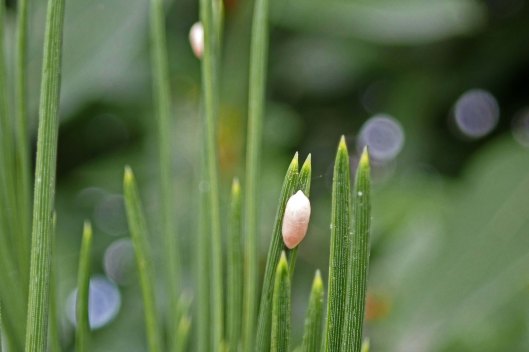
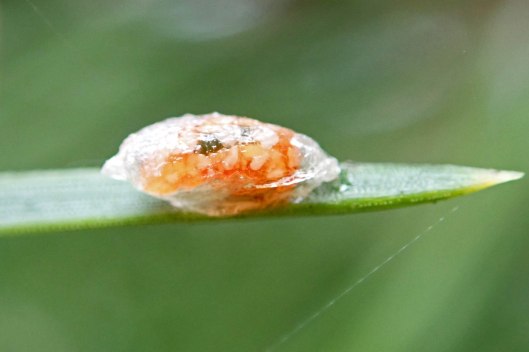
As the spring and summer progress, this first ‘mystery’ post may well develop in to a mystery series, depending on how many intriguing things I manage to find and how many I don’t manage to identify. These first mystery items were found recently when I was looking more closely than usual at Pine trees to see if I could spot any more Pine ladybirds. I did find one more of those lovely creatures but I also found these ‘things’, dotted sparsely around, attached to the Pine needles.

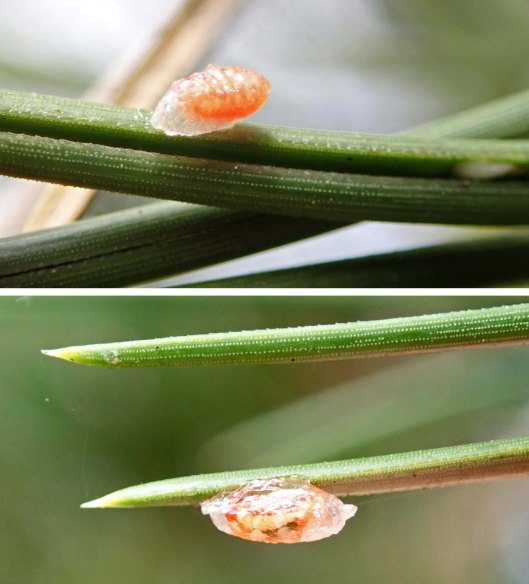
No amount of googling has produced any similar images or information and, when I asked for help on social media, I was inundated with helpful people saying they were Pine scale, which, after checking the lifecycle of those scales, I’m fairly sure they’re not. They look to me like some kind of egg sac or pupal case, with a tiny creature growing and developing inside.

In an attempt to solve the mystery, I plucked a couple of Pine needles, with the things attached, off one tree, and I’ve brought them home, stuck them in a jar on my kitchen window sill. Whether or not something will emerge remains to be seen and, rest assured, I will definitely write another blog post if that does happen. In the meantime, if any of you has any bright ideas, please do share them in the comments.

Like Loading...

Staring at willows

21 Friday Mar 2025

Posted by sconzani in insects, spring, trees

≈ Leave a comment

Tags

Bombus hypnorum, Bombus terrestris, Brimstone, British butterflies, Buff-tailed bumblebee, butterflies feeding on willow flowers, insects feeding on willow flowers, insects on willow, Small tortoiseshell, Tree bumblebee, willow

This is your occasional reminder, if you are interested in spotting flying insects, that it is a very good idea at this time of year, when the various willows (Salix species) are coming in to flower, to spend a little staring at these trees. That is partly how I came to find so many butterflies yesterday. Several of the Brimstones I saw, in particular the two females that were feeding up prior to egg-laying, and the beautiful Small tortoiseshell were all found initially on willow flowers.

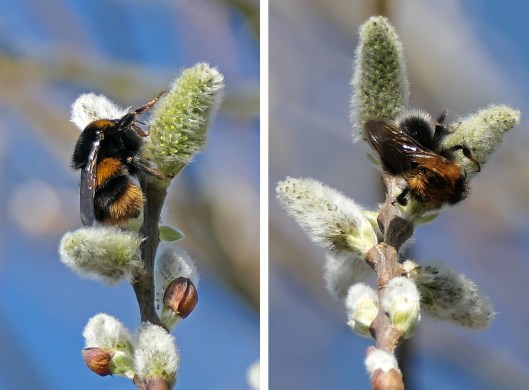
The fluffy yellow flowers were also providing much needed sustenance for a variety of flies, for honey bees and hoverflies. Due to their larger size, I was also able to see at least two species of bumblebee, Buff-tailed (Bombus terrestris) (left below) and Tree bumblebee (Bombus hypnorum) (below right).

Like Loading...

Elm bark beetle

19 Wednesday Feb 2025

Posted by sconzani in insects, trees

≈ Leave a comment

Tags

dead Wych elm, Dutch Elm disease, elm bark beetle, elm bark beetle tunnels, Large elm bark beetle, Scolytus scolytus, Wych elm

After last Friday’s post about the Velvet shanks I’d found on a dead Wych elm, it occurred to me that I couldn’t recall seeing any traces of the elm bark beetles (likely the Large elm bark beetle Scolytus scolytus, according to an article on the Forest Research website) that carry the fungus that killed the tree. So, I went back for another look, and it turns out I hadn’t looked closely enough: there were signs of beetle activity all over the exposed areas of trunk where bark had fallen away and this showed up much more clearly on the darker underside of the bark itself.

During the summer, the female elm bark beetle drills a hole through the tree’s bark, then creates a long straight burrow (called the mother tunnel) under the bark. As she excavates, she lays eggs and, when the larvae hatch they create their own tunnels outwards from the mother tunnel. If the effects of their presence weren’t so deadly, the tunnels could almost be viewed as tiny works of art.

Like Loading...

Velvet shanks and a Wych elm

14 Friday Feb 2025

Posted by sconzani in fungi, insects, trees

≈ Leave a comment

Tags

British fungi, Flammulina velutipes, fungi on dead Wych elm, fungi on standing dead wood, Velvet shanks

The tree where I found these lush Velvet shanks growing was the Wych elm where, in October 2021, I found my first ever Elm zigzag sawfly larvae (Aproceros leucopoda), the first of this invasive species to be recorded in Wales (see my blog post Zorro comes to Wales). Now, that tree and several other young Wych elms growing in the margins of this field are all dead, presumably as a result of another invasive species, the fungus that causes Dutch elm disease (Ophiostoma novo-ulmi).

The Elm zigzag sawflies have spread well beyond this field now so won’t be affected by the tree’s death, and, though, presumably, the Dutch elm disease fungus dies when its host tree has died, it will continue to spread as it’s carried to new trees by Elm bark beetles (Scolytus species).

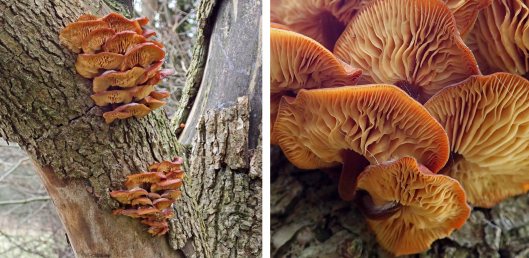
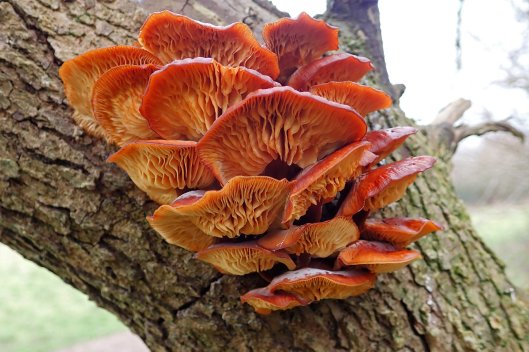
Yet, as with all living organisms, the death of one brings life-giving opportunities for others. So, though dead, the Wych elm is now providing sustenance to invertebrates that thrive in decaying wood and to the lovely Velvet shanks (Flammulina velutipes) that are specialists in devouring standing dead wood. Some of the clumps of Velvet shanks had already completed their lifecycle and were themselves rotting away but, as you can see in my photos below, more were oozing from the cracks in the tree’s trunk and branches.

Like Loading...

Leafmines: Stigmella atricapitella

02 Monday Dec 2024

Posted by sconzani in insects, leaves, trees

≈ 2 Comments

Tags

British leafminers, British moths, leaf-mining moth larvae, leafmines on Oak, Stigmella roborella

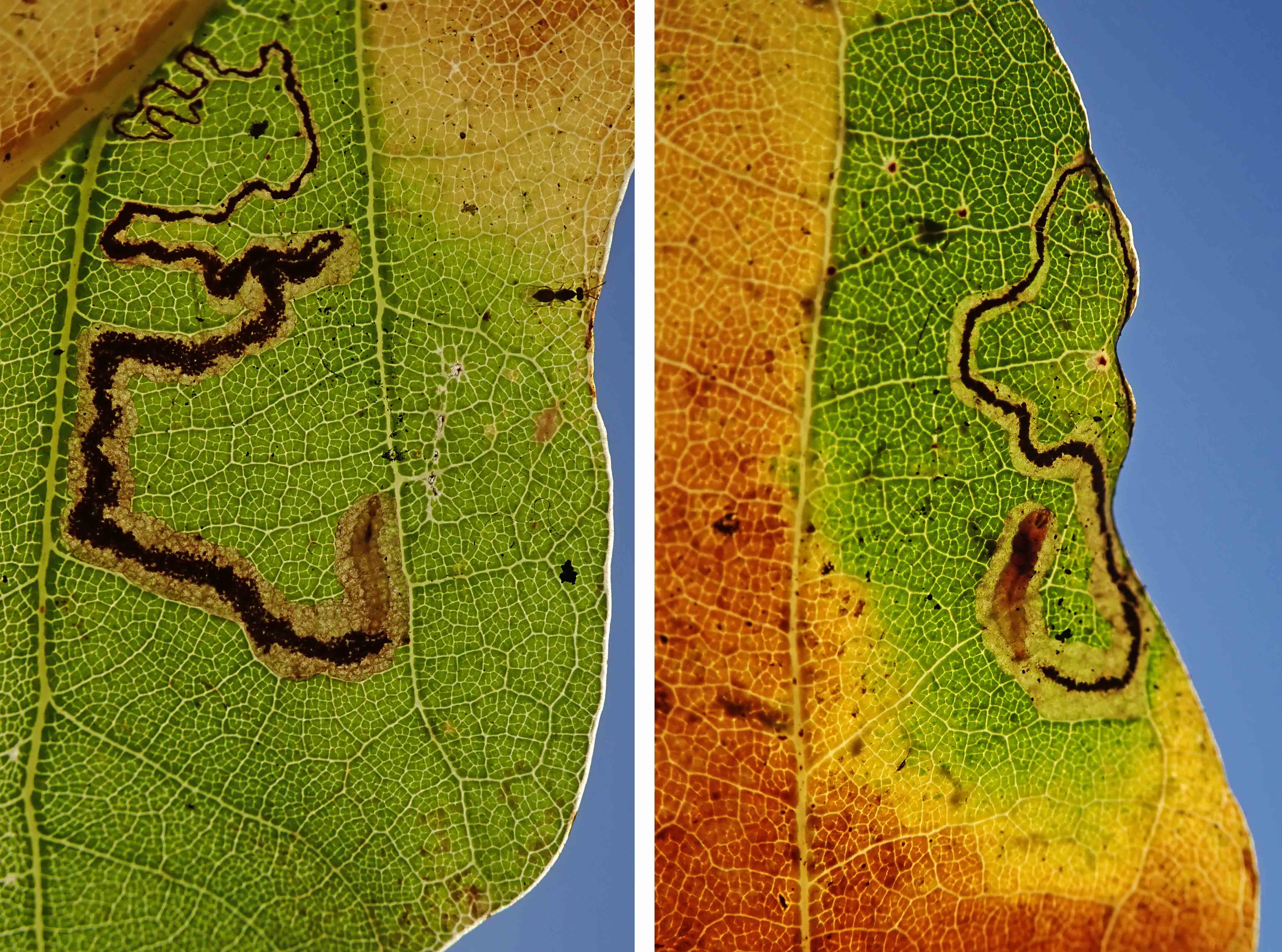
This is the third of the three new leafminers in ‘green islands’ on fallen Oak leaves that I found during one 30-minute period checking leaves in a local park. These are the work of the moth Stigmella atricapitella, the larvae of which you can see inside the mines shown below.

241202 Stigmella atricapitella

This moth breeds twice each year, so the mines can be seen in June – July and again between September and November, though the mines differ slightly each time (see the information on the British Leafminers website). It is possible to confuse these leafmines with those of Stigmella roborella but, fortunately, S. atricapitella has ‘dark prothoracic sclerites’, the dark marks you can see just below the head of the larvae in my images.

Like Loading...

Leafmines: Ectoedemia subbimaculella

25 Monday Nov 2024

Posted by sconzani in insects, leaves, trees

≈ Leave a comment

Tags

British leafminers, British moth larvae, Ectoedemia subbimaculella, leaf-mining moth larvae, leafmines on Oak, Oak leafminers

This is the second of the three new leafminers I recently found in ‘green islands’ on fallen Oak leaves during half an hour’s fossicking in one of my local parks. And this one, both the adult you can see on the UK Moths website and the mine of its larva, is very similar to the first of the three I blogged about (Leafmines: Ectoedemia heringi, 18 November).

241125 Ectoedemia subbimaculella (1)

Active during October and November, today’s leafmines were created by the larvae of the moth Ectoedemia subbimaculella, and the difference between the mines of the two species is the slit in the lower part of the mine, on the under side of the leaf, of this one. If you want further information and to see additional, better photos, check out the entry on the British Leafminers website.

241125 Ectoedemia subbimaculella (2)

Like Loading...

Leafmines: Ectoedemia heringi

18 Monday Nov 2024

Posted by sconzani in leaves, trees

≈ Leave a comment

Tags

British moths, Ectoedemia heringi, leaf-mining larvae on Oak leaves, leaf-mining moth larvae, moth larvae on Oak, Oak leafmines

There’s a local park I don’t often visit as it’s a bit too managed for my liking but, recently, when I didn’t have time for a longer walk, I headed in that direction. And I’m very glad I did as, during one 30-minute period of fossicking through fallen Oak leaves, I found three new leafminers, all feeding in the ‘green islands’ their own chemicals had induced in the leaves. This is the first, Ectoedemia heringi, distinguishable from a similar species Ectoedemia albifasciella by the brown head seen here on the larva in the mine. You can read more about this species on the British Leafminers website and see the very attractive adult moth on the UK Moths website.

241118 Ectoedemia heringi

Like Loading...
← Older posts
Newer posts →

About me

sconzani

sconzani

I'm a writer and photographer; researcher and blogger; birder and nature lover; countryside rambler and city strider; volunteer and biodiversity recorder.

View Full Profile →

Follow earthstar on WordPress.com

Enter your email address to follow this blog and receive notifications of new posts by email.

Recent blog posts

  • M is for mite December 18, 2025
  • L is for lepidopteran lifers December 17, 2025
  • K is for Keeled skimmers December 16, 2025
  • J is for Jersey tiger December 15, 2025
  • I is for Ichneumon December 14, 2025

From the archives

COPYRIGHT

Unless otherwise acknowledged, the text and photographs on this blog are my own and are subject to international copyright. Nothing may be downloaded or copied without my permission.

Fellow Earth Stars!

  • Unknown's avatar
  • Unknown's avatar
  • Unknown's avatar
  • Unknown's avatar
  • Unknown's avatar
  • Unknown's avatar
  • Unknown's avatar
  • Unknown's avatar
  • Unknown's avatar
  • Unknown's avatar
  • Unknown's avatar
  • Unknown's avatar
  • Unknown's avatar
  • Unknown's avatar
  • Unknown's avatar
  • Unknown's avatar
  • Unknown's avatar
  • Unknown's avatar
  • Unknown's avatar
  • Unknown's avatar
  • Unknown's avatar
  • Unknown's avatar
  • Unknown's avatar
  • Unknown's avatar
  • Unknown's avatar
  • Unknown's avatar
  • Unknown's avatar
  • Unknown's avatar
  • Unknown's avatar
  • Unknown's avatar
  • Unknown's avatar
  • Unknown's avatar
  • Unknown's avatar
  • Unknown's avatar
  • Unknown's avatar
  • Unknown's avatar
  • Unknown's avatar
  • Unknown's avatar
  • Unknown's avatar
  • Unknown's avatar
  • Unknown's avatar
  • Unknown's avatar
  • Unknown's avatar
  • Unknown's avatar
  • Unknown's avatar
  • Unknown's avatar
  • Unknown's avatar
  • Unknown's avatar
  • Unknown's avatar
  • Unknown's avatar

Blog at WordPress.com.

Privacy & Cookies: This site uses cookies. By continuing to use this website, you agree to their use.
To find out more, including how to control cookies, see here: Cookie Policy
  • Subscribe Subscribed
    • earthstar
    • Join 667 other subscribers
    • Already have a WordPress.com account? Log in now.
    • earthstar
    • Subscribe Subscribed
    • Sign up
    • Log in
    • Report this content
    • View site in Reader
    • Manage subscriptions
    • Collapse this bar
 

Loading Comments...
 

You must be logged in to post a comment.

    %d