• ABOUT
  • BIRDING 2018
  • Birding 2019
  • BLOG POSTS
  • Butterflies 2018
  • Resources

earthstar

~ a celebration of nature

earthstar

Category Archives: trees

Leafmines: Phyllonorycter viminiella

20 Monday Nov 2023

Posted by sconzani in insects, leaves, trees

≈ Leave a comment

Tags

British leafminers, British moths, leaf-mining moth larvae, leaf-mining moths, leafmines on willow, Phyllonorycter viminiella

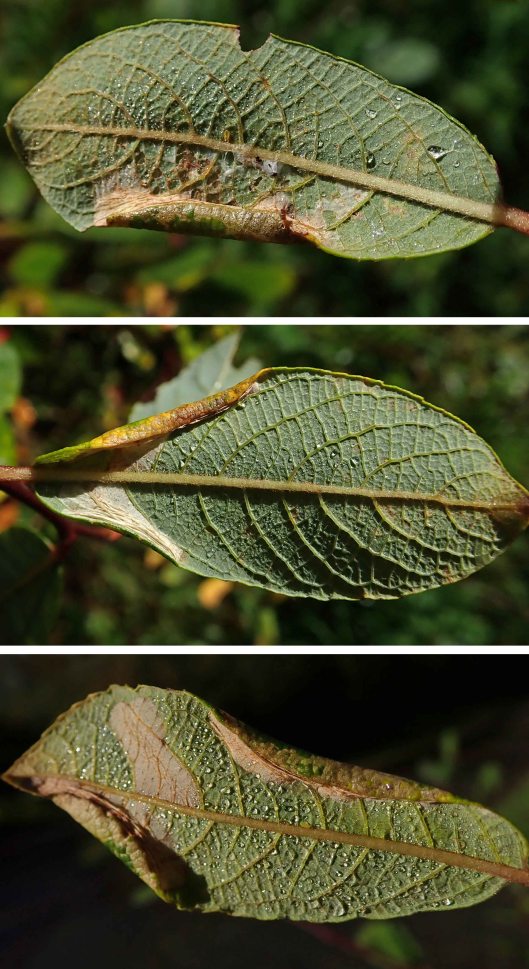
This was just the second time I’ve spotted these particular leafmines: they got a mention in On narrow-leaved willows, 26 December 2022, but I thought they deserved their own post. The larvae of the moth Phyllonorycter viminiella munch on the underside of Willows (usually those Salix species with smooth leaves), their feeding causing the edges of leaves to fold over and develop strong creasing in the mine, as you can see in my images below. These attractive little moths are bivoltine, so you can find the larval mines first around July and then again around October.

Like Loading...

Leaf grazers: Carcina quercana

06 Monday Nov 2023

Posted by sconzani in insects, plants, trees

≈ Leave a comment

Tags

British moths, Carcina quarcana, leaf-grazing moth larvae, moth larvae on Blackthorn, moth larvae on Bramble, moth larvae on Buckthorn, moth larval foodplants

I found these first on Blackthorn when looking for leafminers but couldn’t find any examples on the British Leafminers website, so I posted photos on Twitter and asked my ecologically minded followers ‘what’s this?’.

231106 Carcina quercana on blackthorn

The response was almost instant: ‘Carcina quercana does that on several trees. The silk tube is always against the midrib or a vein and they venture out to graze from there’.

231106 carcina quercana on bramble

Carcina quercana is a lovely little moth and the little silken tubes are created by its larvae. The UK Moths website says ‘The foodplants are various deciduous trees, including oak (Quercus) [hence the quercana, in its name] and beech (Fagus)’, but, as my examples here show, the larvae don’t seem too fussy about what they eat. My photos here, showing both the upper and lower sides of the leaves, are on Blackthorn, Bramble, and Buckthorn.

231106 carcina quercana on buckthorn (1)

And why did I not find this species on the British Leafminers website? Well, strictly speaking, it’s not a miner – the larvae graze on the underside of the leaf when they venture out from their protective silken homes. You might just be able to spot the larva in the photo below.

231106 carcina quercana on buckthorn (2)

Like Loading...

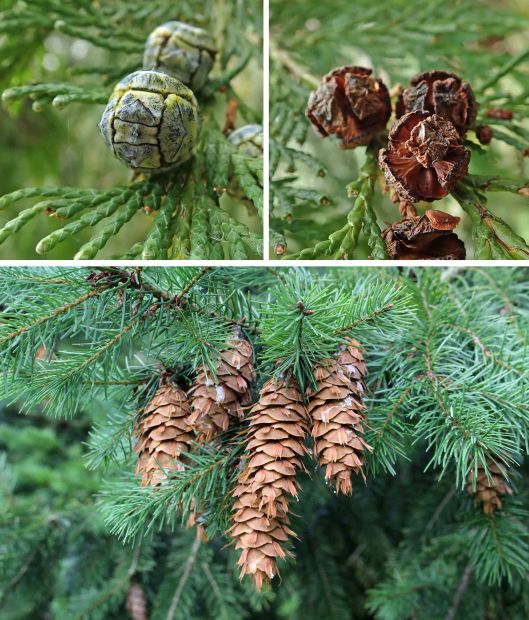
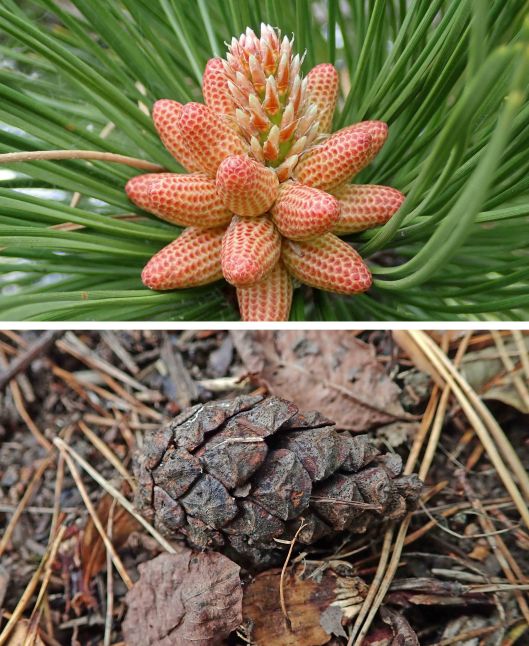
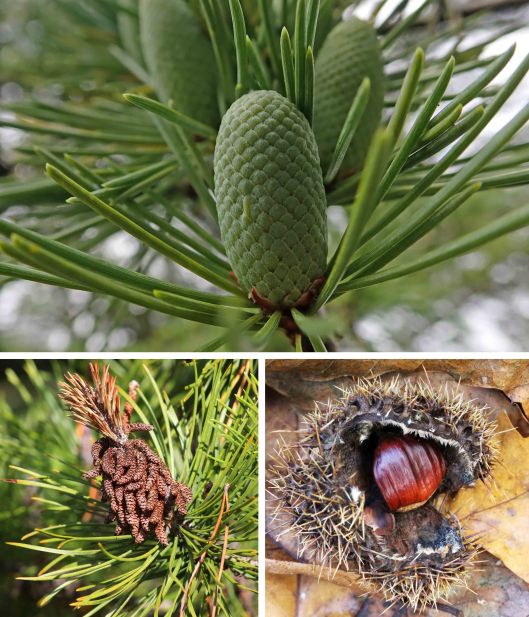
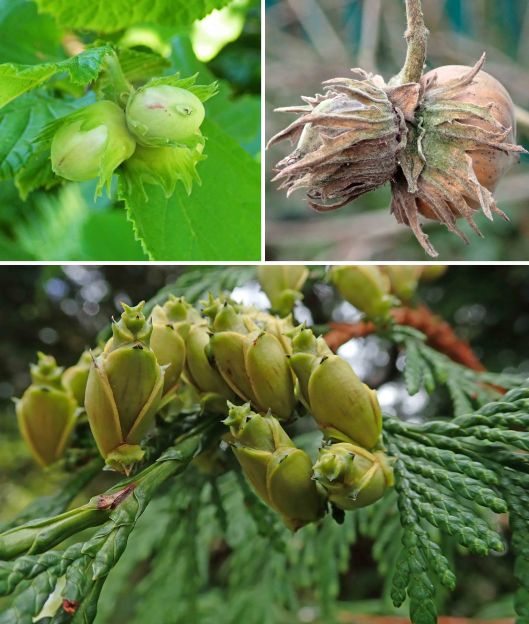
Cones, and a few nuts

05 Sunday Nov 2023

Posted by sconzani in autumn, trees

≈ 2 Comments

Tags

cones, conifers, nuts, seeds of trees

Probably because I am guilty of ignoring most conifers, I hadn’t realised how diverse their seed structures, their cones are. I am also not able to identify most of the conifers I see, neither the natives in local woodland nor the exotics in local parks. I must try to remedy that but, in the meantime, here are some of the many cones, and a few nuts, I’ve been noticing.

231105 cones nuts (1)231105 cones nuts (2)231105 cones nuts (3)231105 cones nuts (4)

Like Loading...

Aphids: Tuberolachnus salignus

25 Wednesday Oct 2023

Posted by sconzani in insects, trees

≈ Leave a comment

Tags

aphids on willow, British aphids, Giant willow aphid, Tuberolachnus salignus

I know, I know. I said there’d probably be no more aphids during the winter months but they overwinter as adults, and I just happened to be looking at the leaves of a willow while waiting for a train when I spotted these and couldn’t resist a few photos. These are Giant willow aphids (Tuberolachnus salignus), and I happened to catch them in various sizes and forms: the winged aphid is an adult (the scientific term is alate).

231026 Tuberolachnus salignus on willow (1)

The Influential Points website gives some fascinating information about these aphids:

Tuberolachnus salignus is anholocyclic and no males have ever been found, so all reproduction is assumed to be parthenogenetic. The females produce live young which are all genetically identical (clones) … [and]
One part of the giant willow aphid’s life cycle remains shrouded in mystery. Tuberolachnus salignus have only been found on willow trees from July through to early March. Numbers tend to peak in October, but by February few are left on the trees and none has been seen from April to July. [So, where do they go?]

231026 Tuberolachnus salignus on willow (2)

Though I didn’t catch it on camera as my train was pulling in to the station, the aphids got annoyed with my lens being so close to them and started waving their legs at me, apparently something they do to frighten off potential predators.

Like Loading...

Leafmines: Phyllonorycter corylifoliella

23 Monday Oct 2023

Posted by sconzani in insects, leaves, trees

≈ 2 Comments

Tags

Hawthorn, Hawthorn midget, leaf-mining moths, leafminers, leafmines on Hawthorn, moth larvae on Hawthorn, Phyllonorycter corylifoliella

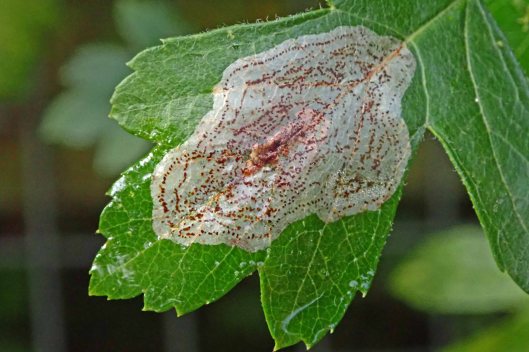
I thought I’d already shared this leafmine but it seems not so say hello to the Hawthorn midget (Phyllonorycter corylifoliella), a very attractive chestnut –and-white moth, which can be viewed on the UK Moths website and whose larvae mine the leaves of various Rosaceous trees and shrubs. As you can probably see, the mines I’ve found have been on Hawthorn (Crataegus species) but they also mine Apple (Malus sp.) and Cherry (Prunus sp.)

231023 Phyllonorycter corylifoliella (1)

The mines, which are found on the upperside of the leaves, look almost silvery and contains strings of brown frass, can be found in July, and again in September –October. The adult moths are active in May and August, though I’ve not seen one yet.

231023 Phyllonorycter corylifoliella (2)

Like Loading...

Beautiful berries

22 Sunday Oct 2023

Posted by sconzani in autumn, plants, trees

≈ 2 Comments

Tags

autumn berries, autumn colour, autumn fruit, berries, fruits

I hate when this happens: I had a free Microsoft video editor that was easy to use but, for reasons known only to themselves, Microsoft have deleted it and introduced new software which is totally incomprehensible to me. So, I made a video of my berry (and other fruit) images but with no title card and no captions, and no time to spend trying to figure out how easily to add them.
So, from the local fields and hedgerows, here are: Black bryony; Blackthorn; Bramble; Buckthorn; two types of Cotoneaster which, I think, are C. horizontalis and C. luteus; Dewberry; Field rose; Guelder-rose; Hawthorn; Ivy (not yet ripe); Japanese rose; Privet; Snowberry; Spindle (not really a berry/fruit but rather a case for the seeds within, but I love their colour); Stinking iris; Whitebeam; and Yew.

Like Loading...

Galls: Rabdophaga rosaria

17 Tuesday Oct 2023

Posted by sconzani in insects, trees

≈ Leave a comment

Tags

gall midges, gall-causing midges, galls, galls made by midges, galls on willow, Rabdophaga rosaria, Rabdophaga strobilina / rosaria agg, willow species

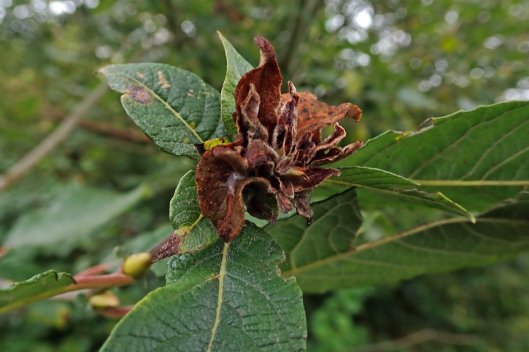
Although I’ve named this blog post Rabdophaga rosaria, it is apparently difficult to be specific as to which exact species has caused galls like the one pictured below, so finds are recorded as Rabdophaga strobilina / rosaria agg. The gall causer is a midge, of the family Cecidomyiidae, of which there are more than 600 species in Britain. All are tiny, less than 5mm in length, and it is their larvae that cause the plants they inhabit to form galls. In this instance, the galls are formed in the buds of willow species.

231017 Rabdophaga rosaria

Like Loading...

Leafmines: Agromyza alnivora

16 Monday Oct 2023

Posted by sconzani in insects, leaves, trees

≈ Leave a comment

Tags

Agromyza alnivora, Alder, British leafminers, fly mines, leaf-mining fly larvae, leafmines, leafmines on Alder

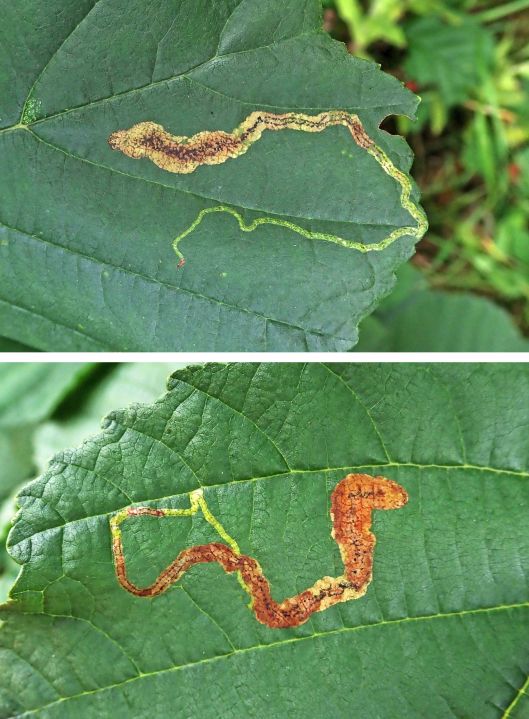
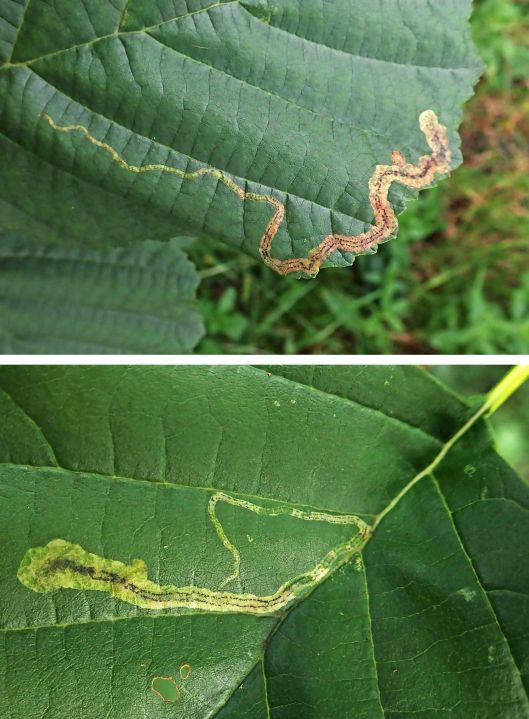
These are new leafmines for me, found during time recently spent checking the leaves of Alder trees, both the more frequently seen Alder (Alnus glutinosa) and the Italian alder (Alnus cordata), a common planting here along street edges and in parks. To me, these mines all look very snake-like!

231016 Agromyza alnivora (1)

These are the work of larvae of the fly species Agromyza alnivora. As the British Leafminers website describes, they create ‘An upper surface corridor, gradually widening, which is not associated with leaf margin or veins’, but the most distinctive feature of these mines is the frass, which is always deposited in two rows. The larvae make their mines twice each year – the technical term is bivoltine – in summer and in early autumn.

231016 Agromyza alnivora (2)

Like Loading...

A Jay and its acorn

12 Thursday Oct 2023

Posted by sconzani in autumn, birds, trees

≈ 2 Comments

Tags

birding, birdwatching, British birds, Jay, Jay and acorn, Oak

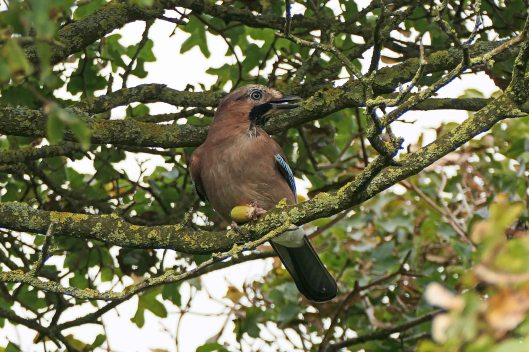
This morning I spent a lovely half hour watching two Jays flying back and forth from Oak trees to their nut-stashing places, secreting away plenty of goodies to tide them over the winter months.

231012 jay (1)

But, apparently, this particular acorn was so good it had to be eaten immediately.

231012 jay (2)

Like Loading...

Leafmines: Lyonetia prunifoliella

09 Monday Oct 2023

Posted by sconzani in insects, leaves, trees

≈ Leave a comment

Tags

British leafmines, British moths, leaf mines, leafmines on Blackthorn, leafmining moth larvae, leafmining moths, Lyonetia prunifoliella

For over 100 years, the lovely little micro moth Lyonetia prunifoliella was thought to be extinct in the UK until it was rediscovered in the 2000s in southern England. It took a while to spread across the country but was found new to Wales, near Holyhead, last autumn and, soon afterwards, found here in south Wales, at Kenfig National Nature Reserve, though just one larval mine was found despite much searching by Butterfly Conservation’s senior moth ecologist George Tordoff.
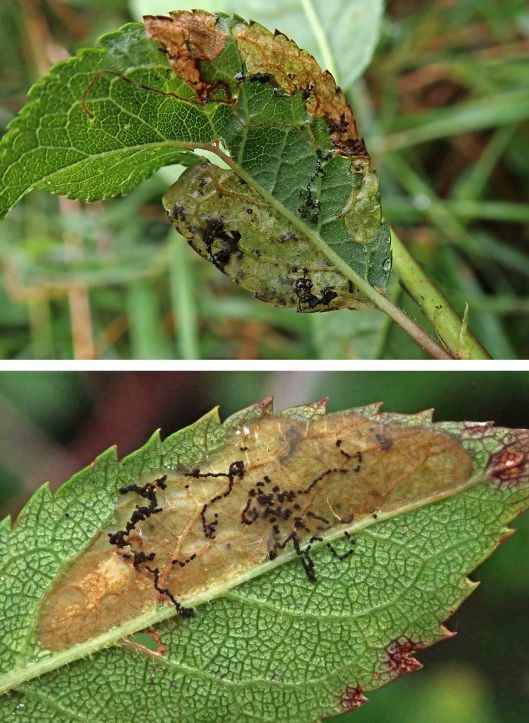
231009 lyonetia prunifoliella (1)

This year, though, George says, it’s really taken off in south Wales: he’s found it in various Cardiff parks and at Lavernock Nature Reserve. When I heard this news last Sunday, 1 October, I immediately decided to go searching, focussing in particular on the suckering growth of Blackthorn (Prunus spinosa), the tree this moth appears to favour locally for its larval leafmines (though it is known to use other roseaceous trees elsewhere).

231009 lyonetia prunifoliella (2)

Last Monday I found Lyonetia prunifoliella mines immediately at the first place I looked, and have since found it at six locations in my surrounding area, sometimes in abundance, other times just one or two mines, despite a plentiful supply of young Blackthorn leaves. The mines are relatively easy to identify, as the larvae eject their frass from the mines in a ‘string of black pearls’, a rather poetic description from someone on Twitter but easy to remember. (The photographs above show the upper and under sides of the same leaf, with the larva apparent above and its frass ejected below.)
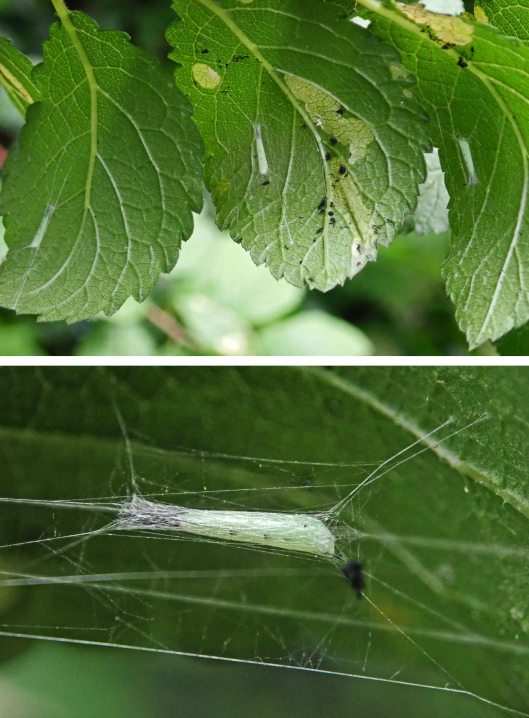
231009 lyonetia prunifoliella (3)

Although most mines I’ve seen have been empty (this moth overwinters as an adult), a few have held larvae, and I was particularly delighted last Thursday to find a group of five cocoons, strung like hammocks on the underside of leaves with silk produced by the larvae before they pupate. I’ve yet to see an adult moth but will definitely share that exciting moment when it happens.

Like Loading...
← Older posts
Newer posts →

About me

sconzani

sconzani

I'm a writer and photographer; researcher and blogger; birder and nature lover; countryside rambler and city strider; volunteer and biodiversity recorder.

View Full Profile →

Follow earthstar on WordPress.com

Enter your email address to follow this blog and receive notifications of new posts by email.

Recent blog posts

  • City Hall Peregrine January 12, 2026
  • Blackthorn in bloom January 11, 2026
  • Weevil: Mecinus pyraster January 10, 2026
  • Red in beak and claw January 9, 2026
  • Who’s watching who? January 8, 2026

From the archives

COPYRIGHT

Unless otherwise acknowledged, the text and photographs on this blog are my own and are subject to international copyright. Nothing may be downloaded or copied without my permission.

Fellow Earth Stars!

  • Unknown's avatar
  • Unknown's avatar
  • Unknown's avatar
  • Unknown's avatar
  • Unknown's avatar
  • Unknown's avatar
  • Unknown's avatar
  • Unknown's avatar
  • Unknown's avatar
  • Unknown's avatar
  • Unknown's avatar
  • Unknown's avatar
  • Unknown's avatar
  • Unknown's avatar
  • Unknown's avatar
  • Unknown's avatar
  • Unknown's avatar
  • Unknown's avatar
  • Unknown's avatar
  • Unknown's avatar
  • Unknown's avatar
  • Unknown's avatar
  • Unknown's avatar
  • Unknown's avatar
  • Unknown's avatar
  • Unknown's avatar
  • Unknown's avatar
  • Unknown's avatar
  • Unknown's avatar
  • Unknown's avatar
  • Unknown's avatar
  • Unknown's avatar
  • Unknown's avatar
  • Unknown's avatar
  • Unknown's avatar
  • Unknown's avatar
  • Unknown's avatar
  • Unknown's avatar
  • Unknown's avatar
  • Unknown's avatar
  • Unknown's avatar
  • Unknown's avatar
  • Unknown's avatar
  • Unknown's avatar
  • Unknown's avatar
  • Unknown's avatar
  • Unknown's avatar
  • Unknown's avatar
  • Unknown's avatar
  • Unknown's avatar

Blog at WordPress.com.

Privacy & Cookies: This site uses cookies. By continuing to use this website, you agree to their use.
To find out more, including how to control cookies, see here: Cookie Policy
  • Subscribe Subscribed
    • earthstar
    • Join 669 other subscribers
    • Already have a WordPress.com account? Log in now.
    • earthstar
    • Subscribe Subscribed
    • Sign up
    • Log in
    • Report this content
    • View site in Reader
    • Manage subscriptions
    • Collapse this bar
 

Loading Comments...
 

You must be logged in to post a comment.

    %d