• ABOUT
  • BIRDING 2018
  • Birding 2019
  • BLOG POSTS
  • Butterflies 2018
  • Resources

earthstar

~ a celebration of nature

earthstar

Category Archives: wildflowers

Ring-ting!

09 Friday Feb 2018

Posted by sconzani in flowers, nature, spring, wildflowers

≈ Leave a comment

Tags

British flora, British wildflowers, primrose, William Allingham poem

180209 primroses (1)
180209 primroses (2)

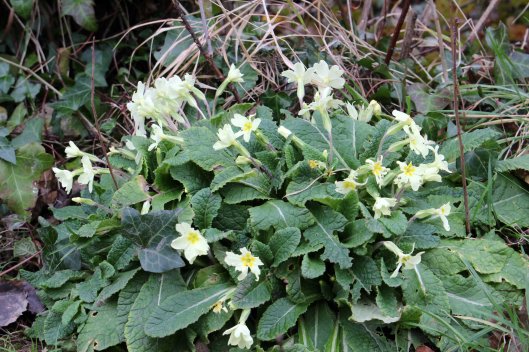
‘Ring-ting! I wish I were a Primrose,
A bright yellow Primrose blowing in the spring!
The stooping boughs above me,
The wandering bee to love me,
The fern and moss to creep across,
And the elm-tree for our king!’

~  from William Allingham, ‘Wishing, A Child’s Song’. Allingham (1824-1889) was an Irish poet and man of letters.

180209 primroses (3)

Like Loading...

Another winter ten

28 Sunday Jan 2018

Posted by sconzani in flowers, nature, wildflowers, winter

≈ Leave a comment

Tags

#theWinter10, British flora, January flowers, wildflowers, winterf-flowering wildflowers

It was about time I had another go at WildflowerHour’s current challenge: ‘our weekly winter challenge is #thewinter10 which is to find ten different wild flowers in bloom each week. Once you’ve found them, work out what they are, and post them for the rest of us to see.’

So, on Thursday’s walk, though I was really looking for birds, I also remembered to cast my eyes downwards for flowers. And, on one relatively short stretch along the western edge of Cardiff Bay, I found my ten: Creeping buttercup (I think). a Dandelion species, Nipplewort, Petty spurge, possibly Common mouse-ear, Red dead nettle, Groundsel, Sweet meadow grass, Gorse, and Red clover.

180128 Winter ten (1)
180128 Winter ten (2)
180128 Winter ten (3)
180128 Winter ten (5)
180128 Winter ten (6)
180128 Winter ten (8)
180128 Winter ten (9)
180128 Winter ten (10)
180128 Winter ten (11)
180128 Winter ten (12)
Like Loading...

Signs of spring: snowdrops

21 Sunday Jan 2018

Posted by sconzani in flowers, nature, plants, seasons, spring, wildflowers

≈ 6 Comments

Tags

Bute Park, signs of spring, snowdrop, spring flowers

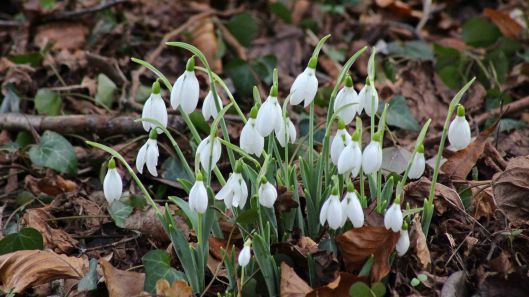
During my walk in Bute Park a few days ago, I saw my first signs of spring. And, though I love winter – as I love each of the seasons for the differences they offer – still, it is always heart-warming, when the days are short and cold and often grey, to see small signs, like these snowdrops, of the earth’s re-awakening.

180121 snowdrops

Like Loading...

Spurge laurel

19 Friday Jan 2018

Posted by sconzani in flowers, nature, plants, wildflowers

≈ 2 Comments

Tags

British flora, British native daphne, British native flowers, Daphne laureola, Spruge laurel, winter flowers

Spurge laurel is such an uninspiring name for this lovely British native, which I was surprised and delighted to find in full flower when I was walking the south Wales coastal path at Lavernock last weekend.

180119 Spurge laurel (2)

Any gardener will recognise this plant as a member of the Daphne family – its scientific name is Daphne laureola – and, not only does it flower from the middle of winter through spring and into early summer, it also has a delicious honey smell. It’s evergreen and prefers to have its roots in rich, shaded soil, growing best on the edge of woodlands on chalk or limestone.

180119 Spurge laurel (4)
180119 Spurge laurel (1)

I must add one note of caution, though: everything about this plant is poisonous to humans, from the sap (which can cause a nasty skin rash) to the black berries that appear in late summer. Luckily, the berry toxins do not appear to affect birds, and there are reports of robins and greenfinches enjoying an autumn feast.

180119 Spurge laurel (3)
180119 Spurge laurel (5)
Like Loading...

The Winter Seventeen

29 Friday Dec 2017

Posted by sconzani in flowers, nature, plants, wildflowers, winter

≈ Leave a comment

Tags

#TheWinterTen, #WildflowerHour, British wildflowers, Ham Hill, Wildflower Hour, wildflowers, winter wildflowers

171229 Ham Hill

Back in early November I blogged about Wildflower Hour’s winter challenge encouraging us all to try to find ten wildflowers still in bloom each week of winter. Well, I’ve been on holiday in Somerset over Christmas and, when my friend Sarah and I were out walking at Ham Hill on Christmas Eve, we took the challenge and were amazed to find not ten but seventeen wildflowers in bloom. Here (with apologies for the blurry pics – the wind was howling – and the lack of accurate names – I didn’t take my guide book on holiday) they are: ragwort, red campion, white dead nettle, hogweed, bramble, dog’s mercury, possible one of the Hawk’s-beard family, chamomile, cow parsley, ivy, a species of thistle and another of grass, wild parsnip, a variety of speedwell, the ever-reliable daisy, yarrow, and the equally reliable gorse.

p.s. Ham Hill is a fascinating place to explore if you’re ever in that vicinity and I’m already planning another walk there when I visit Sarah again in the summer.

171229 Ham Hill wildflowers (1)
171229 Ham Hill wildflowers (2)
171229 Ham Hill wildflowers (3)
171229 Ham Hill wildflowers (4)
171229 Ham Hill wildflowers (5)
171229 Ham Hill wildflowers (6)
171229 Ham Hill wildflowers (7)
171229 Ham Hill wildflowers (8)
171229 Ham Hill wildflowers (9)
171229 Ham Hill wildflowers (10)
171229 Ham Hill wildflowers (11)
171229 Ham Hill wildflowers (12)
171229 Ham Hill wildflowers (13)
171229 Ham Hill wildflowers (14)
171229 Ham Hill wildflowers (15)
171229 Ham Hill wildflowers (16)

171229 Ham Hill wildflowers (17)

Like Loading...

Berries full to bursting

26 Sunday Nov 2017

Posted by sconzani in autumn, nature, plants, wildflowers, winter

≈ Leave a comment

Tags

autumn colour, Black bryony, British flora, bryony, poisonous berries, red berries, Tamus communis, winter colour

The name ‘bryony’ is entirely appropriate for this plant as it comes from the Greek word bruein which, apparently, means ‘to be full to bursting’. However, though the berries of Black bryony (Tamus communis) are cherry-red and luscious-looking, please don’t be tempted to eat them as they are deadly poisonous.

171126 Black bryony berries (2)

There are, in fact, two plants with the bryony name in Britain, White bryony and Black, but they are not part of the same plant family. Rather surprisingly, Black bryony is the only member of the yam family to grow here but, again, don’t be tempted to eat its roots. In spring and summer, Black bryony’s long tangling vines can be found rambling over, under and through the shrubs and bushes of hedgerows and scrub-lands, and in autumn and winter, though the heart-shaped leaves brown and drop, the masses of red berries brighten up the countryside for many months.

171126 Black bryony berries (3)
171126 Black bryony berries (1)
Like Loading...

Wildflowers at Barry Docks

21 Tuesday Nov 2017

Posted by sconzani in autumn, flowers, nature, wildflowers

≈ 2 Comments

Tags

Barry Docks, British wildflowers, Common toadflax, Daisy, Hemp agrimony, Hoary mustard, Ragwort, Red valerian, scabious, Wild parsnip, wildflowers, Yellow-wort

I caught the train to Barry Docks last Friday, hoping to get a good look at an uncommon bird (a Great northern diver) that had been making itself at home there for the previous week or so.

171121 Barry Docks

Unfortunately, the bird spent most of the two hours I was there happily swimming and diving several hundred yards away on the other side of the dock, but it was a gloriously sunny day and I did find lots of lovely wildflowers still in bloom around the edge of the docks so I was happy.

171121 Hemp agrimony
171121 Hoary mustard
171121 Wild parsnip
171121 Cow parsley
171121 Ragwort sp
171121 Red valerian
171121 Daisy
171121 Sow-thistle sp
171121 Yellow-wort
171121 Scabious sp
171121 Bindweed sp
171121 Common toadflax
Like Loading...

The winter ten

05 Sunday Nov 2017

Posted by sconzani in flowers, nature, wildflowers

≈ 10 Comments

Tags

#WildflowerHour, British flora, British wildflowers, Cardiff Bay, wildflowers

Do you know about #WildflowerHour? Its aim is to spread the love of plants – not garden plants (though, of course, they are also lovely) but the glorious flowers that grow wild in Britain’s woods and meadows, alongside tracks, beneath hedgerows, beside streams, around buildings, in cracks in pavements. The idea is to take photos of the wildflowers you see, try to identify them (but others will help if you’re not sure), then post your photos on Facebook or Twitter (with the #WildflowerHour tag) every Sunday night between 8 and 9pm.

171105 Lady's bedstraw

On 20 October the folks at WildflowerHour issued a new challenge: ‘our weekly winter challenge is #thewinter10 which is to find ten different wild flowers in bloom each week. Once you’ve found them, work out what they are, and post them for the rest of us to see.’ So, as I walked around Cardiff Bay on a grey, gloomy Friday, I kept an eye out for wild flowers. To be honest, I was amazed to find so many still in bloom (not just 10 but 24!). I have not managed to name them all but I hope you enjoy seeing them as much as I did.

171105 Bramble
171105 Buttercup
171105 Chamomile perhaps
171105 Common stork's-bill
171105 Common toadflax
171105 Creeping thistle
171105 Crown vetch
171105 Daisy
171105 Evening primrose
171105 Hare's-foot clover
171105 Hedge bindweed
171105 Herb-Robert
171105 Hoary mustard
171105 Mugwort perhaps
171105 Pale flax
171105 Red clover
171105 Sea-holly
171105 Sow-thistle
171105 Unknown
171105 Vicia sp
171105 Western gorse
171105 White campion
171105 White clover
171105 Yarrow
Like Loading...

‘Dedicated Naturalist’: Herb Robert

03 Friday Nov 2017

Posted by sconzani in 'Dedicated Naturalist' Project, flowers, nature, wildflowers

≈ Leave a comment

Tags

botanical drawing, Dr Mary Gillham, Geranium Robertianum, Herb Robert, Mary Gillham Archive Project, plant anatomy

A snippet from my volunteer work on the ‘Dedicated Naturalist’ Project, helping to decipher and digitise, record and publicise the life’s work of naturalist extraordinaire, Dr Mary Gillham.

171103 Herb Robert (1)

As part of my current work to research and write the story of Mary’s life for the project website, I was, this week, going through items from Mary’s university days – she held a BSc in agriculture and botany from the University of Wales at Aberystwyth and a PhD from the University of Wales at Bangor. Amongst the treasures Mary had retained was a folder of botanical drawings, and I couldn’t resist choosing a few to scan for the website and also to share here.

171103 Herb Robert (2)

The paper Mary used is tissue-thin so doesn’t scan well – the details on the reverse show through – and I’ve had to clean this up a lot on photoshop. It’s still not great but I love the level of detail in these drawings and, as Herb Robert (Geranium robertianum) is still to be found blooming here and there (photographed yesterday), this seemed a good flower to feature.

171103 Herb Robert (3)

For the full story about the Mary Gillham Archive Project, check out our blog, https://marygillhamarchiveproject.wordpress.com/  and follow our progress on Facebook and on Twitter.

Like Loading...

Stinking Iris

30 Monday Oct 2017

Posted by sconzani in flowers, nature, wildflowers

≈ 2 Comments

Tags

British flora, British wildflowers, flower seeds, Iris, Iris foetidissima, plant seeds, Roast-beef plant, seeds, Stinking iris

I gave it a really good sniff but I smelled nothing. It was only later that I read the smell comes from the leaves, but only when you crush or rub them, which I didn’t do. And, even then, some people can’t smell the ‘slightly stale, raw beef’ smell that Stinking iris is named for. Even its scientific name, Iris foetidissima, refers to the smell, as do two of its vernacular names: Roast-beef plant and Bloody bones.

171030 Stinking iris (7)

However, I’m not here to warn about this iris’s smell nor, in fact, to extol the virtues of the plant itself, which is often a bit untidy and tatty looking, but rather to praise the beauty of its seeds. The flowers themselves are nothing to write home about, being a rather dull greyish-purple but the seeds erupt in the autumn, like bright orange peas in a papery brown pod. As the weather gets colder, if they’re not plundered as food by birds, they turn a fabulous scarlet and then, eventually, if the weather’s not too wet, dry to a rich golden brown. Just beautiful!

171030 Stinking iris (1)
171030 Stinking iris (2)
171030 Stinking iris (3)
171030 Stinking iris (4)
171030 Stinking iris (5)
171030 Stinking iris (6)
Like Loading...
← Older posts
Newer posts →

About me

sconzani

sconzani

I'm a writer and photographer; researcher and blogger; birder and nature lover; countryside rambler and city strider; volunteer and biodiversity recorder.

View Full Profile →

Follow earthstar on WordPress.com

Enter your email address to follow this blog and receive notifications of new posts by email.

Recent blog posts

  • Goose barnacles March 26, 2026
  • Black-tailed godwits fighting March 25, 2026
  • Singing from every tree top March 24, 2026
  • Turtle bug March 23, 2026
  • Springtime invasives March 22, 2026

From the archives

COPYRIGHT

Unless otherwise acknowledged, the text and photographs on this blog are my own and are subject to international copyright. Nothing may be downloaded or copied without my permission.

Fellow Earth Stars!
  • Unknown's avatar
  • Unknown's avatar
  • Unknown's avatar
  • Unknown's avatar
  • Unknown's avatar
  • Unknown's avatar
  • Unknown's avatar
  • Unknown's avatar
  • Unknown's avatar
  • Unknown's avatar
  • Unknown's avatar
  • Unknown's avatar
  • Unknown's avatar
  • Unknown's avatar
  • Unknown's avatar
  • Unknown's avatar
  • Unknown's avatar
  • Unknown's avatar
  • Unknown's avatar
  • Unknown's avatar
  • Unknown's avatar
  • Unknown's avatar
  • Unknown's avatar
  • Unknown's avatar
  • Unknown's avatar
  • Unknown's avatar
  • Unknown's avatar
  • Unknown's avatar
  • Unknown's avatar
  • Unknown's avatar
  • Unknown's avatar
  • Unknown's avatar
  • Unknown's avatar
  • Unknown's avatar
  • Unknown's avatar
  • Unknown's avatar
  • Unknown's avatar
  • Unknown's avatar
  • Unknown's avatar
  • Unknown's avatar
  • Unknown's avatar
  • Unknown's avatar
  • Unknown's avatar
  • Unknown's avatar
  • Unknown's avatar
  • Unknown's avatar
  • Unknown's avatar
  • Unknown's avatar
  • Unknown's avatar
  • Unknown's avatar

Blog at WordPress.com.

Privacy & Cookies: This site uses cookies. By continuing to use this website, you agree to their use.
To find out more, including how to control cookies, see here: Cookie Policy
  • Subscribe Subscribed
    • earthstar
    • Join 642 other subscribers
    • Already have a WordPress.com account? Log in now.
    • earthstar
    • Subscribe Subscribed
    • Sign up
    • Log in
    • Report this content
    • View site in Reader
    • Manage subscriptions
    • Collapse this bar
 

Loading Comments...
 

You must be logged in to post a comment.

    %d