• ABOUT
  • BIRDING 2018
  • Birding 2019
  • BLOG POSTS
  • Butterflies 2018
  • Resources

earthstar

~ a celebration of nature

earthstar

Category Archives: wildflowers

Merry marsh marigolds

25 Friday Mar 2016

Posted by sconzani in flowers, nature, wildflowers

≈ 2 Comments

Tags

Caltha palustris, marsh marigold, spring, spring flowers

Yellow is the colour of happiness, optimism, enlightenment, creativity, hope, cheerfulness, and sunshine. Yellow is also the most luminous in the colour spectrum – the colour that most easily catches our eye and the eyes of bees so it’s no surprise that yellow is the most common flower colour, and the quintessential colour of Spring.
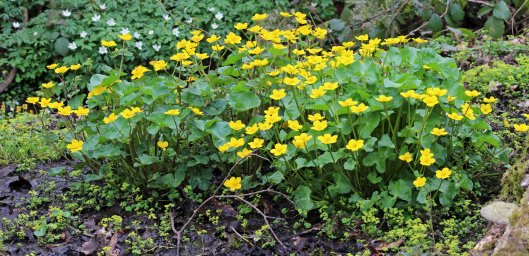
marsh marigold

One of the wonderfully vibrant plants whose flowers have been catching my eye over the past couple of weeks is the Marsh marigold (Caltha palustris). As its name implies, this wildflower likes the dampness of marshes, fens, ditches and the wetter areas of my local woodlands. According to Wikipedia, it ‘is probably one of the most ancient native plants, surviving the glaciations and flourishing after the last retreat of the ice in a landscape inundated with glacial meltwaters.’

marsh marigold (1)

The Marsh marigold is commonly known as Kingcup – its Latin name Caltha comes from the Greek word for goblet and its large golden cup-shaped flowers certainly look glorious enough to adorn the table of a king.

marsh marigold (2)

Like Loading...

Coltsfoot for your cough?

26 Friday Feb 2016

Posted by sconzani in nature, nature photography, wildflowers

≈ 4 Comments

Tags

Coltsfoot, spring, spring flowers

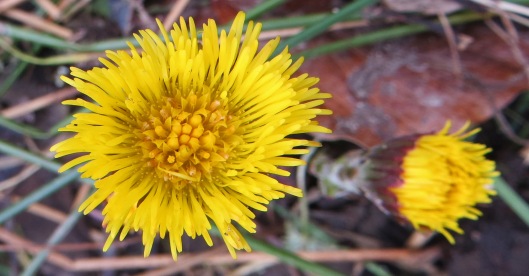
I saw my first coltsfoot in bloom this week. Though it looks a little like a dandelion, coltsfoot (Tussilago farfara) is actually a member of the sunflower family. It is favoured by herbalists as its leaves and flowers apparently make an effective cough remedy – the scientific name tussilago comes from the Latin tussis, which means cough, and ago, which means to act on. However, coltsfoot has been found to cause problems with the liver so long-term constant use is probably not wise.

coltsfoot (7)

This is another wildflower with a multitude of common names including, not surprisingly, coughwort, but also tash plant, ass’s foot, bull’s foot, foal’s foot, foalswort, and horse foot. Apparently, all those references to ‘foot’ result from the fact that the leaves are a similar shape to animal hooves, though I haven’t yet seen the leaves myself – they don’t appear until the flower has set its seed.

coltfoot (2)

In Britain, there is also a confection called Coltsfoot Rock, made exclusively by Stockley’s Sweets, in Oswaldtwistle, in Lancashire. Though its exact recipe is secret, this rock candy is flavoured using the leaves of coltsfoot. I wonder if any of my readers can tell us what it tastes like.

coltsfoot (5)
coltsfoot (8)
Like Loading...

The lovely Lesser Celandine

24 Wednesday Feb 2016

Posted by sconzani in nature, nature photography, plants, wildflowers

≈ 4 Comments

Tags

Lesser Celandine, Ranunculus ficaria, William Wordsworth

160224 lesser celandine (3)

Everyone associates poet extraordinaire William Wordsworth with daffodils – ‘I wandered lonely as a cloud …’ – but Wordsworth’s favourite flower was, in fact, the Lesser Celandine (Ranunculus ficaria), as witnessed by the bloom carved on his memorial plaque at the Church of St Oswald in Grasmere. As I wandered through woodlands and along river banks today, feeling not the slightest bit lonely, I saw a lot of this pretty flower. Along with the primroses and daffodils, it’s another of the yellow wildflowers that is both charming and uplifting at this time of year.

160224 lesser celandine (1)

I’m not sure what ailments Wordsworth suffered from but perhaps he favoured the Lesser Celandine because it has long been considered a treatment for haemorrhoids, hence its old English name of Pilewort. According to the Ancient Greek physician Galen, sniffing a mixture of the juice of the roots with honey was also good for clearing the head of ‘foul and filthy humours’, though I wouldn’t recommend sniffing anything that also cured piles!

160224 lesser celandine (2)

Like Loading...

Sweet early Flower

10 Wednesday Feb 2016

Posted by sconzani in flowers, nature, spring, wildflowers

≈ 3 Comments

Tags

primrose, spring flowers

From Samuel Taylor Coleridge’s poem, ‘To a Primrose’

Thy smiles I note, sweet early Flower,
That peeping from thy rustic bower
The festive news to earth dost bring,
A fragrant messenger of Spring.

160210 primrose (1)

As Coleridge noted, the primrose (Primula vulgaris) is one of the first spring flowers, blooming as early as December when the weather is as mild as it has been so far this winter, and continuing on until May. The primrose was the favourite flower of British Prime Minster Benjamin Disraeli (1804-81) and so was used as the emblem for the Primrose League, an organisation founded a couple of years after Disraeli’s death and active until the 1990s, whose purpose was to promote the ideals of the Conservative Party throughout Britain.

160210 primrose (2)

In the language of flowers, the primrose has several somewhat conflicting meanings: it’s symbolic of timidity but also of fickleness, it can refer to young love but can also convey the message ‘I can’t live without you’. In Norse mythology, the primrose was sacred to Freya, the goddess of love, and in England there is a superstition that you must always bring 13 primrose flowers into the home – any more or any less means bad luck.

Like Loading...

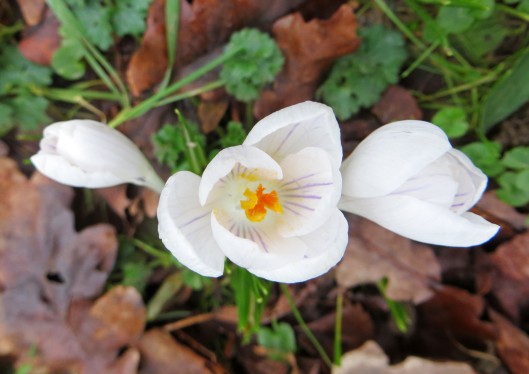
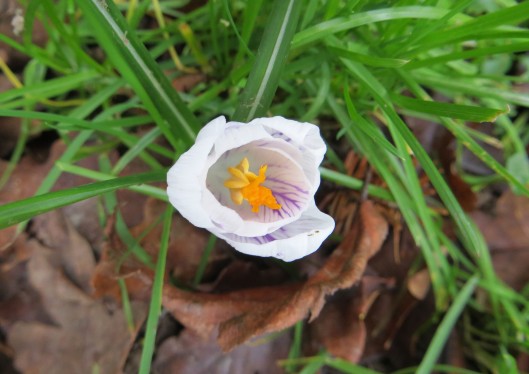
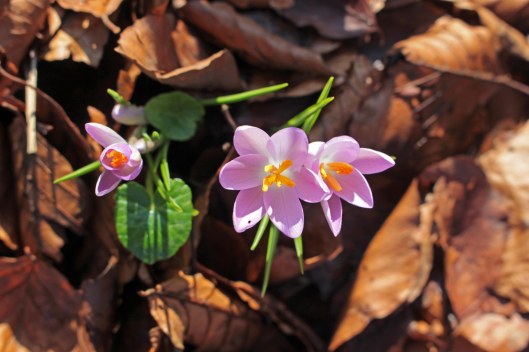
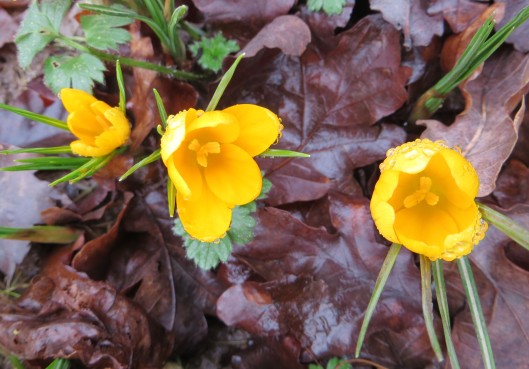
‘The Crocus’s Soliloquy’

26 Tuesday Jan 2016

Posted by sconzani in flowers, nature, nature photography, spring, wildflowers

≈ 4 Comments

Tags

crocus, spring flowers, wildflowers

160126 crocus (1)

‘Soon as the frost will get out of my bed,
From this cold dungeon to free me,
I will peer up with my little bright head;
And all will be joyful to see me.

Then from my heart will young petals diverge,
As rays of the sun from their focus;
I from the darkness of earth shall emerge
A happy and beautiful Crocus!’

From the poem ‘The Crocus’s Soliloquy’ by Miss H. F. Gould in The Poetry of Flowers and Flower of Poetry, ed. Frances Sargent Locke Osgood, J. B. Lippincott & Co, Philadelphia, 1863.

160126 crocus (2)160126 crocus (3)160126 crocus (4)160126 crocus (5)160126 crocus (6)160126 crocus (7)160126 crocus (8)

Like Loading...

The lion’s tooth: Dandelion

25 Friday Dec 2015

Posted by sconzani in nature, nature photography, wildflowers

≈ Leave a comment

Tags

dandelion, medicinal plant, wildflowers, yellow flowers

One of my favourite wildflowers is the humble dandelion. On grey winter days it provides a welcome burst of cheery yellow, and seeing the fluffy seed heads brings me fond childhood memories, of dandelion clocks to tell the time from the number of blows it takes to remove the seeds, and of making a wish when the last of the seeds blows away.

151224 dandelion (1)

Officially labelled Taraxacum officinale agg., the common name dandelion comes from the French dent de lion, lion’s tooth, a reference to its deeply toothed leaves. In England, it is also commonly called ‘wet-the-bed’ and ‘pissy-beds’, from the idea that just touching a dandelion causes bed-wetting. Luckily, that’s not true, though the dandelion is a scientifically proven diuretic.

151224 dandelion (2)

In fact, the dandelion is an extremely useful plant. It’s a good source of beta-carotene, is rich in Vitamin C and the B-complex vitamins and also high in protein, so has been used for thousands of years to improve the functioning of the liver, gallbladder, and urinary and digestive systems. And, though I’ve never tried it, dandelion is also widely used to make wine. So, the next time you’re tempted to eradicate these ‘weeds’ from your garden, think again and, instead, make use of Nature’s bounty.

Like Loading...

The common daisy

18 Friday Dec 2015

Posted by sconzani in nature, nature photography, wildflowers

≈ Leave a comment

Tags

bruisewort, Common daisy, English daisy, lawn daisy, woundwort

Gardeners hate them, greenkeepers detest them, grounds(wo)men loathe them. Yet, little Bellis perennis, the common, lawn or English daisy, is an attractive wee plant, its dainty white flowers twinkling like tiny stars even on the dullest of days. I recall many happy childhood hours spent making daisy chains.

151218 common daisy (2)

How charming that the word daisy comes from ‘day’s eye’, referring to the fact that the little flowers close up at night and reopen each morning. In the Middle Ages, the English called it Mary’s Rose, and its other common names include bruisewort and woundwort. These refer to the plant’s medicinal properties: the ancient Romans extracted the juice from the common daisy to soak the bandages with which they bound sword and spear cuts in times of battle. And herbalists and homeopaths still use the plant today, to help heal soft tissue injuries, sprains and bruises, and to treat skin infections like acne and boils, amongst other things.

151218 common daisy (1)

Like Loading...

Fox and cubs

16 Wednesday Dec 2015

Posted by sconzani in autumn, nature, nature photography, wildflowers

≈ 1 Comment

Tags

autumn, autumn colour, cemetery, Fox and cubs, Grim the collier, orange hawkweed, wildflowers

151216 Pilosella aurantiaca Orange hawkweed aka fox and cubs

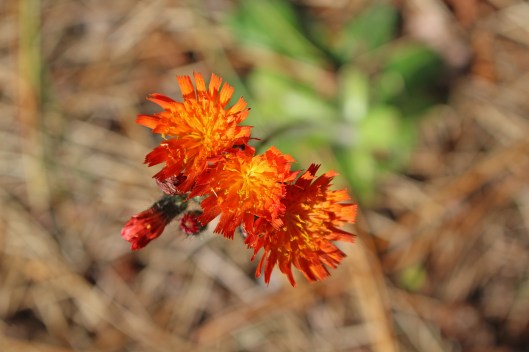
Just two short weeks ago, my local cemetery was dotted with these vibrant little bursts of orange. Now they’ve all disappeared. This pretty little member of the daisy family is officially known as Pilosella aurantiaca but I much prefer its many common names: orange or tawny hawkweed (‘hawk’ because the Romans believed hawks ate the blossoms to enhance their vision and ‘weed’ because it can be very invasive in the right conditions); Grim-the-collier (after the character Grim, who appeared in English devil plays in the 1600s); devil’s paintbrush (another reference to the devil in those old plays or, maybe, because it can be a devil of a plant to get rid of!); and, my favourite, fox-and-cubs (perhaps because the yet-to-open flowers seem to hide beneath those that are open or, more likely, because the furry rosette of leaves sends out runners to produce more furry little plants). Love it or curse it, this little plant is rich in nectar so a favourite of bees.

Like Loading...
Newer posts →

About me

sconzani

sconzani

I'm a writer and photographer; researcher and blogger; birder and nature lover; countryside rambler and city strider; volunteer and biodiversity recorder.

View Full Profile →

Follow earthstar on WordPress.com

Enter your email address to follow this blog and receive notifications of new posts by email.

Recent blog posts

  • Thrift March 29, 2026
  • The day of the Wheatears March 28, 2026
  • Cetti’s warblers March 27, 2026
  • Goose barnacles March 26, 2026
  • Black-tailed godwits fighting March 25, 2026

From the archives

COPYRIGHT

Unless otherwise acknowledged, the text and photographs on this blog are my own and are subject to international copyright. Nothing may be downloaded or copied without my permission.

Fellow Earth Stars!

  • Unknown's avatar
  • Unknown's avatar
  • Unknown's avatar
  • Unknown's avatar
  • Unknown's avatar
  • Unknown's avatar
  • Unknown's avatar
  • Unknown's avatar
  • Unknown's avatar
  • Unknown's avatar
  • Unknown's avatar
  • Unknown's avatar
  • Unknown's avatar
  • Unknown's avatar
  • Unknown's avatar
  • Unknown's avatar
  • Unknown's avatar
  • Unknown's avatar
  • Unknown's avatar
  • Unknown's avatar
  • Unknown's avatar
  • Unknown's avatar
  • Unknown's avatar
  • Unknown's avatar
  • Unknown's avatar
  • Unknown's avatar
  • Unknown's avatar
  • Unknown's avatar
  • Unknown's avatar
  • Unknown's avatar
  • Unknown's avatar
  • Unknown's avatar
  • Unknown's avatar
  • Unknown's avatar
  • Unknown's avatar
  • Unknown's avatar
  • Unknown's avatar
  • Unknown's avatar
  • Unknown's avatar
  • Unknown's avatar
  • Unknown's avatar
  • Unknown's avatar
  • Unknown's avatar
  • Unknown's avatar
  • Unknown's avatar
  • Unknown's avatar
  • Unknown's avatar
  • Unknown's avatar
  • Unknown's avatar
  • Unknown's avatar

Blog at WordPress.com.

Privacy & Cookies: This site uses cookies. By continuing to use this website, you agree to their use.
To find out more, including how to control cookies, see here: Cookie Policy
  • Subscribe Subscribed
    • earthstar
    • Join 642 other subscribers
    • Already have a WordPress.com account? Log in now.
    • earthstar
    • Subscribe Subscribed
    • Sign up
    • Log in
    • Report this content
    • View site in Reader
    • Manage subscriptions
    • Collapse this bar
 

Loading Comments...
 

You must be logged in to post a comment.

    %d