More herons at the lake

Tags

, , , , , , ,

Last week we had Grey herons at Cardiff’s Roath Park Lake; this week we have another member of the heron family, two of them in fact, gorgeous Little egrets (Egretta garzetta).

In Britain these days, if you’re lucky, you can see three white egrets, Cattle, Little and Great white, but I still find these birds exotic.

And, although I feature them here relatively frequently, I make no apology for that, as they are beautiful birds.

I find Little egrets quite mesmerising to watch, and I’m certainly not the only one. Despite these beauties being quite common at Roath Lake these days, several other people stopped to watch and pulled out their phones to take photos, so I imagine the egrets were featuring on social media that day.

Bedellia somnulentella revisited

Tags

, , , , , ,

Back in September, in my blog Leafmines: Bedellia somnulentella, I covered the mines of a moth whose larvae have some unusual habits, spinning hammocks outside their mines to rest and pupate in. Now that I’m aware of them, I’ve been seeing these mines almost everywhere I see Field bindweed. And, during last Tuesday’s walk, when I saw the plant and turned over a few leaves, I spotted two leaves that had a total of three pupae suspended beneath. I decided to bring them home so that I could, hopefully, see what the adult moth looked like.

In the intervening six days, another larva has pupated – I hadn’t even realised there was another larva in the leaves but, on Thursday, as the leaves began to dry and shrivel, it appeared, climbed up the side of the jar, spun a hammock under the lid, and pupated.

Then, yesterday, when the wild, wet, windy weather meant I spent a day at home – a rarity for me, two of the adult moths hatched from their pupae. I couldn’t get any decent images through the glass so decided to risk opening the jar to grab a few quick photos.

And today I released them into the wild. All going well, there should be two more moths to come.

The scabious and the bee

Tags

, , , ,

This has been such a strange year for flora and fauna. Usually, in mid autumn, I’d be checking what insects I could find on the Devil’s-bit scabious flowers, as they are one of the last sources of nourishment for many of our flying insects. Not this year. The summer drought seems to have led to a lot of our local insects either failing to breed second and third generations or, perhaps, just dying off earlier than usual due to a lack of food, and the Devil’s-bit scabious flowers are nowhere near as lush as they normally are. When I walked through a local nature reserve this week, I found just one Common carder bee on the scabious … just one! It will be very interesting to see what effect this changing climate has on next year’s flora and fauna when they begin to grow and emerge.

A wasp but which

Tags

, , , , , ,

Back in July, when the leaves were falling early from the trees due to the hot dry conditions, I noticed several ‘green islands’ in the Poplar leaves at a local park and, as I didn’t have my macro camera with me, brought a few home to photograph.

Once home I realised that two of the leaves still had live larvae in them, larvae of the moth Stigmella trimaculella, happily munching away within their green island homes (see Leafmines: Stigmella trimaculella, 21 October 2024).

Rather than return them to the park, I put the leaves in a jar to see whether the larvae would go on to pupate and hatch as adult moths. Though I checked the jar regularly, nothing seemed to be happening. The leaves had dried up as expected but, as the larvae usually pupate in leaf debris on the ground, I didn’t think that would be a problem. This week I decided to empty the jar so tipped everything out on to a sheet of white paper … and found this.

It appears that, although the two larvae seemed to be acting and eating as normal, at least one of them had been parasitised by a wasp, and this adult had emerged. It was miniscule, less than 2mms long, more like a speck of dust than a creature. I didn’t expect to get a decisive answer as to what it was but I took some photos and posted them online. Luckily for me, the wasp person I knew was able to connect me with a national parasitic wasp expert. He gave me a tentative identification based on what he could see and referred me to a document I could follow to try to key the wasp to species. The problem is that the key was very specific and, without a microscope, I simply couldn’t see the features clearly enough. So, this little creature would appear to belong to the family Braconidae, the subtribe Adeliinae, one of the Adelius species of parasitic wasp, but I can’t be 100% sure.

An inedible dessert

Tags

, , , , ,

When you read the name Plums and Custard, you might well think, as I always do, that it sound like a delicious dessert. If only!

In this instance, Plums and Custard is not your Friday night after-dinner delight but a fungus, also known as Tricholomopsis rutilans. The two parts of the name come from the cap, which starts off a rich plum colour but fades over time, and the custard yellow colour of the gills. And, no, you shouldn’t eat it, no matter how edible it looks.

Though you can’t always see this – and you certainly can’t in my photos, these fungi grow on wood, specifically decayed conifers, usually pine. They’re often found in large groups, and are common throughout the UK.

A drake Mandarin

Tags

, , , , , ,

I’ve been holding off posting about this handsome drake Mandarin duck, hoping to get better photos. He was first spotted on the River Ely in Cardiff a few days before the Hobbies appeared – I saw him on 25 September – but he has subsequently proved to be very elusive, frequently disappearing in amongst the reed beds, especially when there were quite a few birders on the opposite bank watching the Hobbies’ aerial displays.

Thinking he might reappear once the Hobbies flew south and activity in the area died down, I went for another look a couple of days ago, but failed to find him. He was associating with a group of Mallards, and his provenance may well be dubious – Mandarins often escape from wildfowl collections in parks – but he wasn’t ringed, and there is a wild population in the Forest of Dean, in Gloucestershire, not too far from Cardiff as the duck flies.

Date waxcaps

Tags

, , , , , , ,

During last Sunday’s local meander, I couldn’t help but notice how the recent rains have triggered autumnal fungi to begin fruiting and so, as I often find fungi very photogenic, I took rather a lot of photos. Of course, when I got home and thought I’d try to put names to those I’d photographed, I was reminded, as happens every year, of how tricky they can be to identify and of how many require microscopic analysis to determine their exact species. I, almost literally, threw my hands in the air, filed the photos in a temp folder, and didn’t look at them again until yesterday.

And then, when I went through the images more carefully and looked more closely, I realised that I might just have found something rather good, something I’d never seen before, something quite rare. I sought opinions from a couple of fungi experts and both agreed with me – you could’ve knocked me over with a feather … or a fungus!

These are Date waxcaps, also known as Date-coloured waxcaps, Hygrocybe spadicea. There are fewer than 100 British records of these beauties showing on iRecord but, luckily for those of us who live here, Wales has enjoyed the majority of those sightings. I understand they are found most years at Kenfig National Nature Reserve and, in the past, there have been one-off sightings in a couple of places around Cardiff but none since 2018.

Like most waxcap species, Hygrocybe spadicea grows mostly on unimproved calcareous grasslands but fungi don’t always follow what we humans think we know about them. Mine were growing on a road verge, under an Ash tree. Perhaps they have survived from the time when the area was unimproved grassland, before roads and houses were built all around them.

I revisited the site today, for a better look and to take more images. Amazingly, the waxcaps were more abundant than I had initially thought, with many still just emerging brown bumps barely visible amongst the grass. I’m still buzzing from the find.

Herons at the lake

Tags

, , , , , ,

The Grey heron family was well represented yesterday at Cardiff’s Roath Park Lake, with at least two, that I saw, either wading slowly through the shallow muddy water, using their feet to disturb potential edible snacks, or standing stock still, a perfect example of intense concentration, as they waited for a fish to swim by.

The second Grey heron, which looked to be a juvenile, seemed very concerned about something, turning its head to one side then the other to watch the sky above.

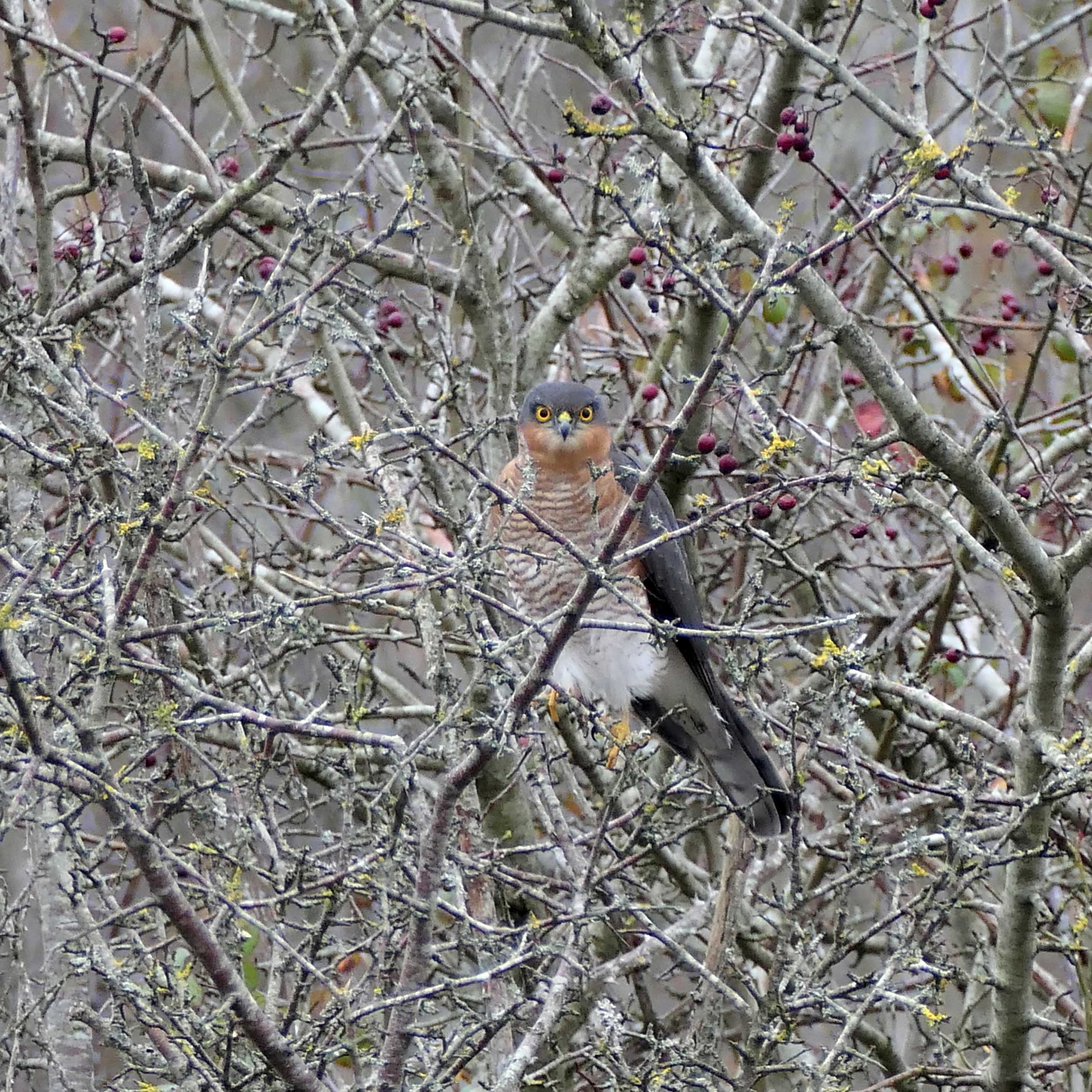
That led me check what it was looking at and it seemed to be a Goshawk (too big for a Sparrowhawk) chasing a flock of panicking Feral pigeons across the sky. I didn’t see if it was successful as they were obscured by a stand of tall trees, and the Grey heron went back to its fishing and I went back to watching the Grey heron at its fishing.

Spider: Eratigena species

Tags

, , , ,

The day I saw the Choughs (see last Friday’s blog Choughed), I was actually in Barry looking for a rare spider. Our local spider expert had found them in the garden centre attached to a local department store so I figured it was worth a look. I did manage to find lots of that particular spider’s webs (the spider was Badumna longinqua; an example of its lace-like web is shown below) but the beasties themselves proved more elusive.

I thought I would buy some potting mix while I was there but, as I had a one mile uphill walk from the train to where I live, I didn’t want to carry anything too heavy, so I tried to pick up one of the 10-litre bags to check its weight. In doing so I uncovered a large spider that had been lurking unseen between two stacks of bags. I thought I’d finally found my target and got as many photos as I could before it scurried back under the pile.

Unfortunately, once I had a closer look at my images, I could see it wasn’t the right spider. What I had found was a Giant house-spider, one of the Eratigena species that can only be positively identified by microscopic examination of the spider’s genitals – and that definitely was not going to happen. As their common name infers, these beauties like to live in our houses, tucked away somewhere you’d probably never see them except when you’re having a spring clean … though I’ve just been reading that the males like to go wandering in search of a female in the late summer/early autumn.

The ones I missed

Tags

, , ,

Despite finding a respectable 60 wildflowers still in bloom during last week’s walk, I knew I could find even more so I’ve kept my eyes peeled during this week’s walks. These are the ones I missed last week …

Bird’s-foot trefoil, Blue fleabane, Bramble, Common chickweed, Common mallow, Common toadflax, Creeping thistle, Gorse, and Hedge bedstraw.

Hogweed, Honeysuckle, and Mayweed.

Meadow buttercup, Narrow-leaved ragwort, Nipplewort, Red dead-nettle, Selfheal, White melilot, Woody nightshade, Yellow corydalis, and Yellow-wort.

I had to add this last one – not a wildflower, but a random Tomato that had somehow self-seeded along the edge of one of the local back lanes. I admire its tenacity.