Meet Beaky

Tags

, , , , ,

Let me introduce you to Beaky the Carrion crow. It lives at Cosmeston Lakes Country Park, in the area around the visitor centre and car park at the southern end of the east lake. I’ve heard about Beaky from other park visitors and know some elderly gents who throw it some bread whenever they visit but, as I don’t often walk in that area (too many people for my liking), I hadn’t met Beaky until last Friday. I had some bird food with me so threw it into the water at the lake edge for the Tufted ducks then was sitting on a bench, putting away my bins and camera in preparation for heading home, when this crow landed in front of me and stared, as if to say ‘Where’s my food?’ And, of course, I couldn’t help but notice its deformed bill so knew immediately this must be Beaky. Unfortunately, I didn’t have any food left but I’ll definitely save some for this characterful bird next time I head that way.

And, just in case you’re wondering, ‘my’ crows are well, and still/always hungry. I don’t go to Cosmeston as often as I used to (too many people for my liking, and that’s only going to get worse, as the Welsh government has just approved a development of 576 new homes on the land opposite) but, as soon as I walk in to my crows’ territory, they come flying in to see me.

The male, above, usually lands right by my feet, whereas the female, below, more wary, perches in a nearby tree. I don’t know if you’ve ever felt a close connection to a wild creature but it truly makes my heart sing when these birds fly in, feed near me, and often walk around the field with me.

Autumn trees: Ash

Tags

, , , , ,

My Flora Britannica contains a myriad of fascinating information about the Ash tree (Fraxinus excelsior) but nothing that specifically relates to the tree in autumn. So, I googled “Ash keys”, thinking that might turn up some interesting facts. The AI overview produced this rather bizarre result:

“Ash keys” can refer to the winged seeds of an ash tree, which are used in poetry collections, or a caravan park in Yorkshire, UK. The ash tree seeds are a common sight in autumn and are also used to make pickles.

Yes, I was expecting the ‘winged seeds of an ash tree’ but ‘used in poetry collections’? (Turns out, there’s a book of poetry called Ash keys.) And, yes, ‘ash tree seeds are a common sight in autumn’ but are they really used to make pickles? (Turns out, this can be done but is an incredibly long-winded process, using a lot of electricity for multiple cooking stages and spices to create flavour, and is surely neither environmentally friendly nor worth the effort.) You may have guessed I’m no fan of AI!

So, here’s one of the much more interesting pieces from Flora Britannica instead:

In Britain, up until the end of the eighteenth century, it was regarded as a healing tree, and Gilbert White knew Hampshire villagers who, as children, had been through an Ash ritual as a ritual as a treatment for rupture or weak limbs. It was an extraordinary ceremony, a relic of pre-Christian sympathetic magic. A young Ash was split and held open by wedges, while the afflicted child was passed, stark naked, through the gap. The split was then ‘plastered with loam, and carefully swathed up. If the parts coalesced and soldered together … the party was cured; but, where the cleft continued to gape, the operation, it was supposed, would prove ineffectual.

The Black redstarts are back

Tags

, , , ,

I wrote that title in an optimistic frame of mind a week ago, when planning forthcoming blog posts and after seeing my first Black redstart of the autumn/winter season in a nearby seaside town. This female / immature bird – it’s impossible to tell whether they’re male or female at this time of year when they haven’t yet acquired their adult plumage – was moving between the rooftops of local houses and an adjacent newly planted park.

This was apparently one of two birds, and, a few days later, two males were also seen. I had intended to go for another look but the park also held a children’s playground very close to where the birds were feeding and it’s not really a good idea to linger near a playground with binoculars and a camera. Then, yesterday I heard that no Black redstarts have been seen at all this week so it looks like they’ve moved on. Fingers crossed we’ll get some local over-wintering birds, in a more suitable location.

Oak mazegill

Tags

, , , , , ,

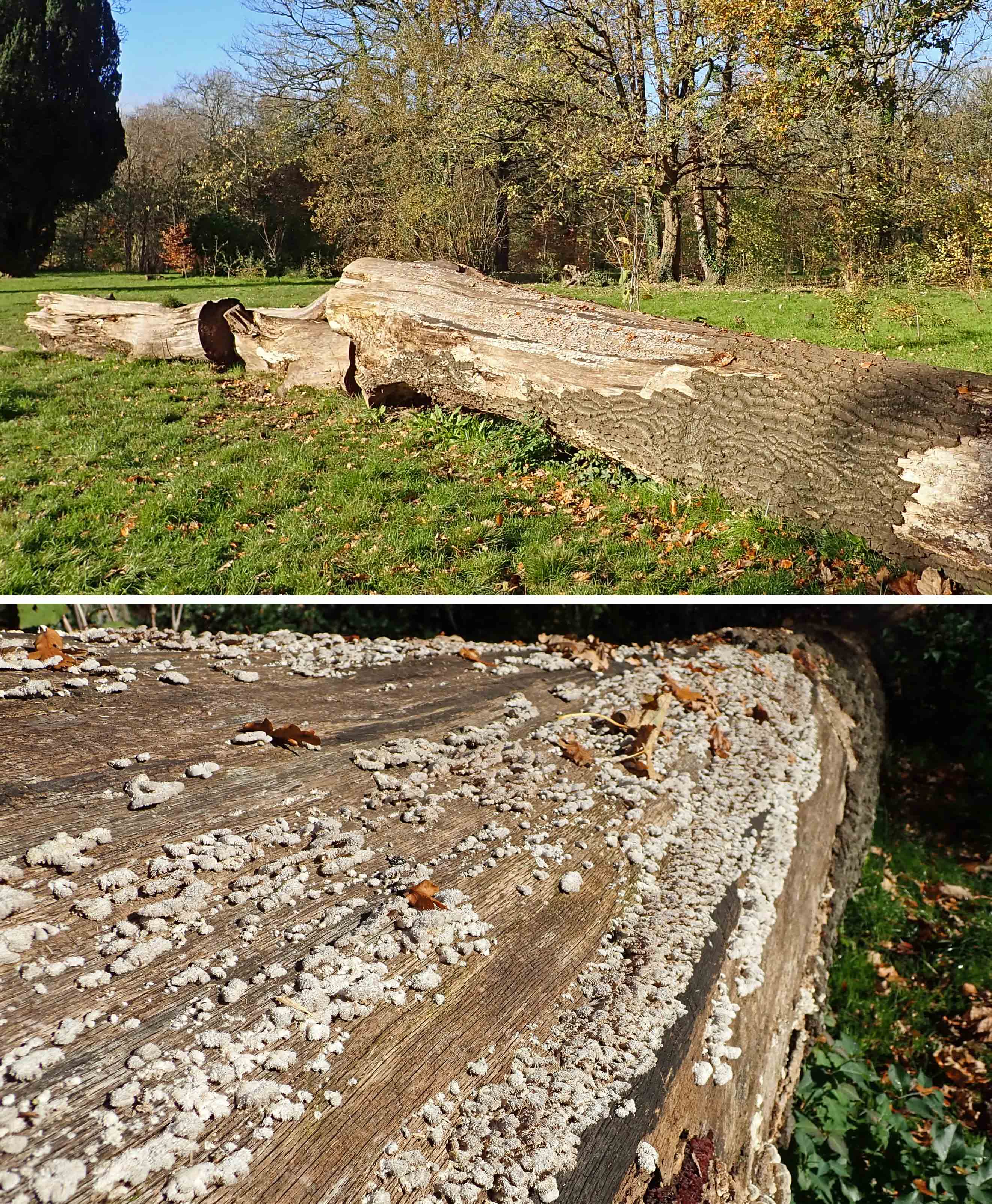
I’m sure I must have seen these stunning bracket fungi, Oak mazegill (Daedalea quercina), before this week but I have no images of them on my laptop. Growing on a huge old fallen Oak – they always grow on Oak (i.e. Quercus species), hence the quercina epithet, consuming dead fallen and still standing trees and large branches, these brackets grow annually, eventually reaching a thickness of 10cm and a diameter of 20cm. And, as you can see from my photos, the fertile surface (i.e. the underside of the bracket, from which the spores are released) has maze-like channels, which explains the mazegill name.

Pat O’Reilly, in his book Fascinated by Fungi, explains that its generic name (Daedalea) refers to Daedalus, the legendary figure who supposedly designed the maze on ancient Crete, in which Pasiphaë, wife of King Minos, hid her offspring the Minotaur, half man and half bull.

O’Reilly’s book also includes a couple of other fascinating facts about Oak mazegill:

This fungus was valued by beekeepers who used the smoke from smouldering fruitbodies to anaesthetise bees. Once the bees had been calmed by the dense smoke, the beekeeper could open a hive and work on it without triggering painful panic reactions by the occupants.

The deep, hard-wearing channels make these tough and durable brackets very handy as combs for grooming horses – one of their traditional uses.

The return of the Woodpigeons

Tags

, , , , , ,

This time is 7.35am Monday morning, and the sun has just risen above the Mendip Hills, on the north Somerset coast.

And the Woodpigeons have begun moving northwards again, along the south Wales coast, reversing the journey they made a week or so ago. Their flocks – at least, the ones I can see – are smaller, in the tens and hundreds, not the massive flocks of several thousand birds I saw moving south.

Did they get to Land’s End and think ‘You’ve gotta be kidding me?’ Do the young birds tag along for the British section of the flight as a learning exercise? Are Woodpigeons like sheep that just mindlessly follow a leader? Do they get caught up in the fun, the exhilaration, the sense of adventure but then realise their limitations when they meet the challenge of a sea crossing? Do they somehow realise the grass, and the berries, are not greener on the other side?

Just as with their migration south, so with the move of smaller numbers back north, no one knows why they do it; why some carry on with their migration while others return back the way they came, and whether they return to where their journey originated or whether they stop off to overwinter somewhere different along the way. Woodpigeons are much more mysterious than you might think!

Viviparous umbellifers

Tags

, , , ,

I’ve seen viviparous Teasels before (see Wild word: viviparity, January 2024) but these viviparous umbellifers – I think these are Wild Carrots (Daucus carota), spotted during my circuit of Cardiff Bay last Thursday, were a first for me and a result, I’m sure, of how warm and wet this autumn has been.

Viviparity is when seeds begin the germination process, producing their primary leaves, while the seeds are still joined to their parent plant.

I must make a point of visiting this location in the next week or so to see whether the seeds continue to grow, producing secondary leaves, and more, while still within the seedhead structures.

A female Vapourer

Tags

, , , , , , ,

The highlight of my walk last Saturday was finding my first female Vapourer moth (Orgyia antiqua), sitting on her cocoon, presumably newly emerged.

Now, you might look at her and think ‘That doesn’t look like a moth. Where are the wings?’ That’s the amazing thing about a female Vapourer – she’s almost wingless; her wings are so tiny that she’s unable to fly. Once she hatches, the female sits on her cocoon, as this one was, emitting pheromones and waiting for a male to fly by, notice and mate with her. Then, she’ll lay her eggs on the outside of her empty cocoon (as you can see on the other cocoon I found very close to the female, and which I also blogged about earlier this year: Vapourer pupa and eggs, January 2025). As she can’t fly, the female can’t feed, so she will die soon after laying her eggs.

Ominously, there were tiny parasitic wasps hanging around the female, presumably waiting to inject her eggs, so some of those eggs may not produce caterpillars come the spring.

Birds and Buckthorn berries

Tags

, , , , , , , ,

Last Wednesday’s weather was dreich. (Are you familiar with that word? It’s Scottish English, a word I learnt when married to a Scotsman and from having lived for a few years in Scotland. It means bleak and dreary, and is the perfect descriptive for much of our recent weather.)

Back to last Wednesday … it was too bleak even for me to go out walking so, while sitting at my dining table/desk, deliberately placed by my living room windows for maximum external views, I had one eye on any wildlife activity happening outside.

Though the berries on this Buckthorn tree had looked ripe for a week or more, the birds chose this particular day to begin selecting the most juicy plump fruit to eat. As I watched, first male and female Blackbirds flew in and began scoffing the berries. Then, the Woodpigeons turned up, the branches of the tree drooping and swaying under their weight. And, lastly, a handsome Song thrush appeared to join in the feast.

As my photos were taken through rain-covered double-glazed windows, they’re not very sharp but I thought they were still worth sharing. Watching all these beautiful birds certainly cheered a very grey day.

Autumn trees: Beech

Tags

, , , , ,

Things I didn’t know about the Beech tree (Fagus sylvatica) until I started to research this post, all courtesy of Richard Mabey’s Flora Britannica

Even its arrival in this country has been a contentious matter, and it is often claimed to be a Roman introduction … But beech pollen remains have been found in the Hampshire basin that date from 6000 BC – about 2,000 years after the oaks returned to post-glacial Britain and 500 years before the Channel opened. So the beech just passes the key test of botanical nativeness; it was here when Britain became on island.

The leaves have been made into a potent alcoholic drink – beech-leaf noyau. This is a recipe remembered by a 70-year-old man in the southern Chilterns: ‘Wash and dry enough been leaves to fill your stone jar – cover them with gin. Leave for a week, then strain off the liquid and measure. To each pint add a pound of sugar which is dissolved in half a pint of boiling water. Add a good quantity of brandy and stir together, then leave to go cold before bottling.’

I’m not sure I’d give that drink a try but, standing tall and statuesque amongst its tree companions, the Beech is a magnificent tree, a definite favourite of mine in every season, but especially in autumn.

Bountiful Ground-ivy

Tags

, , , , , ,

When the weather’s wet, which it often has been of late, I tend to focus more on looking for small things when out walking. This is partly because the larger creatures, like birds, tend to prefer taking shelter as much as we humans do but also because I don’t want to get my good camera wet and my small camera, the one I use for close-up shots, is waterproof. Monday was one such day and, when I stooped to pat a random black cat that appeared out of nowhere, I noticed how marked and mottled were the leaves of the Ground-ivy the cat was sitting next to. So, I investigated.

And what a bountiful patch of Ground-ivy it was. Firstly, I couldn’t help but notice how many of the leaves were covered with the pustules of the rust fungus Puccinia glechomatis.

Then I discovered that many of the leaves also had small bumps on them, galls caused by the miniscule mite Rondaniola bursaria.

And, perhaps best of all, while investigating the rust and the galls, I also spotted a single tiny dark case sticking up from one leaf, the self-constructed home of a larva of the moth Coleophora albitarsella. And, with that, the rain starting coming down a little too heavily for comfort so both the cat and I headed for home.