Cones, and a few nuts

Tags

, , ,

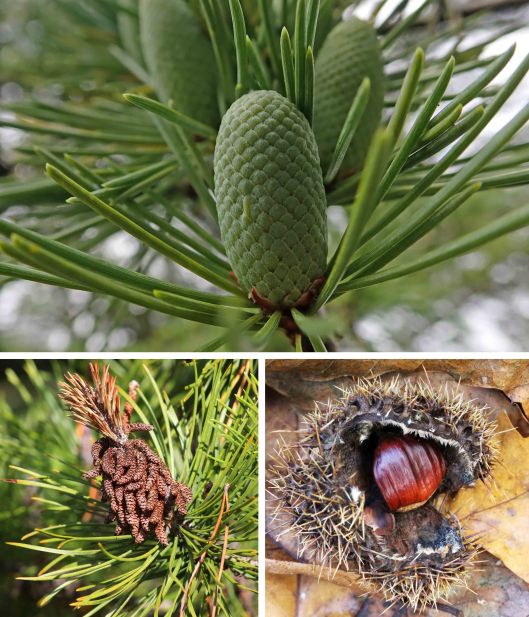
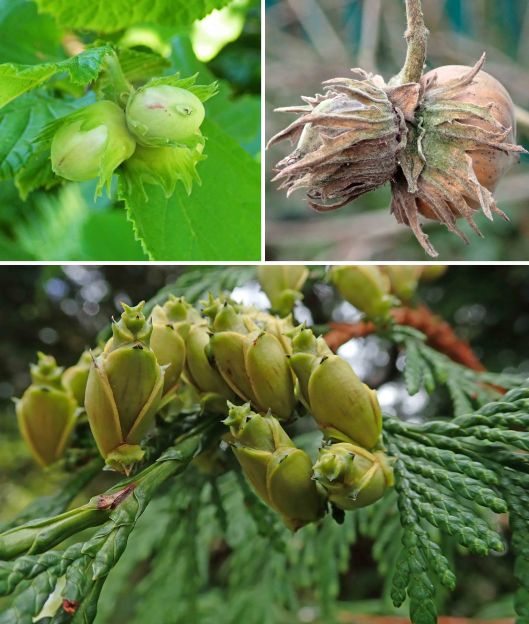
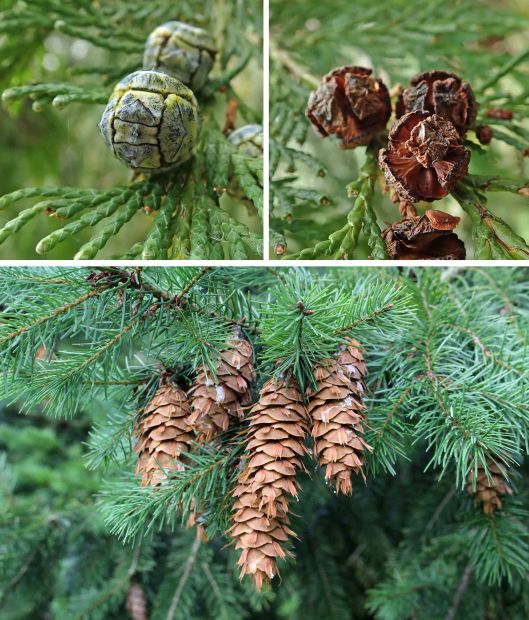
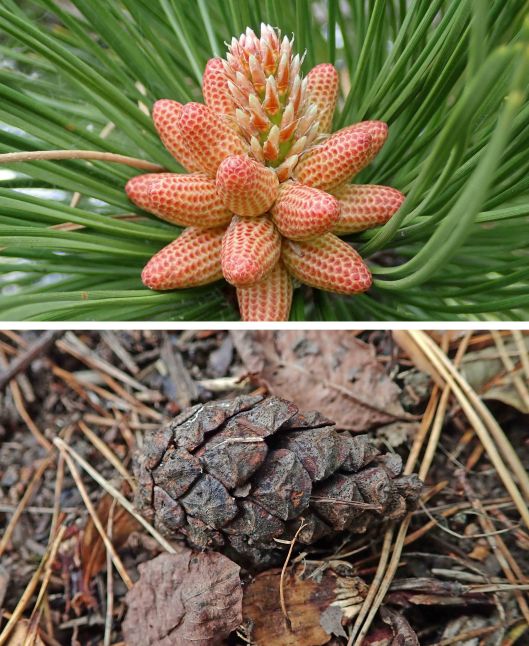
Probably because I am guilty of ignoring most conifers, I hadn’t realised how diverse their seed structures, their cones are. I am also not able to identify most of the conifers I see, neither the natives in local woodland nor the exotics in local parks. I must try to remedy that but, in the meantime, here are some of the many cones, and a few nuts, I’ve been noticing.
231105 cones nuts (1)231105 cones nuts (2)231105 cones nuts (3)231105 cones nuts (4)

Cheery yellow

Tags

, , , ,

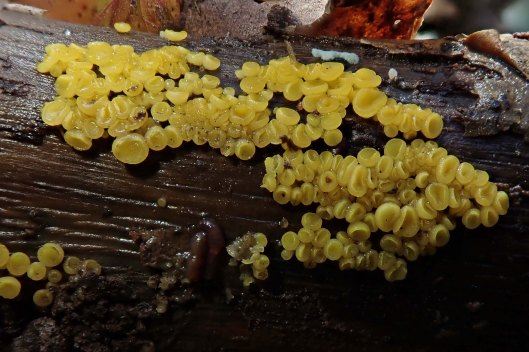
After the last few grey, wet, windy days of Storm Ciarán, I thought we needed a little sunshine, even if it’s coming from the ground below rather than the sky above. It’s not exactly warming but it certainly made me feel more cheery after days of gloom. These are likely to be Lemon disco fungi (Bisporella citrina), though they really need examination under a microscope to be sure.

231103 lemon disco

Leaf grazers: a snail

Tags

, ,

When I first spotted this Holly leaf, I thought some new-to-me leafminer had been busy devouring it.

231102 a snail's lunch (1)

Then I turned the leaf over. The culprit, as you can see, was this little snail. And a little more leaf-turning revealed several more small snails, on various shrubs and trees, not something I expected to see. I assumed snails mostly lived closer to the ground but obviously not.

231102 a snail's lunch (2)

Great northern diver

Tags

, , , , , ,

I’m so glad I battled the elements (and it was a battle, with strong winds, frequent showers, and one particularly nasty squall that saw me sheltering behind trees that were bending at an alarming angle from the force of the wind!) to walk across to Cardiff Bay Wetlands Reserve this morning.

231101 great northern diver (1)

Even though my views of this Great northern diver (what you Americans out there call a Common loon) were always distant, I was lucky to meet up with a local birding friend who let me use his telescope for a better look. We seldom see these handsome birds in my area, and, even better, this diver was still in its spectacular summer plumage (check here for better photos). A distant treat!

231101 great northern diver (2)

T is for plume

Tags

, , , , , ,

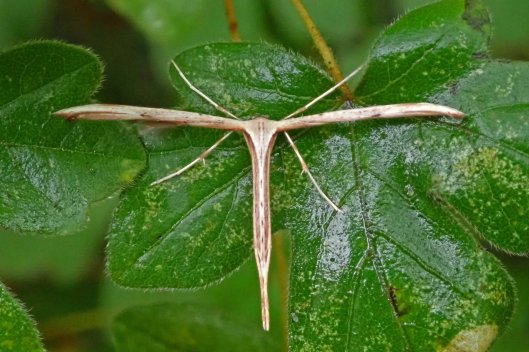
‘T is for plume’ may sound an odd title but it’s the T shape these moths make when they’re resting that makes them recognisable as plume moths, the Pterophorinae. And why plume? Well, when their wings are spread, the deep indentations look like feathers (the photos of a White plume on the UK Moths website show a beautiful example).

231031 common plume

Common plume (Emmelina monodactyla)
As you’d expect from its name, this pretty moth is quite common – in fact, I’ve seen several in the last few weeks.

231031 Beautiful plume

Beautiful plume (Amblyptilia acanthadactyla)
Though this moth can be confused with another that’s very similar (Brindled plume, Amblyptilia punctidactyla), the reddish-brown hue confirms it as a Beautiful plume.

A spider’s lunch

Tags

, , , , ,

What’s on the menu at the Web Café? Probably anything that makes the unfortunate mistake of colliding with a silken web of sticky fibres but, in this case, a couple of varieties of fly – one that appears to have been beheaded; a species of caterpillar; and a well-wrapped wasp. Definitely not a vegetarian café!

231030 spiders lunch

Crane’s-bill vs stork’s-bill

Tags

, , , , , ,

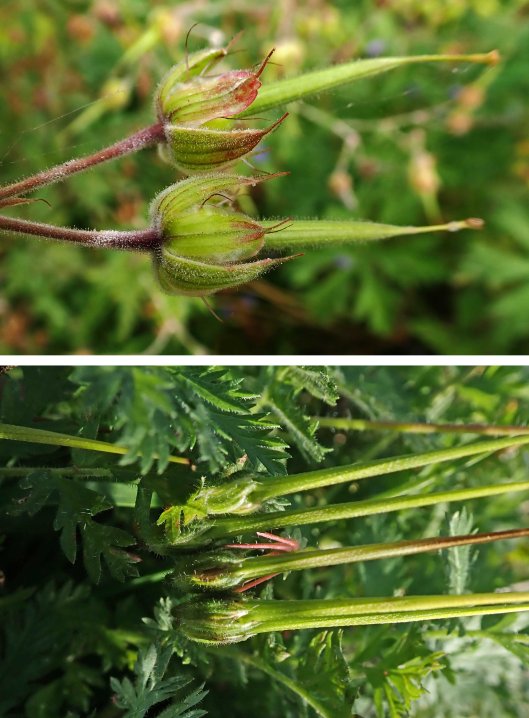
It occurred to me today, after seeing both Common stork’s-bill (Erodium cicutarium) and Meadow crane’s-bill (Geranium pratense) still flowering locally, to wonder what the difference is between stork’s-bills and crane’s-bills. According to my Flora Britannica, it’s to do with the length of the birds’ bills, i.e. the seed cases of the stork’s-bills are longer than those of the crane’s-bills. The photos below show the relative differences, Meadow crane’s-bill above, Common stork’s-bill below.

231029 meadow crane's-bill vs common stork's-bill (1)

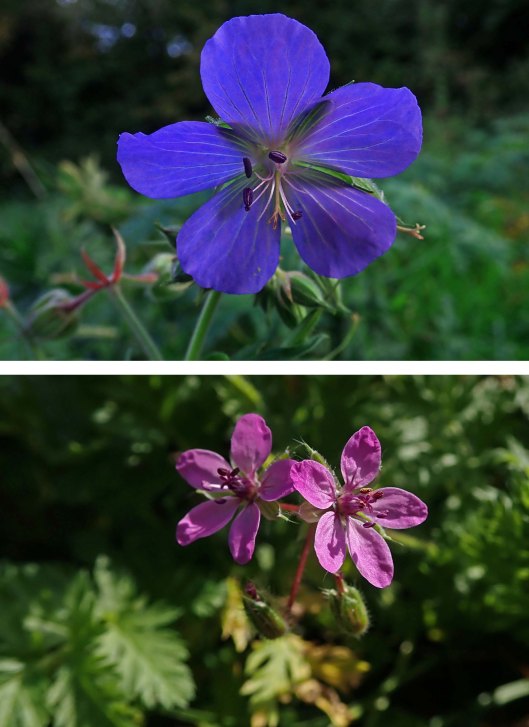
And because they both have lovely flowers, albeit of very different sizes (Common stork’s-bill is a tiny plant compared to Meadow crane’s bill), here they are, again Meadow crane’s-bill above, Common stork’s-bill below.

231029 meadow crane's-bill vs common stork's-bill (2)

Short-eared owl

Tags

, , ,

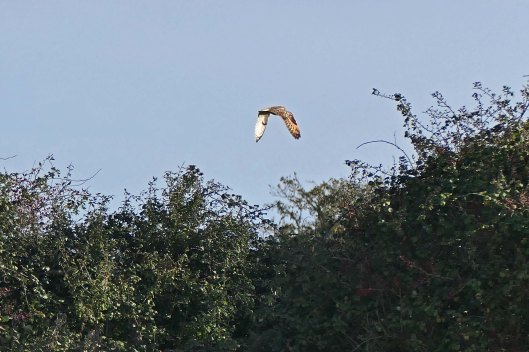
As I’ve only ever seen Short-eared owls once before – and those two were mere specks, very distantly flying back and forth over Kenfig National Nature Reserve’s dunes at dusk five years ago, I felt compelled to seek out the bird that was reported from the local coastal fields on Wednesday. I had slipped and squelched my way around the sodden field edges, stood staring this way and that for almost two hours when the sounds reached me of Carrion crows creating a ruckus – always worth a look. I turned in that direction just in time to see two crows following close behind an owl flying along the hedge line of the adjacent field. I was on the opposite side of the field to where they were so I grabbed a couple of quick photos and hurried as fast as I could around my field to the corner of theirs. Unfortunately, the owl had gone to ground, perhaps literally, and, though I waited and watched for another 40 minutes, there was no further sign. But I was still buzzing all the way home!

231028 short-eared owl

Fungi fight back

Tags

, , , ,

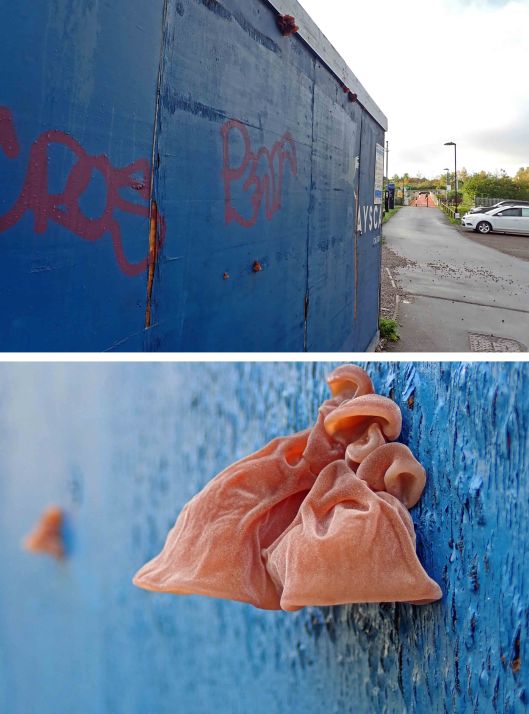
These two fungi sightings made me smile because they reminded me that, given half a chance, Nature is very very good at fighting back against destruction by humans by colonising human-made products. The first fungi – little colonies of Jelly ear growing along the top and centre of the wood-panelled sides of a PortaCabin – were a surprise. I usually see Jelly ear on dead or dying Elder trees, and it can grow on other hardwood trees, but painted wood panels? Amazing, really.

231027 fungi (1)

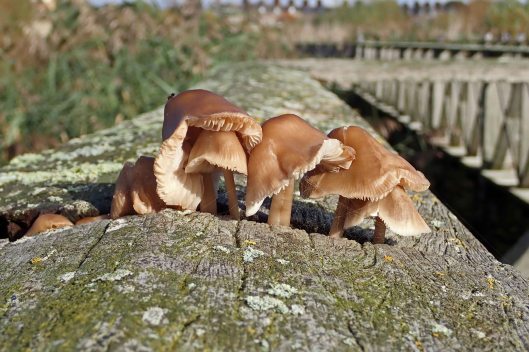
My second sighting, on the same day as the first, was not such a surprise, as the wooden structure of the boardwalk at Cardiff Bay Wetlands Reserve is now quite old and rotting in places. Fungi are very good at taking advantage of these situations.

231027 fungi (2)