• ABOUT
  • BIRDING 2018
  • Birding 2019
  • BLOG POSTS
  • Butterflies 2018
  • Resources

earthstar

~ a celebration of nature

earthstar

Tag Archives: autumn migration

233/366 Migration, migration, migration

20 Thursday Aug 2020

Posted by sconzani in autumn, birds, nature

≈ 2 Comments

Tags

autumn migration, bird migration, birding, British birds, Pied flycatcher, Redstart, Sedge warbler, Whitethroat, Willow warbler

While yesterday’s Clouded yellow butterfly was migrating northwards on the hot southerlies, our local birds were heading in the opposite direction, to their various wintering spots around the Mediterranean and in locations all over the African continent. They started heading south in ever-increasing numbers about three weeks ago – at least, that’s when I started noticing this year’s autumn migration. Blackcaps, Chiffchaffs, Swallows, Sand and House martins … for a lot of these little birds their long journey has already begun.
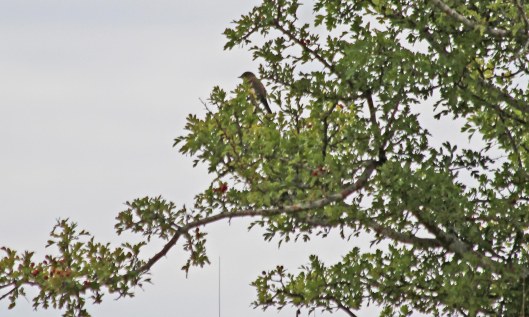
200820 pied flycatcher

The first noteworthy bird for me was a Pied flycatcher, found by a local birder at Cosmeston one day, and I just happened to be right there he re-found it the following day. That was 22 July, the day I also began to notice how many Willow warblers there were everywhere – I’ve been seeing good numbers of these lovely little birds almost daily since then.
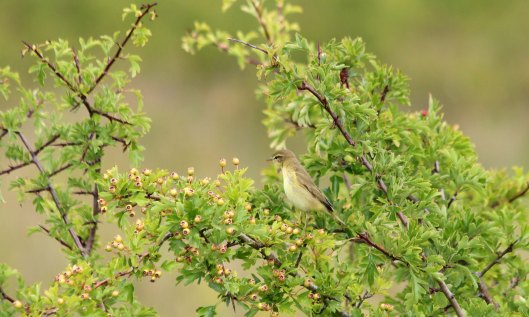
200820 willow warbler

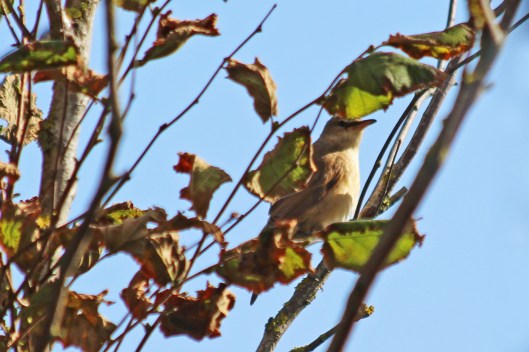
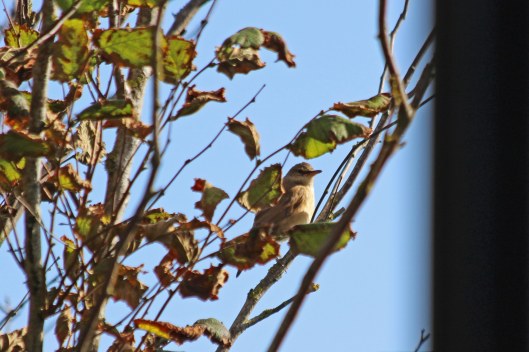
On 2 August, this Sedge warbler was a surprise find in the hedgerow on a local farm. With any luck, it will be well on its way to sub-Saharan Africa by now.

200820 sedge warbler

Also on 2 August, in that same hedgerow, I noticed a lot of Whitethroats, and they’re also passing through in small numbers every day now.

200808 whitethroat (1)
200808 whitethroat (2)

I’ve seen a Redstart at Cosmeston a few times – these photos were taken on 4 August and 16 August in almost the exact same location. Might it be the same bird that has perhaps found the place to its liking and is trying to fatten up before flying onward?

200820 redstart (1)
200820 redstart (2)

In recent days, I’ve also been seeing some of my favourite migrants, Spotted flycatchers (several now seen) and Whinchat (just one so far) but I’m going to post separate blogs about those superb little birds.
Like Loading...

277/365 Lifer: Great reed warbler

04 Friday Oct 2019

Posted by sconzani in birds, nature

≈ 2 Comments

Tags

autumn migration, birding, birdwatching, Great reed warbler, Portland Bird Observatory

I’ve left the best till last. We saw a lot of nice birds during our long weekend at Portland Obs but this bird was the undoubted star.

It was late morning, on Saturday 28 September, and a few of us were standing in the Obs front garden, watching for a Firecrest that had been seen there, when keen-eyed Tim noticed a brown bird hopping about in a buddleja right in front of us. It looked like a Reed warbler but was too big, and our experts almost immediately realised it was a Great reed warbler (Acrocephalus arundinaceus). The bird disappeared for a short time (John raced inside to tell the other birders, and I went in to grab my camera), then, luckily, it reappeared and proceeded to munch on some blackberries growing alongside the garden wall. Unfortunately, it didn’t linger long, soon disappearing along the side of the buildings.

191004 great reed warbler (1)

Several people had noticed the bird had a ring on one leg so this Great reed warbler must have been the same bird that had been caught and ringed in the Obs garden 10 days earlier. Amazingly, it had lingered in the surrounding scrub and bushes without anyone spotting it.

191004 great reed warbler (2)

The largest of the European warblers, the Great reed warbler is only occasionally seen in Britain – it breeds in Europe and Asia and overwinters in sub-Saharan Africa – so, this bird had somehow lost its way during migration.

191004 great reed warbler (3)

If you want to see much clearer photos of this cracking bird, check out Martin Cade’s photos and reports on the Portland Obs blog here (when it was first ringed) and again here (when the bird was re-found, during Saturday afternoon, in the Obs back garden).

Like Loading...

260/365 Stonechats

17 Tuesday Sep 2019

Posted by sconzani in 365DaysWildin2019, autumn, birds, nature

≈ 10 Comments

Tags

#365DaysWild, autumn migration, bird migration, birding, birdwatching, British birds, Cosmeston Lakes Country Park, Stonechat

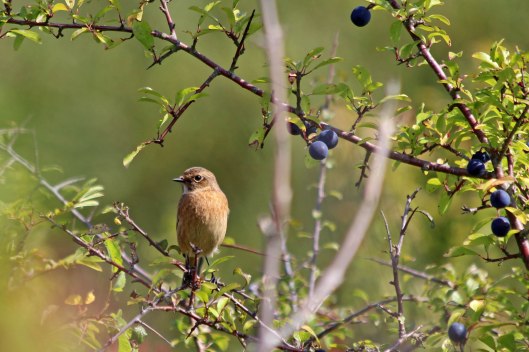
The Autumn migration flow of birds continued through Cosmeston Lakes Country Park, with several species reported: a Redstart, a Whinchat, a Spotted flycatcher and several Stonechats, two of which very kindly popped up in the hedge right in front of me.

190917 stonechat (1)190917 stonechat (2)

Like Loading...

243/365 Turn of the seasons

31 Saturday Aug 2019

Posted by sconzani in 365DaysWildin2019, autumn, birds, nature

≈ 3 Comments

Tags

#365DaysWild, autumn migration, birding, birdwatching, British birds, Turnstone

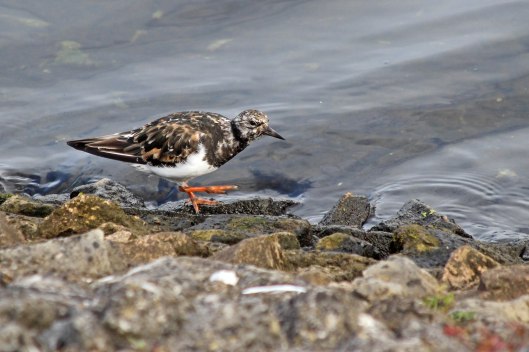
The yellowing of the leaves on the tree outside my window, my sightings of migrating birds, the cooler night-time temperatures have all been telling me for a couple of weeks that autumn is on its way, something the calendar will agree with tomorrow. But, for me, one of the true indicators is the arrival of the Turnstones, back from their breeding season in Greenland and northern Canada.

190831 turnstone

The five I spotted on the Ely embankment this morning still show some of their summer colouring but those chestnut feathers will soon disappear as the birds complete their moult into winter plumage. Welcome back, my little friends!

Like Loading...

241/365 Spot fly

29 Thursday Aug 2019

Posted by sconzani in 365DaysWildin2019, birds, nature

≈ 2 Comments

Tags

#365DaysWild, autumn migration, birding, birdwatching, British birds, migrating birds, Spot fly, Spotted flycatcher

The day started cool, with a heavy dew and clouds hiding the sun, and I thought I wasn’t going to find a lot during my Cosmeston meander. I was wrong.

190829 spot fly (2)

Once the sun came out so did the creatures: two Green woodpeckers together on the grassy track ahead; two migrating Whinchats, my first this season; a Hummingbird hawkmoth that only hummed a little before landing on the dirt track in front of me – not something I’ve ever seen before; another magnificent Clouded yellow; and, today’s star, yet another Spotted flycatcher, my fifth at Cosmeston in the past week and the most confiding, allowing me to get quite close for photos. It has been a wonderful, and much needed, immersion in Nature today.

190829 spot fly (1)

Like Loading...

224/365 It’s autumn!

12 Monday Aug 2019

Posted by sconzani in 365DaysWildin2019, autumn, birds, nature

≈ 2 Comments

Tags

autumn migration, birding, birdwatching, British birds, Lavernock Nature Reserve, Spotted flycatcher

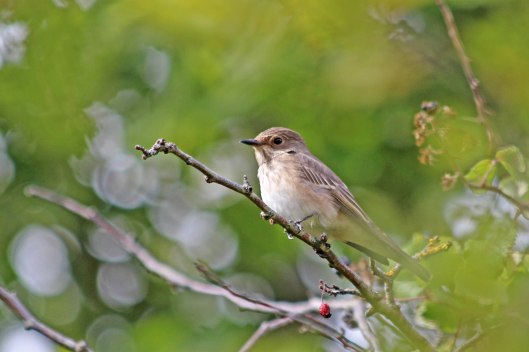
Willow warblers are peeping from every bush, Blackcaps are chacking, Swallows and martins are swooping low over the fields at Cosmeston for last minute snacks before they cross their first stretch of water on their way south and, today, at Lavernock, I saw my first Spotted flycatcher of the year. Autumn migration is well and truly underway!

190812 spotted flycatcher

Like Loading...

Lesser yellowlegs

04 Sunday Nov 2018

Posted by sconzani in birds, nature

≈ Leave a comment

Tags

American bird, autumn migration, birding, birdwatching, Black-tailed godwit, British vagrant bird, Dunlin, Greenshank, Lesser yellowlegs, RSPB Lodmoor, Tringa flavipes

Its name says it all really – the Lesser yellowlegs (Tringa flavipes) is a slender wader, with long yellow legs, and the smudgy, less defined markings on the breast of this particular bird point to it being a juvenile.

181104 lesser yellowlegs (1)

The Lesser yellowlegs is native to the Americas, spending its summers breeding in the northern forests that lie between Alaska and Quebec and its winters on the United States’ Gulf coast and in parts of South America.

181104 lesser yellowlegs (2)
181104 lesser yellowlegs (3)

The birds we see here in Britain are vagrants, birds that have strayed or been blown off course during their migration. On average, about ten birds are seen in various parts of Britain each year and, amazingly, there was also a Lesser yellowlegs at RSPB Lodmoor when we visited during last year’s Portland trip

181104 lesser yellowlegs (4)
181104 lesser yellowlegs (5)

Two interesting facts about this bird from the Cornell Lab of Ornithology website:

Both the male and female Lesser Yellowlegs provide parental care to the young, but the female tends to leave the breeding area before the chicks can fly, thus leaving the male to defend the young until fledging.

and …

The oldest recorded Lesser Yellowlegs was at least 4 years, 11 months old when it was found in South Dakota in 1965. It had been banded in the Lesser Antilles in 1960.

181104 lesser yellowlegs (6)

Back here in Dorset, it was great to get such close views of the Lodmoor Lesser yellowlegs and particularly to see it in close company firstly with two Greenshanks and a Black-tailed godwit (photo above), and then with the same two Greenshanks and a Dunlin (below). This really helped to see the relative differences in size, shape and plumage.

181104 lesser yellowlegs (7)

Heck, I even managed to get a short video of the lovely little thing. Enjoy!

Like Loading...

Scurrying Sanderlings

22 Saturday Sep 2018

Posted by sconzani in autumn, birds, nature

≈ 8 Comments

Tags

autumn migration, bird migration, birding, birdwatching, British birds, Calidris alba, migrating birds, Sanderling, Sker Rocks

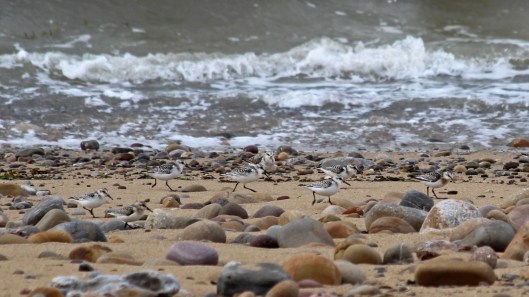
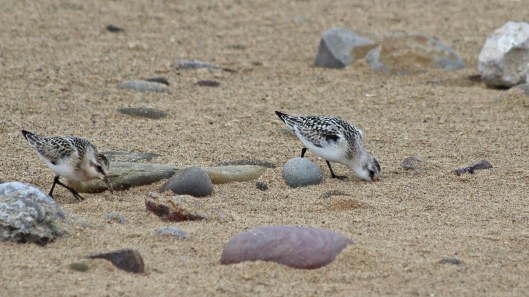
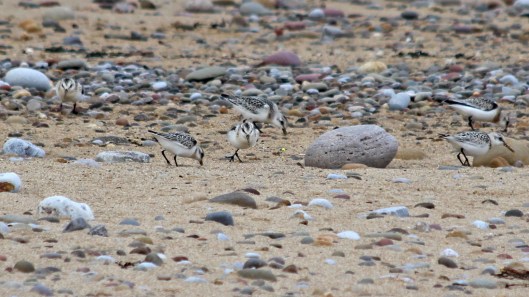
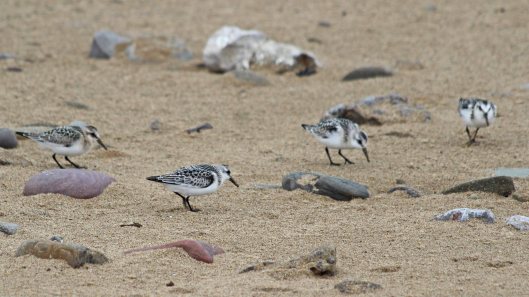
Watching these busy little birds scurrying back and forth along the beach at Sker last Saturday was the highlight of my day.

180922 sanderlings (1)

I had walked away a little from the group of birders I was with as I wanted to try to get better photographs of the waders moving along the water’s edge, and I’m so glad I did, as the birds weren’t as bothered about one person standing very still and silent as they would’ve been about 25 chattering people moving about, and so came up reasonably close to me.

180922 sanderlings (2)

Small flocks of Sanderlings (Calidris alba), and other small waders, were flying back and forth from the rocks to the sandy beach to feed, poking their heads right up to their eyes in the soft sand to probe for their preferred food of small crustaceans and molluscs.

180922 sanderlings (3)180922 sanderlings (3a)

According to the Merriam Webster dictionary, the name Sanderling is a combination of the fairly obvious ‘sand’ and ‘erling’, which probably comes from the Old English yrthling, meaning ploughman (from yrth earth and erian to plough). That certainly makes sense when you see these little birds in action.

180922 sanderlings (4)

Sanderlings are passage migrants that move through Britain in spring and autumn on their way to and from their breeding grounds in the High Arctic and their over-wintering sites in southern Europe and Africa.

180922 sanderlings (5)

The birds’ plumage changes for the breeding season, becoming much darker, with shades of reddish-brown on the head, neck and back, and you can still see hints of that on some of the birds in my photos. Also, many of my birds seem to be juveniles, with quite chequered markings on their backs and very clean white under-parts.

180922 sanderlings (6)

One fascinating factoid I discovered when reading up about these birds is that they have only three toes on each foot, with no hind toe to provide balance, and this is the reason for their scurrying motion. If you want to see Sanderlings in action, I uploaded a very short video to youtube.

180922 sanderlings (7)

Like Loading...

White vs Pied wagtails

13 Thursday Sep 2018

Posted by sconzani in autumn, birds, nature

≈ 5 Comments

Tags

autumn migration, birding, birdwatching, British birds, difference between Pied and White wagtail, Motacilla alba alba, Motacilla alba yarrellii, Pied wagtail, White wagtail

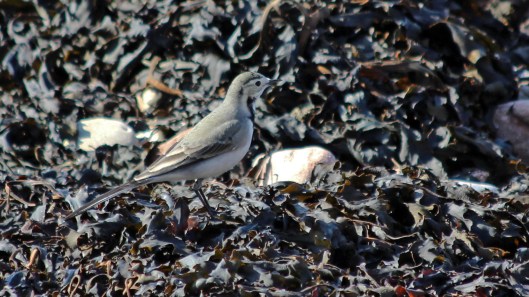
It’s taken me a couple of years to find and recognise White wagtails for myself. I would hear other birders talk about them and look at the photos they posted, but not really see any difference between Pied and White wagtails. Finally, I found some and it was immediately obvious they had a different look.

180913 white wagtail (1)

To be clear, these are not two different species of bird: Pied Wagtails (Motacilla alba yarrellii) and White Wagtails (Motacilla alba alba) are different subspecies of the same species, which rather confusingly is known as the White Wagtail (Motacilla alba).

180913 white wagtail (2)

In Britain, we mostly see Pied wagtails, with the Whites passing through during the spring and autumn migration periods, and the White wagtails tend to have a much lighter grey back and a very clean, white belly and flanks.

180913 white wagtail (4)

Thanks to an excellent blog post I found, I discovered the reason why it was easier for me to tell these particular Whites from the Pied wagtails they were with. The blog has much more detail but, essentially, the Whites complete their moult sooner (usually by the end of August) because of their need to migrate in peak condition from northern latitudes (most of our western Britain White wagtail migrants pass through from Iceland to the southern Mediterranean and Africa, and vice versa), whereas the Pieds, being mostly resident in Britain, don’t complete their moult until mid to late September.

180913 white wagtail (3)

So, the plumage of the Whites I saw looked clean and crisp and fresh, whereas the Pieds were still looking rather scruffy, as you can see below.

180913 pied wagtail (1)
180913 pied wagtail (2)
180913 pied wagtail (3)
180913 pied wagtail (4)
180913 pied wagtail (5)
180913 pied wagtail (6)
Like Loading...

A Whinchat family

08 Saturday Sep 2018

Posted by sconzani in autumn, birds, nature

≈ 2 Comments

Tags

autumn migration, bird migration, birding, birdwatching, British birds, Cosmeston, Cosmeston Lakes Country Park, migrating birds, Saxicola rubetra, Whinchat

180908 2 whinchats (1)

One of the highlights of this week at Cosmeston Lakes Country Park has been watching the party of three Whinchats that have stopped off to feed up prior to their migration to central and southern Africa. I think they’re a family group because this one appears still to have the plumage of a juvenile.

180908 whinchat (1)

Another (below) is still part way through the moulting process. I read recently that birds don’t usually migrate until after their moult is complete, as the lack of all their proper flight feathers, in particular, can affect their ability to fly long distances. Perhaps that’s another reason why they’ve broken their journey at Cosmeston.

180908 whinchat (2)

This is the third Whinchat, or Saxicola rubetra, to give it its scientific name.

180908 whinchat (3).jpg

Their common name, as with many birds, reflects their behaviour – whin is another word for gorse, as these little birds are commonly found amongst gorse and bracken and areas of low shrubs and bushes. Chat relates to their call, which combines the sound of two stones being tapped together with a series of melodic whistles.

180908 2 whinchats (2).jpg

Like Loading...
← Older posts
Newer posts →

About me

sconzani

sconzani

I'm a writer and photographer; researcher and blogger; birder and nature lover; countryside rambler and city strider; volunteer and biodiversity recorder.

View Full Profile →

Follow earthstar on WordPress.com

Enter your email address to follow this blog and receive notifications of new posts by email.

Recent blog posts

  • The Marl Med gull January 29, 2026
  • Recording Grey squirrels January 28, 2026
  • Jimmy Wren January 27, 2026
  • Millipede: Nanogona polydesmoides January 26, 2026
  • Mid-winter 10 January 25, 2026

From the archives

COPYRIGHT

Unless otherwise acknowledged, the text and photographs on this blog are my own and are subject to international copyright. Nothing may be downloaded or copied without my permission.

Fellow Earth Stars!

  • Unknown's avatar
  • Unknown's avatar
  • Unknown's avatar
  • Unknown's avatar
  • Unknown's avatar
  • Unknown's avatar
  • Unknown's avatar
  • Unknown's avatar
  • Unknown's avatar
  • Unknown's avatar
  • Unknown's avatar
  • Unknown's avatar
  • Unknown's avatar
  • Unknown's avatar
  • Unknown's avatar
  • Unknown's avatar
  • Unknown's avatar
  • Unknown's avatar
  • Unknown's avatar
  • Unknown's avatar
  • Unknown's avatar
  • Unknown's avatar
  • Unknown's avatar
  • Unknown's avatar
  • Unknown's avatar
  • Unknown's avatar
  • Unknown's avatar
  • Unknown's avatar
  • Unknown's avatar
  • Unknown's avatar
  • Unknown's avatar
  • Unknown's avatar
  • Unknown's avatar
  • Unknown's avatar
  • Unknown's avatar
  • Unknown's avatar
  • Unknown's avatar
  • Unknown's avatar
  • Unknown's avatar
  • Unknown's avatar
  • Unknown's avatar
  • Unknown's avatar
  • Unknown's avatar
  • Unknown's avatar
  • Unknown's avatar
  • Unknown's avatar
  • Unknown's avatar
  • Unknown's avatar
  • Unknown's avatar
  • Unknown's avatar

Blog at WordPress.com.

Privacy & Cookies: This site uses cookies. By continuing to use this website, you agree to their use.
To find out more, including how to control cookies, see here: Cookie Policy
  • Subscribe Subscribed
    • earthstar
    • Join 670 other subscribers
    • Already have a WordPress.com account? Log in now.
    • earthstar
    • Subscribe Subscribed
    • Sign up
    • Log in
    • Report this content
    • View site in Reader
    • Manage subscriptions
    • Collapse this bar
 

Loading Comments...
 

You must be logged in to post a comment.

    %d