• ABOUT
  • BIRDING 2018
  • Birding 2019
  • BLOG POSTS
  • Butterflies 2018
  • Resources

earthstar

~ a celebration of nature

earthstar

Tag Archives: birding

World Curlew Day

21 Saturday Apr 2018

Posted by sconzani in birds, nature

≈ 2 Comments

Tags

birding, birdwatching, British birds, Curlew, Numenius arquata, World Curlew Day

I consider myself extremely fortunate to be able to see the Curlew (Numenius arquata) quite frequently during the winter months as the birds graze along the seashore and in adjacent playing fields at a seaside town close to where I live in south Wales. But the Curlew is in trouble. Due to changes in the habitat management of its breeding grounds and possibly to an increase in predatory mammals like foxes, the Curlew population has seen worrying declines in recent decades and the bird is now an amber-listed species in Britain.

180421 curlew (1)

Today, 21 April, is World Curlew Day, a day not only to celebrate all the various species of Curlew but also to recognise that these birds are threatened all over the world, and to focus on the research, conservation programmes, and support initiatives needed to ensure their continued survival.

180421 curlew (2)

This particular date was chosen because of the Curlew’s special link with Wales. A post on the Wader Study Group website explains:

April 21 was chosen to be World Curlew Day because of a delightful, traditional Welsh tale that identifies the first curlew conservationist. St Beuno, was a 6th century abbot from Wales. Legend has it he was sailing off the coast when he dropped his prayer book in the sea. A curlew flew over and rescued it and took it to the shore to dry. The grateful St Beuno decreed that from then on, the bird be given special protection and that its nest must be difficult to find; which is indeed the case.

You can read more about the RSPB’s Curlew Recovery programme here, and about the international Curlew situation on the BTO website here. There is also a World Curlew Day Facebook page here and a Twitter page here.

180421 curlew (3)

Like Loading...

Birding at Craig Cerrig Gleisiad and Garwnant

19 Thursday Apr 2018

Posted by sconzani in birds, nature, spring, walks

≈ 2 Comments

Tags

birding, birdwatching, Brecon Beacons, British birds, Craig Cerrig Gleisiad, Dipper, Glamorgan Bird Club, Grey wagtail, Pen-y-fan, Pied flycatcher, Stonechat, Willow tit

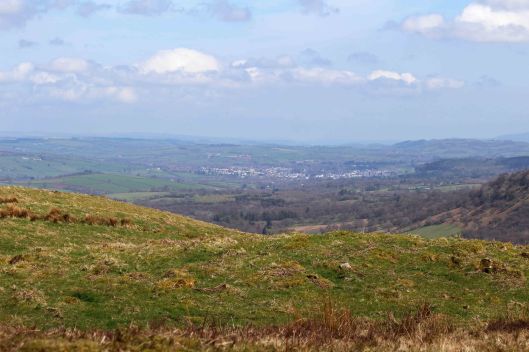
Derek the weatherman got the forecast absolutely right for our Glamorgan Bird Club trip yesterday: foggy and a bit mizzly until 10am, then the cloud lifted to leave clear blue skies and t-shirt weather – it almost felt like summer!

180419 Brecon in the distance

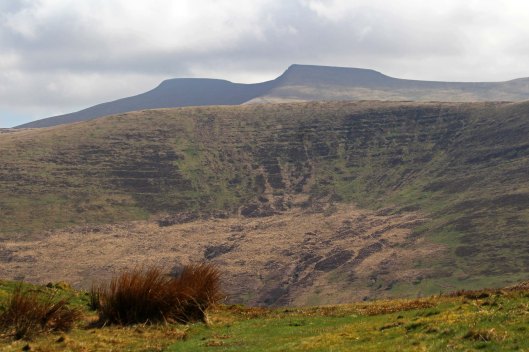
We twenty-two birding enthusiasts had headed north of Cardiff to the Brecon Beacons National Park – when the cloud lifted, we could see Pen-y-fan, at 2,907 feet (886m), Wales’s 10th highest mountain. The plan was to walk the lower slopes of Craig Cerrig Gleisiad National Nature Reserve, in the hope of seeing Ring Ouzels, Whinchats, Redstarts, Wheatears and possibly Pied Flycatcher, amongst other birds.

180419 Pen-y-Fan

Because of the damp weather and low cloud, we began the day by exploring the woodland around the Youth Hostel across the road from the reserve and immediately had superb views of Pied flycatchers, and not only male birds but also a female who was making a start on nest building. A Tree pipit sitting high on bushes in the neighbouring fields was also a year tick for me.

180419 Pied flycatcher female
180419 Pied flycatcher male

After a spot of early lunch back at the cars, we climbed the slopes into the dramatic landscape of Craig Cerrig Gleisiad, the southernmost glacial boulder field in Britain. Here we had Willow warblers singing all along the stream, and frequent views of Stonechats and Meadow pipits.

180419 stonechat female
180419 stonechat male

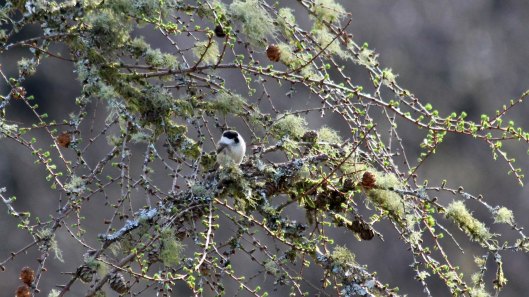
Some of the party went further up the track and were rewarded with views of distant Ring ouzels – I wasn’t one of the lucky ones, but it was great that others got on to them. Then, after regrouping back at the cars, some of us took a small detour on the way home for a quick visit to the Garwnant Forestry Centre, where we saw Grey wagtails and Dippers on the river and a Red kite and Sparrowhawk overhead. And we were very lucky that the resident Willow tit showed well for us near the Centre’s car parking area. It was another splendid day’s birding!

180419 Grey wagtail
180419 Dipper

My species list for the day was: Red Kite, Sparrowhawk, Buzzard, Peregrine, Lesser Black-backed Gull, Woodpigeon, Crow, Raven, Blue Tit, Great Tit, Coal Tit, Willow Tit, Willow Warbler, Blackcap, Wren, Nuthatch, Treecreeper, Dipper, Blackbird, Song Thrush, Robin, Pied Flycatcher, Redstart, Stonechat, Dunnock, Grey Wagtail, Pied Wagtail, Tree Pipit, Meadow Pipit, Chaffinch, and Siskin. And other birds seen (but not by me) were: Kestrel, Marsh Tit, Wheatear, Skylark, Swallow, Goldcrest, Ring Ouzel, and Linnet.

180419 Willow tit

Like Loading...

Wild words: nuptial plumage

11 Wednesday Apr 2018

Posted by sconzani in birds, nature

≈ 1 Comment

Tags

#WildWords, alternate plumage, birding, birdwatching, breeding plumage, British birds, nuptial plumage, Turnstone, wild words

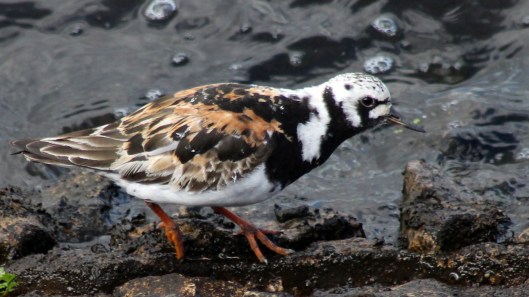
Nuptial plumage, also known as breeding plumage and alternate plumage, is the plumage assumed by adult birds prior to their annual breeding season. This plumage is generally more colourful than the bird’s usual plumage, presumably in order to attract the opposite sex. Birds achieve this change by moulting their feathers, before breeding into their nuptial ‘glad-rags’, and then afterwards, returning to their usual ‘day wear’.

180411a Turnstone in January

My photos show the change happening in the Turnstones I see so often in my local patch. The first photo (above), taken in January, shows the bird’s winter plumage. The following two photos, taken in March and April, show the moult in progress, and the final photo, taken in August, is after breeding has finished, when the bird is moulting from its nuptial plumage back to its winter, non-breeding plumage. To see these birds in their full nuptial plumage, I would have to head to their breeding grounds in Canada or Greenland, a tempting proposition but not affordable at this time!

180411b Turnstone in March180411c Turnstone in April180411d Turnstone in August

Like Loading...

Nests

09 Monday Apr 2018

Posted by sconzani in birds, nature, spring

≈ 2 Comments

Tags

birding, birdwatching, Buzzard, Carrion crow, Coot, Great Crested Grebe, Magpie, Mute swan, nesting, nesting birds, signs of spring

Just like their makers, nests come in all shapes and sizes, and they’re made of all sorts of materials: twigs and branches, feathers, moss, paper and plastic, mud. They can be seen high in trees and on buildings, hidden secretively away in hedges and behind reeds, or plonked in a hole in a concrete platoon, as I saw some Coots do recently in Cardiff. Some are messy and loosely constructed, others are cosy and snug, still others are miniature works of art.

180409 buzzard

This is prime bird-nesting season so it’s quite likely you’ll see nests when you’re out walking. Please stay well away and do not disturb parents, eggs or babies. In Britain (and I’m sure in most countries) it is, in fact, an offence under The Wildlife and Countryside Act 1981 to ‘intentionally take, damage, destroy the nest of any wild bird while it is in use or being built’ and to ‘intentionally take or destroy  the egg of any wild bird’. (You can read more details here.) And, rest assured, my photos were all taken with a long lens, well away from the birds, so as not to disturb them.

180409 coot (2)
180409 unknown
180409 great crested grebe
180409 magpie
180409 coot
180409 coot (3)
180409 crow
180409 swan
Like Loading...

Bundles of fluff

05 Thursday Apr 2018

Posted by sconzani in birds, nature, spring

≈ Leave a comment

Tags

birding, birdwatching, British birds, bundles of fluff, goslings, Greylag, Greylag goose, Roath Park Lake, signs of spring

180405 Greylag goslings (1)

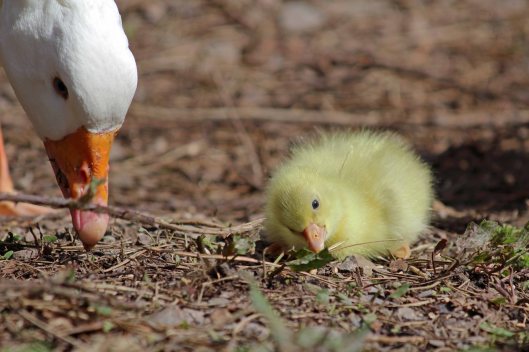
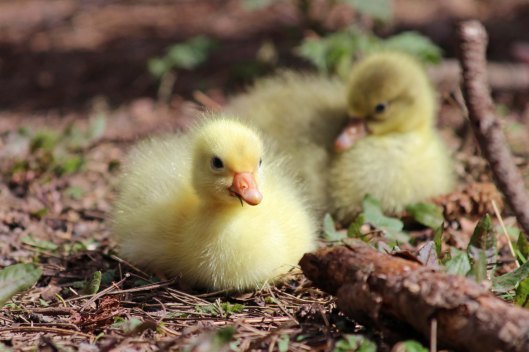
As this year’s lingering wintery weather has delayed the true advent of spring by about three weeks, I certainly wasn’t expecting to see these four gorgeous Greylag goslings when I went for a wander around Roath Park Lake on Tuesday. But, as Greylag eggs take about 28 days to incubate, Mrs Goose may well have started laying just prior to the ‘Beast from the East’ storm on 1 March. Full praise to her for persevering through two heavy dumpings of snow, freezing temperatures, and some very heavy deluges of rain as well!

180405 Greylag goslings (2)180405 Greylag goslings (5)180405 Greylag goslings (3)180405 Greylag goslings (4)180405 Greylag goslings (7)180405 Greylag goslings (6)180405 Greylag goslings (8)

Like Loading...

Winning ways?

02 Monday Apr 2018

Posted by sconzani in birds, nature, spring

≈ 2 Comments

Tags

birding, birdwatching, British birds, British ducks, ducks, male mallards fighting, Mallard, signs of spring, Spring is in the air, springtime

You can tell spring is in the air when the males start fighting over the females. These drake Mallards were really going at it. To the victor the spoils?

This slideshow requires JavaScript.

Like Loading...

March at Cosmeston

29 Thursday Mar 2018

Posted by sconzani in birds, flowers, nature, reptiles, spring, wildflowers

≈ 2 Comments

Tags

birding, birdwatching, British birds, Chiffchaff, Common frog, Cosmeston, Cosmeston Lakes Country Park, Gadwall, Great Crested Grebe, Hawfinch, Meadow pipit, primrose, Reed buntin, Sand martin, Scaup, treecreeper

11 March  This visit to Cosmeston started with me being yaffled at by a Green woodpecker – I always think they’re jeering at me, trying to lure me into stalking them for that ever-elusive close-up. I resisted and walked on, then paused to watch a Magpie trying to carry off a very large twig / small branch, proof that nest-building has begun.
180329 1 primroses

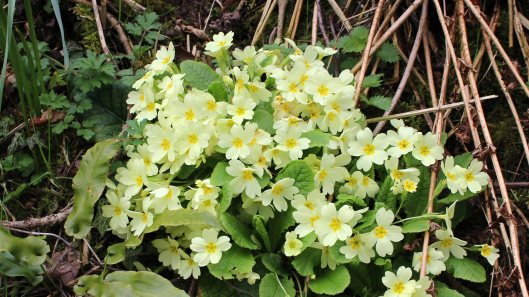
Masses of pale Primroses were flowering prettily along the western boundary path, and the lake was overflowing the boardwalk at the west end due to recent heavy rain.
180329 2 drake Scaup

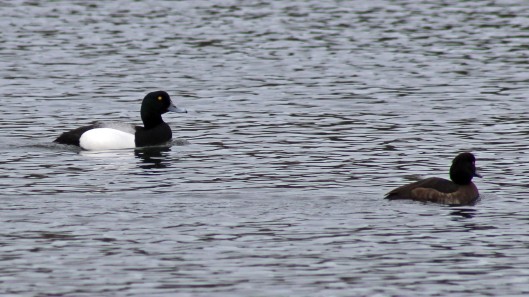
I paused near there, as I always do, to look at the gulls and finally, FINALLY, spotted the drake Scaup that’s been visiting the Cosmeston lakes on and off in recent weeks, this time in company with a female Tufted duck, which could be why some interesting hybrids are occasionally sighted locally.

180329 3 Treecreeper
180329 4 Gadwall & Tufted ducks

I walked up Mile Road and then off the main track to where the bird hide used to be (it was burnt down by vandals last year and has not been rebuilt), and spotted a Treecreeper hopping up a nearby tree, then turned to see a group of five Gadwall on the east lake, much closer in than usual.
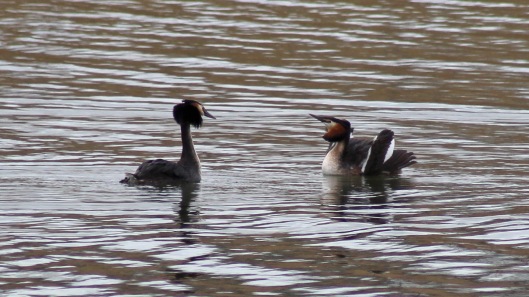
180329 5 Great crested grebes

I watched them a while then was charmed to also watch a pair of Great crested grebes displaying – more on those here. I wandered on, up Mile Road to the top end where I head back in to suburbia, and was farewelled by a large flock of perhaps fifty Fieldfare and Redwing that flew up from the area of Old Cogan Farm and landed in the trees above me.

180329 6 Scaup
180329 7 Common frog

16 March  I only walked through Cosmeston as part of a longer walk from Sully to Penarth, so I didn’t linger long but I did manage to get closer views and better photos of the Scaup, as it was sitting right off the boardwalk and ‘swan feeding area’ near the cafe. And I also detoured past the dipping pond to check out the Common frog eruption – see more on the frogs here.

180329 8 Meadow pipits
180329 9 Meadow pipits

19 March  I stomped off to Cossie with snow still on the ground (but steadily melting) after the ‘Mini-beast from the east’, the second instalment of cold weather to blast us this month. The most notable wildlife effect was in the large numbers of Meadow pipits to be seen, sometimes in singles, at one point a flock of at least 20 grazing together.
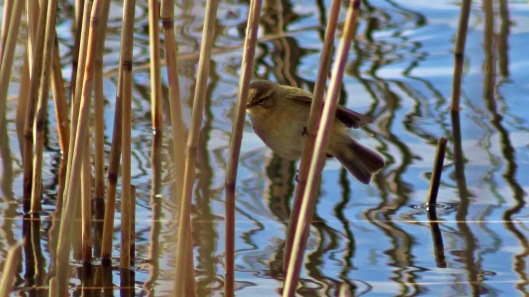
180329 10 Chiffchaff

It was also a day of confusing birds: there was a female Blackbird with a pale bib, making me think she might be a Ring ouzel, and two Chiffchaffs pretending to be Reed warblers, presumably because there were more insects to be had close to the water – behaviour also seen at another site in south Wales that day.
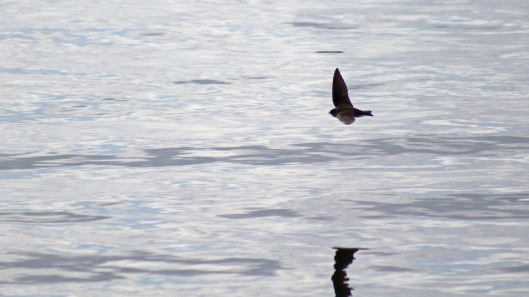
180329 11 Sand martin

And, another sign of spring, I saw my first Sand martins of the year, three of them, hawking back and forth on the east lake.
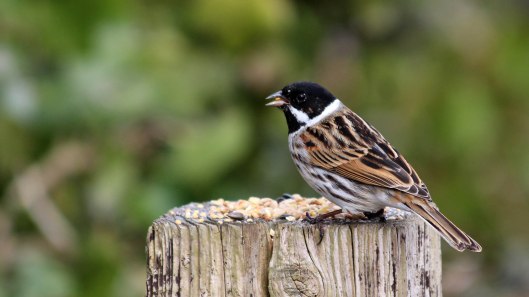
180329 12 Reed bunting

23 March  Once again, this was a walk through rather than around Cosmeston, as I was doing the same walk as a week ago, from Sully back home. As I had recently stocked up on bird seed, I was sprinkling small amounts here and there as I strolled, and was delighted to see three male Reed buntings come down for a snack in one spot – such handsome birds. The other highlight was the Chiffchaffs, at least six crisscrossing the lane between the two lakes, flycatching the multitude of little gnatty things flying about on this sunny day.
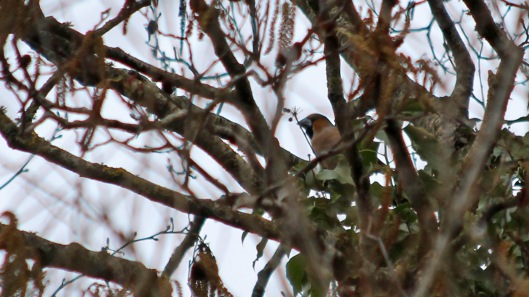
180329 13 hawfinch

29 March  Well, I wasn’t intending to make another visit to Cossie this month but then one of my birding friends spotted a Hawfinch there on the 27th and I couldn’t let that pass without at least having a look for it. (For non-birders, Hawfinches are usually difficult to find, though they have been having a good winter this year.) So, trying, somewhat unsuccessfully, to dodge heavy rain showers, I headed over to Cosmeston early this morning. I knew the approximate location to look but it certainly wasn’t easy spotting anything in the dense trees. Luckily, I had listened to the bird’s call on the RSPB website before I set off and that’s how I found it … by listening very very carefully and then following that sound. The bird was very high in a tree and almost obscured by intervening branches (my photo is a heavy crop) … but I was very chuffed to find it!

Like Loading...

Wild words: display

28 Wednesday Mar 2018

Posted by sconzani in birds, nature, spring

≈ 1 Comment

Tags

#WildWords, bird courtship display, bird displays, birding, birds displaying, birdwatching, British birds, Great Crested Grebe, wild words

Display: Verb; the Oxford Dictionary defines this as: ‘(of a male bird [though, from what I’ve seen, female birds also respond to and/or participate in displays], reptile, or fish) to engage in a specialized pattern of behaviour that is intended to attract a mate’. The word comes from the Anglo-French desplaier or desploier, meaning literally, ‘to unfold’.

180328 Great crested grebes displaying (1)

The birds section of the Stanford University website has a really thorough description of this behaviour, including a diagram of some of the display postures adopted by their Western Grebe. In Britain, the equivalent bird is the Great crested grebe, which also gets a mention and which has a particularly lovely display to watch, as you can see in these recent shots of local birds displaying.

180328 Great crested grebes displaying (2)180328 Great crested grebes displaying (3)

Like Loading...

Spring migration: Wheatear

26 Monday Mar 2018

Posted by sconzani in birds, nature, spring

≈ 5 Comments

Tags

bird migration, birding, birdwatching, British birds, Oenanthe oenanthe, spring migration, Wheatear

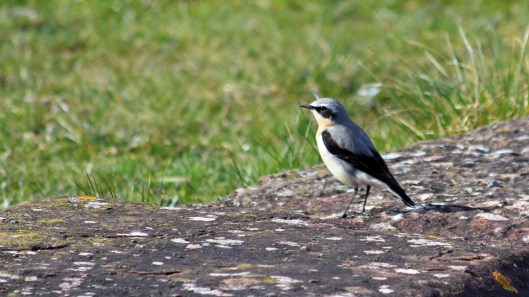
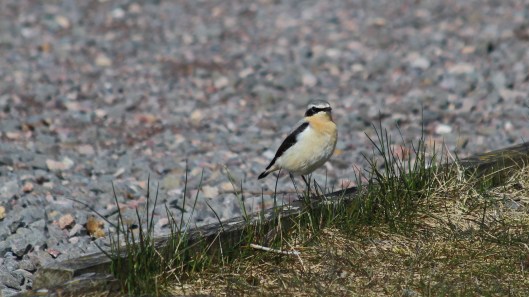
I’ve walked miles – seriously, miles and miles and miles! – in the past ten days, trying to spot my first Wheatear (Oenanthe oenanthe) of 2018. I was following up reported local sightings by my fellow birders – ‘Wheatear at Swanbridge/Sully Island this morning’, ‘Wheatear for 2nd day at Hayes Rd car park’, ‘Wheatear on Cardiff Bay barrage’ (two people saw that one on the same day – but did it show for me? Did it heck as like!), ‘Wheatear on the Barrage’ (4 days later), ‘Male wheatear Penarth Marina’ (my local patch and I couldn’t find that one despite three walks around about).

18032 wheatear (1)

Then finally, on the 23rd, I got a fleeting glimpse of one (and a couple of fuzzy photos) just off Sully beach. And, just like the proverbial buses that don’t turn up at all and then all turn up together, I spotted another one on Cardiff Bay Barrage the very next day. That one’s the very handsome male in these photos.

18032 wheatear (2)

Wheatears are just returning from having spent their winter in the tropical parts of Africa. The males arrive first, usually in March, followed not long afterwards by the females. We see them arriving along the south Wales coast for a few weeks, then they move inland to their breeding sites. Now, to keep an eye out for a female!

18032 wheatear (3)

Like Loading...

Swans in flight

24 Saturday Mar 2018

Posted by sconzani in birds, nature

≈ 3 Comments

Tags

birding, birdwatching, British birds, Mute swan, swans flying, swans in flight, swans taking off

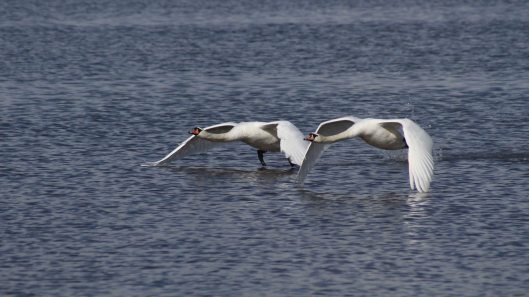
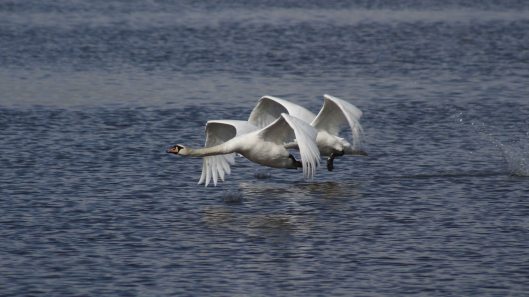
It takes a bit of effort, powerful flapping of their wide wings and jogging along on top of the water, but once they’re airborne, what a truly majestic sight these Mute swans make!

180324 swans in flight (1)180324 swans in flight (2)180324 swans in flight (3)180324 swans in flight (4)

Like Loading...
← Older posts
Newer posts →

About me

sconzani

sconzani

I'm a writer and photographer; researcher and blogger; birder and nature lover; countryside rambler and city strider; volunteer and biodiversity recorder.

View Full Profile →

Follow earthstar on WordPress.com

Enter your email address to follow this blog and receive notifications of new posts by email.

Recent blog posts

  • Thrift March 29, 2026
  • The day of the Wheatears March 28, 2026
  • Cetti’s warblers March 27, 2026
  • Goose barnacles March 26, 2026
  • Black-tailed godwits fighting March 25, 2026

From the archives

COPYRIGHT

Unless otherwise acknowledged, the text and photographs on this blog are my own and are subject to international copyright. Nothing may be downloaded or copied without my permission.

Fellow Earth Stars!

  • Unknown's avatar
  • Unknown's avatar
  • Unknown's avatar
  • Unknown's avatar
  • Unknown's avatar
  • Unknown's avatar
  • Unknown's avatar
  • Unknown's avatar
  • Unknown's avatar
  • Unknown's avatar
  • Unknown's avatar
  • Unknown's avatar
  • Unknown's avatar
  • Unknown's avatar
  • Unknown's avatar
  • Unknown's avatar
  • Unknown's avatar
  • Unknown's avatar
  • Unknown's avatar
  • Unknown's avatar
  • Unknown's avatar
  • Unknown's avatar
  • Unknown's avatar
  • Unknown's avatar
  • Unknown's avatar
  • Unknown's avatar
  • Unknown's avatar
  • Unknown's avatar
  • Unknown's avatar
  • Unknown's avatar
  • Unknown's avatar
  • Unknown's avatar
  • Unknown's avatar
  • Unknown's avatar
  • Unknown's avatar
  • Unknown's avatar
  • Unknown's avatar
  • Unknown's avatar
  • Unknown's avatar
  • Unknown's avatar
  • Unknown's avatar
  • Unknown's avatar
  • Unknown's avatar
  • Unknown's avatar
  • Unknown's avatar
  • Unknown's avatar
  • Unknown's avatar
  • Unknown's avatar
  • Unknown's avatar
  • Unknown's avatar

Blog at WordPress.com.

Privacy & Cookies: This site uses cookies. By continuing to use this website, you agree to their use.
To find out more, including how to control cookies, see here: Cookie Policy
  • Subscribe Subscribed
    • earthstar
    • Join 642 other subscribers
    • Already have a WordPress.com account? Log in now.
    • earthstar
    • Subscribe Subscribed
    • Sign up
    • Log in
    • Report this content
    • View site in Reader
    • Manage subscriptions
    • Collapse this bar
 

Loading Comments...
 

You must be logged in to post a comment.

    %d