• ABOUT
  • BIRDING 2018
  • Birding 2019
  • BLOG POSTS
  • Butterflies 2018
  • Resources

earthstar

~ a celebration of nature

earthstar

Tag Archives: birding

A stroll at Sully

06 Tuesday Feb 2018

Posted by sconzani in birds, coastal fauna, nature, seaside, walks

≈ Leave a comment

Tags

birding, birdwatching, British birds, Curlew, Grey plover, Little ringed plover, Oystercatchers, Rock pipit, Sully, Turnstone, Wales Coastal Path

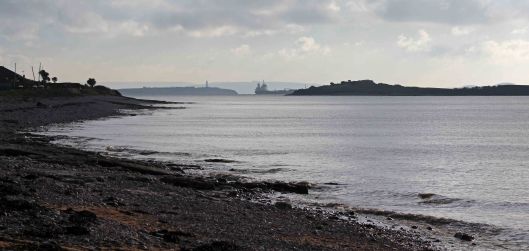
At 9:20am yesterday I was on the bus to Sully, looking forward to seeing what seabirds might be scavenging along the shore at the 10:16 high tide. A bonus was seeing my first pheasant of the year in a passing field.
180206 Sully stroll (1)

Walking down the long narrow path to the beach, I was immediately rewarded with the sight of Black-headed gulls and Oystercatchers looking for worms in the neighbouring field, and a Rock pipit flew up from the shore to join them in their foraging.

180206 Sully stroll (2)
180206 Sully stroll (3)

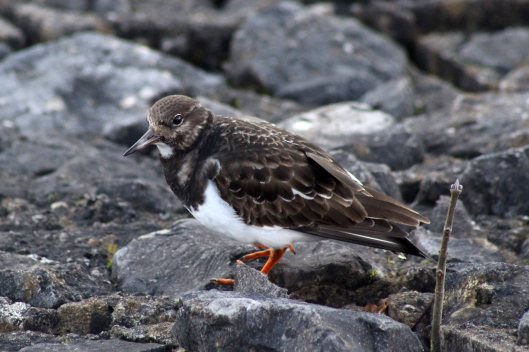
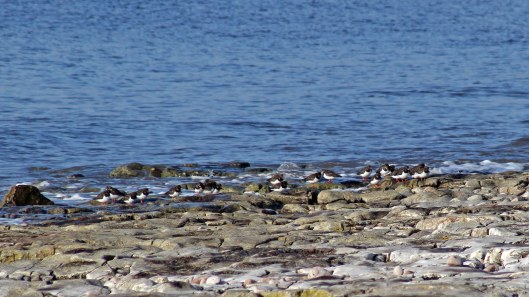
The beach looked empty as I strolled along the ‘coastal path’ – really just a line of rocks and mud here – but a flurry of loud peeping made me turn my head and bring the camera up in time to catch this flock of Turnstones flying in.

180206 Sully stroll (4)180206 Sully stroll (5)

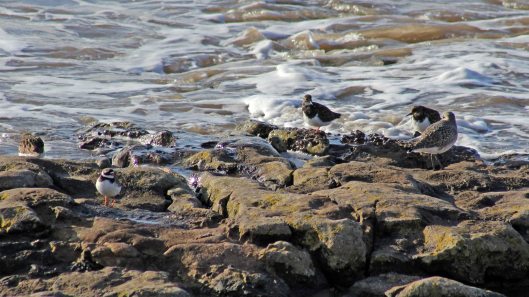
Further east, scanning the water’s edge with my binoculars, I finally spotted an interesting little group of 3 Turnstones, a Little ringed plover and a Grey plover, the latter two year ticks for me, and I’d not seen a Grey plover so close before (I’m still talking a couple of hundred metres away but see-able with bins and long lens). I watched them for perhaps 10 minutes before two loud women and their dog scared the birds off.
180206 Sully stroll (6)

180206 Sully stroll (7)
180206 Sully stroll (8)

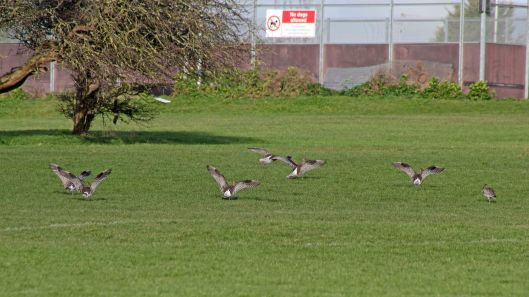
Last, but mostly certainly not least, as these beautiful birds are endangered in Britain, 28 handsome Curlews were using their long curving beaks to probe the playing fields that abut the coastal path in search of worms. After 15 minutes’ watching I left them to their feast, with a silent ‘thanks for being the icing on the cake of my lovely morning at Sully’, and strolled on …

180206 Sully stroll (9)180206 Sully stroll (10)

Like Loading...

The habit of looking

03 Saturday Feb 2018

Posted by sconzani in birds, nature

≈ 4 Comments

Tags

birding, birdwatching, British birds, Collared dove, habit of looking

Someone asked me recently how you become a good birder. Well, I’m not sure I am, yet, a good birder but I was reminded of some thoughts I read in Simon Barnes’s most excellent book How to be a bad birdwatcher (Short Books, London, 2006) (which you really should read): ‘I have developed the habit of looking: when I see a bird I always look, wherever I am.’ And, in response to seeing a ‘How often do you go birdwatching?’ questionaire in a birdwatching magazine, ‘I don’t go birdwatching. I am birdwatching’ (my emphasis).

180203 Collared dove

This photograph is, I think, an example of what Simon meant. A couple of days ago I went for a wander around the local town of Barry and was at the station, waiting for my train home, when, out of the corner of my eye, I noticed movement above me. Two birds were walking along the beams that support the platform roof. So, of course, I had to look closer to see what they were – two lovely Collared doves – and, as I had my camera in my backpack, I had to quickly grab a couple of photos before my train pulled in. I am always looking! I am always birdwatching!

Like Loading...

January at Cosmeston

01 Thursday Feb 2018

Posted by sconzani in birds, nature, parks

≈ 6 Comments

Tags

birding, birdwatching, blackbird, British birds, chaffinch, coal tit, Common Gull, Cosmeston, Cosmeston Lakes Country Park, Gadwall, Great tit, long-tailed tit, Marsh tit, nuthatch, Pochard, Reed bunting, robin, shoveler

180201 1 Long-tailed tits & Blackbird

7 January Gale-force winds were blasting across the exposed areas around the lake today but, with blue skies overhead, the park was full of people out walking, despite the chill. The wee birds were hungry and I was greeted with much happy peeping wherever I scattered seed and virtually mobbed at the dragon tree in Cogan Woods, by Great, Blue, Coal and Long-tailed tits, Dunnocks and Robins, Chaffinches and Nuthatches, Blackbirds and a Reed bunting were all happy to accept any tasty little morsels.

180201 2 Reed bunting
180201 3 Chaffinch
180201 4 Nuthatch
180201 5 Great tit
180201 6 Robin
180201 7 Coal tit

On the lakes the birds were mostly hunkered down, as it was too windy for flying. Teal, Gadwall, Pochard and a Shoveler were some of the highlights.

180201 8 Shoveler
180201 9 Gadwall & Pochard

17 January After much scrutinising of the huge numbers of gulls that you nearly always find at Cosmeston, I spotted my first Common gull of the year.

180201 10 Common gull

23 January A regular Cosmeston-going birding friend had reported an adult Yellow-legged gull the previous day and I fancied a good walk so I headed to Cossie for a look. These was no sign of the gull but I was delighted to see one of the Marsh tits that frequents a particular spot in Cogan Woods, and it became bird number 67 on this year’s list, before I strode quickly home in pouring rain (yep, drenched!).

180201 11 Marsh tit

I’ve been to Cosmeston a couple more times this month but those outings were more about braving the rain  to satisfy my cravings for fresh air and exercise than nature-watching, particularly as it’s been too wet to have camera and binoculars out and about. Let’s hope February is a bit drier.

Like Loading...

January on the Ely embankment

30 Tuesday Jan 2018

Posted by sconzani in birds, nature, walks

≈ 2 Comments

Tags

birding, birdwatching, British birds, Carrion crow, Ely embankment, Goosander, Grey wagtail, little grebe, Pied wagtail, Redshank, River Ely, Rock pipit, Turnstone

31 December 2017 I’m being a bit sneaky here as I managed to fit in one last walk along the embankment before the start of 2018 but after I’d written my December summary. So, on the last day of last year there were 5 Turnstones, 2 Redshanks, 2 Pied wagtails and 2 Grey wagtails, 1 Rock pipit and a couple of Crows.

180130 Ely embankment birds (1)
180130 Ely embankment birds (2)
180130 Ely embankment birds (3)
180130 Ely embankment birds (4)

1 January 2018 The very next day, New Year’s Day, I passed this way as part of a complete circuit of Cardiff Bay. It was a glorious blue-sky day but there were just 3 Turnstones present.

180130 Ely embankment birds (5)

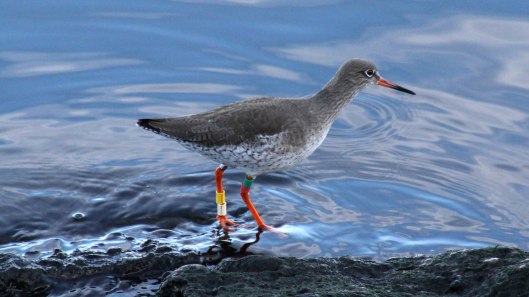
11 January This was another glorious day and another circuit of Cardiff Bay, though in the opposite direction. And it was a bumper day for the Ely embankment, with four Redshanks (including the ringed bird, shown above, which I’ve seen and written about previously), 6 Turnstones, 1 Pied and 4 Grey wagtails, and a Rock pipit.

180130 Ely embankment birds (6)
180130 Ely embankment birds (7)
180130 Ely embankment birds (8)

16 January With 40-mph winds blasting down from snow-covered areas further north, the air temperature was hovering below zero when I walked along the embankment late morning. I wasn’t surprised, then, to find very few birds around – a single Turnstone that was wandering along half way up the embankment (not wanting to put its feet in the chilly water?), which was good for me as it was closer for photos, and just two Grey wagtails. There weren’t many birds on the river either, just a couple of coots, one Great crested grebe and several Black-headed gulls looking hopefully in my direction.

180130 Ely embankment birds

20 January I didn’t get out till late afternoon as it had rained most of the day, so the light was going as I strolled along the embankment path. But I was pleasantly surprised to see a few birds: my friends the Grey wagtails never disappoint (two of those); just one Turnstone poking away amongst the stones; and two Redshanks, including my little buddy the colour-ringed bird. Floating along the river were a Little grebe, a Great crested grebe and a pair of Goosanders – the latter were scared away by a boat cruising by and flew off towards the other side of Cardiff Bay, where I had seen a pair a week or so previously – perhaps the same birds.

180130 Ely embankment birds (9)
180130 Ely embankment birds (10)
180130 Ely embankment birds (11)

25 January I detoured along the embankment on my return from a longer walk and was delighted to find six Turnstones (lovely to see so many), two Redshanks (but not my little ringed mate), two Grey and two Pied wagtails.

Like Loading...

A gathering of grebes

25 Thursday Jan 2018

Posted by sconzani in birds, nature

≈ Leave a comment

Tags

birding, birdwatching, British birds, little grebe, Roath Park Lake, Tachybaptus ruficollis

Six is the highest number of Little grebes (Tachybaptus ruficollis) I’ve ever seen in one group – these were on Roath Park Lake a couple of days ago – but the really tricky thing was to get them all above water and in shot at the same time!

180125 Little grebes (1)

One, two, plus two with their heads below water … and two circles of bubbles.

180125 Little grebes (2)

One up, three on their way under … and two nowhere to be seen.

180125 Little grebes (3)

Nope!

180125 Little grebes (4)

Almost!

180125 Little grebes (5)

YES! Success at last.

Like Loading...

Heads up for Big Garden Birdwatch

23 Tuesday Jan 2018

Posted by sconzani in birds, nature, winter

≈ 4 Comments

Tags

Big Garden Birdwatch, birding, birdwatching, British birds, counting the birds in your garden, RSPB birdwatch

180123 1 blackbird
180123 2 blue tit
180123 3 chaffinch

I don’t have a garden but that doesn’t mean I can’t take part in this weekend’s RSPB Big Garden Birdwatch ’cause you can also do your count in your local park.

180123 4 coal tit
180123 5 collared dove
180123 6 dunnock

All it takes is an hour of your time on either the 27th, 28th or 29th of January, a pen and paper so you can make a note of the birds you see, and maybe a cup of tea and a couple of biscuits to keep you going.

180123 7 Goldfinch
180123 8 great tit
180123 9 house sparrow

The specific list of birds to be counted is Blackbird, Blue tit, Chaffinch, Coal tit, Collared dove, Dunnock, Goldfinch, Great tit, House sparrow, Greenfinch, Long-tailed tit, Magpie, Robin, Starling and Woodpigeon. Of course, the RSPB is also interested in any other birds you see in your garden (not flying overhead), and any other creatures that have visited your garden in the past year – a mole or a hedgehog or maybe a fox?

180123 10 greenfinch
180123 11 long-tailed tit
180123 12 magpie

Here’s the link so all you Brits out there can check the details and get involved.

180123 13 robin
180123 14 Starling
180123 15 woodpigeon


Like Loading...

A halcyon day

22 Monday Jan 2018

Posted by sconzani in birds, nature

≈ 2 Comments

Tags

Alcyone, birding, birdwatching, British birds, Ceyx, Forest Farm, Glamorgan Canal, Greek myth about kingfisher, Halcyon, Halcyon days, Kingfisher

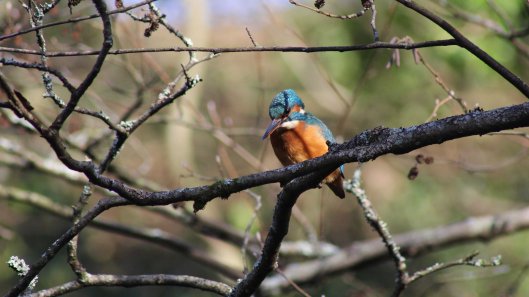
Did you know that the word halcyon is Greek for kingfisher?

180122 Kingfisher (1)

It comes from an ancient myth about Alcyone and her husband Ceyx who angered the gods by calling each other Zeus and Hera. The real Zeus and Hera were livid and punished the couple by killing Ceyx, using a thunderbolt to sink Ceyx’s ship.

180122 Kingfisher (2)

Overcome with grief at the news, Alcyone jumped into the sea and also drowned. Impressed by Alcyone’s love and compassion, Zeus and Hera transformed the couple into vibrant blue birds, the kingfishers that delight all who are privileged to see them.

180122 Kingfisher (3)

But life was not all plain sailing for the newly transformed kingfishers as Zeus declared that Alcyone could only lay her eggs in winter, at a place close to the shore where Ceyx’s body had washed up. This caused Alcyone further grief because the winter storms kept washing her eggs away.

180122 Kingfisher (4)

Eventually, Zeus relented and decreed that there would always be a period of fourteen days in the middle of winter when the seas would be calm enough for Alcyone to lay and brood her eggs.

180122 Kingfisher (5)

This period of calm came to be known as the period of halcyon days. And, though the wind was strong, gusty and icy cold for my walk along the Glamorgan Canal at Forest Farm Nature Reserve on Friday, yet it was a day of seeing beautiful kingfishers so I feel I can still call it a halcyon day!

Like Loading...

Twitching a Firecrest

20 Saturday Jan 2018

Posted by sconzani in birds, nature, parks

≈ 2 Comments

Tags

birding, birdwatching, British birds, Bute Park, Firecrest, Regulus ignicapillus

I don’t consider myself a twitcher – by which I mean one of those obsessives who cares only about adding ticks to lists and accumulating huge numbers of bird sightings and will travel long distances at word of a sighting to get them – but I have set myself a personal challenge of seeing 200 species of birds in Britain in 2018 if at all possible. So, when a relatively scarce bird happens to be seen in a Cardiff park, and that park is a favourite place of mine for a walk, then, of course, I’m going to go for a look.

180120 Firecrest (1)
180120 Firecrest (2)

The bird is a Firecrest (Regulus ignicapillus), cousin to the Goldcrest I blogged about a couple of days ago, only ever so slightly bigger and an equally elusive little bush flitter that is currently enjoying the bushes alongside the River Taff in Bute Park. It was first sighted by a local birder, further up the Taff, on 4 January, and I did go looking then. I couldn’t find in that day – but I did enjoy a delightful walk along the riverside trail.

180120 Firecrest (5)

Then, on 11 January, the bird – presumably the same one, as they are not very common hereabouts – was spotted further down the river, almost in the heart of Cardiff, by a local RSPB staffer out for a lunchtime run. On Thursday I went for a look and was really lucky to meet two other birders who already had the bird in their sights (when I passed by again later, on my way to the train after a long walk in the park, the bird had temporarily disappeared so I was really glad I’d seen it earlier). Typically, this little Firecrest wasn’t still for an instant and the bushes it favoured meant the light was not great for photographs but it was a real treat to see and to watch its insect-catching antics.

180120 Firecrest (3)
180120 Firecrest (4)
Like Loading...

Britain’s smallest bird

18 Thursday Jan 2018

Posted by sconzani in birds, nature

≈ 12 Comments

Tags

birding, birdwatching, British birds, Goldcrest, Regulus regulus

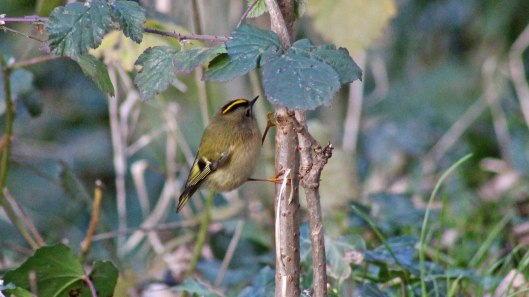
Weighing in at just 6 grams and measuring a miniscule 9cm from top of head to tip of tail, the Goldcrest (Regulus regulus) holds the title of Britain’s smallest bird. And it’s a cutie!

180118 goldcrest (1)

Though its overall plumage is a somewhat dull green, its distinguishing feature is the Mohawk-style stripe on the top of its head – it’s a vibrant yellow that’s easy to spot, and the stripe has an orange centre in male birds.

180118 goldcrest (3)

Goldcrests are most often found in coniferous woodland but they can also be found in urban settings. The birds in my photos were at Cosmeston Lakes Country Park (which is not primarily coniferous), along part of the south Wales coastal path (where there were no conifers to be seen) and in Cardiff’s Cathays Cemetery (where the wee bird was doing a grand job of cleaning up the old gravestones).

180118 goldcrest (2)

Goldcrests are completely insectivorous so are not able to feed from garden bird feeders, putting them at risk in very cold winters when there are no insects to be found. Fortunately, though, their numbers are stable, and their delightful antics can be enjoyed throughout Britain.

Like Loading...

Yellow-legged gull

15 Monday Jan 2018

Posted by sconzani in birds, nature, winter

≈ 2 Comments

Tags

birding, birdwatching, British birds, gull identification, Larus michahellis, Yellow-legge gull 2w, Yellow-legged gull

Back in November, I thought I’d found my first Yellow-legged gull (Larus michahellis) – and it still might have been – though I’m really not convinced about it. But, this gull, the one pictured here, is absolutely, one-hundred-percent definitely a Yellow-legged gull … even though its legs are not yellow. Have I not written previously that gulls are tricksy?!

180115 Yellow-legged Gull 2w (1)

As you might guess from looking at it, this is not an adult gull. I’m reliably informed, by the expert birding friend who identified it for me, that this gull is in its second winter. My bird guide book tells me these gulls take four years to reach adult plumage so it’s half way there. Its age is the reason its legs are not yet yellow.

180115 Yellow-legged gull 2w (2)
180115 2nd winter Herring gull

One of the main keys to its identification is the colour of the feathers on its back: Yellow-legged gulls are about mid way between the light grey of Herring gulls and the darker grey of Lesser black-backeds. The two photos above show my Yellow-legged gull, on the left, and, on the right, a Herring gull of the same age. I can see the difference in the feather colour and, to my eye, the shape of the head and bill look slightly different but I’m not sure I’d be confident of IDing one of these gulls without expert help.

180115 Yellow-legged gull 2w (3)
180115 Yellow-legged gull 2w (4)

180115 Yellow-legged gull 2w (5)

Like Loading...
← Older posts
Newer posts →

About me

sconzani

sconzani

I'm a writer and photographer; researcher and blogger; birder and nature lover; countryside rambler and city strider; volunteer and biodiversity recorder.

View Full Profile →

Follow earthstar on WordPress.com

Enter your email address to follow this blog and receive notifications of new posts by email.

Recent blog posts

  • Thrift March 29, 2026
  • The day of the Wheatears March 28, 2026
  • Cetti’s warblers March 27, 2026
  • Goose barnacles March 26, 2026
  • Black-tailed godwits fighting March 25, 2026

From the archives

COPYRIGHT

Unless otherwise acknowledged, the text and photographs on this blog are my own and are subject to international copyright. Nothing may be downloaded or copied without my permission.

Fellow Earth Stars!

  • Unknown's avatar
  • Unknown's avatar
  • Unknown's avatar
  • Unknown's avatar
  • Unknown's avatar
  • Unknown's avatar
  • Unknown's avatar
  • Unknown's avatar
  • Unknown's avatar
  • Unknown's avatar
  • Unknown's avatar
  • Unknown's avatar
  • Unknown's avatar
  • Unknown's avatar
  • Unknown's avatar
  • Unknown's avatar
  • Unknown's avatar
  • Unknown's avatar
  • Unknown's avatar
  • Unknown's avatar
  • Unknown's avatar
  • Unknown's avatar
  • Unknown's avatar
  • Unknown's avatar
  • Unknown's avatar
  • Unknown's avatar
  • Unknown's avatar
  • Unknown's avatar
  • Unknown's avatar
  • Unknown's avatar
  • Unknown's avatar
  • Unknown's avatar
  • Unknown's avatar
  • Unknown's avatar
  • Unknown's avatar
  • Unknown's avatar
  • Unknown's avatar
  • Unknown's avatar
  • Unknown's avatar
  • Unknown's avatar
  • Unknown's avatar
  • Unknown's avatar
  • Unknown's avatar
  • Unknown's avatar
  • Unknown's avatar
  • Unknown's avatar
  • Unknown's avatar
  • Unknown's avatar
  • Unknown's avatar
  • Unknown's avatar

Blog at WordPress.com.

Privacy & Cookies: This site uses cookies. By continuing to use this website, you agree to their use.
To find out more, including how to control cookies, see here: Cookie Policy
  • Subscribe Subscribed
    • earthstar
    • Join 642 other subscribers
    • Already have a WordPress.com account? Log in now.
    • earthstar
    • Subscribe Subscribed
    • Sign up
    • Log in
    • Report this content
    • View site in Reader
    • Manage subscriptions
    • Collapse this bar
 

Loading Comments...
 

You must be logged in to post a comment.

    %d