• ABOUT
  • BIRDING 2018
  • Birding 2019
  • BLOG POSTS
  • Butterflies 2018
  • Resources

earthstar

~ a celebration of nature

earthstar

Tag Archives: British bees

Cuckoo bees

26 Thursday Apr 2018

Posted by sconzani in insects, nature

≈ Leave a comment

Tags

British bees, Cuckoo bees, Nomada bees, Nomada goodeniana, Nomada marshamella, Nomada ruficornis, Nomada species

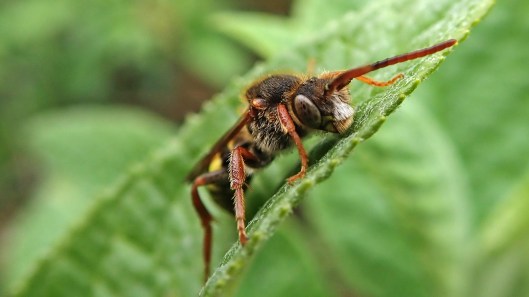
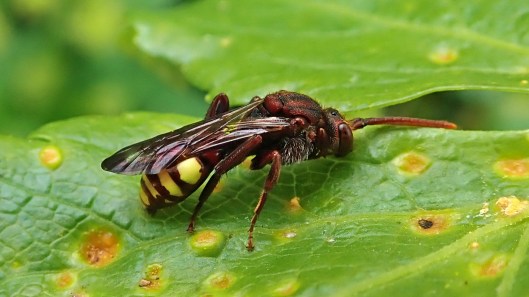
Is it a bird? Is it an insect? Well, it’s definitely an insect but one that’s pretending to be something it’s not in order to act as a kleptoparasite on other insects, hence the name cuckoo. The ‘cuckoo bees’, the Nomada species, consist of some 850 species of bee worldwide, over 30 of which can be found in Britain. Rather than collect pollen, they lay their eggs in the nests of other bees and let those bees do all the pollen-collecting and egg-rearing.
180426 Nomada ruficornis maybe (1)
180426 Nomada ruficornis maybe (3)

I thought I’d got reasonably good photos of these two Nomada bees but they are notoriously difficult to identify so, according to the experts I consulted, the bee in the photos above may perhaps be Nomada ruficornis and that in the photos below could be Nomada marshamella or N. goodeniana. Despite their parasitic habits, I still find these bees attractive.

180426 Nomada marshamella or goodeniana (3)
180426 Nomada marshamella or goodeniana (1)

180426 Nomada marshamella or goodeniana (2)


Like Loading...

An Ivy bee mating ball

24 Sunday Sep 2017

Posted by sconzani in insects, nature, plants

≈ 5 Comments

Tags

bee mating frenzy, bees, bees on ivy, British bees, Colletes hederae, Ivy bee, Ivy bee mating ball, ivy flowers

Some days are just magical! I went out looking for birds – instead I got mobbed by Red admiral butterflies while walking along the coastal path, which made me grin like a Cheshire cat, and then I found these little buzzers.

170924 Ivy bees Colletes hederae (4)
170924 Ivy bees Colletes hederae (5)

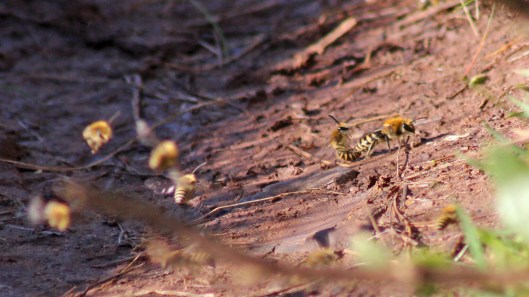
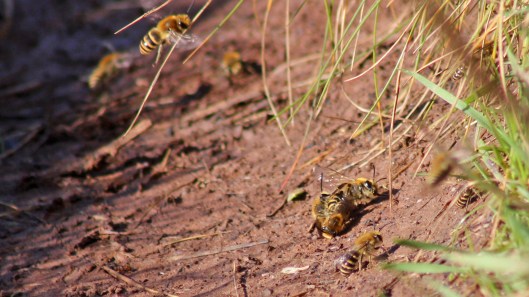
They’re Ivy bees (Colletes hederae) and, as their name suggests, they feed on ivy flowers so they don’t appear until early autumn, when most other bees are winding down activities for the year. With an orange woolly thorax and orange-and-black striped abdomen, these bees are easy to identify, though Colletes hederae was only described as a separate species back in 1993 (before that it was confused with two other species of Colletes). Ivy bees only arrived in Britain from Europe in 2001 but have since gradually spread across southern England and in to south Wales: the extent of their spread is being tracked by BWARS, the Bees, Wasps and Ants Recording Society, so please do log your sightings, either on their website here or with your local records centre.

170924 Ivy bees Colletes hederae (6)
170924 Ivy bees Colletes hederae (7)

I had seen my first Ivy bees for the year the previous week but this new sighting was more special because it was a colony. Though the Ivy bee is a solitary bee (it doesn’t form a hive), a group of females will often excavate their individual burrows and underground chambers together in a sandy bank or similar area of loose earth. And, as the BWARS website explains, male bees often wait by the burrows for females to return and then pounce on them. When the other males spot what’s happening, they also want a piece of the action, jumping on the mating couple to form a writhing mass or mating ball. I was lucky enough to see one of these happen, as shown below.

170924 Ivy bees Colletes hederae (1)170924 Ivy bees Colletes hederae (2)170924 Ivy bees Colletes hederae (3)

Like Loading...
Newer posts →

About me

sconzani

sconzani

I'm a writer and photographer; researcher and blogger; birder and nature lover; countryside rambler and city strider; volunteer and biodiversity recorder.

View Full Profile →

Follow earthstar on WordPress.com

Enter your email address to follow this blog and receive notifications of new posts by email.

Recent blog posts

  • My first moth of the year February 18, 2026
  • Three Common sandpipers February 17, 2026
  • Beetle: Athous bicolor February 16, 2026
  • Crocus flower power February 15, 2026
  • Delightful doves February 14, 2026

From the archives

COPYRIGHT

Unless otherwise acknowledged, the text and photographs on this blog are my own and are subject to international copyright. Nothing may be downloaded or copied without my permission.

Fellow Earth Stars!

  • Unknown's avatar
  • Unknown's avatar
  • Unknown's avatar
  • Unknown's avatar
  • Unknown's avatar
  • Unknown's avatar
  • Unknown's avatar
  • Unknown's avatar
  • Unknown's avatar
  • Unknown's avatar
  • Unknown's avatar
  • Unknown's avatar
  • Unknown's avatar
  • Unknown's avatar
  • Unknown's avatar
  • Unknown's avatar
  • Unknown's avatar
  • Unknown's avatar
  • Unknown's avatar
  • Unknown's avatar
  • Unknown's avatar
  • Unknown's avatar
  • Unknown's avatar
  • Unknown's avatar
  • Unknown's avatar
  • Unknown's avatar
  • Unknown's avatar
  • Unknown's avatar
  • Unknown's avatar
  • Unknown's avatar
  • Unknown's avatar
  • Unknown's avatar
  • Unknown's avatar
  • Unknown's avatar
  • Unknown's avatar
  • Unknown's avatar
  • Unknown's avatar
  • Unknown's avatar
  • Unknown's avatar
  • Unknown's avatar
  • Unknown's avatar
  • Unknown's avatar
  • Unknown's avatar
  • Unknown's avatar
  • Unknown's avatar
  • Unknown's avatar
  • Unknown's avatar
  • Unknown's avatar
  • Unknown's avatar
  • Unknown's avatar

Blog at WordPress.com.

Privacy & Cookies: This site uses cookies. By continuing to use this website, you agree to their use.
To find out more, including how to control cookies, see here: Cookie Policy
  • Subscribe Subscribed
    • earthstar
    • Join 670 other subscribers
    • Already have a WordPress.com account? Log in now.
    • earthstar
    • Subscribe Subscribed
    • Sign up
    • Log in
    • Report this content
    • View site in Reader
    • Manage subscriptions
    • Collapse this bar
 

Loading Comments...
 

You must be logged in to post a comment.

    %d