We saw the swallows gathering in the sky
And in the osier-aisle we heard them noise …


The pilgrims of the year waxed very loud
In multitudinous chattering.
~ George Meredith, Modern Love, sonnet xlvii



08 Saturday Aug 2020
We saw the swallows gathering in the sky
And in the osier-aisle we heard them noise …
The pilgrims of the year waxed very loud
In multitudinous chattering.
~ George Meredith, Modern Love, sonnet xlvii
06 Thursday Aug 2020
It’s two weeks today since junior Lesser black-backed gull flew the coop – or, in this case, the nest amongst the chimney pots, and I’m pleased to report that it seems to be thriving.
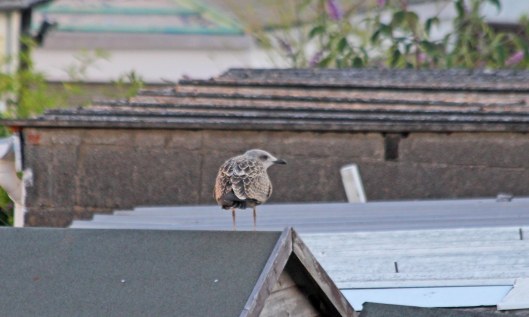
I’ve spotted it on neighbouring shed and house rooftops several times, and I’m sure it’s the same bird, as one or both of the adults sit on the nest site while junior screeches at them for food from somewhere nearby. It’s so nice to be able to report a success story.

28 Tuesday Jul 2020
Tags
birding, birdwatching, British birds, Ely embankment, Great Crested Grebe, House martin, Mute swan, Pied wagtail, River Ely
This morning’s wander took me down to Cardiff Bay to walk the path along the embankment of the River Ely, my first walk that way for a while, as there tend to be less interesting birds to see during the summer months and more people to avoid. And so it was, though there is never nothing to see.
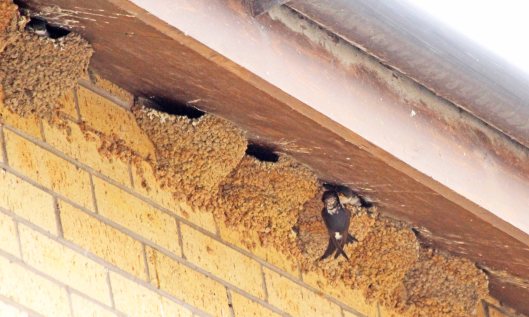


House martins were still filling the air with their calls and zipping swiftly back and forth, hunting low over the water then taking insects back to feed their young, which must be second or even third broods now.

Large numbers of Coot and Mallard were feeding on the water weed or sitting preening on the water’s edge of the embankment, and several Swan were floating regally past. A couple fell out and were half-heartedly chasing each other.


I saw only three Great crested grebes, a low number for this location. Two were adults and one a well grown juvenile that was snoozing amongst the weed.
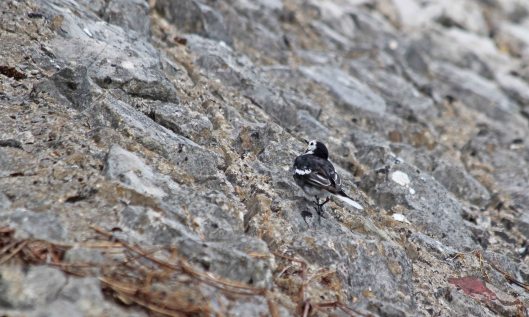
And I saw only two Pied wagtails, which is also a small quantity for the embankment. Their jaunty striding back and forth always makes me grin.
27 Monday Jul 2020
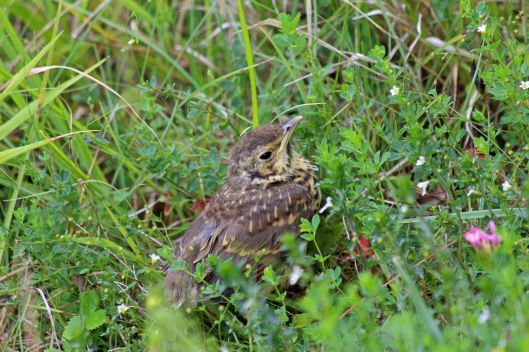
I hope this little Song thrush fledgling managed to find its parents, or they found it. I spotted sitting in the middle of a footpath but it managed to hop into the vegetation at the side of the path as I approached, and I could hear what might have been adult birds peeping softly from the surrounding bushes and trees. Fingers crossed!
24 Friday Jul 2020
Tags
birding, birdwatching, British birds, gull chick learning to fly, gull chicks, Lesser black-backed gull, urban gull nest
From an initial count of three chicks, the local Lesser black-backed gulls nesting amongst a neighbour’s chimney pots have managed to raise one to fledging. I’ve been watching it practising its flying skills over recent days and, finally this morning, it has left the shelter of its nest site.
Though it was pottering around the rooftops for a while, I can no longer see the chick. Now follows the dangerous time for this fledgling of learning to find its own food, finding shelter against bad weather, escaping domestic cats and dogs in the various neighbours’ gardens, and avoiding cars on roads…. Good luck, little one!

23 Thursday Jul 2020
Tags
British birds, British butterflies, Brown argus, Gatekeeper, juvenile Spotted flycatcher, mating Gatekeepers, Minnetts Field, Peacock butterfly, Siskin, Slade Wood, Spotted flycatcher
On Wednesday I ventured on to public transport for the first time in four months – suitably masked, of course – for a visit to Slade Wood, near Rogiet. This was a site where I’d seen Silver-washed fritillaries and White admiral butterflies last summer so I was hoping for more of those but, unfortunately, huge areas of the woodland have been felled over the winter months, which has destroyed a lot of the butterflies’ habitat.

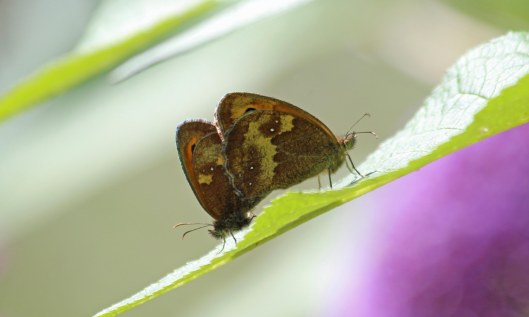
I did still see a lot of butterflies on the Buddleja bushes – in fact, probably more Peacocks than I’ve seen in one day before, and I got some pics of a pair of Gatekeepers mating – but only spotted one Silver-washed fritillary (and didn’t manage a photo) and no White admirals. There was also a butterfly consolation prize in the form of a Brown argus, a butterfly that’s not common locally, which was in Minnett’s Field, a nearby meadow managed by Gwent Wildlife Trust.

Though the butterflies were a little disappointing, the birds were a huge bonus as I managed to find a family of Spotted flycatchers, with two adults and a couple of juveniles (below left), which I’d not seen before.


And the flycatchers were joined at their watering hole, a couple of muddy puddles, by two beautiful bright Siskin.
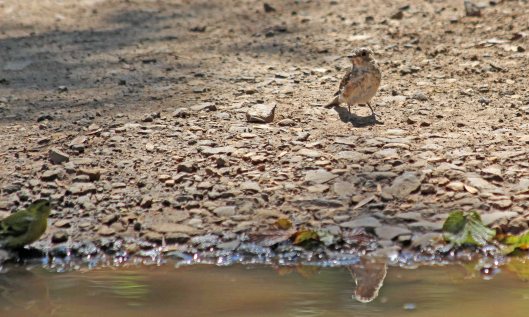
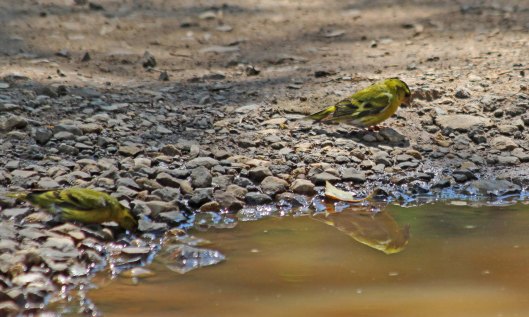
I may not have seen what I was expecting and I was saddened to see how many trees had been felled but I still had a wonderful day out. The sense of freedom was exhilarating, and Nature certainly didn’t disappoint!
21 Tuesday Jul 2020
Tags
birding, birdwatching, British birds, Cosmeston Lakes Country Park, juvenile Stonechat, Stonechat, Stonechat preening video
For the first time in who knows how long a pair of Stonechats overwintered at Cosmeston Lakes Country Park and, came the Spring, they bred, the first time this has ever been recorded at Cosmeston. The two offspring are now well grown juveniles and, if you’re lucky, the family can be seen feeding and flitting about together along the hedgerows and amongst the wildflowers in Cosmeston’s meadows. I caught up with them during a walk last Thursday and was delighted that at least one of the family was happy to be photographed and videoed.
15 Wednesday Jul 2020
As I was walking down a narrow country lane last Sunday, I was delighted to come across this family of Starlings – Mum, Dad and several juveniles – perched in the tops of the hedgerow that bordered the lane.
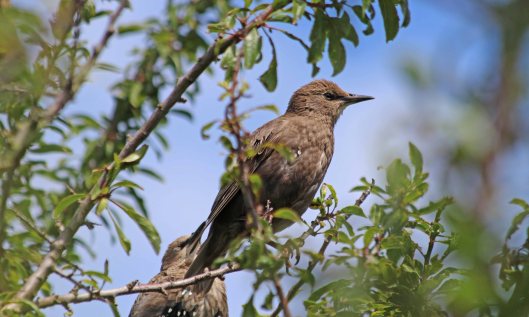
Young birds are often more trusting than adults but, in this case, the whole family was content to sit and chatter and poke about in the bushes, so I managed to get a few reasonable photos.

To me, juvenile Starlings are a bit like the proverbial ugly duckling – they start out quite plain but develop into exceedingly beautiful birds. As you can see, these young ones are just beginning to get their magnificently iridescent adult plumage.

27 Saturday Jun 2020
Tags
birding, birdwatching, bobbing robin, British birds, British robin, Erithacus rubecula, juvenile Robin, robin
As the song goes …
‘When the red, red robin comes bob, bob, bobbin’ along, along
There’ll be no more sobbin’ when he starts throbbin’ his old sweet song….’
~ Harry Woods, ‘When the red red robin comes bob bob bobbin’ along’, 1926


Woods was writing about an American Robin (Turdus migratorius), which is a very different bird from the British Robin (Erithacus rubecula), but the bobbing still applies. And this juvenile Robin, which is just moulting into its adult plumage, was bobbing very well for me during yesterday’s exercise walk.


24 Wednesday Jun 2020
Tags
birding, birdwatching, British birds, Cardiff Bay, Cardiff Bay wetlands, Great Crested Grebe, Great crested grebe chicks, Humbugs
Monday’s walk was a delight, my first of the new-fangled socially distanced walks with a friend. As well as each other’s good company, we enjoyed a lovely wander around part of Cardiff Bay, including the wetlands reserve. There is always an abundance of Great crested grebes in the waters around the reserve and this day we also spotted two pairs breeding.

One pair was perhaps making a second attempt, as this is late in the season to begin their breeding cycle. While one bird brooded their single (so far) egg, the other was keeping itself busy gathering extra materials to add to the nest.

We then noticed another pair of grebes that already had two chicks (birders commonly call them ‘humbugs’ because of their striped colouring) and, while the two little ones sheltered on one adult’s back, the other went fishing for sprats for its offspring. It was wonderful to watch them.

 earthstar
You must be logged in to post a comment.