• ABOUT
  • BIRDING 2018
  • Birding 2019
  • BLOG POSTS
  • Butterflies 2018
  • Resources

earthstar

~ a celebration of nature

earthstar

Tag Archives: British fungi

Phellinus pomaceus

12 Friday Mar 2021

Posted by sconzani in fungi, trees

≈ Leave a comment

Tags

blackthorn, bracket fungi, British fungi, fungi on Blackthorn, Phellinus pomaceus, Prunus spinosa

Though I haven’t been able to verify its identification, I’m fairly sure today’s fungus is Phellinus pomaceus.

210312 Phellinus pomaceus (1)

It’s a hard, woody bracket fungus that grows on Prunus tree species – in this case, it’s growing on Blackthorn (Prunus spinosa).

210312 Phellinus pomaceus (2)
210312 Phellinus pomaceus (3)

The NBN (National Biodiversity Network Trust) Atlas entry for this species (which also includes a map showing where in Britain the fungus has been recorded) says ‘It is not aggressively pathogenic but can cause considerable decay in trees suffering from other stress factors’, so you wouldn’t want to find it in a commercial fruit orchard. In my case, the fungi were only showing on two adjacent trees in a large copse of Blackthorn, and the trees looked quite elderly, so I don’t think it’s causing a problem.

210312 Phellinus pomaceus (4)
210312 Phellinus pomaceus (5)
Like Loading...

Nipplewort Rust

26 Friday Feb 2021

Posted by sconzani in fungi, plants

≈ Leave a comment

Tags

British fungi, Lapsana communis, Nipplewort, Nipplewort rust, Puccinia lapsanae, rust fungus

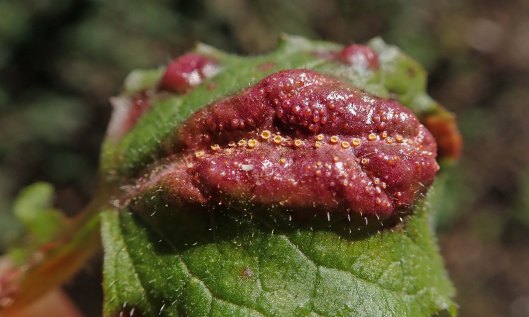
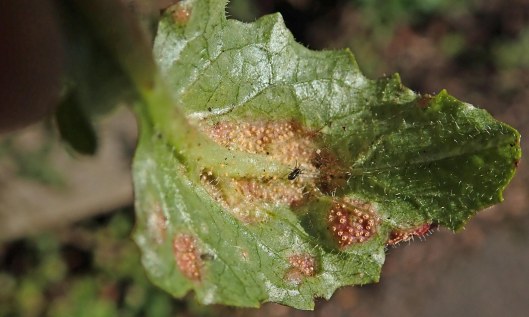
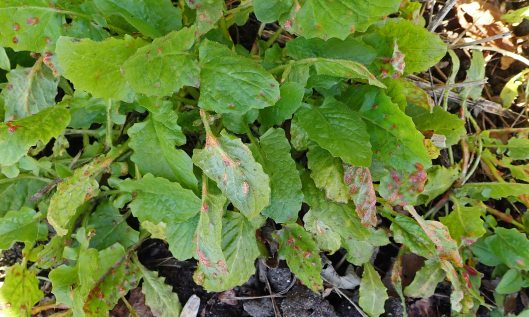
I was almost home from today’s 7-mile walk when I spotted the subject of this post, lots of pink gall-like bumps on the leaves of a group of plants I quickly realised were Nipplewort (Lapsana communis).

210226 nipplewort rust (2)

And that clinched the identification of the bumps, especially when I turned a leaf over and spotted the little yellow dots. These are the aecia, cup-shaped structures in which aeciospores are produced. (And, as you can see, this particular leaf was also home to a tiny spider.)

210226 nipplewort rust (3)

These Nipplewort plants were absolutely covered in rust fungi, Nipplewort Rust (Puccinia lapsanae), a rust I’ve seen before but never in such quantity.

210226 nipplewort rust (1)

Like Loading...

Bands of colour

19 Friday Feb 2021

Posted by sconzani in fungi

≈ 2 Comments

Tags

#FungiFriday, bracket fungi, British fungi, Trametes versicolor, Turkey tail

I can never go past Turkey tail fungi (Trametes versicolor) without checking out their wonderful rings of colour.

210219 turkey tail (1)

These are neither as vibrant nor as varied as some I’ve seen but there is a hint of blue in one of those outer bands that doesn’t really show up well in my photos, as the light was very dull this day. I figured they were still worth sharing for Fungi Friday.

210219 turkey tail (2)

Like Loading...

Rusty-gilled polypore

12 Friday Feb 2021

Posted by sconzani in fungi

≈ Leave a comment

Tags

British fungi, Conifer mazegill, Gloeophyllum sepiarium, Rusty-gilled polypore, winter fungi

In Britain, the fungi with the tongue-twisting scientific name Gloeophyllum sepiarium are known as Conifer mazegills, while in North America their common name is Rusty-gilled polypore. I blogged about these same fungi, on a wooden railing on the local coastal path, two years ago (see Conifer mazegill, February 2019) but I couldn’t find them last year, mostly because the railing was too overgrown with bramble and ivy.

210212 rusty-gilled polypore (1)

This year the contractors responsible for managing the vegetation along the path have been more ruthless in their cutting and strimming, and so the fungi have once again made an appearance. In 2019, the specimens I saw were very young and hadn’t developed their characteristic bracket-like structure so I thought it was worth posting about them again to show how marked the difference is.

210212 rusty-gilled polypore (2)

Like Loading...

Elvish beauty

09 Tuesday Feb 2021

Posted by sconzani in fungi, nature, winter

≈ 4 Comments

Tags

British fungi, Elfcups, fungi, red elfcups, Ruby elfcup, Scarlet elfcup, woodland fungi

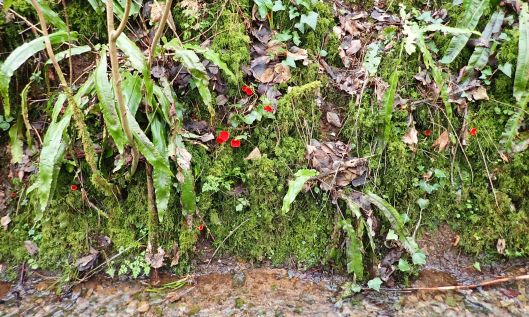
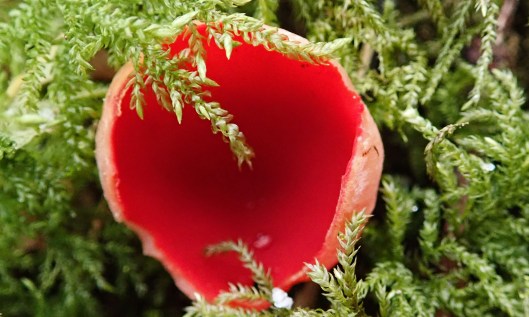
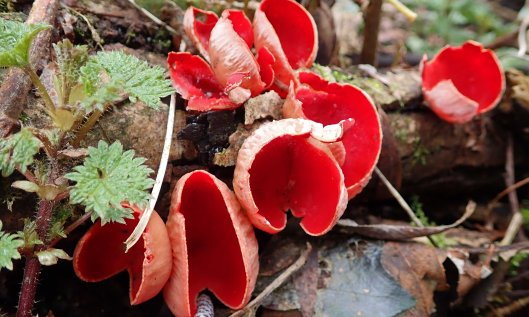
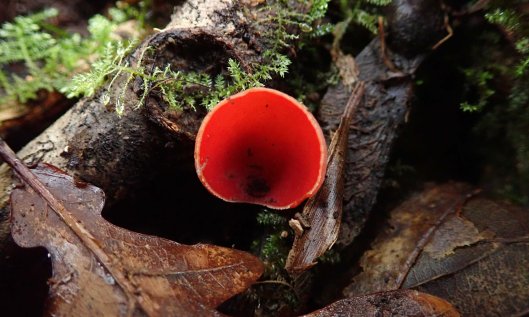
As I walked through a local woodland yesterday, in light sleet and a biting wind, I was seduced by these gorgeous elfcups, punctuating the dull greens and dirty browns with their glorious pops of bright red.

210209 red elfcups (1)

And there were lots of them: tucked under draping fern fronds, nestled amongst lush mosses, almost every rotting log and every broken branch had its cup of scarlet (or ruby) red.

210209 red elfcups (2)

I’m not sure if anyone has ever checked, microscopically, to determine whether the elfcups in these woodlands are Scarlet (Sarcoscypha austriaca) or Ruby (Sarcoscypha coccinea).

210209 red elfcups (3)

And, though it would certainly be good to add them to the local biodiversity records, it was enough yesterday to simply feast my eyes on their magical elvish beauty.

210209 red elfcups (4)

Like Loading...

Dead man’s fingers

29 Friday Jan 2021

Posted by sconzani in fungi, nature

≈ Leave a comment

Tags

British fungi, Dead man's fingers, fungi, wood-rotting fungi, Xylaria polymorpha

210129 dead man's fingers
Be afraid! A dead man is poking his rotting blackened fingers up from the leaf litter, reaching for the passing ankles of unwary walkers.

Nah, not really, though the ‘fingers’ – really the fungal fruiting bodies of the aptly named Dead man’s fingers (Xylaria polymorpha) – can look rather spooky when first encountered.

As the First Nature website explains, these wood-rotting fungi play an important environmental role:

they specialise in consuming neither the softish cellulose nor the much tougher lignin but rather the polysaccharides … As a result, when these and various other ascomycetous fungi have consumed what they can of a dead stump the remainder is a nutrient-rich soft mess that insects and other small creatures are able to feed upon.

Like Loading...

Hairy curtain crust

22 Friday Jan 2021

Posted by sconzani in fungi, winter

≈ Leave a comment

Tags

British fungi, crust fungi, Hairy curtain crust, Stereum hirsutum

This colony of Hairy curtain crust (Stereum hirsutum) was making an impressive display on a fallen tree I passed today.

210122 hairy curtain crust (1)

These fungi often start out hugging the wood they’re growing on (the scientific description is resupinate, with the fertile surface adnate to the substrate), then form wavy edged brackets are they age.

210122 hairy curtain crust (2)

The upper surface is hairy (hence the epithet hirsutum), and the lower surface smooth, with no obvious pores.

210122 hairy curtain crust (3)

Like Loading...

Winter rusts

15 Friday Jan 2021

Posted by sconzani in fungi, plants

≈ Leave a comment

Tags

British fungi, Melampsora euphorbiae, Puccinia lagenophorae, Puccinia smyrnii, rust, rust fungi, rust on Alexanders, rust on Groundsel, rust on Petty spurge, rust on plants

It may be the middle of winter – and chilly with it – but rust fungi can still be found, thriving on those plants that survive these cold temperatures. I’ve found these three in the past week, and I’m sure there must be more around. The good thing about rust fungi is that they generally only infect one species of plant so they’re easier than most fungi to identify – and that’s got to be good thing!

210115 Melampsora euphorbiae

Melampsora euphorbiae on Petty spurge (Euphorbia peplus)

210115 Puccinia lagenophorae

Puccinia lagenophorae on Groundsel (Senecio vulgaris)

210115 Puccinia smyrnii

Puccinia smyrnii on Alexanders (Smyrnium olusatrum)

Like Loading...

Ash key fungi

12 Tuesday Jan 2021

Posted by sconzani in fungi, leaves, trees, winter

≈ Leave a comment

Tags

Ash tree, British fungi, Diaporthe samaricola, fungi on Ash keys, Neosetophoma samarorum

These two fungi, found on Ash keys, were last week’s record of the week at my local biodiversity records centre, SEWBReC – not my record, that of another local recorder – but seeing this on Twitter last Friday reminded me to check the next Ash trees I saw. That opportunity came on Sunday’s walk and I found the fungi on just the second tree I passed by.

210112 ash key fungi (1)

The two fungi are Diaporthe samaricola (the small black dots on the seed part of the key, on the left below) and Neosetophoma samarorum (the much smaller, black speckles on the wing part of the key, on the right in my photo). Both fungi are under-recorded in my area, so I’ll now be checking all the Ash keys I find.

210112 ash key fungi (2)

Like Loading...

Yellow brain fungi

08 Friday Jan 2021

Posted by sconzani in fungi, winter

≈ Leave a comment

Tags

British fungi, Tremella mesenterica, winter colour, winter fungi, Yellow Brain Fungus

Yellow is such a cheery colour, and the sight of these bright yellow fungi during a walk on a particularly grey, gloomy day certainly brought a smile to my face.

210108 yellow brain fungi (1)
210108 yellow brain fungi (2)

Although there are two very similar-looking, yellow, jelly-like fungi, I’m 99% sure these are Yellow brain fungi (Tremella mesenterica) because they are parasitic on the Peniophora species of crust fungi (rather than the Stereum hirsutum fungi, on which the other yellow fungi Tremella aurantia are parasitic), and you can, hopefully, just make out the Peniophora fungi (the lilac-grey crust on the wood) in the photo immediately below.

210108 yellow brain fungi (3)

I explained more about these two fungi in my blog Golden ears and Yellow brains, February 2017.

Like Loading...
← Older posts
Newer posts →

About me

sconzani

sconzani

I'm a writer and photographer; researcher and blogger; birder and nature lover; countryside rambler and city strider; volunteer and biodiversity recorder.

View Full Profile →

Follow earthstar on WordPress.com

Enter your email address to follow this blog and receive notifications of new posts by email.

Recent blog posts

  • Q is for Quercus December 22, 2025
  • P is for Phalarope December 21, 2025
  • O is for Odonata December 20, 2025
  • N is for nest December 19, 2025
  • M is for mite December 18, 2025

From the archives

COPYRIGHT

Unless otherwise acknowledged, the text and photographs on this blog are my own and are subject to international copyright. Nothing may be downloaded or copied without my permission.

Fellow Earth Stars!

  • Unknown's avatar
  • Unknown's avatar
  • Unknown's avatar
  • Unknown's avatar
  • Unknown's avatar
  • Unknown's avatar
  • Unknown's avatar
  • Unknown's avatar
  • Unknown's avatar
  • Unknown's avatar
  • Unknown's avatar
  • Unknown's avatar
  • Unknown's avatar
  • Unknown's avatar
  • Unknown's avatar
  • Unknown's avatar
  • Unknown's avatar
  • Unknown's avatar
  • Unknown's avatar
  • Unknown's avatar
  • Unknown's avatar
  • Unknown's avatar
  • Unknown's avatar
  • Unknown's avatar
  • Unknown's avatar
  • Unknown's avatar
  • Unknown's avatar
  • Unknown's avatar
  • Unknown's avatar
  • Unknown's avatar
  • Unknown's avatar
  • Unknown's avatar
  • Unknown's avatar
  • Unknown's avatar
  • Unknown's avatar
  • Unknown's avatar
  • Unknown's avatar
  • Unknown's avatar
  • Unknown's avatar
  • Unknown's avatar
  • Unknown's avatar
  • Unknown's avatar
  • Unknown's avatar
  • Unknown's avatar
  • Unknown's avatar
  • Unknown's avatar
  • Unknown's avatar
  • Unknown's avatar
  • Unknown's avatar
  • Unknown's avatar

Blog at WordPress.com.

Privacy & Cookies: This site uses cookies. By continuing to use this website, you agree to their use.
To find out more, including how to control cookies, see here: Cookie Policy
  • Subscribe Subscribed
    • earthstar
    • Join 667 other subscribers
    • Already have a WordPress.com account? Log in now.
    • earthstar
    • Subscribe Subscribed
    • Sign up
    • Log in
    • Report this content
    • View site in Reader
    • Manage subscriptions
    • Collapse this bar
 

Loading Comments...
 

You must be logged in to post a comment.

    %d