• ABOUT
  • BIRDING 2018
  • Birding 2019
  • BLOG POSTS
  • Butterflies 2018
  • Resources

earthstar

~ a celebration of nature

earthstar

Tag Archives: British orchids

145/366 Common spotteds

24 Sunday May 2020

Posted by sconzani in flowers, nature, wildflowers

≈ 5 Comments

Tags

British orchids, Common spotted orchid, Cosmeston Lakes Country Park, native orchids

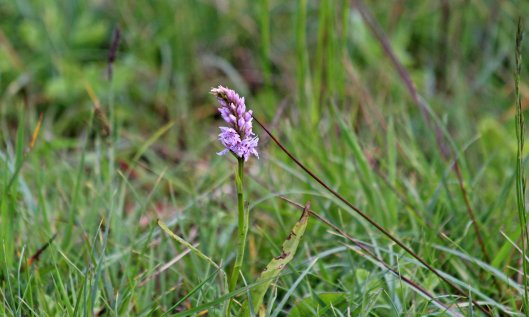
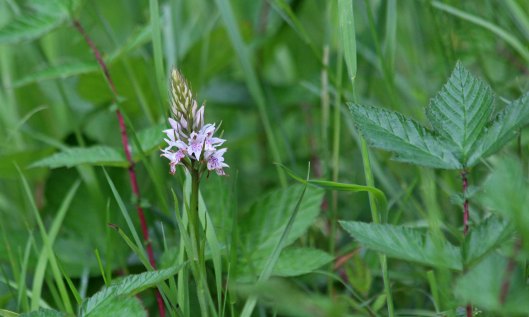
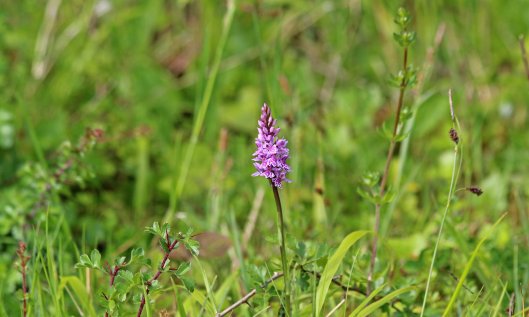
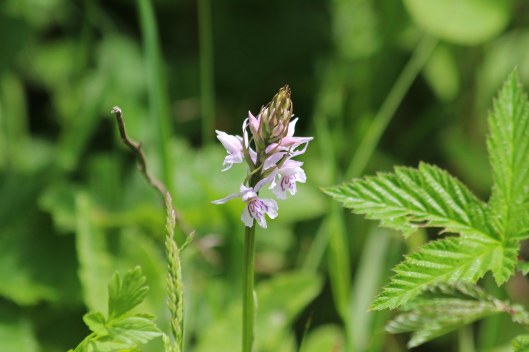
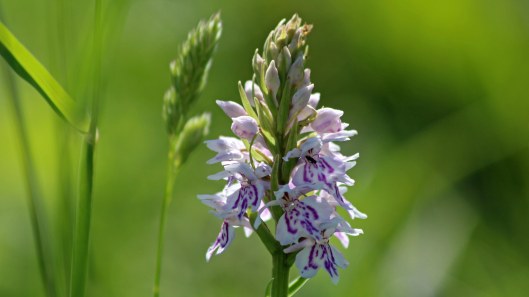
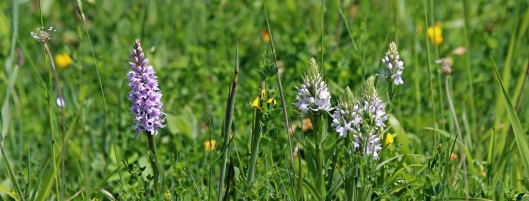
The occasional smatterings of rain we’ve had in the last few days have eased, ever so slightly, the drought conditions hereabouts, and the flush of new growth that was evident during this morning’s early walk through the fields at Cosmeston included my first Common spotted orchids of the year. Superb!

200524 common spotted orchid (1)200524 common spotted orchid (2)200524 common spotted orchid (3)200524 common spotted orchid (4)

Like Loading...

110/366 Even earlier purples

19 Sunday Apr 2020

Posted by sconzani in flowers, nature, spring, wildflowers

≈ 2 Comments

Tags

British orchids, Early purple orchid, native orchids, Orchis macula

I spotted 8 flower spikes of Early-purple orchid (Orchis macula) during my walk last Wednesday, 15 April, though not all the flowers were yet open.

200419 early-purple orchids (1)

This sighting was earlier than last year’s, which was on 23 April and which the locals told me was earlier than usual. It seems like climate change keeps changing the goal posts for these orchids.

200419 early-purple orchids (2)
200419 early-purple orchids (3)

200419 early-purple orchids (4)

Like Loading...

244/365 Autumn lady’s-tresses

01 Sunday Sep 2019

Posted by sconzani in 365DaysWildin2019, autumn, flowers, nature, seasons, wildflowers

≈ 8 Comments

Tags

#365DaysWild, Autumn Lady’s-tresses, British orchids, British wildflowers, Cosmeston, Cosmeston Lakes Country Park, orchids, Spiranthes spiralis

Happy (calendar) Autumn!

190901 autumn lady's-tresses (1)

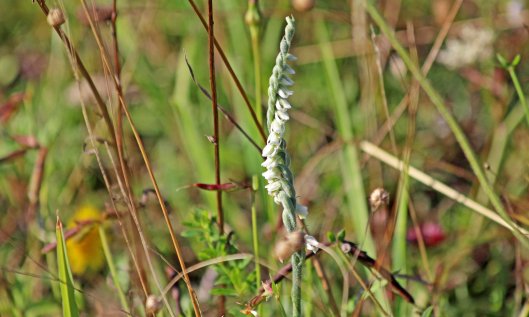
Today’s plant couldn’t be more appropriate – these are Autumn lady’s-tresses (Spiranthes spiralis). True to their name, they usually appear when the weather turns more autumnal, and their twirling spiral form apparently reminded their original namer of the ringlets once popular in women’s hairstyles.

190901 autumn lady's-tresses (4)
190901 autumn lady's-tresses (5)

Though they like to grow in very short turf, Autumn lady’s-tresses are themselves quite small and, surrounded as these were by other wildflowers, especially the superficially similar Eyebright, they weren’t easy to spot.

190901 autumn lady's-tresses (2)
190901 autumn lady's-tresses (3)

Luckily for me, when I was having an early wander around Cosmeston this morning, I bumped into a friend of a friend, who is extremely knowledgeable about the local flora, and he very kindly showed me where these gorgeous little orchids were growing.

190901 autumn ladies tresses (6)

Like Loading...

209/365 Broad-leaved helleborines

28 Sunday Jul 2019

Posted by sconzani in 365DaysWildin2019, flowers, nature, wildflowers

≈ 6 Comments

Tags

British orchids, Broad-leaved helleborine, Grangemoor Park, native orchids

I almost left it too late!

190728 broad-leaved helleborines (1)

I’ve been keeping an eye on these Broad-leaved helleborines for over a month now: at my first visit, the flowers scarcely showed a tinge of red; at my second visit, on 14 July, a couple were in bloom but most still to open; and this morning, many of them had already started to go over.

190728 broad-leaved helleborines (5)
190728 broad-leaved helleborines (6)
190728 broad-leaved helleborines (7)

And, as today was quite windy, my photos are not very sharp so I’ve added in a couple from two weeks ago.

190728 broad-leaved helleborines (2)

Hey ho, at least I managed to see them in all their beauty before they disappear for another year.

190728 broad-leaved helleborines (3)
190728 broad-leaved helleborines (4)
Like Loading...

185/365 Beauty and the Beast

04 Thursday Jul 2019

Posted by sconzani in 365DaysWildin2019, flowers, nature, wildflowers

≈ 2 Comments

Tags

#365DaysWild, British orchids, Epipactis palustris, Marsh helleborine, native orchids, orchids, orchids at brownfield site, Rhoose Point Nature Reserve

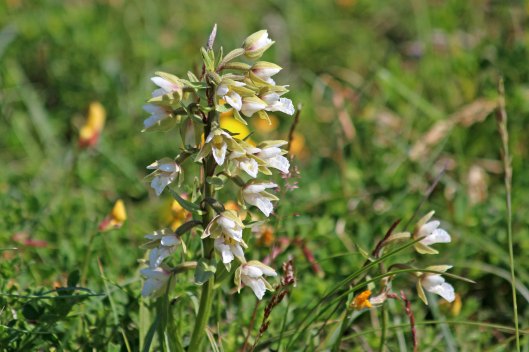
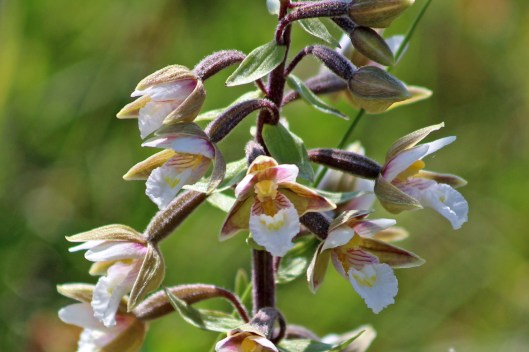
Like many brownfield sites, the former limestone quarries at Rhoose Point, the southernmost point in Wales, are now a nature-filled paradise, and yesterday one area was positively teeming with these beautiful Marsh helleborines (Epipactis palustris).

190704 marsh helleborines (1)

As their name implies, these orchids need water to flourish: the First Nature website says ‘This plant thrives in habitats which are usually submerged with water during the winter and maintain high levels of moisture during the summer. Dune slacks are often home to vast colonies, as are fens which are fed by alkaline springs running through limestone rocks – chalk being the other essential element to enable the Marsh Helleborine to flourish.’
190704 marsh helleborines (3)

I love what Richard Mabey has to say about orchids in Flora Botannica:

These days [their lightweight seed] often fetches up on artificially open habitats, low in nutrients and free of competition (quarries, for example), which replicate orchid-rich natural habitats such as sand dunes and cliff tops. It is this paradoxical, opportunistic quality of many orchids – the exquisite bloom transforming the spoil tip – that has become the basis for the true modern myth of the family, a botanical version of Beauty and the Beast.

190704 marsh helleborines (2)

The Marsh helleborines (and the many other species of orchid) that grow so well in the old Rhoose quarries are a stunning example of this transformation.

190704 marsh helleborines (4)

Like Loading...

183/365 Smiling bees

01 Monday Jul 2019

Posted by sconzani in 365DaysWildin2019, flowers, nature, wildflowers

≈ 4 Comments

Tags

#365DaysWild, Bee orchid, British orchids, faces in flowers

190702 bee orchid (1)

Some of the beautiful Bee orchids in my local wild places are starting to go over now, punished perhaps by the extreme June heat we’ve been experiencing. So, before they disappear completely for another year, I thought I’d share some of their wonderfully cheery, smiling faces. No two are the same.

190702 bee orchid (2)
190702 bee orchid (3)
190702 bee orchid (4)
190702 bee orchid (5)
190702 bee orchid (6)
190702 bee orchid (7)
Like Loading...

145/365 An orchid update

25 Saturday May 2019

Posted by sconzani in 365DaysWildin2019, flowers, nature, wildflowers

≈ 4 Comments

Tags

Aberbargoed Grasslands, Bee orchid, British orchids, Common spotted orchid, Cosmeston Lakes Country Park, Early purple orchid, Heath spotted-orchid, Lavernock Nature Reserve, native orchids

As more and more orchids are now appearing, I thought I’d post a few photos of those I’ve seen so far this year. The first were the aptly named Early purples (Orchis macula), though this year they were even earlier than usual I’m told – I spotted these beauties at Lavernock Nature Reserve on 23 April.

190525 early purple orchids

Next up were these pretty little Heath spotted-orchids (Dactylorhiza maculata) found growing at the Aberbargoed Grasslands National Nature Reserve on 15 and 21 March, when I was visiting for the Marsh fritillaries.

190525 heath spotted-orchid

During Monday’s wander at Lavernock I spotted the first open flower of a Common spotted-orchid (Dactylorhiza fuchsia) and on Thursday, 23 May, I found the first couple of these at Cosmeston Lakes Country Park.

190525 common spotted lavernock190525 common spotted cosmeston

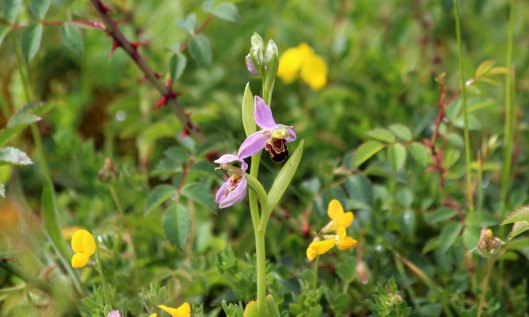
And today’s delightful discovery, also at Cosmeston, was my first Bee orchid (Ophrys apifera) for 2019. I look forward to the warm summer days when the fields at Cosmeston are awash with (mostly Common spotted) orchids – they’re a joy to behold!

190525 bee

Like Loading...

Orchidelicious

03 Sunday Jun 2018

Posted by sconzani in flowers, nature, parks, wildflowers

≈ 2 Comments

Tags

#30DaysWild, 30 Days Wild, Bee orchid, British orchids, Common spotted orchid, Cosmeston, Cosmeston Lakes Country Park, Greater butterfly-orchid, orchid, Southern marsh orchid

180603 orchids at Cosmeston

For day three of #30DaysWild I went searching for orchids at Cosmeston Lakes Country Park, and I got lucky. The Common spotted-orchids are blooming in good numbers now, two of the small number of well hidden Greater butterfly-orchids are flowering, I found my first Bee orchid of the season, and I think I found my first Southern marsh-orchid as well. It couldn’t get much better than that!

Common spotted-orchid (Dactylorhiza fuchsii)

180603 Common spotted orchid (1)

180603 Common spotted orchid (3)
180603 Common spotted orchid (2)

Greater butterfly-orchid (Platanthera chlorantha)

180603 Greater butterfly orchid (1)
180603 Greater butterfly orchid (2)
180603 Greater butterfly orchid (3)
180603 Greater butterfly orchid (4)

Bee orchid (Ophrys apifera)

180603 Bee orchid (2)
180603 Bee orchid (1)

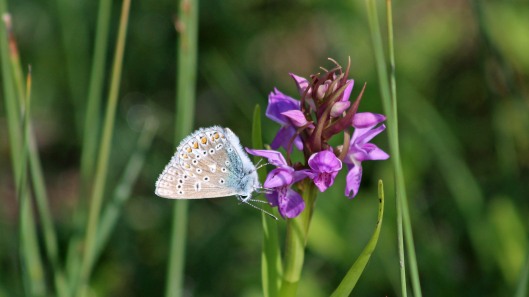
Southern marsh-orchid (Dactylorhiza praetermissa) (and Common blue butterfly)

180603 Southern marsh orchid

Like Loading...

Autumn Lady’s-tresses

01 Friday Sep 2017

Posted by sconzani in flowers, nature, wildflowers

≈ 4 Comments

Tags

Aberthaw Nature Reserve, Autumn Lady’s-tresses, British orchids, orchid, Spiranthes spiralis

On the first calendar day of autumn it seems entirely appropriate to showcase Britain’s tiny autumnal orchid with the perfectly suited name of Autumn Lady’s-tresses (Spiranthes spiralis).

170901 Autumn lady's tresses (1)
170901 Autumn lady's tresses (2)

Growing up to 20cms (7.8ins) tall but often much smaller, these little beauties can be hard to spot – last week I couldn’t find them at Cosmeston (a friend spotted the first-ever sighting of them there recently) though I managed to spot these at Aberthaw Nature Reserve last Sunday. They are mostly coastal plants because they prefer sandy dunes or calcareous grasslands. In a good year, they can grow in colonies of hundreds, as thickly as grass, often in seaside suburban lawns.

170901 Autumn lady's tresses (3)
170901 Autumn lady's tresses (4)

It’s easy to see where the epithet spiralis comes from: the flowers spiral around the stem as they grow, though you might not guess these were orchids at all until you took a close look at the flowers. Their orchid shape is distinctive but the hairiness of the pure white petals seems a little incongruous. I presume the common name of Lady’s tresses comes from a resemblance to spiralling ringlets.

Like Loading...

A triumph of nature

28 Friday Jul 2017

Posted by sconzani in flowers, nature, parks, wildflowers

≈ Leave a comment

Tags

British flora, British native orchids, British orchids, Broad-leaved helleborine, Epipactis helleborine, orchid, terrestrial orchid

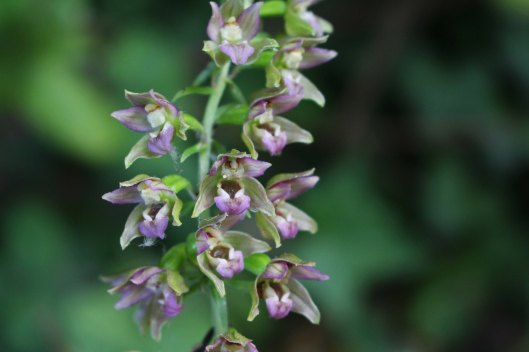
These Broad-leaved helleborines (Epipactis helleborine) are a little past their best but I just had to post about them, partly because I love all of Britain’s native orchids and partly because these are survivors. You would usually find these terrestrial orchids growing in clearings or along path edges in forests and woodlands but these particular plants are growing on the edges of a former rubbish tip, now urban park, in Cardiff. Despite humans dumping thousands of tons of rubbish on their habitat, then covering that over with imported rocks and soil, laying tarmac paths and planting cultivated plants like cotoneaster, these helleborines have somehow survived. The idea of that made my day!

170728 Broad-leaved helleborine (5)
170728 Broad-leaved helleborine (7)
170728 Broad-leaved helleborine (2)
170728 Broad-leaved helleborine (4)
170728 Broad-leaved helleborine (1)
170728 Broad-leaved helleborine (6)
170728 Broad-leaved helleborine (3)
Like Loading...
← Older posts
Newer posts →

About me

sconzani

sconzani

I'm a writer and photographer; researcher and blogger; birder and nature lover; countryside rambler and city strider; volunteer and biodiversity recorder.

View Full Profile →

Follow earthstar on WordPress.com

Enter your email address to follow this blog and receive notifications of new posts by email.

Recent blog posts

  • City Hall Peregrine January 12, 2026
  • Blackthorn in bloom January 11, 2026
  • Weevil: Mecinus pyraster January 10, 2026
  • Red in beak and claw January 9, 2026
  • Who’s watching who? January 8, 2026

From the archives

COPYRIGHT

Unless otherwise acknowledged, the text and photographs on this blog are my own and are subject to international copyright. Nothing may be downloaded or copied without my permission.
Fellow Earth Stars!

  • Unknown's avatar
  • Unknown's avatar
  • Unknown's avatar
  • Unknown's avatar
  • Unknown's avatar
  • Unknown's avatar
  • Unknown's avatar
  • Unknown's avatar
  • Unknown's avatar
  • Unknown's avatar
  • Unknown's avatar
  • Unknown's avatar
  • Unknown's avatar
  • Unknown's avatar
  • Unknown's avatar
  • Unknown's avatar
  • Unknown's avatar
  • Unknown's avatar
  • Unknown's avatar
  • Unknown's avatar
  • Unknown's avatar
  • Unknown's avatar
  • Unknown's avatar
  • Unknown's avatar
  • Unknown's avatar
  • Unknown's avatar
  • Unknown's avatar
  • Unknown's avatar
  • Unknown's avatar
  • Unknown's avatar
  • Unknown's avatar
  • Unknown's avatar
  • Unknown's avatar
  • Unknown's avatar
  • Unknown's avatar
  • Unknown's avatar
  • Unknown's avatar
  • Unknown's avatar
  • Unknown's avatar
  • Unknown's avatar
  • Unknown's avatar
  • Unknown's avatar
  • Unknown's avatar
  • Unknown's avatar
  • Unknown's avatar
  • Unknown's avatar
  • Unknown's avatar
  • Unknown's avatar
  • Unknown's avatar
  • Unknown's avatar

Blog at WordPress.com.

Privacy & Cookies: This site uses cookies. By continuing to use this website, you agree to their use.
To find out more, including how to control cookies, see here: Cookie Policy
  • Subscribe Subscribed
    • earthstar
    • Join 669 other subscribers
    • Already have a WordPress.com account? Log in now.
    • earthstar
    • Subscribe Subscribed
    • Sign up
    • Log in
    • Report this content
    • View site in Reader
    • Manage subscriptions
    • Collapse this bar
 

Loading Comments...
 

You must be logged in to post a comment.

    %d