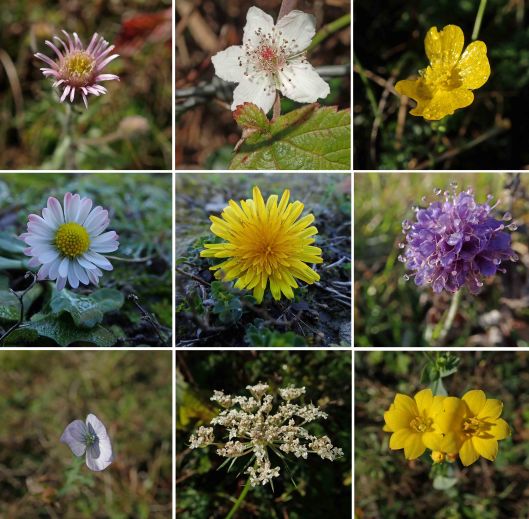
If proof were needed to confirm how mild this autumn has been so far then this is it: 48 species of wildflower still in bloom during this past week (and I know for certain that I’ve missed a few of the smaller ones I’ve seen during my wanders).
23 Sunday Oct 2022
Posted in autumn, wildflowers
If proof were needed to confirm how mild this autumn has been so far then this is it: 48 species of wildflower still in bloom during this past week (and I know for certain that I’ve missed a few of the smaller ones I’ve seen during my wanders).
09 Sunday Oct 2022
Posted in autumn, wildflowers
I was initially puzzled by this wildflower, growing lush and plentiful along the southern and eastern edges of the old Bute East Dock in central Cardiff. The structure reminded me of a dead-nettle but it wasn’t till I got home, checked my photos and did some online research that I discovered this is Gypsywort (or Gipsywort, depending on how you choose to spell that word) (Lycopus europaeus). It’s a wildflower I’ve only seen a couple of times previously and never in such profusion.

The intriguing name, according to Richard Mabey in Flora Britannica, comes from the fact that the plant can be used to produce a black dye that, people once believed, was used by Gypsies to darken their skin. More likely it was used by Gypsy fortune tellers, as the WildflowerFinder website suggests, to dye their clothes black.

25 Sunday Sep 2022
Posted in autumn, flowers, walks, wildflowers
A railway line used to run along the south Wales coast from my town to the next large town but it fell victim, like so many other railway lines, to the Beeching cuts of the 1960s (the last passenger train ran on 4 May 1968). Part of that old line is now a well-used walking and cycle path, the rest runs through land that is both in private hands and owned by the Welsh government. When Covid first told hold and our county council stupidly closed the local country park (where people could exercise with space in safety), many locals began using the government land or either side of the old rail line. Though there are government plans afoot to turn this land into a cheap, nasty and overcrowded housing estate, in the interim local people continue to use the area for walking, both themselves and their dogs, which means it’s now also possible to access the old rail trail. Today’s little video shows the trail and the wildflowers that were still in bloom along it during a walk I took earlier this week.
23 Friday Sep 2022
Posted in autumn, flowers, wildflowers
Happy equinox! Today is the first day of astronomical autumn in the northern hemisphere, and what better way to celebrate than with some autumnal blooms, in this case some Wild cyclamen (Cyclamen hederifolium) flowers I spotted growing in a nearby green space earlier this week.

18 Sunday Sep 2022
Posted in autumn, wildflowers
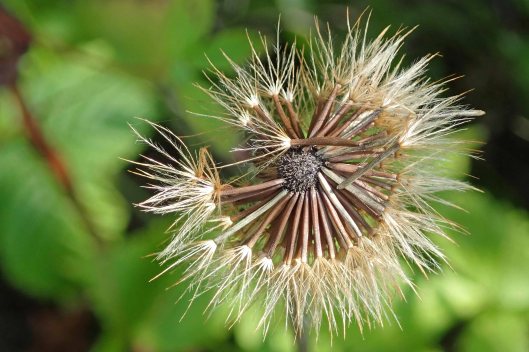
At this time of year, when there are few wildflowers in bloom, the presence of Rough sow-thistle, with its glowing yellow flowers and fluffy white seedheads, is a lifesaver for thirsty bees and butterflies, and a boon for finches wanting to nibble at its seeds. And, for me, it provides yet another example of the sculptural beauty of the seedheads of plants.

11 Sunday Sep 2022
Posted in autumn, flowers, wildflowers
Over the summer, one of the local fields I regularly walk around was a sea of yellow, chock full of tall flowering Ragwort plants.

Now that it’s autumn, the landscape has changed to a rich brown, dotted with tiny spots of white, the fluffy Ragwort seeds. It would be easy to overlook this brown field but, when you look closely, the seedheads are quite lovely.

01 Thursday Sep 2022
Posted in flowers, wildflowers
New month, new season, new plant. This is Salad burnet, which seems recently to have had a change of scientific name from Sanguisorba minor to Poterium sanguisorba. As you might guess from the root of the word, the sanguisorba part of those names, old and new, refers to blood. Richard Mabey explains in Flora Britannica: ‘The round, rust-speckled flower-heads, a little like scabs or blood clots, made it a signaturist’s favourite, for staunching wounds….’ I don’t see the resemblance myself – in fact, I think the flower-heads look a little like terrestrial versions of sea-anemones.
From the common name, it is obvious that this plant can be used as a salad green and, though I haven’t tried it myself, I’ve read that it has a slightly bitter taste and that the leaves smell of cucumber when crushed. I will have to revisit the find site to check that out.

27 Saturday Aug 2022
Posted in nature

‘What is this life if, full of care,
We have no time to stand and stare?’
From the poem ‘Leisure’ by Welsh poet W. H. Davies, Songs of Joy and Others, A. C. Fifield, 1911.
21 Sunday Aug 2022
Posted in insects, wildflowers
Tags
British butterflies, British insects, British wildflowers, Common fleabane, fleabane, insects on fleabane, yellow wildflower
Fleabane is a godsend. It starts to flower in mid summer and carries on flowering through to early autumn, providing a much-needed food source for a diverse range of insects at a time when many other wildflowers are beginning to wilt and wither. I’ve been accumulating the photos in this video for several weeks, and many of the featured insects have themselves now faded away, victims of the passing of time and also of the sizzling hot temperatures we’ve been experiencing. I’m sure those insects that have managed to survive the hot dry weather have been very grateful for the sustenance Fleabane has provided.
17 Wednesday Aug 2022
Posted in flowers, wildflowers
There’s no mistaking Sea holly (Eryngium maritimum) – no other plant is so blue and spiky. I only see it locally in one place, growing in the sandy soil of the Cardiff Bay Barrage, where it may originally have been introduced in a sown wildflower mix but has since made itself at home and prospered. In Flora Britannica, Richard Mabey explains that the leaves ‘are covered with a waxy cuticle, a device to help the plant retain water in salt winds and seaside sunshine’. And, despite its name and how spiky it is, it’s not related to Holly the shrub/tree but is, rather, a member of the carrot family.

You must be logged in to post a comment.