• ABOUT
  • BIRDING 2018
  • Birding 2019
  • BLOG POSTS
  • Butterflies 2018
  • Resources

earthstar

~ a celebration of nature

earthstar

Tag Archives: British wildflowers

The winter ten

05 Sunday Nov 2017

Posted by sconzani in flowers, nature, wildflowers

≈ 10 Comments

Tags

#WildflowerHour, British flora, British wildflowers, Cardiff Bay, wildflowers

Do you know about #WildflowerHour? Its aim is to spread the love of plants – not garden plants (though, of course, they are also lovely) but the glorious flowers that grow wild in Britain’s woods and meadows, alongside tracks, beneath hedgerows, beside streams, around buildings, in cracks in pavements. The idea is to take photos of the wildflowers you see, try to identify them (but others will help if you’re not sure), then post your photos on Facebook or Twitter (with the #WildflowerHour tag) every Sunday night between 8 and 9pm.
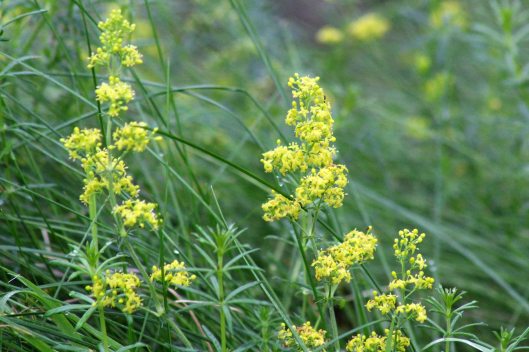
171105 Lady's bedstraw

On 20 October the folks at WildflowerHour issued a new challenge: ‘our weekly winter challenge is #thewinter10 which is to find ten different wild flowers in bloom each week. Once you’ve found them, work out what they are, and post them for the rest of us to see.’ So, as I walked around Cardiff Bay on a grey, gloomy Friday, I kept an eye out for wild flowers. To be honest, I was amazed to find so many still in bloom (not just 10 but 24!). I have not managed to name them all but I hope you enjoy seeing them as much as I did.

171105 Bramble
171105 Buttercup
171105 Chamomile perhaps
171105 Common stork's-bill
171105 Common toadflax
171105 Creeping thistle
171105 Crown vetch
171105 Daisy
171105 Evening primrose
171105 Hare's-foot clover
171105 Hedge bindweed
171105 Herb-Robert
171105 Hoary mustard
171105 Mugwort perhaps
171105 Pale flax
171105 Red clover
171105 Sea-holly
171105 Sow-thistle
171105 Unknown
171105 Vicia sp
171105 Western gorse
171105 White campion
171105 White clover
171105 Yarrow
Like Loading...

Stinking Iris

30 Monday Oct 2017

Posted by sconzani in flowers, nature, wildflowers

≈ 2 Comments

Tags

British flora, British wildflowers, flower seeds, Iris, Iris foetidissima, plant seeds, Roast-beef plant, seeds, Stinking iris

I gave it a really good sniff but I smelled nothing. It was only later that I read the smell comes from the leaves, but only when you crush or rub them, which I didn’t do. And, even then, some people can’t smell the ‘slightly stale, raw beef’ smell that Stinking iris is named for. Even its scientific name, Iris foetidissima, refers to the smell, as do two of its vernacular names: Roast-beef plant and Bloody bones.

171030 Stinking iris (7)

However, I’m not here to warn about this iris’s smell nor, in fact, to extol the virtues of the plant itself, which is often a bit untidy and tatty looking, but rather to praise the beauty of its seeds. The flowers themselves are nothing to write home about, being a rather dull greyish-purple but the seeds erupt in the autumn, like bright orange peas in a papery brown pod. As the weather gets colder, if they’re not plundered as food by birds, they turn a fabulous scarlet and then, eventually, if the weather’s not too wet, dry to a rich golden brown. Just beautiful!

171030 Stinking iris (1)
171030 Stinking iris (2)
171030 Stinking iris (3)
171030 Stinking iris (4)
171030 Stinking iris (5)
171030 Stinking iris (6)
Like Loading...

Taking great pleasure …

27 Friday Oct 2017

Posted by sconzani in autumn, flowers, nature, wildflowers

≈ 2 Comments

Tags

#FloralFriday, autumn colour, autumn flowers, British wildflowers, white wildflowers, wildflowers, yellow wildflowers

‘Who would live happily in the country
must be wisely prepared to take great pleasure in little things.’
~ Henry Beston, in Northern Farm: A chronicle of Maine, Reinhart & Co, 1948

171027 Bindweed
171027 Sow thistle
171027 Daisy
171027 Dandelion agg
171027 Yarrow
171027 Buttercup agg


Like Loading...

A Milky blob

20 Friday Oct 2017

Posted by sconzani in flowers, nature, wildflowers

≈ 2 Comments

Tags

Bee-bread, British wildflowers, Milky blobs, Sheepy-maa's, Trifolium repens, White clover

For today’s Floral Friday theme, we have a very common wildflower White clover (Trifolium repens), which is also known by the vernacular names Milky blobs, Sheepy-maa’s and Bee-bread.

171020 White clover

It seems I had a deprived childhood because, according to Richard Mabey’s Flora Britannica, ‘Almost all children learn two traditions about white clover: that the white flowers can be pulled out of the heads and sucked for a bead of honey (hence ‘bee-bread’ …); and that four- and, even better, five-leaved clovers are lucky, though you must ideally come across them by accident.’ Okay, so I knew about four-leaved clovers being lucky but I’d never heard about sucking the flowers for honey. Did you?

Like Loading...

October pinks

06 Friday Oct 2017

Posted by sconzani in autumn, flowers, nature, wildflowers

≈ Leave a comment

Tags

#FloralFriday, autumn flowers, British wildflowers, lilac flowers, pink flowers, purple flowers, wildflowers

‘I’m so glad I live in a world where there are Octobers,’ exclaims Anne one Saturday morning, in L.M. Montgomery’s classic story Anne of Green Gables.

171006 October pinks (1)
171006 October pinks (2)
171006 October pinks (3)
171006 October pinks (4)
171006 October pinks (5)
171006 October pinks (6)
171006 October pinks (7)
Like Loading...

Devil’s-bit scabious

15 Friday Sep 2017

Posted by sconzani in flowers, nature, wildflowers

≈ 3 Comments

Tags

British flora, British wildflowers, Devil's-bit scabious, scabious, Succisa pratensis

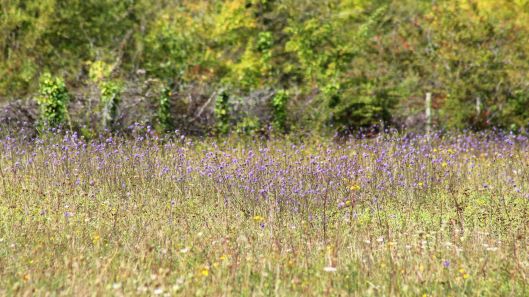
There are several species of scabious – and I love them all – but the scabious I’m seeing most in my local nature reserves is the Devil’s-bit (Succisa pratensis).

170915 devil's-bit scabious (7)

Apparently, the scabious name is due to the rough stalks of these plants and dates to times past when scabious was used to treat scabies because people believed in the ‘signature of all things’ – not Elizabeth Gilbert’s latest book but that of Jakob Böhme, who presented the idea, in 1622, that God had imprinted prescriptions for human ailments in the shapes and forms of medicinal plants – thus, rough stalk = rough skin. The ‘Devil’s-bit’ comes from the fact that this plant’s roots have a short, bitten off look.

170915 devil's-bit scabious (1)
170915 devil's-bit scabious (2)
170915 devil's-bit scabious (3)

Massed displays of Devil’s-bit scabious lend a purplish tinge to the landscape but it’s the flowers I love best. They begin as fairies’ pincushions and bloom into luscious globular gloriousness.

170915 devil's-bit scabious (4)
170915 devil's-bit scabious (5)
170915 devil's-bit scabious (6)
Like Loading...

Butter and eggs

08 Friday Sep 2017

Posted by sconzani in flowers, nature, wildflowers

≈ 6 Comments

Tags

British flora, British wildflowers, Bunny mouths, Butter and eggs, Common toadflax, Linaria vulgaris

It’s a pretty little thing, this Butter and eggs. There’s none of the bold bright brashness of the stark sunflower; instead, it has a mouth-watering combination of soft warm creamy butter and that bright pop of yellow of a perfectly cooked free-range egg yolk. Mmmmmmmm!

170908 Common toadflax (2)

This is Linaria vulgaris, which has the very bland and rather uninspiring name of Common toadflax. I much prefer the vernacular Butter and eggs or, indeed, its other vernacular name, Bunny mouths, which appeals instantly to the child in me and brings back memories of snapdragon flowers, which these resemble and which can be gently squeezed to make the bunny ‘talk’.

170908 Common toadflax (1)
170908 Common toadflax (3)

Linaria vulgaris beautifies waysides and waste grounds, as well as open grassy areas, flowering from late spring right through till November. Because of its bunny-shaped mouth, the flower can be difficult for insects to access – it takes a strong bee or bumblebee to make the bunny ‘talk’. And, as well as providing bees and bumbles with nectar and pollen in exchange for pollination, L. vulgaris is also a favourite food plant for several species of moth, including the Silver Y, the Toadflax pug, and the Brown rustic. Butter and eggs all round then!

Like Loading...

Grim the collier

06 Wednesday Sep 2017

Posted by sconzani in flowers, nature, wildflowers

≈ 5 Comments

Tags

British flora, British wildflowers, Fox and cubs, Grim the collier, orange hawkweed, Pilosella aurantiaca

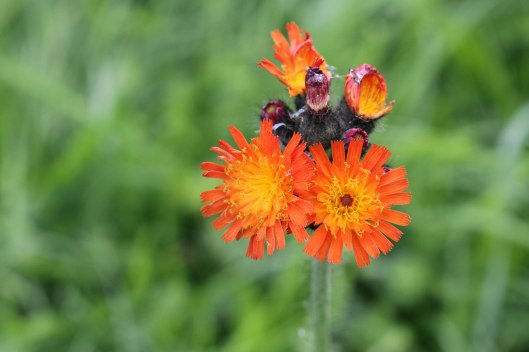
Although Pilosella aurantiaca (more commonly known as Fox-and-cubs) is a native of northern Europe, it must’ve been introduced to Britain a very long time ago as it gets a mention in Gerard’s 1633 Herbal. Gerard called it Grimme the Collier, which seems to me a most intriguing name.

170906 Grim the collier (2)

I’ve read speculation that the name may have been coined because the plant’s hairs resemble coal dust on a miner’s beard (really?) but there was also a play that originated in the early 1600s called Grim the Collier of Croydon and that was apparently based on a real-life character from the mid 16th century.

170906 Grim the collier (1)

It would seem more likely that the plant’s name relates to the person or the play but, in that case, I can’t help wondering: was Grim tall with a head of bright orange hair? Was Grim an invader from northern Europe? Were these particular flowers mentioned in the play? So many questions! If you can shed any light on the collier story, please do tell.

Like Loading...

What’s on the teasel, 2

30 Wednesday Aug 2017

Posted by sconzani in flowers, insects, nature, wildflowers

≈ 1 Comment

Tags

6-spot Burnet moth, bees, British wildflowers, bumblebees, Six-spot burnet, Teasel

The pretty lilac of teasel flower is beginning to fade now but the mini beasts have certainly been enjoying its nectar. In my local parks and reserves it’s a favourite with the 6-spot Burnet moths and with bees of all species. And not long after those pretty little flowers fade away, the seeds will begin to form and grow, and provide food for the birds, particular the dapper little goldfinch, during the winter months. I’ll try to catch photos of them on the teasels in a couple of months’ time.

170830 whats on the teasel 6spot burnet (1)
170830 whats on the teasel 6spot burnet (2)
170830 whats on the teasel bees (1)
170830 whats on the teasel bees (2)
170830 whats on the teasel bees (3)
Like Loading...

The everlasting thistle

18 Friday Aug 2017

Posted by sconzani in flowers, nature, wildflowers

≈ 5 Comments

Tags

British flora, British wildflowers, Carlina vulgaris, Carline thistle, Cosmeston Lakes Country Park, everlasting flower, Everlasting thistle, thistle

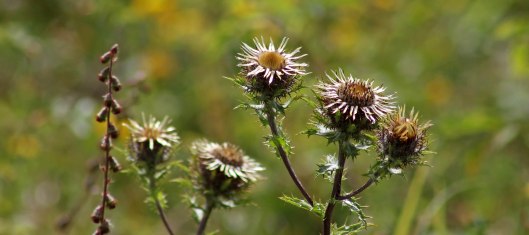
My new favourite flower resembles something you might find in a dried arrangement rather than a flower in full bloom but such is the look of the Carline thistle (Carlina vulgaris).

170818 Carline thistle (1)

It grows best on calcareous soils in Wales and England – they are thriving on the dry, stony grassland areas at Cosmeston Lakes Country Park. It’s spiny, as you would expect from a thistle, but is not a tall plant, probably no more than knee-height, and it sends up its spiky flower heads on solitary stems that have between 2 and 5 flowers on top.

170818 Carline thistle (2)
170818 Carline thistle (3)
170818 Carline thistle (4)

At first glance, you might think the flowers were dead but, if you look closer, you can see that they’re just like any other daisy-like flower, except for their brownish hues. When the sun touches them, they positively glow, and when the weather is cold and wet, they close up. The flowers can be seen from July through to September, after which they will dry out and often last right through the winter. I’m thinking that once they finish flowering, I might have to snaffle a couple to enjoy at home over the winter.

170818 Carline thistle (5)

Like Loading...
← Older posts
Newer posts →

About me

sconzani

sconzani

I'm a writer and photographer; researcher and blogger; birder and nature lover; countryside rambler and city strider; volunteer and biodiversity recorder.

View Full Profile →

Follow earthstar on WordPress.com

Enter your email address to follow this blog and receive notifications of new posts by email.

Recent blog posts

  • Alder flies April 9, 2026
  • Lily beetle April 8, 2026
  • First bee-flies April 7, 2026
  • Bloody-nosed beetle April 6, 2026
  • Gorse and its weevil April 5, 2026

From the archives

COPYRIGHT

Unless otherwise acknowledged, the text and photographs on this blog are my own and are subject to international copyright. Nothing may be downloaded or copied without my permission.

Fellow Earth Stars!

  • Unknown's avatar
  • Unknown's avatar
  • Unknown's avatar
  • Unknown's avatar
  • Unknown's avatar
  • Unknown's avatar
  • Unknown's avatar
  • Unknown's avatar
  • Unknown's avatar
  • Unknown's avatar
  • Unknown's avatar
  • Unknown's avatar
  • Unknown's avatar
  • Unknown's avatar
  • Unknown's avatar
  • Unknown's avatar
  • Unknown's avatar
  • Unknown's avatar
  • Unknown's avatar
  • Unknown's avatar
  • Unknown's avatar
  • Unknown's avatar
  • Unknown's avatar
  • Unknown's avatar
  • Unknown's avatar
  • Unknown's avatar
  • Unknown's avatar
  • Unknown's avatar
  • Unknown's avatar
  • Unknown's avatar
  • Unknown's avatar
  • Unknown's avatar
  • Unknown's avatar
  • Unknown's avatar
  • Unknown's avatar
  • Unknown's avatar
  • Unknown's avatar
  • Unknown's avatar
  • Unknown's avatar
  • Unknown's avatar
  • Unknown's avatar
  • Unknown's avatar
  • Unknown's avatar
  • Unknown's avatar
  • Unknown's avatar
  • Unknown's avatar
  • Unknown's avatar
  • Unknown's avatar
  • Unknown's avatar
  • Unknown's avatar

Blog at WordPress.com.

Privacy & Cookies: This site uses cookies. By continuing to use this website, you agree to their use.
To find out more, including how to control cookies, see here: Cookie Policy
  • Subscribe Subscribed
    • earthstar
    • Join 642 other subscribers
    • Already have a WordPress.com account? Log in now.
    • earthstar
    • Subscribe Subscribed
    • Sign up
    • Log in
    • Report this content
    • View site in Reader
    • Manage subscriptions
    • Collapse this bar
 

Loading Comments...
 

You must be logged in to post a comment.

    %d