Tags
Buddhist proverb, Cambodia, Flowers of Cambodia, Lotus, Lotus flower, lotus grows from mud, No mud no lotus

The lotus flower blooms most beautifully from the deepest and thickest mud.
~ Buddhist Proverb

26 Wednesday Apr 2017
Tags
Buddhist proverb, Cambodia, Flowers of Cambodia, Lotus, Lotus flower, lotus grows from mud, No mud no lotus
The lotus flower blooms most beautifully from the deepest and thickest mud.
~ Buddhist Proverb
31 Saturday Dec 2016
Tags

the sun sets over the sea at Kep, in Cambodia, January 2013
‘Learn from yesterday, live for today, hope for tomorrow. The important thing is not to stop questioning.’ ~ Albert Einstein
28 Wednesday Dec 2016
Tags
Banteay Srey Butterfly Centre, butterfly, butterfly conservation, Cambodia, Cambodian butterflies, forest conservation
As today is the winter solstice I thought it would be nice to celebrate world wildlife Wednesday in sunnier warmer climes. So, let’s head to Cambodia where, although this is the cool dry season – their equivalent of winter – temperatures are still averaging in the very pleasant mid-20-degree-Celsius range. And let’s pay a visit to the Banteay Srey Butterfly Centre, about 25 kilometres north of Siem Reap.

Not only does it have a large netted garden full of tropical flowers with hundreds of butterflies fluttering around, it also has a butterfly breeding programme. Egg-covered leaves are collected from the garden each day and stored in plastic tubs in a small propagation area. Once hatched the caterpillars, ranging in colour from the camouflaging pale greens to the bright red and black stripes of warning, are fed on their favourite plants until its time for their pupation. The butterflies, when they emerge, are equally varied, some vibrant reds and oranges, others plain black and white but intricately patterned, some large, others small and delicate. All are native to Cambodia.
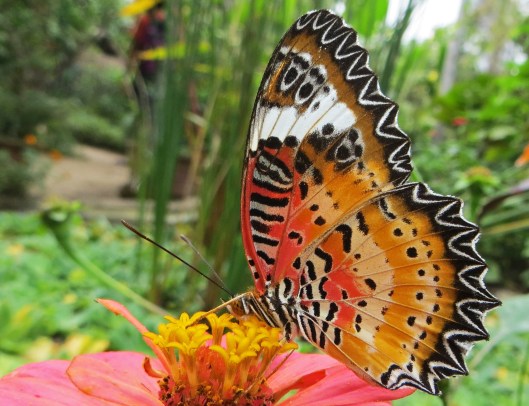
The friendly centre guides provide a short guided tour, sharing their knowledge of the different species and explaining the life cycle and peculiarities of each species. By training Cambodian people who reside near forested areas to farm butterflies, and employing locals as staff, the butterfly centre benefits local impoverished communities, encourages the preservation of native forests, and helps to conserve the native butterflies – a win, win situation!


28 Wednesday Sep 2016
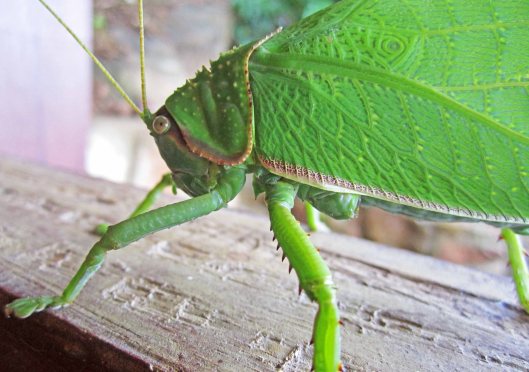
I’ve not been able to find out anything about the star of today’s world wildlife Wednesday post but I know one thing for sure – it’s a master of disguise!

It’s a Coconut grasshopper (Pseudophyllanax imperialis) and I encountered it while on a brief holiday in the seaside town of Kep in Cambodia. Apparently, it’s one of the largest species of grasshopper in the world and can be found in other coconut-growing locations, like New Caledonia, in the Pacific.


I’m not sure in what ways it’s associated with coconut trees because its patterning and colouration make it look more like the leaf of an ordinary tree rather than the palm fronds of a coconut. Mind you, those jaws look like it could quite easily crack open a coconut. Though it looks rather fierce, these grasshoppers are harmless to humans, otherwise I wouldn’t have had it sitting on my hand!
16 Tuesday Aug 2016
Tags
bovine, Cambodia, cattle, Cattle in Cambodia, cow, Water buffalo
World wildlife Wednesday has rolled around again, and I was stuck for an idea this week until my friend Viv, who lives in Thailand, posted a photo of one of her local water buffalo.

My photos, however, were not taken in Thailand but in Cambodia, where I lived and worked for seven months back in 2013. Both water buffalo and the local cattle are common sights there, pulling wagons and ploughs, and wallowing in muddy watering holes. These valuable, well-tended beasts of burden are also farmed for their dairy products, and cow dung has long been used both as fertiliser and as fuel in impoverished countries like Cambodia. Cattle also feature in their ancient religions, and representations can be seen in the stone statues and sculptured reliefs that adorn the world-famous temples of Angkor Wat and the local pagodas. So, today we have a celebration of ‘bovinity’!


10 Wednesday Aug 2016
Posted in nature
Tags
Cambodia, crab market, crab traps, crabs, crustaceans, hermit crab, Kep
For world wildlife Wednesday this week we’re heading to Cambodia where I lived and worked for 7 months in 2013. In January that year, I visited the seaside town of Kep with some friends. Kep is particularly famous for its delicious crabs and, just as other places have huge statues of their typical food product (in New Zealand, Ohakune has an enormous carrot; in Australia, Woombye a huge pineapple – I’m sure there are others), so Kep has this large statue of a crab – a male crab I am reliably told – something to do with the width of the central plate on its tummy!


The locals make a living from farming and catching crabs, and it was interesting to watch them checking their traps in the warm waters near the crab market. Both the sunset, which we enjoyed at the one of the restaurants near the crab market, and the crabs we ate later, were superb, as were all the other types of fresh seafood we savoured in Kep: prawns, shrimps, fish, squid and octopus. Seafood is my absolute favourite food so I was in heaven.


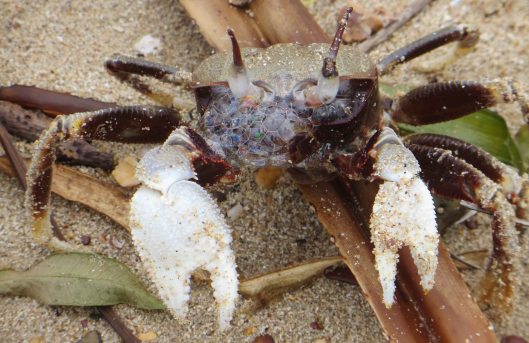
Our beach walks also featured many crabs: this large one had escaped the traps and was blowing bubbles on the sand at the water’s edge (thought to be how crabs aerate their gills when out of water), and the tiny hermit crabs were fun to watch, scuttling along the sand with their homes on their backs.


29 Wednesday Jun 2016
Tags
Cambodia, Common green frog, frog, Green paddy frog, Hylarana erythraea, Wat Damnak, waterlilies, waterlily
When I lived in Cambodia in 2013, one of the things that regularly made me smile was these little frogs, the Common greens (Hylarana erythraea), also known as the Green paddy frogs. Although they would live almost anywhere there was a pond or stagnant water, there was one particular pond, in the grounds of a local pagoda, where I knew they could always be found.

The frogs were quite wary of humans – perhaps they had some realisation that the locals considered them a food source – so I would have to move very slowly and quietly ever closer to the pond to try to get photos. And, even then, the slightest breeze or loud noise or change in the light would see some of them leap frantically away to hide, well camouflaged, under a lily pad. And that just made me laugh out loud, which scared the rest of them into panicky hopping. The long narrow pond was also full of waterlilies so, for me, the combination of cute frogs and gorgeous blooms was irresistible.


01 Tuesday Mar 2016
Posted in nature, nature photography, reptiles
Tags
Calotes versicolour, Cambodia, Changeable lizard, Eastern garden lizard, lizard, Oriental garden lizard
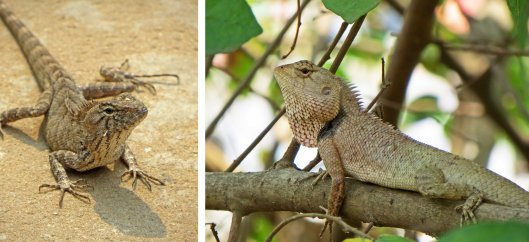
It’s St David’s Day here in Wales so I thought to feature something Welsh, but I’ve already covered the Daffy and the Taffy, and leeks aren’t exactly inspiring. Then I thought ‘Dragon’! Though I have photos of Welsh dragon sculptures and carvings, this is as close as I can get to the real thing, the lizards I encountered almost daily while living in Cambodia.

Though these critters all look quite different, they are the same species, Calotes versicolour, also known as the Oriental garden lizard, the Eastern garden lizard and – no surprise – the Changeable lizard. As well as having naturally variable colouration, the males also take on red and black hues during the breeding season.

Interesting facts? They have incredibly long stiff tails which, unlike other lizards, they do not drop. However, like other lizards, they do shed their skin, they do lay eggs – between five and fifteen, usually in a hole in the ground or a hollow in a tree, and, like chameleons, they can move each eye independently of the other. They mostly eat insects and small rodents but they don’t have teeth for chewing so gobble them down whole, after a little pre-dinner food-bashing. Sounds remarkably dragon-like to me, though I’m not sure of their attitude to gold!

 earthstar
You must be logged in to post a comment.