• ABOUT
  • BIRDING 2018
  • Birding 2019
  • BLOG POSTS
  • Butterflies 2018
  • Resources

earthstar

~ a celebration of nature

earthstar

Tag Archives: dragonflies

Dragons at Lavernock

27 Sunday Aug 2017

Posted by sconzani in insects, nature, parks

≈ 2 Comments

Tags

British dragonflies, Broad-bodied Chaser, Common Darter, dragonflies, dragonfly ovipositing, Emperor dragonfly, Lavernock Nature Reserve

There were some cracking dragonflies scooting around the pond at Lavernock Nature Reserve yesterday.

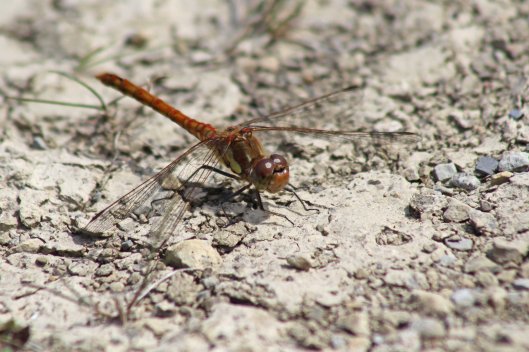
170827 Common darter male
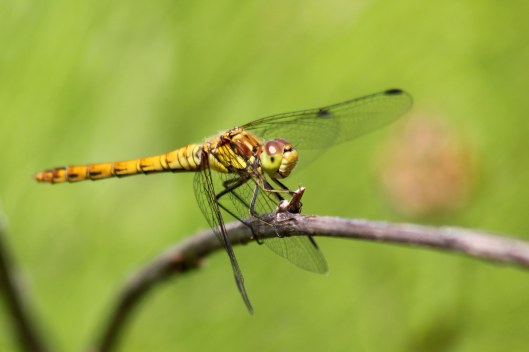
170827 Common darter female

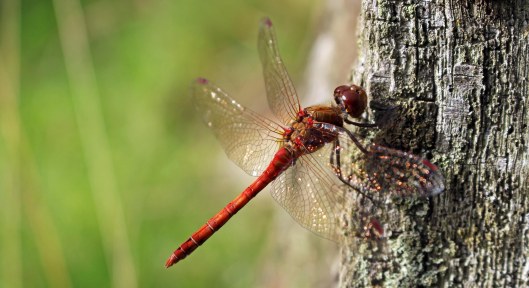
Both the male and the female Common darters posed very obligingly for me.

170827 Emperor male

The male Emperor kept busy patrolling the pond and indulging in occasional rapid trysts with a female. Judging by his tattered wings, he’s notched up quite a few trysts in recent days / weeks. He only stopped once, and then very briefly, so this photo doesn’t really do him justice.

170827 Emperor female

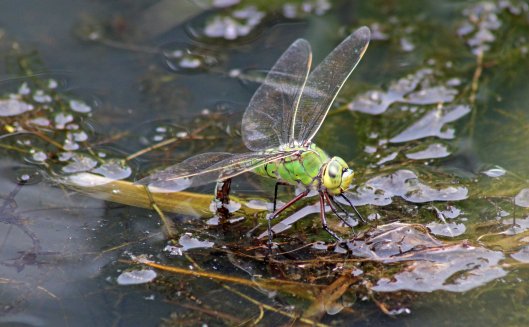
The female Emperor was then kept busy laying eggs at various spots all around the pond edges. A woman’s work is never done!

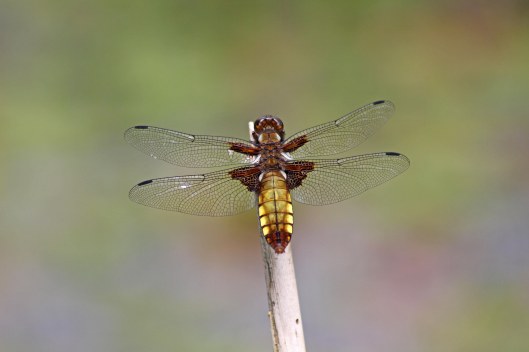
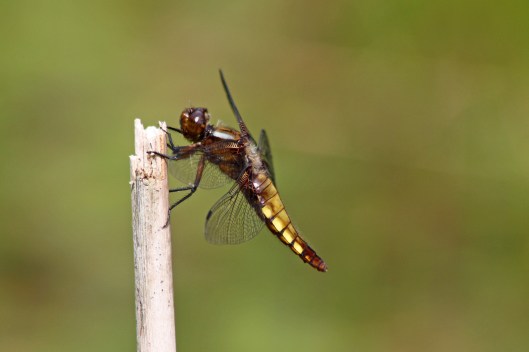
170827 Broad-bodied chaser male

The star of the show was this gorgeous male Broad-bodied chaser. Apparently, this is very late in the season for them, and he was looking pristine, so perhaps he had only recently hatched. Whatever his story, he was a stunning sight.

Like Loading...

Three Aeshnidae

09 Wednesday Aug 2017

Posted by sconzani in insects, nature

≈ Leave a comment

Tags

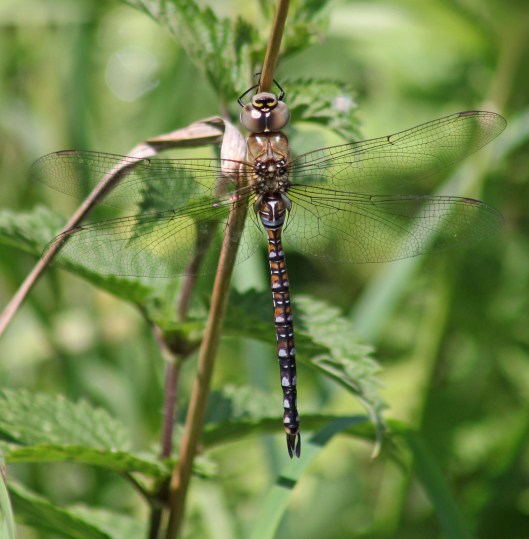
Aeshna cyanea, Aeshna mixta, Aeshnidae, Anax imperator, British dragonflies, dragonflies, dragonfly, Emperor dragonfly, Migrant hawker, Southern hawker

The Aeshnidae are one of the five families of dragonflies to be found in Britain, and the family is made up of twelve Emperors and Hawkers. In the past week I have been privileged to see three members of the family during my local walks.

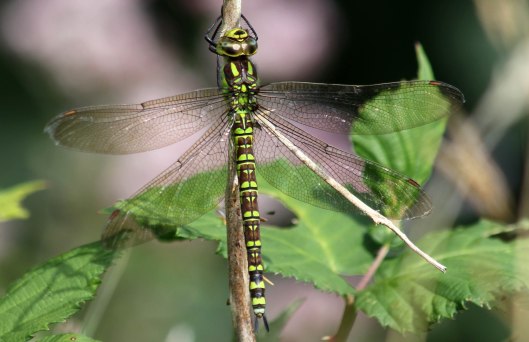
170809 Southern hawker
170809 Migrant hawker

The Southern hawker (Aeshna cyanea) (above left) is relatively common in Wales. In Aderyn, the national biodiversity recording database, there are 3312 records of Southern Hawker sightings and these are spread across 225 of the 275 10-kilometre grid squares that divide up Wales.

If the recorded numbers are anything to go by, the Migrant hawker (Aeshna mixta) (above right) is half as common as the Southern, with 1662 records in 143 grid squares, and its coverage across Wales is more spasmodic. This was only my second sighting of this slightly smaller Hawker but then I have only been living in Wales two years so my personal statistics aren’t really relevant.

170809 Emperor

This last creature is the most recorded of the Aeshnidae, with 4098 records in 221 of Wales’s grid squares, but, rather than reflecting how common it is, that may be because it’s one of the easiest dragonflies to identify because it’s the biggest. This is the Emperor (Anax imperator). I often get buzzed by these stunning creatures hawking over fields of wildflowers when I’m out walking – and they sound like a small helicopter approaching! – but I rarely get lucky enough to see them perched so I was particularly chuffed to get this photo.

Like Loading...

Migrant hawker

02 Wednesday Aug 2017

Posted by sconzani in insects, nature

≈ 4 Comments

Tags

Aeshna mixta, British dragonflies, dragonflies, dragonfly, Migrant hawker

This is my very first Migrant Hawker dragonfly (Aeshna mixta) – isn’t she a beauty?

170802 Migrant hawker

Before the 1940s, these dragonflies visited Britain but didn’t breed here – hence the name ‘Migrant’ – but they have since become established and are gradually increasing their range northwards. They’re described as small to medium size dragonflies but, at around 63mm long, I think they’re quite big, and this one was certainly quite prominent as she hawked for food along a hedgerow, the nearest standing water probably 500 metres away as the dragon flies. Migrant hawkers have a later flying season than many other dragon- and damselflies, usually ranging from August to October, so there’s plenty of time yet to spot one flying along a hedgerow or woodland edge near you. And I’ll be keeping an eye out for the male of the species.

Like Loading...

Happy hour

25 Tuesday Jul 2017

Posted by sconzani in insects, nature

≈ 9 Comments

Tags

British dragonflies, Broad-bodied Chaser, dragonflies, dragonfly, female Broad-bodied Chaser, Lavernock Nature Reserve, Libellula depressa, Odonata

170725 Broad-bodied chaser (1)

These stunning female Broad-bodied chasers (Libellula depressa) were at the pond at Lavernock Nature Reserve today. Watching them fly, perch, and lay their eggs was an hour very well spent. Bliss!

170725 Broad-bodied chaser (2)

Like Loading...

Not so Common darters

20 Thursday Jul 2017

Posted by sconzani in insects, nature

≈ 8 Comments

Tags

British dragonflies, Common Darter, dragonflies, dragonfly, National Dragonfly Week, Sympetrum striolatum

170720 Common darter (1)

I haven’t been seeing a lot of dragonflies this year – probably just me not going to the right places, rather than an actual scarcity – but I have seen two Common darters (Sympetrum striolatum) in the past week. Although I blogged about these beauties around this time last year, I thought I’d share these latest images to celebrate National Dragonfly Week, which is happening right now.

170720 Common darter (2)

I had a bit of luck this week as I finally managed to photograph one of these lovely creatures in flight. It’s not the sharpest of shots but I’ll take it.

170720 Common darter (3)

Like Loading...

The skimmers

24 Saturday Jun 2017

Posted by sconzani in insects, nature

≈ 4 Comments

Tags

Black-tailed skimmer, British dragonflies, dragonflies, dragonfly, Keeled skimmer, Orthetrum cancellatum, Orthetrum coerulescens

When the birds disappear behind the leaves of the trees during the summer months, my eye turns to the other creatures that delight and amaze with their aerial displays, and the dragonflies are some of the most impressive. In recent weeks I’ve seen my first Skimmers.

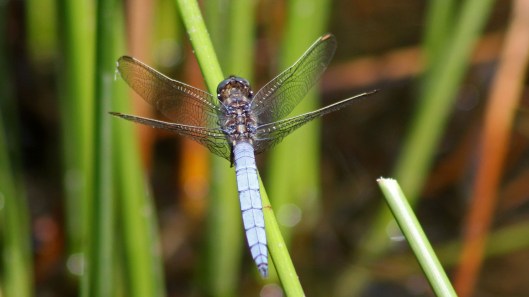
170624 Keeled skimmer

Keeled skimmer (Orthetrum coerulescens)
I was on a walk with my bird club buddies in the hills above Swansea this week when I saw my first Keeled skimmer. It was flitting back and forth quite restlessly in a boggy reed-filled area, perching on the reeds and other vegetation but only for short periods, so I was lucky to get some reasonable photos. I love the brilliant blue colour, called pruinescence, which is actually a covering of wax particles and which can be rubbed off during mating or if the dragonfly accidentally rubs against vegetation. Keeled skimmers are mostly found in western Britain and fly from June through to September.

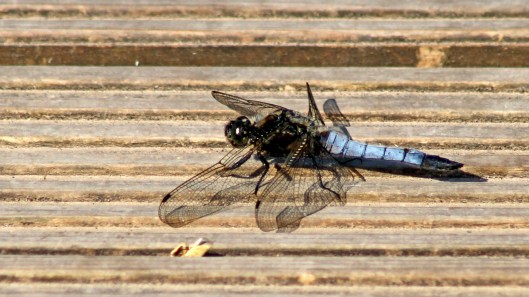
170624 Black-tailed skimmer

Black-tailed skimmer (Orthetrum cancellatum)
Though very similar in appearance to the Keeled skimmer, the Black-tailed skimmer has, as its name implies, a darker end to its abdomen, and it’s much more common, as it’s happy to live around any pond, lake or stream, rather than the acidic moorland that the Keeled skimmer prefers. Though it is more common in southern parts of Britain, it has gradually been extending its range northwards, and its flight period is a little longer than its keeled cousin, being on the wing sometimes as early as late April right through to October if conditions are mild enough.

170624 Keeled skimmer (2)
170624 Black-tailed Skimmer (2)
Like Loading...

From photograph to painting

20 Saturday Aug 2016

Posted by sconzani in insects, nature

≈ 9 Comments

Tags

dragonflies, dragonfly, Southern hawker

A few days ago I posted a photo of a Southern hawker dragonfly on the UK Dragonflies & Damselflies page on Facebook, just to be sure of my identification of this beautiful creature.

160820 Southern Hawker (1)

Julie Horner was one of the people who liked my photo and she also commented, asking my permission to paint the dragonfly. I said yes, if she would give me permission to share her painting here on the blog. A deal was struck and I emailed Julie the images I shared on my Southern Hawker blog post last week.

160820 Souther Hawker Julie Horner painting

Yesterday, Julie completed the painting and I am really delighted to be able to share her work with you. I love how she has simplified the subject matter – the iris is the perfect flower for the dragonfly to perch on, I think, and I also admire how well she has captured the detail in the wings. I’m sure you’ll agree that Julie is a really talented artist and I’m thrilled at what this impromptu collaboration has produced. You can check out more of Julie’s gorgeous paintings on her Facebook page, Horner Art Studio, and on her Etsy page.

Like Loading...

A Southern hawker

15 Monday Aug 2016

Posted by sconzani in insects, nature

≈ 1 Comment

Tags

Aeshna cyanea, dragonflies, dragonfly, Southern hawker

Although I’d seen a Southern hawker dragonfly (Aeshna cyanea) once before, I hadn’t managed to get any good photos until I spotted this little beauty while on an outing to Lewes in East Sussex during last week’s holiday. Though the spot where she settled meant she was slightly obscured by vegetation, she very obligingly stayed put while I got several shots.

160815 Southern Hawker (1)

At around 70mm (2¾ inches) long, Southern hawkers are reasonably large creatures, and my research tells me they can be very inquisitive, sometimes flying right up to the people watching them to check them out. I’ve yet to see a male but imagine them to be rather handsome as they have vivid blue and green colouring with similar dark patterning to the female.

160815 Southern Hawker (3)
160815 Southern Hawker (2)

Neither of the Southern hawkers I’ve seen was near water and this is quite common, apparently. Though they need well-vegetated ponds in which to lay their eggs, they can often be seen hawking for food along tree-lined paths and woodland rides. These dragonflies are common in southern parts of England and Wales, hence the name Southern hawker.

160815 Southern Hawker (4)

Like Loading...

National Dragonfly Week: The Emperor

31 Sunday Jul 2016

Posted by sconzani in insects, nature

≈ 5 Comments

Tags

Anax imperator, dragonflies, dragonfly, dragonfly ovipositing, Emperor dragonfly, National Dragonfly Week 2016

We’re finishing National Dragonfly Week with a grand flourish … let me introduce you to the royalty of the dragonfly world, the Emperor (Anax imperator) and his female, who, strangely enough, is not called the Empress but rather the female Emperor. I think we need to change that!

160731 Emperor male (1)

At around 78mm (just over 3 inches) long, these are Britain’s biggest dragonflies, twice as large as most damselflies, as you can see in my photo below right (sorry for the poor quality of this one but I wanted to show the size comparison). Though they are usually found around water – canals, lakes, ponds, ditches, slow-moving rivers, I have also seen the males hawking over the wildflower areas and around the trees and shrubs at my local cemetery, where the nearest water source is perhaps a kilometre away as the dragonfly flies.

160731 Emperor male (2)
160731 Emperor fem ovipositing (2)

The males are very territorial and seem to be constantly on the move, flying around the boundaries of their empires, chasing away other intruding males, hunting for food (insects, butterflies, tadpoles) and even eating as they fly. After mating – also on the wing – the female lays her eggs (known as ovipositing, see above right and below) in amongst vegetation in the water. The Emperors and their Empresses can be seen flying from June to August, in southern parts of Britain, though they seem gradually to be extending their empires northwards.

160731 Emperor fem ovipositing (3)

Like Loading...

National Dragonfly Week: The Common Darter

25 Monday Jul 2016

Posted by sconzani in insects, nature

≈ 3 Comments

Tags

Common Darter, dragonflies, dragonfly, National Dragonfly Week 2016, Sympetrum striolatum

Did you know that the dragonfly is one of the fastest flying insects in the world? The Smithsonian says that, with a speed of 56 kms (35 miles) per hour, it is actually the fastest but other sources say the Horsefly is faster – no wonder I can never escape being bitten by those nasty but beautiful flies! Dragonflies also have amazing manoeuvrability, hovering like helicopters, dive-bombing their prey, and even flying backwards.

160725 (1) Common darter male

For day three of our celebration of dragon and damselflies, let me introduce you to one of these incredibly speedy dive-bombing hoverers, the Common Darter (Sympetrum striolatum). As their name suggests they are exceedingly common in England and Wales, though they shy away with the colder climes further north, and, yes, they do dart, particularly when pursuing insects to eat. They can appear quite similar to Ruddy Darters, but those dragonflies have a ‘waisted’ abdomen and black legs whereas the Commons have yellow-striped legs.

160725 (2) Common darter imm male

My photos are only of males – they are lighter in colour when immature – and show them in very typical positions, perched on logs, fences, twigs, wires and farm gates while they keep an eye out for passing insects. Though they need the water of ponds, canals, lakes, even ditches to lay their eggs in, they can often be seen away from water. They are not territorial so they do, apparently, assemble in quite large numbers, with ‘groups of several hundred in a single field’ having been recorded and ‘lines of insects … seen along the top of field gates’. Oh to see such a sight!

160725 (3) Common darter male
160725 (4) Common darter imm male
Like Loading...
← Older posts
Newer posts →

About me

sconzani

sconzani

I'm a writer and photographer; researcher and blogger; birder and nature lover; countryside rambler and city strider; volunteer and biodiversity recorder.

View Full Profile →

Follow earthstar on WordPress.com

Enter your email address to follow this blog and receive notifications of new posts by email.

Recent blog posts

  • P is for Phalarope December 21, 2025
  • O is for Odonata December 20, 2025
  • N is for nest December 19, 2025
  • M is for mite December 18, 2025
  • L is for lepidopteran lifers December 17, 2025

From the archives

COPYRIGHT

Unless otherwise acknowledged, the text and photographs on this blog are my own and are subject to international copyright. Nothing may be downloaded or copied without my permission.

Fellow Earth Stars!

  • Unknown's avatar
  • Unknown's avatar
  • Unknown's avatar
  • Unknown's avatar
  • Unknown's avatar
  • Unknown's avatar
  • Unknown's avatar
  • Unknown's avatar
  • Unknown's avatar
  • Unknown's avatar
  • Unknown's avatar
  • Unknown's avatar
  • Unknown's avatar
  • Unknown's avatar
  • Unknown's avatar
  • Unknown's avatar
  • Unknown's avatar
  • Unknown's avatar
  • Unknown's avatar
  • Unknown's avatar
  • Unknown's avatar
  • Unknown's avatar
  • Unknown's avatar
  • Unknown's avatar
  • Unknown's avatar
  • Unknown's avatar
  • Unknown's avatar
  • Unknown's avatar
  • Unknown's avatar
  • Unknown's avatar
  • Unknown's avatar
  • Unknown's avatar
  • Unknown's avatar
  • Unknown's avatar
  • Unknown's avatar
  • Unknown's avatar
  • Unknown's avatar
  • Unknown's avatar
  • Unknown's avatar
  • Unknown's avatar
  • Unknown's avatar
  • Unknown's avatar
  • Unknown's avatar
  • Unknown's avatar
  • Unknown's avatar
  • Unknown's avatar
  • Unknown's avatar
  • Unknown's avatar
  • Unknown's avatar
  • Unknown's avatar

Blog at WordPress.com.

Privacy & Cookies: This site uses cookies. By continuing to use this website, you agree to their use.
To find out more, including how to control cookies, see here: Cookie Policy
  • Subscribe Subscribed
    • earthstar
    • Join 667 other subscribers
    • Already have a WordPress.com account? Log in now.
    • earthstar
    • Subscribe Subscribed
    • Sign up
    • Log in
    • Report this content
    • View site in Reader
    • Manage subscriptions
    • Collapse this bar
 

Loading Comments...
 

You must be logged in to post a comment.

    %d