• ABOUT
  • BIRDING 2018
  • Birding 2019
  • BLOG POSTS
  • Butterflies 2018
  • Resources

earthstar

~ a celebration of nature

earthstar

Tag Archives: Merthyr Mawr National Nature Reserve

Two orchids

26 Friday May 2017

Posted by sconzani in flowers, nature, wildflowers

≈ Leave a comment

Tags

Common twayblade, Dactylorhiza maculata, Heath spotted-orchid, Merthyr Mawr National Nature Reserve, native orchids, Neottia ovata, orchid, Twayblade

Of the estimated 25,000 different species of orchid that can be found around the world, 56 are native to Britain and, as some of those 56 are now coming in to bloom, I thought I’d share a couple for this week’s Floral Friday.

170526 Twayblade (2)
170526 Twayblade (1)

Twayblade (Neottia ovata)
First up is the Twayblade I saw growing quite prolifically in the woodland at Merthyr Mawr a couple of weeks ago. It’s one of Britain’s most common species but is often overlooked, perhaps because its yellow-green flowers often blend in with their woodland, scrub or grassland habitats. Twayblade means two leaves, as there usually are just two leaves, from the centre of which sprouts the flower stalk, though, like all living things, there are exceptions to the rule and plants with three to five leaves are sometimes found. The thing that most fascinates me about these orchids is the manikin-shaped flower.

170526 Heath spotted-orchid (1)
170526 Heath spotted-orchid (2)

Heath spotted-orchid (Dactylorhiza maculata)
Luckily I was with a group of botanists when I saw my first Heath spotted-orchids last weekend, as they can easily be confused with Common spotted-orchids, though the fact that we were in a damp boggy field at the time was probably also a good species indicator. As the name ‘heath’ implies, this orchid likes to get its feet wet, relishing the sogginess of peaty moors and boggy heaths. As well as being common throughout Europe, this orchid can also be found throughout the British Isles, though it does show a marked preference for northern and western areas. Its gorgeous flowers can be seen from around the middle of May through to mid July.

Like Loading...

More from Merthyr Mawr

09 Tuesday May 2017

Posted by sconzani in insects, nature, wildflowers

≈ Leave a comment

Tags

biodiversity, biological diversity, Blood bee, Common Stork's-bill, Glamorgan Fungus Group, Green dock beetle, Merthyr Mawr National Nature Reserve, Micropterix calthella, Navelwort, Poplar leaf beetle, Red-headed Cardinal beetle

As I wrote yesterday, with very little fungi to be found our Glamorgan Fungus Group foray on Saturday developed into a more general nature ramble. I’m afraid I wasn’t writing down the names of all the various critters and plants we saw so I can’t identify everything in these photos but I can name some.

170509 (2) Pyrochroa serraticornis Red-headed Cardinal beetle
170509 (3) Centipede
170509 (4) Eggs of Gastrophysa viridula Green dock beetle
170509 (5) Micropterix calthella moths
170509 (6) Erodium cicutarium Common Stork's-bill
170509 (7) Two species of snails
170509 (8) Umbilicus rupestris Wall pennywort or Navelwort
170509 (9) Chrysomela populi Poplar leaf beetle
170509 (10) Sphecodes sp Blood bee

The first is a Red-headed cardinal beetle (Pyrochroa serraticornis), a very pretty beetle though this one wouldn’t keep still for me. The centipede was the same and I’m afraid I don’t remember its name, though I was told it’s not particularly common. It tickled! I think the little yellow dots are the eggs of the Green dock beetle (Gastrophysa viridula) as we saw a pair mating nearby. The tiny moths on the buttercup flower are Micropterix calthella. The plant with the pink flower is one I actually remembered from my botany walk on Thursday – a miracle! It’s Common Stork’s-bill (Erodium cicutarium). Then we have two different species of snail cosying up together. Once again, I was told the names but didn’t write them down and have forgotten (must do better next time!). This very pretty plant was a new one for me and it has two common names, so you might know it either as Wall pennywort or Navelwort (scientific name Umbilicus rupestris). Next is another beetle, this time a Poplar leaf beetle (Chrysomela populi). It was a gorgeous wee thing, with metallic green thorax and dark red body, almost like an oversized ladybird. And, last but not least, was this rather angry Blood bee (Sphecodes sp.). It was trying to lay its eggs in the holes of mining bees when it was netted and potted up for a quick close-up look.

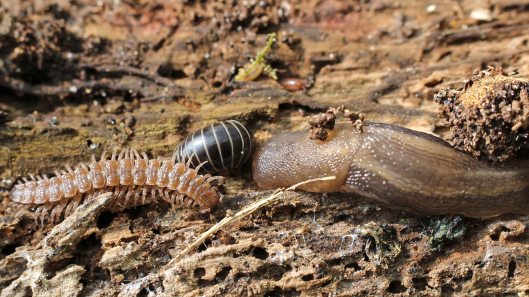
170509 (1) Millipede Pill bug Slug

My favourite moment of the day, though, was when I turned over this log. I particularly loved the little grouping of millipede, pill-bug and slug but these were only a few of the various creatures to be seen. It was just nice to see such biodiversity co-existing happily together. A lesson for us all, I think.

Like Loading...

Fungi foray: Merthyr Mawr

08 Monday May 2017

Posted by sconzani in fungi, nature, parks, spring, walks

≈ Leave a comment

Tags

Daedaleopsis confragosa, fungi enthusiasts, fungi foray, Glamorgan Fungus Group, Kuehneola uredinis, Melampsora epita var epitea, Melampsora populnea, Merthyr Mawr National Nature Reserve, Microbotryum silenes-dioicae, Mollisia, Phellinus hippophaeicola, Phylloporia ribis, rust fungi, Synchytrium taraxaci

Saturday dawned fine and mostly sunny, good news for most but not such good news for fungi enthusiasts, who are already bemoaning the recent lack of rain. Still, keen-eyed fungi fans can always find something and our Glamorgan Fungus Group has some of the keenest in ‘Eagle-eyes’ Emma. Though we were just a small group of six and a half, we enjoyed a splendid day searching the woodland areas of Merthyr Mawr National Nature Reserve, and our limited numbers were, in fact, a bonus, as we had amongst us the county recorder for Orthoptera (grasshoppers and related insects) and an experienced botanist, so we were able to enjoy, discuss and identify a broad range of flora and fauna. As expected, our fungi finds were limited but we finished the day with a very respectable total of 21 species and had a great time along the way.

Here are some of our finds: the rust Melampsora populnea on Dog’s mercury; another rust Kuehneola uredinis, on Bramble; Microbotryum silenes-dioicae, a smut that occurs on the anthers of Red campion flowers; another rust Melampsora epita var. epitea on Spindle; fungi enthusiasts inspecting the one group of cap fungi (‘real mushrooms’) found this day; the ‘real mushrooms’ that must remain unidentified as they were much eaten and turning gloopy; likely one of the Mollisia species of Disco fungi; Phellinus hippophaeicola on Sea buckthorn; Phylloporia ribis on Spindle; a rather old and faded Blushing bracket Daedaleopsis confragosa; a Puccinia species of rust on Common ragwort – this needs microscope work to positively ID; and the pimple-like growths of Dandelion wart Synchytrium taraxaci on one of the gazillions of Dandelion species, so Taraxacum officinale agg.

170508 (1) Melampsora populnea on Dog's mercury
170508 (2) Kuehneola uredinis on Bramble
170508 (3) Microbotryum silenes-dioicae Smut on Red campion
170508 (4) Melampsora epita var epitea on Spindle
170508 (5) Fungi enthusiasts
170508 (6) Unidentified fungus
170508 (7) Mollisia sp
170508 (8) Phellinus hippophaeicola on Sea buckthorn
170508 (9) Phylloporia ribis on Spindle
170508 (10) Daedaleopsis confragosa Blushing bracket
170508 (11) Puccinia sp on Common ragwort
170508 (12) Synchytrium taraxaci on Taraxacum officinale agg
Like Loading...

Not just a load of bullocks!

05 Tuesday Apr 2016

Posted by sconzani in animals, nature

≈ 2 Comments

Tags

bullocks, cattle, land management, Merthyr Mawr National Nature Reserve, sand dunes, Yellow dung fly

I was a little surprised last Saturday to see bullocks grazing in the Merthyr Mawr National Nature Reserve but it’s all part of the Countryside Council for Wales’s management plan. Research and monitoring have shown that the sand dune ecosystem needs to be dynamic – the dunes need to be exposed, the sands able to move with wind, tide and storm, in order to function as effective flood defences and to maintain the right environment for the rare plants and invertebrates that live there.

160405 bullocks (5)

So, some of the grasses and shrubs that had previously stabilised the dunes have been removed by earthmoving equipment and, to prevent the dune system developing into woodland, cattle are being allowed to graze parts of the reserve at certain times of the year. The plan is to maintain sparsely vegetated dunes and open grassland so that the rare species that were being choked towards extinction will be rejuvenated.

160405 bullocks (1)
160405 bullocks (2)
160405 bullocks (3)
160405 bullocks (4)

One additional benefit for the photographer – the bullocks are very photogenic, and I’m sure the Yellow dung flies I saw on Saturday are pretty happy with the plan as well.

160405 Yellow dung fly

Like Loading...

The larva before the worm

04 Monday Apr 2016

Posted by sconzani in insects, nature, nature photography

≈ 7 Comments

Tags

glow worm, glow worm larva, Lampyris noctiluca, Merthyr Mawr National Nature Reserve

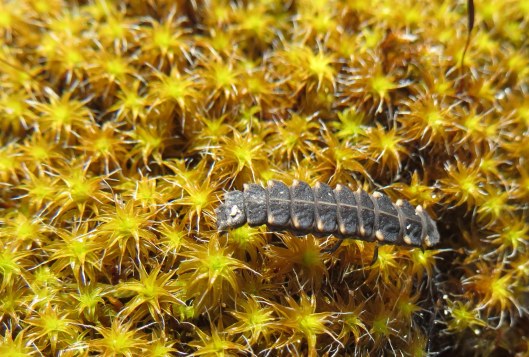
I saw my first Glow worm (Lampyris noctiluca) larva last weekend at the Merthyr Mawr National Nature Reserve, though I admit to thinking it was a caterpillar of some kind at first glance and needed an expert – luckily, I was with one! – to explain my mistake. Even more luckily, my expert Mike has two sons who are wildlife-obsessed and extremely talented young wildlife filmmakers. So, rather than attempt to tell you about this fascinating little insect myself, I am delighted that Rudi and Finn have very kindly agreed to let me link to their video. This is a must watch!

160404 Glow worm larva


Like Loading...

Merthyr Mawr National Nature Reserve

03 Sunday Apr 2016

Posted by sconzani in fungi, nature

≈ 6 Comments

Tags

Merthyr Mawr National Nature Reserve, national nature reserve, sand dunes, SSSI

What a marvellous place this is! Yesterday, I joined several of my friends from the Glamorgan Fungi Club for a foray up, down and around the rolling sand dunes of the Merthyr Mawr National Nature Reserve. You might think the words fungi and sand dunes are incompatible but you’d be wrong. Though we didn’t find the somewhat elusive fungi we were seeking, we did find several other interesting species, as well as an assortment of the more common critters: ladybirds and butterflies, hoverflies and bees, a glow worm larva and a lizard.

Auricularia auricula-judae Jelly ear
Daedaleopsis confragosa Blushing bracket (1)
Rickenella fibula Orange mosscap (1)
Taphrina alni Alder tongue
Tulostoma brumale Winter stalkball
Xylaria hypoxylon Candlesnuff

The dunes provide the perfect habitat for some rare insect species (the Dune tiger beetle, a rare weevil, the Solitary wasp, the Cuckoo bee and the Mining bee), and are also home to many rare and endangered plants, including two species of Marsh-orchid.

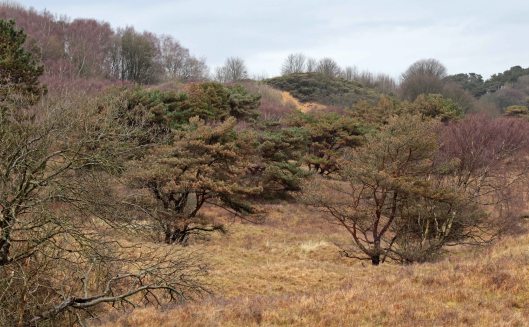
160403 merthyr mawr (2)

These dunes are the second highest in Europe, and, as well as providing a home to wildlife, they have also seen their fair share of human activity over the millennia: everything from Mesolithic stone axes and Neolithic pottery to Bronze Age burial chambers and Roman coins have been found here. It is a place to explore again and again, with each season offering the visitor something special and superb.

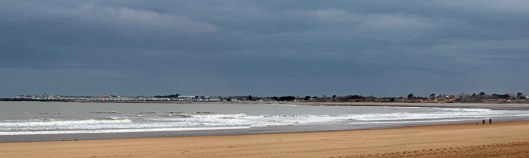
160403 Merthyr Mawr to Porthcawl

At the end of the trail through the dunes, the sea!

Like Loading...

About me

sconzani

sconzani

I'm a writer and photographer; researcher and blogger; birder and nature lover; countryside rambler and city strider; volunteer and biodiversity recorder.

View Full Profile →

Follow earthstar on WordPress.com

Enter your email address to follow this blog and receive notifications of new posts by email.

Recent blog posts

  • N is for nest December 19, 2025
  • M is for mite December 18, 2025
  • L is for lepidopteran lifers December 17, 2025
  • K is for Keeled skimmers December 16, 2025
  • J is for Jersey tiger December 15, 2025

From the archives

COPYRIGHT

Unless otherwise acknowledged, the text and photographs on this blog are my own and are subject to international copyright. Nothing may be downloaded or copied without my permission.

Fellow Earth Stars!

  • Unknown's avatar
  • Unknown's avatar
  • Unknown's avatar
  • Unknown's avatar
  • Unknown's avatar
  • Unknown's avatar
  • Unknown's avatar
  • Unknown's avatar
  • Unknown's avatar
  • Unknown's avatar
  • Unknown's avatar
  • Unknown's avatar
  • Unknown's avatar
  • Unknown's avatar
  • Unknown's avatar
  • Unknown's avatar
  • Unknown's avatar
  • Unknown's avatar
  • Unknown's avatar
  • Unknown's avatar
  • Unknown's avatar
  • Unknown's avatar
  • Unknown's avatar
  • Unknown's avatar
  • Unknown's avatar
  • Unknown's avatar
  • Unknown's avatar
  • Unknown's avatar
  • Unknown's avatar
  • Unknown's avatar
  • Unknown's avatar
  • Unknown's avatar
  • Unknown's avatar
  • Unknown's avatar
  • Unknown's avatar
  • Unknown's avatar
  • Unknown's avatar
  • Unknown's avatar
  • Unknown's avatar
  • Unknown's avatar
  • Unknown's avatar
  • Unknown's avatar
  • Unknown's avatar
  • Unknown's avatar
  • Unknown's avatar
  • Unknown's avatar
  • Unknown's avatar
  • Unknown's avatar
  • Unknown's avatar
  • Unknown's avatar

Blog at WordPress.com.

Privacy & Cookies: This site uses cookies. By continuing to use this website, you agree to their use.
To find out more, including how to control cookies, see here: Cookie Policy
  • Subscribe Subscribed
    • earthstar
    • Join 667 other subscribers
    • Already have a WordPress.com account? Log in now.
    • earthstar
    • Subscribe Subscribed
    • Sign up
    • Log in
    • Report this content
    • View site in Reader
    • Manage subscriptions
    • Collapse this bar
 

Loading Comments...
 

You must be logged in to post a comment.

    %d