Mining bees, the Adrenidae, are notoriously difficult to identify I find, and, as my brain is already swimming with factors to consider when identifying spiders (and other life stuff that is happening in the background), I don’t have the mental capacity to tackle bees at the moment. Maybe they can be next year’s project.
In the meantime though, I can still appreciate how exceedingly cute they are, especially when they sit still for a few moments (which isn’t often) and allow me to get some close up photos (also not often).
It was still very windy after the rain cleared yesterday so I decided to head to some local but out-of-the-way, sheltered places to spend some time staring at leaves, as you do – well, as I do anyway. I didn’t find any leafminers, which is what I was hoping for (it’s still a little cold for many of them), but I did find a nice assortment of other mini-beasties that I will share over a couple of posts. First up, two mining bees, the identities of which have been verified by an acquaintance of mine who’s a local expert.
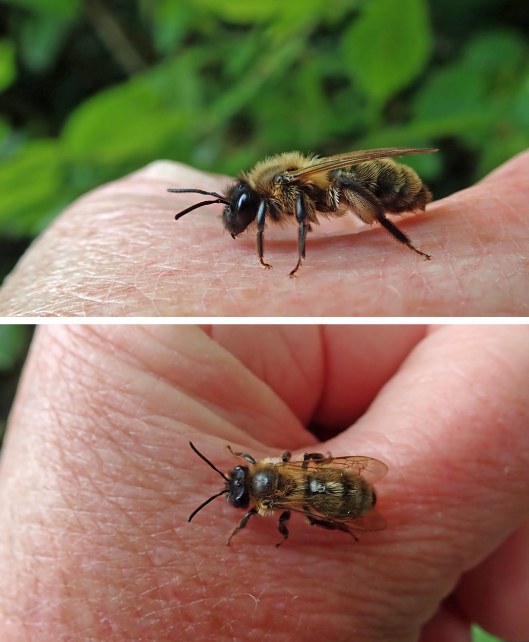
This first is the Chocolate mining bee, Andrena scotica. I spotted it sitting on a leaf that was blowing about a little in the wind. I thought it might fly away when I took hold of the leaf tip to stabilise it so I could get some photos. Instead, it crawled along the leaf and on to my hand. I think perhaps my relative warmth attracted it to me as it continued to sit there while I walked further along the path and found a more sheltered spot with a few flowers to move it to. A special moment!
And the beautiful creature above is a Grey-patched mining bee (Andrena nitida), a rather drab name for such a lovely foxy coloured bee. Both of these mining bees can be difficult to identify so I was lucky to have expert help. I’ve linked both bees to the specific photo albums posted by Steven Falk on Flickr, where there are stunning images that might help with identification and further information.
Bee-cause I hardly ever manage to identify bees to species, I just had to share this one that was a first for me and has been identified. My local go-to guy for bee identification, Liam from Buglife Cymru, says this is a ‘nice distinctive one with the orange thorax and black abdomen with bright orange tail. Also orange hind legs beneath the pollen brush’. Meet Andrena haemorrhoa, in this case a female specimen. When I recorded it, the common name came up as Orange-tailed mining bee, though the Naturespot website calls it the Early mining bee. Same same, but different.
I blogged about Dark-edged bee-flies earlier this month but, since then, I’ve noticed one doing something odd so thought I’d share what I’ve since found out about what it was doing. I spotted an area of miniature soil volcanoes where mining bees were active, digging out the tunnels in which they would lay their eggs, and, nearby, a sweet little bee-fly flicking its own eggs in to the holes of the bees it predates.
Then, that same bee-fly started hovering in one spot, frantically beating its wings but going nowhere (see video below). What was it doing? I asked on Twitter, and one of my followers suggested ‘It could be filling its rear-end up with sand’ – not a sentence I ever thought I’d read! But this was sort of right.
Someone from the Soldierflies and Allies Recording Scheme referred me to their website entry for bee-flies, which explains that ‘the adult females collect dust or sand at the tip of their abdomen, using it to coat their eggs, which helps protect the eggs from drying out.’ I’m guessing the sandy coating also means the eggs roll more easily into the bees’ tunnels. It was a fascinating insight into what is an extraordinary lifecycle, though I can’t help but feel some sympathy for the hard-working mining bee victims.
I can’t take the credit for the title of today’s post: by sheer coincidence, after returning from a walk with photos of these tiny dirt mountains, I spotted a tweet about the mini volcanoes of the bee Andrena fulva, and it seemed a very appropriate description. Mine may not be the work of that same bee species but they do indicate where solitary bees have dug out nest burrows for their young. I’m not sure whether these bee volcanoes are from newly hatched bees emerging from their winter nests or these volcanoes have only recently been excavated for the adult bees to lay this year’s eggs.
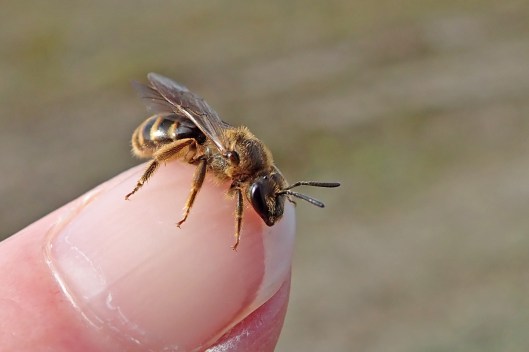
How lucky am I? After blogging last week about my delight at having a hoverfly sit on my hand, I’ve had another tiny percher. This time it was a bee, possibly a Yellow-legged mining-bee (Andrena flavipes), but don’t quote me on that. It was reluctant to fly off, as it was a cool day, so I carried it along with me until I got to a willow with open catkins, which my little flying friend was happy to move on to.
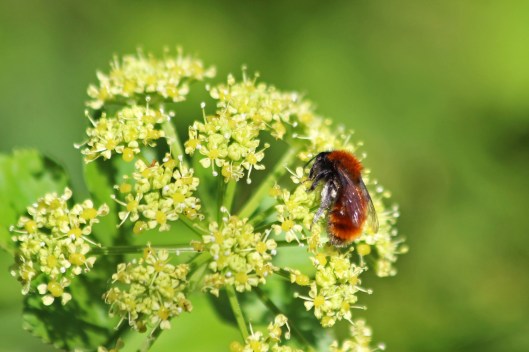
Another day, another mining bee. You’ll recall we had the grey-haired Ashy mining bee on Tuesday; well, today we have the Tawny mining bee (Andrena fulva). And what a cracking colour it is! I’d love to have hair like this.
The Bumblebee Conservation Trust website says these bees ‘can be found nesting in large groups and can be common in urban environments and garden lawns’ but I think that depends on location as the bees I see locally are usually singles, in less urban environments and, sadly, not as common as I’d like them to be, as their rich vibrant colour is very cheering.
Unfortunately, just like the Ashy mining bees, the Tawnies can also fall victim to bee-fly predation. You can read more about that and the bees themselves on the BCT website here.






 earthstar
You must be logged in to post a comment.