• ABOUT
  • BIRDING 2018
  • Birding 2019
  • BLOG POSTS
  • Butterflies 2018
  • Resources

earthstar

~ a celebration of nature

earthstar

Tag Archives: moth

Two in two days

04 Tuesday Sep 2018

Posted by sconzani in insects, nature

≈ 4 Comments

Tags

Aplocera plagiata, British moth, moth, moths, Treble-bar

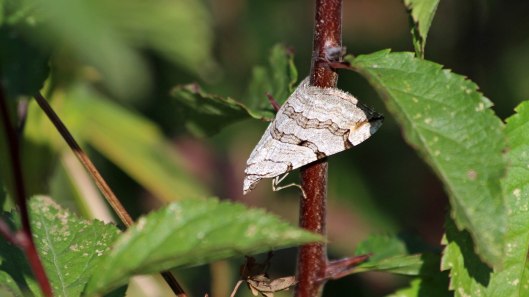
I’d only ever seen this beautifully patterned moth once before so it was a treat last week to see two of them on two consecutive days. Despite having a guide book, I always find moths difficult to identify but this one, the Treble-bar (Aplocera plagiata), lives up to its name rather nicely. Having said that, there is a chance these could be Lesser Treble-bars but they are much less common so I’m assuming they’re not (and I wasn’t able to check the ends of their abdomens to be sure!).

180904 treble bar (1)

These are probably second generation moths, the first having emerged, mated, laid, munched, pupated during May and June, and the second now going through that process during August and September.

180904 treble bar (2)

Like Loading...

Common purple & gold

20 Monday Aug 2018

Posted by sconzani in insects, nature

≈ Leave a comment

Tags

British moths, Common purple & gold, Cosmeston, Cosmeston Lakes Country Park, moth, moths, Pyrausta purpuralis, UK moths

Every step I take across the west paddock at Cosmeston seems to send at least two tiny beige-looking insects flicking off in different directions in front of me. At first, I think they might be grasshoppers or crickets, springing quickly out of the way of my trampling feet but no – these creatures are not making straight leaps, they are fluttering and flying. They’re not easy to follow – as soon as they touch the ground they seem to disappear so I have to focus intently to follow each flight and then approach very slowly to discover what they are.

180820 Pyrausta purpuralis (1)

It turns out they’re not beige at all – they’re a quite striking combination of maroon and yellow, hence their common name, Common purple & gold. This is Pyrausta purpuralis, not to be confused with Pyrausta aurata, a very similar moth of the same family (see more here).

180820 Pyrausta purpuralis (4)
180820 Pyrausta purpuralis (5)

180820 Pyrausta purpuralis (2)

With a wingspan of just 20mm, this moth really is tiny but it’s relatively common throughout Britain, particularly on chalky downs and dry grasslands. The moths I’m seeing now in such abundance are the second brood of the year and fly, both during the day and at night, from July to August. I saw their parents during May and June, though they didn’t seem as plentiful. Perhaps this is a moth species that has enjoyed our hot dry weather this summer.

180820 Pyrausta purpuralis (3)

Like Loading...

A Common footman

04 Wednesday Jul 2018

Posted by sconzani in insects, nature

≈ 2 Comments

Tags

British moths, Common footman, Eilema lurideola, moth, moths

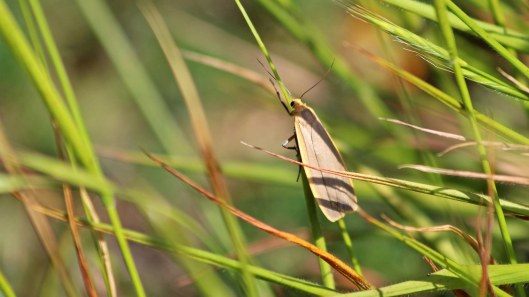
Moths have some wonderful names. I mean, you’ve got to wonder why one little group is named after a domestic servant. As well as this one, the Common footman, there are also Buff, Orange, Scarce, Dingy, Northern, Pigmy, and Hoary footmen, all members of the Eilema group of moths.

180703 common footman (1)

I spotted this little chap, Eilema lurideola, floundering around in the grass at Cosmeston recently. It might well be an elegant flier but it was having a great deal of trouble climbing up stalks of grass.

180703 common footman (2)
180703 common footman (3)
180703 common footman (4)
180703 common footman (5)
Like Loading...

Humming-bird hawk-moth

25 Monday Sep 2017

Posted by sconzani in insects, nature, seaside, wildflowers

≈ 8 Comments

Tags

British moths, Humming-bird hawk-moth, Macroglossum stellatarum, moth, moth like hummingbird, Red valerian

Remember how I wrote yesterday about some days being magical: first I was mobbed by Red admirals, next I discovered the Ivy bee colony and marvelled at its mating antics, and then, la pièce de résistance, I saw my very first Humming-bird hawk-moth.

170925 Humming-bird Hawk-moth (4)

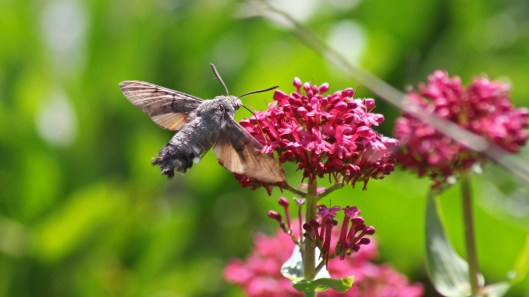
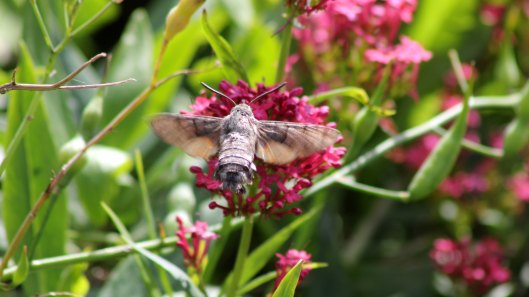
And, by golly, it was difficult to photograph. I took around 70 pictures but most are a blur because, like the bird it’s named after, this moth just does not keep still. Macroglossum stellatarum is its formal name, and it came to Britain originally from Africa and southern Europe. The adult moths can be seen flying any time from April to late November, at which time they start looking for a crevice in a building, a hole in a wall, or a handy crack in a tree to while away the winter months.

170925 Humming-bird Hawk-moth (2)
170925 Humming-bird Hawk-moth (1)

That super-long tongue allows them to specialise in feeding from tube-shaped flowers like the Echiums, though this one was enjoying the nectar of Red valerian plants growing along the high-tide line at a local beach, humming (its wings) as it hovered from one flower to the next. Incredibly, studies have shown that Humming-bird hawk-moths often return to the same flowers at the same time every day. So, it’s a moth that looks like a bird but has the memory of an elephant – simply amazing!

170925 Humming-bird Hawk-moth (3)

Like Loading...

Not one but three!

14 Monday Aug 2017

Posted by sconzani in insects, nature

≈ 1 Comment

Tags

British moths, Euplagia quadripunctaria, Jersey tiger, Lavernock Nature Reserve, moth, moths, UK moths

So, my question today is how many moths does it take to make a colony?

170814 Jersey tiger 100817170814 Jersey tiger 130817 (1)170814 Jersey tiger 130817 (2)

I passed through Lavernock Nature Reserve again yesterday and found two more Jersey tigers (Euplagia quadripunctaria). I can tell neither of these is the same as the one I saw three days earlier because the spots on their wings are all different (see inside bottom edge of right wing in these photos of all three, as shown below). I’m hoping this means there is now a colony of Jersey tigers becoming established in the reserve, rather than immigrants all arriving at the same time.

170814 Jersey tiger 100817 crop
170814 Jersey tiger 130817 crop (1)
170814 Jersey tiger 130817 crop (2)
Like Loading...

A Jersey tiger!

12 Saturday Aug 2017

Posted by sconzani in insects, nature

≈ 7 Comments

Tags

British moth, Euplagia quadripunctaria, Jersey tiger, Lavernock Nature Reserve, moth

170812 Jersey tiger (1)

Ooo look, a Red admiral … hang on a minute … what’s that???!!!

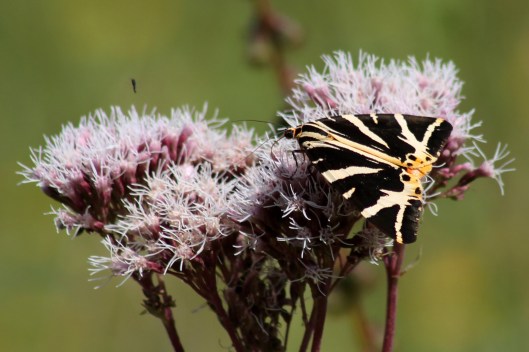
I went looking for migrant birds at high tide at Sully beach – and found nothing more exotic than some Rock pipits and Turnstones – but my walk home, along the coastal path, took me through Lavernock Nature Reserve and there I got lucky. There I found an altogether different migrant, a beautiful Jersey tiger (Euplagia quadripunctaria).

170812 Jersey tiger (3)

Obviously, it’s not a mammal that’s swum across the Channel from Jersey: it’s a moth. It may also not have been an immigrant, as colonies have become established in a couple of places along the southern English coast in recent years. It is still, however, not so common in Wales, with only 24 records in the national database.

170812 Jersey tiger (4)
170812 Jersey tiger (5)

As you can see, it has gorgeous and quite distinctive markings – just look at that bright orange underwing! – so there was no mistaking what it was. Let’s hope a few other Jersey tigers arrive to establish a colony in Lavernock’s wonderful wildflower meadows.

170812 Jersey tiger (2)

Like Loading...

Spots before my eyes

22 Saturday Jul 2017

Posted by sconzani in insects, nature

≈ 5 Comments

Tags

6-spot Burnet, British moths, Cosmeston Lakes Country Park, moth, moths, Six-spot burnet, UK moths, Zygaena filipendulae

170722 6-spot Burnet moth (1)

I have never before seen as many 6-spot Burnet moths (Zygaena filipendulae) as I saw last Monday in one of the fields at Cosmeston Lakes Country Park. I stopped counting at one hundred and there were many many more. They are gorgeous little flying machines and glowed like wee red bumblebees as they flitted from the sunshine-yellow ragwort flowers to the more subtle but no less glorious lilac and purple blooms of knapweed, meadow thistle and teasel. They were wondrous to behold.

170722 6-spot Burnet moth (2)
170722 6-spot Burnet moth (3)
170722 6-spot Burnet moth (4)
170722 6-spot Burnet moth (5)
170722 6-spot Burnet moth (6)
170722 6-spot Burnet moth (7)
170722 6-spot Burnet moth (8)
170722 6-spot Burnet moth (9)
170722 6-spot Burnet moth (10)
170722 6-spot Burnet moth (11)
170722 6-spot Burnet moth (12)
170722 6-spot Burnet moth (13)
Like Loading...

Moths of Kenfig

11 Sunday Jun 2017

Posted by sconzani in insects, nature

≈ 5 Comments

Tags

Beautiful china-mark, British moths, Burnet, Cinnabar, Grass rivulet, Kenfig National Nature Reserve, Lackey, moth, moths, Oak eggar, Small china-mark, Straw dot, Yellow-tail

As the butterflies are still enjoying their summer holidays, I have some moths and soon-to-be moths for you. These were all seen at Wales’s stunning coastal national nature reserve at Kenfig last weekend.

170611 Beautiful china-mark
170611 Burnet
170611 Cinnabar

We have, from left:
Beautiful china-mark (Nymphula nitidulata): It was no surprise to find this near Kenfig pool as its larvae are aquatic.
Burnet: (Zygaena sp.): Not sure which of the Burnet moths this will become as the only difference in the caterpillars is the length of their hairs and I didn’t measure these.
Cinnabar (Tyria jacobaeae): The ‘Jacobaeae’ epithet comes from its larval foodplant, Senecio jacobaea, aka Common ragwort.

170611 Grass rivulet
170611 Lackey
170611 Oak eggar

Grass rivulet (Perizoma albulata): As well as loving grasslands, these little beauties also love a nice sandy beach.
Lackey (Malacosoma neustria): We’ve had these before if you remember (Lackey me).
Oak eggar (Lasiocampa quercus): Don’t go searching around oak trees for this one: its name comes from the acorn-like shape of its cocoon.

170611 Small China-mark
170611 Straw dot
170611 Yellow-tail

Small china-mark (Cataclysta lemnata): Apparently, they don’t often open their wings to show the underwing markings. I got lucky!
Straw dot (Rivula sericealis): Straw coloured with a dot on each wing. I think I might actually remember this one.
Yellow-tail (Euproctis similis): I have yet to see the moth but it seems the female has a yellow tuft of hairs on her bottom.

Like Loading...

Hilary’s moths

06 Tuesday Jun 2017

Posted by sconzani in insects, nature

≈ 9 Comments

Tags

Bright-line Brown-eye, British moth, Buff ermine, Garden Grass-veneer, Ingrailed clay, moth, moths, The Spectacle

When I arrived at my friend Hilary’s house early Saturday morning, to hitch a ride to our monthly fungi foray, she had a wonderful surprise for me. She had put her moth trap out the previous night and had kept the moths for me to have a look at before she released them. (In case you’re wondering, trapping is really the only way to record and monitor the moth population, and it’s done in a way that usually causes no harm to the moths.) Here are some of the beauties I saw …

170606 Agriphila geniculea

One of the Crambidae or grass moths, the Garden Grass-veneer (Chrysoteuchia culmella)

170606 Buff ermine

I blogged about the White ermine recently – this is its cousin the Buff ermine (Spilosoma lutea).

170606 Heart and Dart (1)
170606 Heart and Dart (2)

Heart & Dart (Agrotis exclamationis), named for the heart- and dart-shaped markings on its wings.

170606 Ingrailed clay (1)
170606 Ingrailed clay (2)

Ingrailed clay (Diarsia mendica). Its name is a mystery but its caterpillars live on brambles and bilberries.

170606 Bright-line brown-eye

Bright-line Brown-eye (Lacanobia oleracea). Don’t you just love the common names of moths?

170606 Spectacle (1)
170606 Spectacle (2)

And, last but certainly not least, this amazing creature, for fairly obvious reasons, is called The Spectacle (Abrostola tripartita).

Like Loading...

Moths in the light of day

01 Thursday Jun 2017

Posted by sconzani in insects, nature

≈ 5 Comments

Tags

British moth, Camptogramma bilineata, Euclidia mi, moth, Mother Shipton, Silver-ground Carpet, Spilosoma lubricipeda, White Ermine, Xanthorhoe montanata, Yellow Shell

In the absence of butterflies, I seem to be discovering more moths. (I’m not sure why I’m not seeing many butterflies, though a friend says there’s often a May lull before a June explosion – let’s hope that’s true.)

170601 White ermine (1)
170601 White ermine (2)

White Ermine (Spilosoma lubricipeda)
I found this beauty, wearing the rather regal furry coat that gives it its name, lurking in a clump of tall grass. Flying between May and July, with an occasional second generation appearing in September–October, the White Ermine can be found throughout Britain in a variety of habitats, from heath- and moorland to gardens, hedgerows and woodlands.

170601 Silver-ground Carpet

Silver-ground Carpet (Xanthorhoe montanata)
This pretty member of the carpet group of moths was a lucky find at Cosmeston Lakes Country Park, where I chanced to spot it resting in a clump of grass in a small woodland area. It’s another May to July flier, and its caterpillars enjoy nothing better than a good munch on bedstraws, the plants of the Galium species.

170601 Yellow shell
170601 Mother Shipton

Yellow Shell and Mother Shipton
Both of these images were grab shots from a recent walk around the former rubbish tip that is now Grangemoor Park, in Cardiff. Moths have a habit of not wanting to be disturbed by camera lenses thrust in their direction, I notice, so my apologies that my photos are not very sharp.

I wish the Yellow shell (Camptogramma bilineata) (above left) hadn’t flitted off so quickly as I love its bright markings that resemble the line patterns found on some seashells, hence its name. It’s another common find throughout Britain, though it does have a preference for damper places. Its larvae feed on low-growing plants like sorrel and chickweed so look for it around that type of vegetation, usually between May and August.

Can you see why Mother Shipton (Euclidia mi) (above right) is so named? Those markings on her wings supposedly resemble a witch’s face and she is named for Old Mother Shipton, a 16th-century witch from Yorkshire who produced a series of dire prophecies. The moth, on the other hand, can be found all over Britain and Ireland, though has a particular fondness for the flower-rich meadows where grow the clovers, medics and lucernes its caterpillars like to eat.

Like Loading...
← Older posts
Newer posts →

About me

sconzani

sconzani

I'm a writer and photographer; researcher and blogger; birder and nature lover; countryside rambler and city strider; volunteer and biodiversity recorder.

View Full Profile →

Follow earthstar on WordPress.com

Enter your email address to follow this blog and receive notifications of new posts by email.

Recent blog posts

  • Kestrel 2026 : 86 January 31, 2026
  • Birch polypore January 30, 2026
  • The Marl Med gull January 29, 2026
  • Recording Grey squirrels January 28, 2026
  • Jimmy Wren January 27, 2026

From the archives

COPYRIGHT

Unless otherwise acknowledged, the text and photographs on this blog are my own and are subject to international copyright. Nothing may be downloaded or copied without my permission.

Fellow Earth Stars!

  • Unknown's avatar
  • Unknown's avatar
  • Unknown's avatar
  • Unknown's avatar
  • Unknown's avatar
  • Unknown's avatar
  • Unknown's avatar
  • Unknown's avatar
  • Unknown's avatar
  • Unknown's avatar
  • Unknown's avatar
  • Unknown's avatar
  • Unknown's avatar
  • Unknown's avatar
  • Unknown's avatar
  • Unknown's avatar
  • Unknown's avatar
  • Unknown's avatar
  • Unknown's avatar
  • Unknown's avatar
  • Unknown's avatar
  • Unknown's avatar
  • Unknown's avatar
  • Unknown's avatar
  • Unknown's avatar
  • Unknown's avatar
  • Unknown's avatar
  • Unknown's avatar
  • Unknown's avatar
  • Unknown's avatar
  • Unknown's avatar
  • Unknown's avatar
  • Unknown's avatar
  • Unknown's avatar
  • Unknown's avatar
  • Unknown's avatar
  • Unknown's avatar
  • Unknown's avatar
  • Unknown's avatar
  • Unknown's avatar
  • Unknown's avatar
  • Unknown's avatar
  • Unknown's avatar
  • Unknown's avatar
  • Unknown's avatar
  • Unknown's avatar
  • Unknown's avatar
  • Unknown's avatar
  • Unknown's avatar
  • Unknown's avatar

Blog at WordPress.com.

Privacy & Cookies: This site uses cookies. By continuing to use this website, you agree to their use.
To find out more, including how to control cookies, see here: Cookie Policy
  • Subscribe Subscribed
    • earthstar
    • Join 670 other subscribers
    • Already have a WordPress.com account? Log in now.
    • earthstar
    • Subscribe Subscribed
    • Sign up
    • Log in
    • Report this content
    • View site in Reader
    • Manage subscriptions
    • Collapse this bar
 

Loading Comments...
 

You must be logged in to post a comment.

    %d