Here’s a teeny tiny bonnet mushroom for this week’s #FungiFriday, about the right size for a fairy to wear, one of those miniscule Mycena species you find growing amongst the moss on a tree in a damp woodland.


25 Friday Nov 2022
Posted in fungi
Here’s a teeny tiny bonnet mushroom for this week’s #FungiFriday, about the right size for a fairy to wear, one of those miniscule Mycena species you find growing amongst the moss on a tree in a damp woodland.
27 Wednesday Nov 2019
Finally some fungi I can identify with confidence because, as Pat O’Reilly explains on the First Nature website,
Cap colour is rarely of much help when you are struggling to identify a Mycena, as they vary so much with age, location, humidity and growing substrate. If you look closely at the stem of a Grooved Bonnet you will see that it has longitudinal striations, whereas other common bonnet mushrooms have smooth stems.
So, the striated stems you can, hopefully, see in my second photo below prove that these lovely little bonnets I found growing in a tree in the grounds of a local church are … taaa daaa! … Grooved bonnets (Mycena polygramma).


26 Wednesday Dec 2018
Tags
bramble, Grooved bonnet, leafhopper, leafmine on bramble, Mycena fungi, Penarth to Lavernock coastal path, south Wales coastal path, Stigmella aurella, Wales Coastal Path
I took myself on a meander along the south Wales coastal path from Penarth to Lavernock and back again today. The weather was still quite gloomy, as it’s been for several days now, but at least there was no rain. I often have this trail to myself but not today – every man, woman, child and their dog had obviously decided this was a good way to walk off their festive feasting. As I had made it today’s mission to look for the little, I got a lot of strange looks, and I heard one or two ‘What was that lady doing?’ comments after people had passed. To their credit a couple of folk were brave enough to ask me directly but their eyes glazed over when I began to extol the beauty of the many leafhoppers I was seeing.

I saw lots of lovely things but thought, for the purposes of this blog, I’d focus on the Bramble (Rubus fruticosus agg.), which grows in abundance along the coastal path and, with this year’s mild weather, is still very green, and even flowering in places.

I haven’t yet had a chance to identify my finds but I think I have photos of three different species of leafhoppers (though it’s possible number 3 is just a yellower version of number 1). I was amazed to see so many of these little critters still flying and hopping around the bushes, though the winter has been very mild here so far and I think some species over-winter as adults.


I also spotted a couple of other tiny mini-beasties lurking amongst the leaves. I’m not sure what these are.


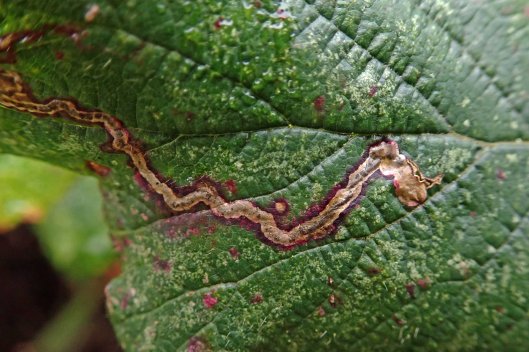
Lots of the leaves had leaf mines, though their makers have now left the leaves. I think most of the mines I saw would have been made by the larvae of Stigmella aurella, a moth.
And my last find was on an old, decaying Bramble branch, where these beautiful little bonnet fungi were growing. Though you can’t see the details in this photo, the caps were striated and the stems grooved so I think these might be Grooved bonnets (Mycena polygramma).

 earthstar
You must be logged in to post a comment.