• ABOUT
  • BIRDING 2018
  • Birding 2019
  • BLOG POSTS
  • Butterflies 2018
  • Resources

earthstar

~ a celebration of nature

earthstar

Tag Archives: National Insect Week

Tiny and red

24 Sunday Jun 2018

Posted by sconzani in insects, nature

≈ 2 Comments

Tags

#30DaysWild, 30 Days Wild, Apion frumentarium, British insects, National Insect Week, red weevil, weevil

For day 24 of my #30DaysWild, I’m actually going on a wander with a friend around my local area this evening, looking out for Swift nesting spots.

Apion frumentarium

But, as that probably won’t produce any photos and won’t finish until late, and as this is the last day of National Insect Week and these particular insects are incredibly cute, I thought I’d blog about some tiny wee red creatures I bumped into a couple of weeks ago.

Apion frumentarium

These are, I believe, Apion frumentarium, a rather gorgeous, if extremely small weevil that is quite common in Britain and spends most of its life on various members of the Dock family.

Apion frumentarium

Like Loading...

Insects of the zigzag path

23 Saturday Jun 2018

Posted by sconzani in flowers, insects, nature, walks, wildflowers

≈ 3 Comments

Tags

#30DaysWild, British butterflies, British insects, flowers for pollinators, National Insect Week, Penarth, wildflowers, Zigzag path

180623 zigzag insects (1)

For day 23 of #30DaysWild, as it’s National Insect Week, I went seeking insects along one my local trails, the zigzag path that runs from upper Penarth down to the marina. This was once a heavily wooded hillside but now has a concrete path that gives pedestrians and cyclists easy access up and down the steep hill. Of course, people sometimes want a more direct route and you can see that the frequent stomping of feet has worn alternate paths down the hillside.

180623 zigzag path

Though it looks quite grassy in this photo from a couple of weeks ago, the hillside is now a mass of self-sown native wildflowers and today it was alive with insects, from bees and hoverflies to butterflies, beetles and damselflies. This is a perfect site for wildflowers to grow – it is steep so difficult and presumably expensive to mow, and its steepness means it can’t be safely used by children playing (though, with a covering of snow, it is perfect for sledging!).

180623 zigzag insects (2)
180623 zigzag insects (3)
180623 zigzag insects (4)
180623 zigzag insects (5)

Though the local council usually strim this slope to death, utterly destroying the wildflowers and the wildlife, they have recently – and rather ironically – ploughed up a small flat area and dumped upon it soil seeded with wildflowers. That might sound hopeful, a positive action, but the ploughed area has not been maintained and, though I may be wrong, I doubt whether the wildflowers were locally sourced. I wonder too why the council would go to the expense of ploughing up perfectly good local wildflowers to plant others – do they think wildflowers should only be of the type they prescribe and only grow within a prescribed rectangular area? Surely they misunderstand the very essence of WILDflowers.

180623 zigzag insects (6)
180623 zigzag insects (7)
180623 zigzag insects (8)
180623 zigzag insects (9)

This blog post, then, is partly a celebration of the amazing variety of insects that enjoy the wildflowers that grow naturally around the zigzag path and partly a plea to the council not to kill those wildflowers and their pollinators but instead to celebrate and foster this wonderfully biodiverse area of Penarth.

180623 zigzag insects (10)
180623 zigzag insects (11)
180623 zigzag insects (12)
180623 zigzag insects (13)
180623 zigzag insects (14)
180623 zigzag insects (15)
Like Loading...

The bug called Grypo

20 Wednesday Jun 2018

Posted by sconzani in insects, nature

≈ Leave a comment

Tags

#30DaysWild, 30 Days Wild, British insects, Grypocoris stysi, National Insect Week, plant bug

180620 Grypocoris stysi (1)

On day 20 of #30DaysWild, I went looking for plant bugs – it is National Insect Week after all – and I found newly opened umbellifer flower heads fairly swarming with the unmistakeable plant bug, Grypocoris stysi. Look for them during June and July, mostly feasting on the pollen of umbellifer and nettle flowers, though they’re also quite partial to the occasional aphid. There are over 10,000 species of plant / leaf / grass bugs, but little Grypo’s distinctive markings mean it’s one that’s easy to identify.

180620 Grypocoris stysi (2)
180620 Grypocoris stysi (3)
180620 Grypocoris stysi (4)
180620 Grypocoris stysi (5)
Like Loading...

Fat thighs are cool!

19 Tuesday Jun 2018

Posted by sconzani in flowers, insects, nature, wildflowers

≈ 2 Comments

Tags

#30DaysWild, 30 Days Wild, British beetles, British insects, Common spotted orchid, National Insect Week, Oedemera nobilis, Swollen-thighed beetle

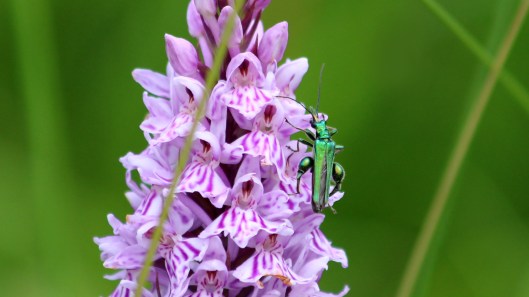
Not only is this day 19 of #30DaysWild, but today is also the second day of National Insect Week. To celebrate, here is one of my favourite British insects, the Swollen-thighed Beetle (Oedemera nobilis). I see these little guys on almost every type of flower at this time of year  – this one’s on a Common spotted-orchid – and they always make me smile. It’s the male beetles that have those fat thighs – I haven’t been able to find out why, so if you know, please do tell.

180619 Swollen-thigh beetle

Like Loading...

The B-B C, but not as you know it

26 Sunday Jun 2016

Posted by sconzani in insects, nature

≈ 6 Comments

Tags

Broad-bodied Chaser, dragonflies, dragonfly, dragonfly ovipositing, Libellula depressa, National Insect Week

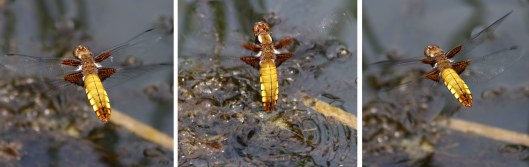
For this last day of National Insect Week 2016 we have one of my favourite types of insect, the dragonfly. Meet the Broad-bodied Chasers (or Libellula depressa to the scientifically minded). If we’re being politically correct, we won’t call them fat – they just happen to be a bit wider in the body than most other dragonflies. Both male and female start off a golden brown colour, but Mr B-B C soon develops a rather dapper layer of blue powdery granules (pruinescence) which matches perfectly with the yellow dots they both have along the sides of their abdomens.

160626 Broad-bodied chaser male

I’ve seen two pairs of Broad-bodied Chasers so far this year, both around small ponds which the males regularly patrol to ensure no intrusions into their territories. I’ve also been privileged to see them mating, a rather brief in-flight encounter, and then to see the female ovipositing – dipping her lower abdomen quickly into the water while in flight, to deposit her eggs into vegetation below the water level (as shown in the photos below). If you’re in southern England or Wales, these beauties will be around till September so go check out the show.

160626 Broad-bodied chaser female ovipositing

Like Loading...

The scorpion that doesn’t sting

25 Saturday Jun 2016

Posted by sconzani in insects, nature

≈ 7 Comments

Tags

National Insect Week, Panorpa communis, Panorpa species, scorpion fly

When is a scorpion not a scorpion? When it’s a fly, with a tail that looks like a scorpion – but only in the males and, even then, the sting can’t actually sting – it is, in fact, his genitals! This may be Panorpa communis but there are three species of scorpion fly in Britain and to distinguish between them you need to examine – you guessed it! – their genitals! (In the photos below, the male is on the left.)

160626 scorpion fly (3)
160626 scorpion fly (2)

While we’re on the subject of genitals, mating can be very risky for the male of the species, as females have been known to kill their mates. To divert the females, it seems the males have a trick up their sleeves under their wings – to woo the fly of their dreams, they offer up a gift of their own saliva which, apparently, works a treat.

160626 scorpion fly (1)

Lurking in hedgerows and woodlands, and particularly partial to nettle-filled areas, scorpion flies feed on dead insects. They are also known as hanging flies, from their habit of camouflaging themselves by dangling from leaves and twigs in order to pounce on the small unsuspecting critters that pass by. They are truly bizarre-looking creatures but completely harmless and rather comical to watch.

Like Loading...

The Gonzo of insect land

23 Thursday Jun 2016

Posted by sconzani in insects, nature

≈ 6 Comments

Tags

National Insect Week, Nettle weevil, Phyllobius pomaceus, weevil

Although The Muppets appeared after my childhood years, I’m still familiar with the main characters and one of my favourites has always been Gonzo. Perhaps that’s why I also love the Gonzos of the insect world, the weevils. And it’s not just their elongated snouts that remind me of him. Although weevils don’t have Gonzo’s energy, they do seem inclined towards occasional death-defying acts, teetering recklessly on the edges of leaves while reaching out for their next foothold, though they draw the line at catching cannonballs!

160623 nettle weevils (1)
160623 nettle weevils (2)
160623 nettle weevils (3)

Weevils can be difficult to identify but, as the ones pictured here were all found on nettles, I’m going to hazard a guess that they’re Nettle weevils (Phyllobius pomaceus). Being slightly more scientific, I think I can see the prominent tooth on the front femur of some of these creatures, which also helps to identify them, as does the position of their antennas on their heads. As you can see, the Neetle weevil is covered in blue-green scales that have a metallic sheen, though these can rub off as they age – and engage in death-defying (and other!) acts – so, older specimens do sometimes look more black than blue-green.

160623 nettle weevils (4)
160623 nettle weevils (5)
160623 nettle weevils (6)


Like Loading...

The rugby player of the insect world

21 Tuesday Jun 2016

Posted by sconzani in insects, nature

≈ 10 Comments

Tags

Fat-legged flower beetle, National Insect Week, Oedemera nobilis, Swollen-thighed beetle, Thick-legged beetle

160621 swollen-thighed beetle (1)

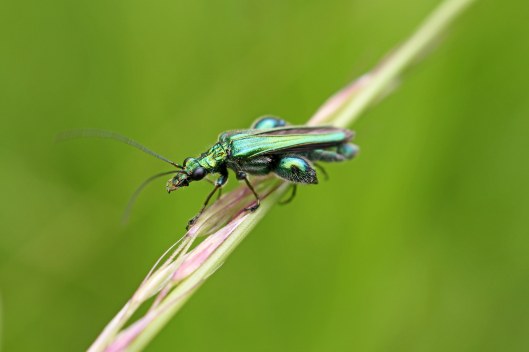
If you thought rugby players had well-developed thighs, take a look at this guy. He must work out at the gym every day of his life. Meet Oedemera nobilis, otherwise known as the Swollen-thighed beetle or, sometimes, the Thick-legged or Fat-legged flower beetle. Once seen, never forgotten … unless you see the female, whose shapely pins are nothing like the male’s.

160621 swollen-thighed beetle (2)

They’re a wonderfully vibrant green, often with a tinge of blue or gold in their metallic sheen, and they’re particularly abundant at this time of year. Though they feed on the nectar and pollen of a wide range of flower species, I’ve often found them immersing themselves in dandelion flowers, to emerge sprinkled in yellow pollen.

Like Loading...

About me

sconzani

sconzani

I'm a writer and photographer; researcher and blogger; birder and nature lover; countryside rambler and city strider; volunteer and biodiversity recorder.

View Full Profile →

Follow earthstar on WordPress.com

Enter your email address to follow this blog and receive notifications of new posts by email.

Recent blog posts

  • N is for nest December 19, 2025
  • M is for mite December 18, 2025
  • L is for lepidopteran lifers December 17, 2025
  • K is for Keeled skimmers December 16, 2025
  • J is for Jersey tiger December 15, 2025

From the archives

COPYRIGHT

Unless otherwise acknowledged, the text and photographs on this blog are my own and are subject to international copyright. Nothing may be downloaded or copied without my permission.

Fellow Earth Stars!

  • Unknown's avatar
  • Unknown's avatar
  • Unknown's avatar
  • Unknown's avatar
  • Unknown's avatar
  • Unknown's avatar
  • Unknown's avatar
  • Unknown's avatar
  • Unknown's avatar
  • Unknown's avatar
  • Unknown's avatar
  • Unknown's avatar
  • Unknown's avatar
  • Unknown's avatar
  • Unknown's avatar
  • Unknown's avatar
  • Unknown's avatar
  • Unknown's avatar
  • Unknown's avatar
  • Unknown's avatar
  • Unknown's avatar
  • Unknown's avatar
  • Unknown's avatar
  • Unknown's avatar
  • Unknown's avatar
  • Unknown's avatar
  • Unknown's avatar
  • Unknown's avatar
  • Unknown's avatar
  • Unknown's avatar
  • Unknown's avatar
  • Unknown's avatar
  • Unknown's avatar
  • Unknown's avatar
  • Unknown's avatar
  • Unknown's avatar
  • Unknown's avatar
  • Unknown's avatar
  • Unknown's avatar
  • Unknown's avatar
  • Unknown's avatar
  • Unknown's avatar
  • Unknown's avatar
  • Unknown's avatar
  • Unknown's avatar
  • Unknown's avatar
  • Unknown's avatar
  • Unknown's avatar
  • Unknown's avatar
  • Unknown's avatar

Blog at WordPress.com.

Privacy & Cookies: This site uses cookies. By continuing to use this website, you agree to their use.
To find out more, including how to control cookies, see here: Cookie Policy
  • Subscribe Subscribed
    • earthstar
    • Join 667 other subscribers
    • Already have a WordPress.com account? Log in now.
    • earthstar
    • Subscribe Subscribed
    • Sign up
    • Log in
    • Report this content
    • View site in Reader
    • Manage subscriptions
    • Collapse this bar
 

Loading Comments...
 

You must be logged in to post a comment.

    %d