• ABOUT
  • BIRDING 2018
  • Birding 2019
  • BLOG POSTS
  • Butterflies 2018
  • Resources

earthstar

~ a celebration of nature

earthstar

Tag Archives: Pedunculate Oak

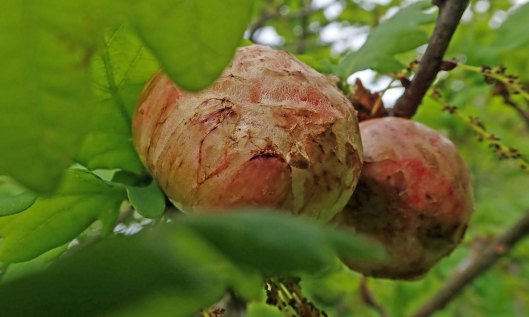
155/365 A good crop of apples

04 Tuesday Jun 2019

Posted by sconzani in 365DaysWildin2019, insects, nature, trees

≈ 2 Comments

Tags

Biorhiza pallida, gall wasps, galls, galls on oak trees, Oak apples, oak galls, Pedunculate Oak

190604 oak apples (1)

But you wouldn’t want to eat them! These are oak apples, the incredible creations of the larvae of the wasp Biorhiza pallida. By a magical process of chemical interaction, the larvae force the buds of the Pedunculate Oak to change and produce these galls, which the larvae call home until they’re ready to develop into their next stage of life.

190604 oak apples (2)
190604 oak apples (3)

A couple of the young oak trees in some fields near where I live are proving particularly attractive to these wasps so they have a bounty of apples growing on them this year. Yet another of Nature’s miracles!

190604 oak apples (4)

Like Loading...

Oak galls: knoppers and artichokes

23 Wednesday Aug 2017

Posted by sconzani in insects, nature, trees

≈ 4 Comments

Tags

Andricus foecundatrix, Andriscus quercuscalicis, Artichoke gall, galls caused by wasps, galls on oak trees, Knopper gall, oak galls, Oak hop gall, oak tree, Pedunculate Oak, Quercus petraea, Quercus robur, Sessile oak

Following quickly on from yesterday’s oak galls, part 1, we have oak attack, part 2, a sorry tale of knoppers and artichokes – and, no, you can’t eat them!

170823 Andricus quercuscalicis Oak knopper gall (2)
170823 Andricus quercuscalicis Oak knopper gall (1)

First the knoppers, which are caused by Andriscus quercuscalicis, a wasp with chemical weapons. The wasp lays its eggs in buds on oak trees and the larvae, when they hatch, secrete a chemical that causes the developing acorn to distort into a knobbly lump, thus forming a home for themselves. The galls are structurally interesting but not so good for the oak tree, as the acorn is no longer a viable seed for the tree and I presume the knopper gall also makes the acorn unsuitable as food for wildlife as well. Apparently, this wasp only arrived in Britain in the 1960s but its spread has been rapid, with the galls now found throughout Wales and England and in southern Scotland, though only on the Pedunculate oak (Quercus robur).

170823 Andricus foecundatrix Oak artichoke gall (1)
170823 Andricus foecundatrix Oak artichoke gall (2)
170823 Andricus foecundatrix Oak artichoke gall (3)

Artichoke galls – also known as hop galls due to their resemblance to flower of the hop plant – are also the result of chemical distortion by a wasp. This time it’s Andricus foecundatrix that does the damage. Using its sharp ovipositor, it lays its eggs in the leaf buds of both the Pedunculate oak and the Sessile oak (Quercus petraea). Like yesterday’s Spangle-causing wasp, Andricus foecundatrix also has both a sexual and an asexual generation. The asexual wasp hatches from her artichoke home in the springtime and lays her eggs in oak catkins, causing a small oval-shaped gall to develop – I don’t yet have any photos of these galls but you can see images here.

Like Loading...

‘Dedicated Naturalist’: Sessile or pedunculate?

03 Saturday Sep 2016

Posted by sconzani in 'Dedicated Naturalist' Project, nature, trees

≈ 2 Comments

Tags

Dr Mary Gillham, Durmast oak, Lowland oak, Mary Gillham Archive Project, Pedunculate Oak, Quercus pedunculata, Quercus petraea, Quercus robur, Quercus sessiliflora, Sessile oak, Upland oak, volunteering

A snippet from my volunteer work on the ‘Dedicated Naturalist’ Project, helping to decipher and digitise, record and publicise the life’s work of naturalist extraordinaire, Dr Mary Gillham. This is an extract from a piece called ‘The British Oak’, written for the Cardiff Naturalists’ Society newsletter, September 1991.

Oak is Britain’s national tree. Hearts of oak were our ships and an oak tree appears on the head of the Cardiff Naturalists’ Society notepaper. Yet how many of us can tell the two native British oaks apart – or even realise that there are two? …

We have the Lowland Oak, [in Wales] predominantly in the Vale of Glamorgan, and the Upland Oak, predominantly on the Coalfield hills. If you live along the South Border Ridges backing Cardiff – Pentyrch or thereabouts – you will have both, and also a wide range of hybrids between, so you may be excused a certain degree of confusion.

160903 Oak painting Mary Gillham

Mary Gillham’s 1962 watercolour of a hybrid oak

The Lowland or Pedunculate Oak has stalked acorns and unstalked leaves [as in my photo, left below]. (A peduncle is a flower of fruit talk and the name applies to these.) The ‘proper’ name was formerly a neatly descriptive Quercus pedunculata until some egg-headed boffin decided to change it to Quercus robur, which seems to mean very little.

The Upland, Durmast or Sessile Oak has stalkless acorns, sessile, or sitting directly on the woody twig, and stalks to the leaves, which taper to the base instead of terminating in two ear flaps [as in Mary’s photo, below right]. The ‘proper’ name of this was Quercus sessiliflora until (probably the same) taxonomist changed it to a meaningless Quercus petraea.

160903 Oak pedunculate
160903 Oak sessile Mary Gillham photo

These scientists do so like to make things difficult for us. Well, yes, so does Mother Nature. I, too, live on the Border Ridges, so my oaks have stalks to both acorns and leaves. That’s the sort of thing which happens with all this indiscriminate sexual intercourse!

For the full story about the Mary Gillham Archive Project, check out our website, https://marygillhamarchiveproject.wordpress.com/  and follow our progress on Facebook and on Twitter.

Like Loading...

About me

sconzani

sconzani

I'm a writer and photographer; researcher and blogger; birder and nature lover; countryside rambler and city strider; volunteer and biodiversity recorder.

View Full Profile →

Follow earthstar on WordPress.com

Enter your email address to follow this blog and receive notifications of new posts by email.

Recent blog posts

  • M is for mite December 18, 2025
  • L is for lepidopteran lifers December 17, 2025
  • K is for Keeled skimmers December 16, 2025
  • J is for Jersey tiger December 15, 2025
  • I is for Ichneumon December 14, 2025

From the archives

COPYRIGHT

Unless otherwise acknowledged, the text and photographs on this blog are my own and are subject to international copyright. Nothing may be downloaded or copied without my permission.

Fellow Earth Stars!

  • Unknown's avatar
  • Unknown's avatar
  • Unknown's avatar
  • Unknown's avatar
  • Unknown's avatar
  • Unknown's avatar
  • Unknown's avatar
  • Unknown's avatar
  • Unknown's avatar
  • Unknown's avatar
  • Unknown's avatar
  • Unknown's avatar
  • Unknown's avatar
  • Unknown's avatar
  • Unknown's avatar
  • Unknown's avatar
  • Unknown's avatar
  • Unknown's avatar
  • Unknown's avatar
  • Unknown's avatar
  • Unknown's avatar
  • Unknown's avatar
  • Unknown's avatar
  • Unknown's avatar
  • Unknown's avatar
  • Unknown's avatar
  • Unknown's avatar
  • Unknown's avatar
  • Unknown's avatar
  • Unknown's avatar
  • Unknown's avatar
  • Unknown's avatar
  • Unknown's avatar
  • Unknown's avatar
  • Unknown's avatar
  • Unknown's avatar
  • Unknown's avatar
  • Unknown's avatar
  • Unknown's avatar
  • Unknown's avatar
  • Unknown's avatar
  • Unknown's avatar
  • Unknown's avatar
  • Unknown's avatar
  • Unknown's avatar
  • Unknown's avatar
  • Unknown's avatar
  • Unknown's avatar
  • Unknown's avatar
  • Unknown's avatar

Blog at WordPress.com.

Privacy & Cookies: This site uses cookies. By continuing to use this website, you agree to their use.
To find out more, including how to control cookies, see here: Cookie Policy
  • Subscribe Subscribed
    • earthstar
    • Join 667 other subscribers
    • Already have a WordPress.com account? Log in now.
    • earthstar
    • Subscribe Subscribed
    • Sign up
    • Log in
    • Report this content
    • View site in Reader
    • Manage subscriptions
    • Collapse this bar
 

Loading Comments...
 

You must be logged in to post a comment.

    %d