• ABOUT
  • BIRDING 2018
  • Birding 2019
  • BLOG POSTS
  • Butterflies 2018
  • Resources

earthstar

~ a celebration of nature

earthstar

Tag Archives: Polygonia c-album

265/366 Hutchinsoni

21 Monday Sep 2020

Posted by sconzani in insects

≈ 2 Comments

Tags

British butterflies, butterfly, Comma, Comma variation hutchinsoni, Polygonia c-album, Polygonia c-album var. hutchinsoni

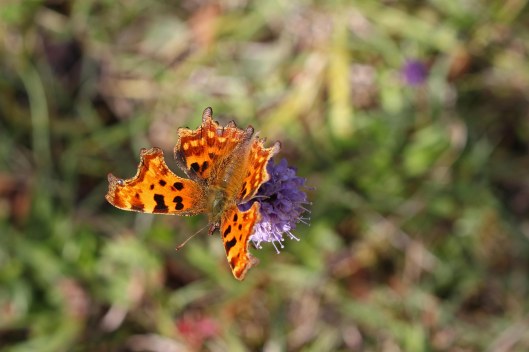
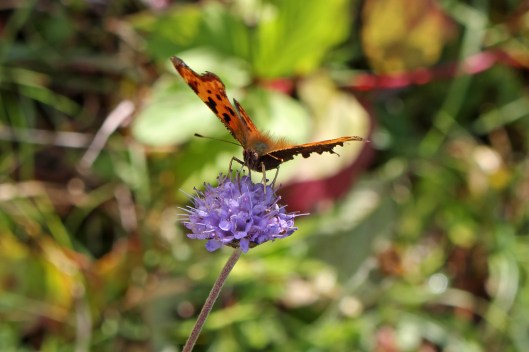
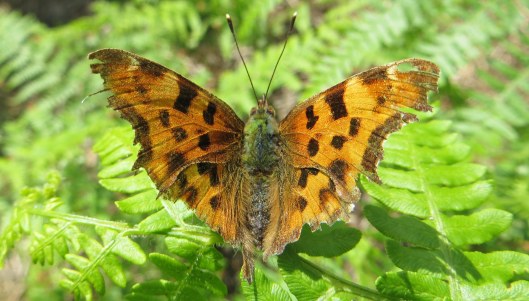
If you happen to see a Comma butterfly on one of our fine autumnal days, have a good look at the colour of its wings. You may notice that both the upper and the undersides of its wings are quite dark, particularly when compared to some of the Commas you saw in the summer months. Why is that?

200921 comma (1)
200921 comma (2)

It may be that your paler summertime Comma was a hutchinsoni. The splendid Life Cycles of British & Irish Butterflies explains:

The Comma is known for a particular form named hutchinsoni that is much paler in appearance on both upperside and underside that the nominate form. This form is found throughout the butterfly’s range and is normally attributed to individuals that go on to produce a second brood in the same year. Its name is a tribute to Emma Hutchinson, a renowned Victorian entomologist … who ultimately discovered its double-brooded nature and the corresponding variation between broods. The name was announced by J.E. Robson in 1881 in The Young Naturalist: ‘The Summer form is so different, and so constant in its appearance, that it ought to have a distinctive name, and we suggest it be called var. Hutchinsoni, in compliment to the lady … whose knowledge of the species is not exceeded by that of any one living.’

200921 comma (3)
200921 comma (4)

In my photos, the Comma on the left, Polygonia c-album var. hutchinsoni, was photographed on 24 June, the Comma on the right on 17 September, both in the same location and on fine, sunny days. I think you can see how marked the difference in their colouring is.

Like Loading...

184/366 Eggs-citing!

02 Thursday Jul 2020

Posted by sconzani in insects, nature

≈ 2 Comments

Tags

British butterflies, butterflies, butterfly egg, Comma, Comma butterfly, Comma egg, Polygonia c-album

Though I set off on yesterday’s walk clad in a rain jacket, the first day of July brightened up and turned into a day full of butterflies, with sightings of my first Gatekeepers of the year, a couple of second-brood Holly blues and more than 20 second-brood Small whites, as well as seven other species. But the highlight for me was watching two Commas egg-laying on nettles, and then taking a look at their tiny eggs, which I’d not seen previously.

200702 commas egglaying (1)

The butterflies were fluttering around, checking out nettle plants growing alongside the footpath I was walking and, when they found a plant to their liking, they would alight briefly on a leaf, lay a single egg, then flutter off again.

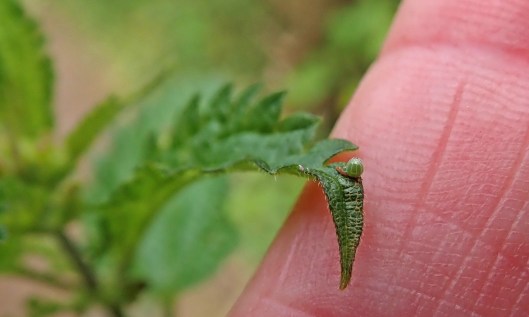
At less than 1mm tall, these eggs are tiny, and I would never have spotted them unless I’d seen them being laid. They’re pale green in colour, with 10 or 11 white ribs running vertically up the sides.

Comma egg one
Comma egg one
Comma egg two
Comma egg two

According to Peter Eeles’s Life Cycles of British & Irish Butterflies, each female Comma will lay about 250 eggs, usually on the upper side of a leaf, in a sheltered, sunny position. The eggs will gradually change colour to yellow and, in two or three weeks, to grey, before the little caterpillars hatch. Eggs-citing!

200702 commas egglaying (5)

Comma showing the distinctive marking that gave it its name

Like Loading...

Shaped like a fallen leaf

19 Tuesday Sep 2017

Posted by sconzani in insects, nature

≈ 5 Comments

Tags

British butterflies, butterflies, butterflies that hibernate, butterfly, Comma, Comma butterfly, Polygonia c-album

170919 Comma (1)

In Fauna Britannica, Stefan Buczacki describes this butterfly’s ragged outline as being the ‘shape of a fallen leaf’ and its colours, too, are quite autumnal. This is the most grammatically correct of Britain’s butterflies, the Comma, Polygonia c-album.

170919 Comma (2)170919 Comma (3)

Though I have no personal experience of this, the Comma is, apparently, one of the three butterflies most likely to be found hibernating in sheds and outhouses – the other two are the Small tortoiseshell and the Peacock. Adult Commas can usually be seen flying between March and September so maybe these ones I’ve seen recently were having their last feeds before looking for a cosy spot to snooze away the cold months of winter. If I had a shed, they’d be most welcome.

170919 Comma (4)

Like Loading...

It’s a Comma!

11 Monday Jul 2016

Posted by sconzani in insects, nature

≈ 8 Comments

Tags

butterfly, Comma, Comma butterfly, Comma butterfly pupa, Polygonia c-album, pupa

I’d seen the stunning Comma butterfly (Polygonia c-album) before, when I lived in Cheshire for 6 months, but this was my first in Wales and the first for 2016. And, surprisingly for a butterfly that can be quite skittish, it was very amenable to photography, fluttering off and coming back to a nearby leaf and changing its pose so I could get a variety of shots – a born model!

160711 Comma (1)

Named for the small white comma-shaped mark on the underside of its wings, the Comma is a resilient species. The main food plant for its caterpillars used to be the hops used in brewing beer so the butterfly’s numbers dwindled perilously when hop farming declined in the 1800s. For some reason, the Comma has changed its larval food plant to the Common nettle so, since the 1960s, both its numbers and the extent of its range have increased dramatically. It’s a born survivor!

160711 Comma (2)
160711 Comma (3)

You can just see the little white comma on the underwide of the wing in the photo above left. On the right is the pupa – a beautifully textured structure, with small silver highlights. And below is a rather battered-looking older specimen, seen when I lived in Cheshire.

160711 Comma (4)

Like Loading...

About me

sconzani

sconzani

I'm a writer and photographer; researcher and blogger; birder and nature lover; countryside rambler and city strider; volunteer and biodiversity recorder.

View Full Profile →

Follow earthstar on WordPress.com

Enter your email address to follow this blog and receive notifications of new posts by email.

Recent blog posts

  • P is for Phalarope December 21, 2025
  • O is for Odonata December 20, 2025
  • N is for nest December 19, 2025
  • M is for mite December 18, 2025
  • L is for lepidopteran lifers December 17, 2025

From the archives

COPYRIGHT

Unless otherwise acknowledged, the text and photographs on this blog are my own and are subject to international copyright. Nothing may be downloaded or copied without my permission.

Fellow Earth Stars!

  • Unknown's avatar
  • Unknown's avatar
  • Unknown's avatar
  • Unknown's avatar
  • Unknown's avatar
  • Unknown's avatar
  • Unknown's avatar
  • Unknown's avatar
  • Unknown's avatar
  • Unknown's avatar
  • Unknown's avatar
  • Unknown's avatar
  • Unknown's avatar
  • Unknown's avatar
  • Unknown's avatar
  • Unknown's avatar
  • Unknown's avatar
  • Unknown's avatar
  • Unknown's avatar
  • Unknown's avatar
  • Unknown's avatar
  • Unknown's avatar
  • Unknown's avatar
  • Unknown's avatar
  • Unknown's avatar
  • Unknown's avatar
  • Unknown's avatar
  • Unknown's avatar
  • Unknown's avatar
  • Unknown's avatar
  • Unknown's avatar
  • Unknown's avatar
  • Unknown's avatar
  • Unknown's avatar
  • Unknown's avatar
  • Unknown's avatar
  • Unknown's avatar
  • Unknown's avatar
  • Unknown's avatar
  • Unknown's avatar
  • Unknown's avatar
  • Unknown's avatar
  • Unknown's avatar
  • Unknown's avatar
  • Unknown's avatar
  • Unknown's avatar
  • Unknown's avatar
  • Unknown's avatar
  • Unknown's avatar
  • Unknown's avatar

Blog at WordPress.com.

Privacy & Cookies: This site uses cookies. By continuing to use this website, you agree to their use.
To find out more, including how to control cookies, see here: Cookie Policy
  • Subscribe Subscribed
    • earthstar
    • Join 667 other subscribers
    • Already have a WordPress.com account? Log in now.
    • earthstar
    • Subscribe Subscribed
    • Sign up
    • Log in
    • Report this content
    • View site in Reader
    • Manage subscriptions
    • Collapse this bar
 

Loading Comments...
 

You must be logged in to post a comment.

    %d