• ABOUT
  • BIRDING 2018
  • Birding 2019
  • BLOG POSTS
  • Butterflies 2018
  • Resources

earthstar

~ a celebration of nature

earthstar

Tag Archives: RSPB Radipole

A confusion of Comfreys

10 Sunday Aug 2025

Posted by sconzani in flowers, wildflowers

≈ Leave a comment

Tags

British wildflowers, Comfrey, Comfrey as healing plant, herbal medicine, RSPB Radipole, Symphytum species, Wildflowers at RSPB Radipole

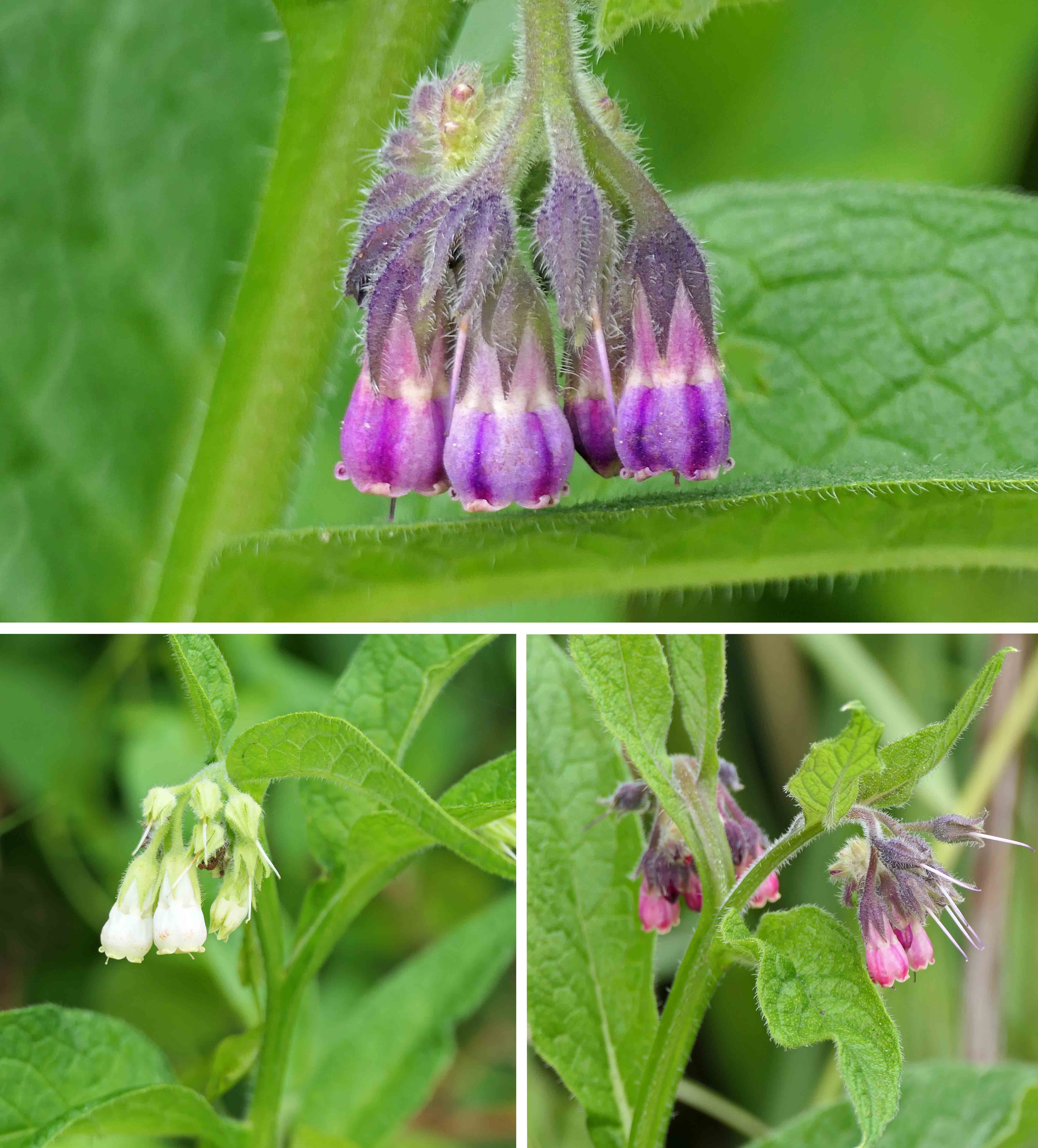
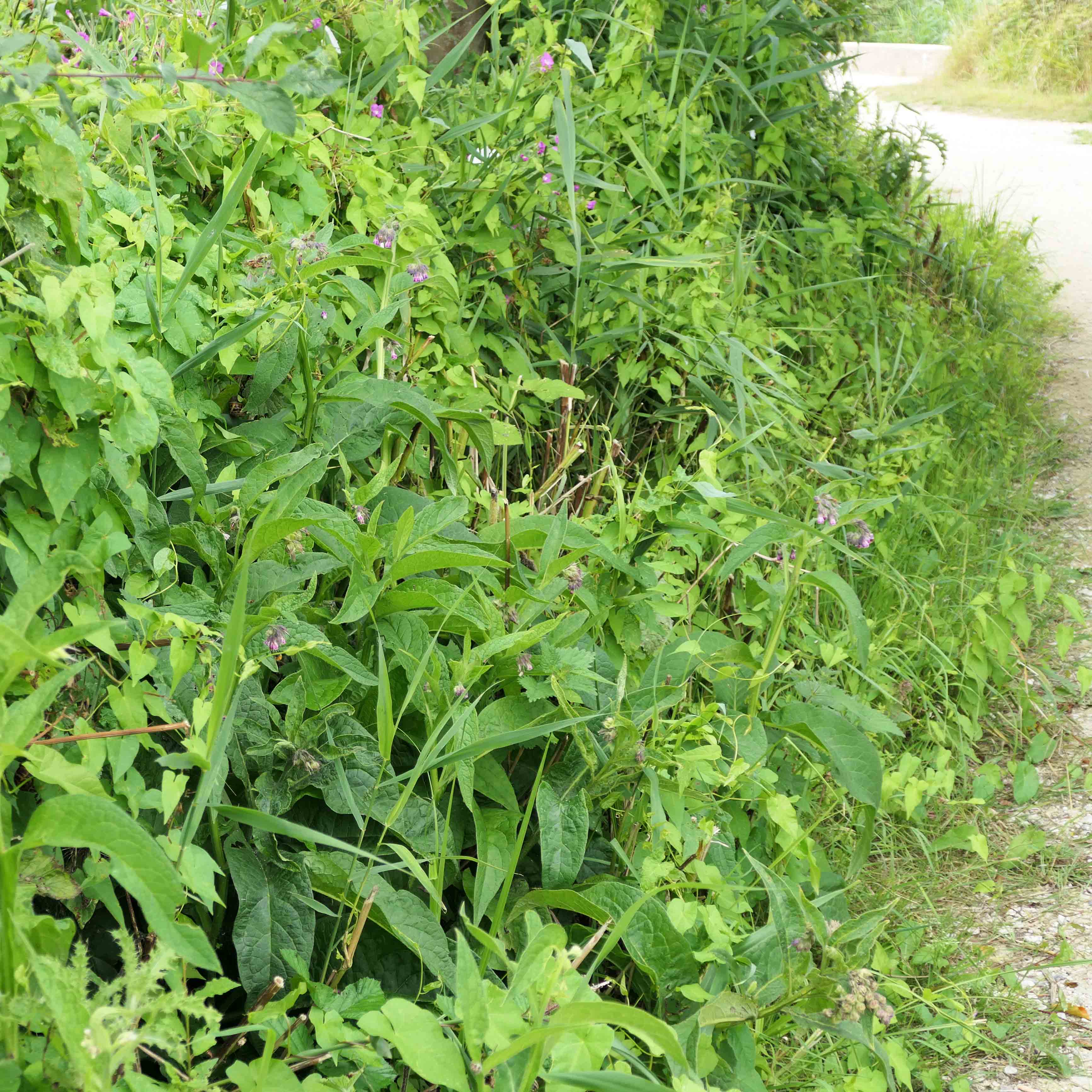
In Flora Britannica, author Richard Mabey explains that Common comfrey (Symphytum officinale) hybridises freely with Russian comfrey (S. x uplandicum) and Rough comfrey (S. asperum), so I make no apology for not being able to be precise about today’s wildflower species. To further confuse the picture, White comfrey (S. orientale), an introduction from west Russia and Turkey, has become naturalised, and is commonly found in hedgerows and on waste ground in southern England. The combination of species certainly provides a wonderful mix of white, blues, lilacs and purples in the Comfrey flowers, which I noticed the bumblebees were particularly enjoying (the flower nectar, not the colours).

The Comfrey plants shown here was at RSPB Radipole in Weymouth, thriving in the reserve’s damp environment, growing beside the footpaths and along the edges of the reed beds.

You probably know that Comfrey is very commonly used in herbal medicine, especially in connection with healing open wounds, broken bones and severe bruising, hence its common names of Knitbone and Nip-bone. It contains Allantoin, a substance that encourages the healing of connective tissue, and Flora Britannica lists many reports from contributors of poultices being used to heal severe cuts, ease the severely bruised knees of miners, and assist with the knitting of broken bones. One of my grandmothers always grew Comfrey in her garden and would drink an infusion of the leaves to ease her sore back and aching limbs, though Mabey warns that Comfrey contains alkaloids that can cause liver damage, so infusions and tablets are now discouraged.

Like Loading...

Radipole Reed warbler

09 Saturday Aug 2025

Posted by sconzani in birds

≈ Leave a comment

Tags

birding, birding at Radipole, birdwatching, British birds, juvenile Reed warbler, Reed warbler, RSPB Radipole

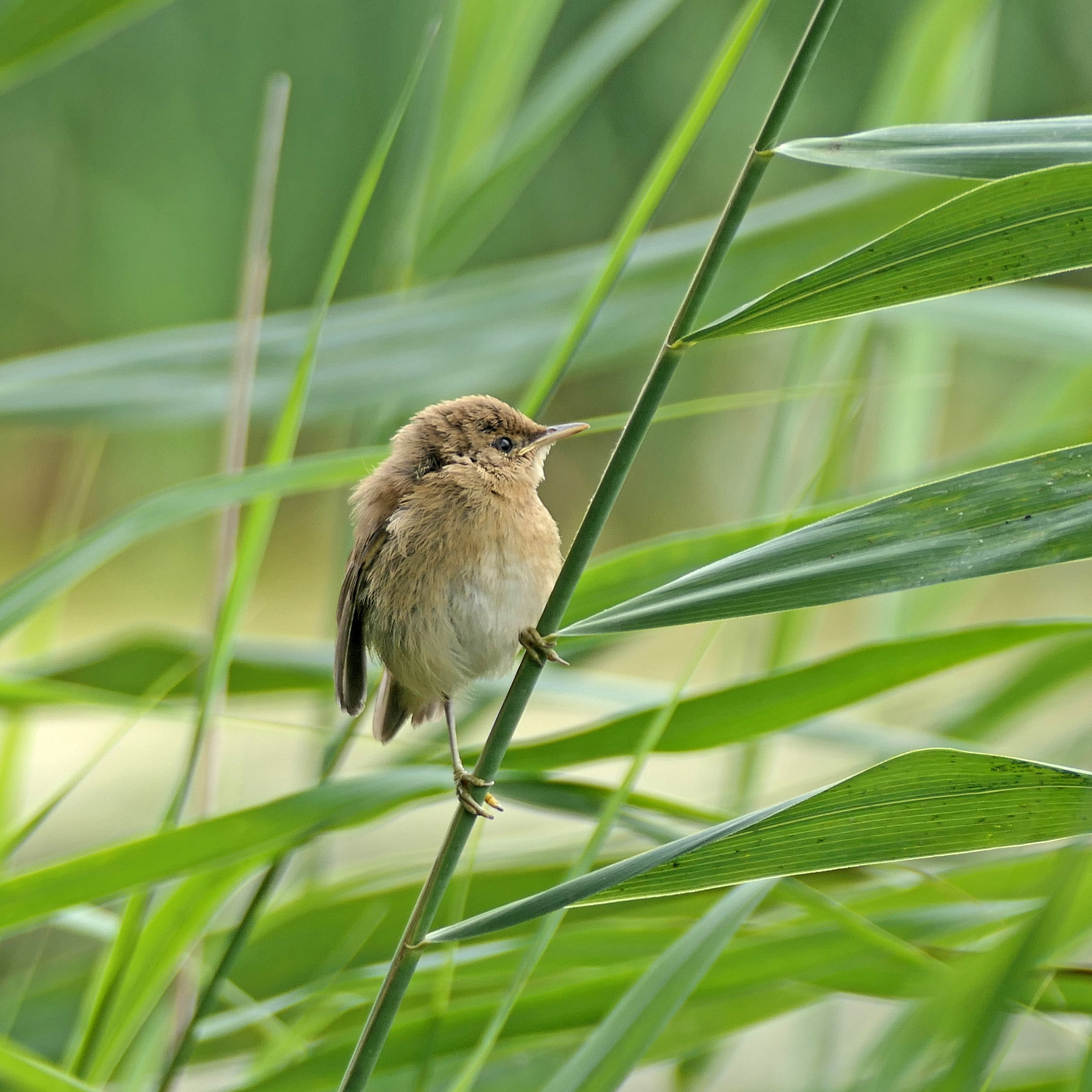
Though the vegetation had been cut back along the pathways so I didn’t get to do my ‘Jane of the Jungle’ impression, my visits to the RSPB Radipole reserve were a little disappointing during last week’s visit to Weymouth. Unlike my June visit, when I saw two dragonflies I’d never ever seen before (Lifer: Norfolk hawker and Lifer: Scarce chaser), this time I saw just one dragonfly and it didn’t stop for a photo. On the birding front, activity had also diminished, though I did enjoy watching a Sedge warbler searching for food and feeding its young, and the sounds of young birds either keeping in contact with their parents or following them through the trees and reed beds were a constant accompaniment to my walks. My best image came from one of those moments, when this juvenile Reed warbler paused momentarily right in front of me.

Like Loading...

Sedge warblers

20 Friday Jun 2025

Posted by sconzani in birds

≈ 2 Comments

Tags

birding, birding at Radipole, birdwatching, British birds, Radipole birds, RSPB Radipole, Sedge warbler

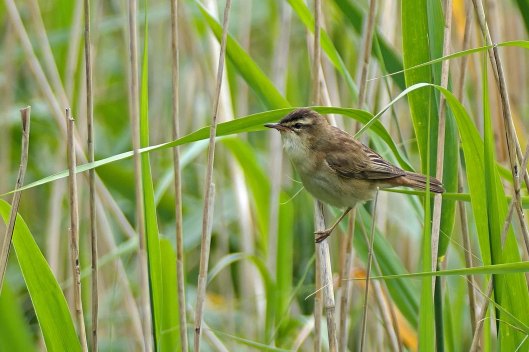
I don’t see Sedge warblers very often; if I’m lucky, I might see or, sometimes only hear, one or two as they pass through the local area during Spring and Autumn migration. That’s my excuse for not recognising these two birds, seen on two separate visits to RSPB Radipole in Weymouth. As I could hear Reed warblers singing all around me while I was exploring the reserve, which is jam-packed full of Reed beds, I just assumed these were also Reed warblers.

Wrong! The streaking of dark and light above the eyes is a sure sign of a Sedge warbler. My more expert birding friends think that the first bird, above, is an adult, though I’m not entirely convinced that it isn’t a well-grown youngster, as it was flapping its wings in the way juvenile birds do to get their parents to feed them.

The bird below is definitely a youngster; one of my friends pointed out that you can still see the gape, the yellow fleshy part at the base of its beak that is a characteristic of chicks. And it behaved like a chick: ‘My mum told me to stay right here until she got back so I’m not moving even though you’re coming along the path towards me, getting closer and closer with that black thing in front of your face, and I’m a little bit scared.’

After quickly grabbing a couple of photos, I moved past, then stopped further along the path and watched as one of its parents brought it food, and moved it to a different bush, a bit further away from the main path.

Like Loading...

Lifer: Scarce chaser

19 Thursday Jun 2025

Posted by sconzani in insects

≈ Leave a comment

Tags

Blue chaser, British chasers, British dragonflies, dragonflies at Radipole, dragonfly, Libellula fulva, RSPB Radipole, Scarce chaser

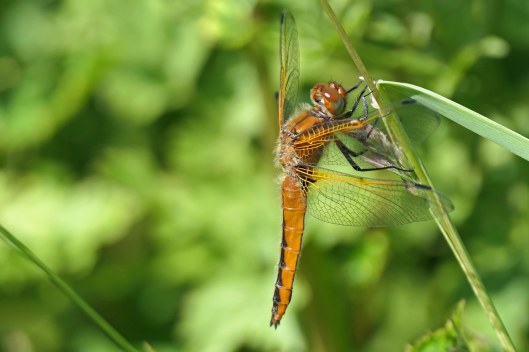
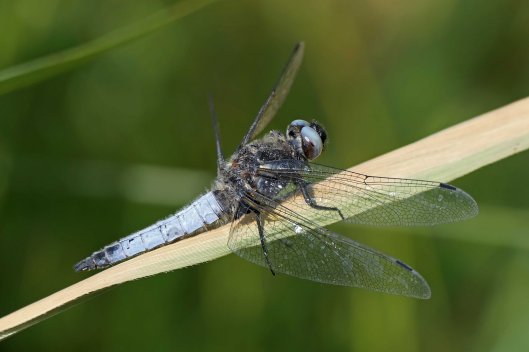
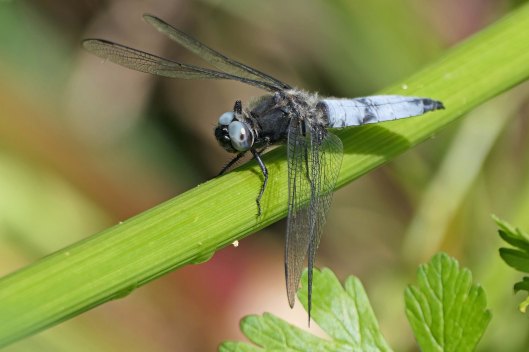
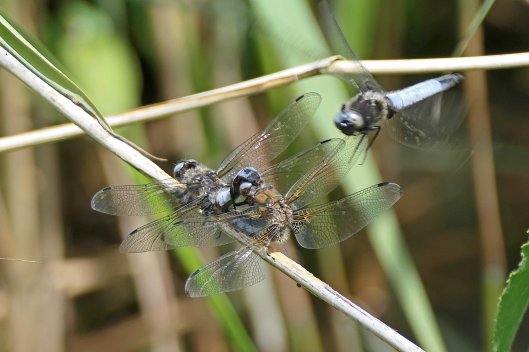
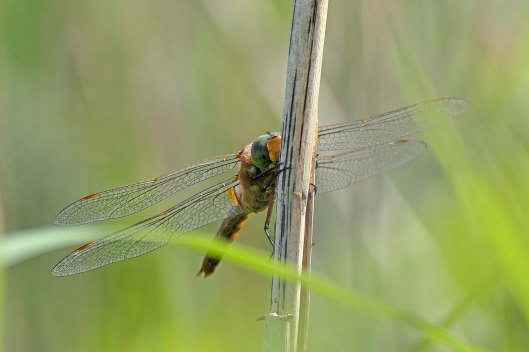
Here they are, the extremely confiding dragonflies mentioned in yesterday’s blog, the Scarce chasers (Libellula fulva) (also known as the Blue chaser). They were everything you could want in a photographer’s model, perching this way and that to show their best sides; not flying off at the slightest hint of movement behind the camera; the consummate professionals!

So, I managed to get photos of a male, female and the two together in cop. The female (above) is described in my guide book as having an olive-brown thorax and ochre-brown abdomen but, as you can see, she was much more vibrant than those descriptions suggest.

The males have a black thorax and blue abdomen with a dark tip. At a glance, with those colours, they could be mistaken for other dragonflies with similar colouration, until you see their eyes, which are the most amazing shade of blue. (In fact, I’ve just decided to add in a second photo of the male so you can get a better look at those eyes.)

I saw several of these dragons at RSPB Radipole Lakes in Weymouth, which left me wondering why they are called ‘Scarce’ chasers. It seems that, where they are found (in isolated spots in the east and south of England) their populations are relatively small, so they are officially designated as rare. Indeed, in the 2008 British Odonata Red List they were officially listed as ‘near threatened’, so I feel very privileged to have enjoyed such excellent views of these stunning creatures.

Like Loading...

Lifer: Norfolk hawker

18 Wednesday Jun 2025

Posted by sconzani in insects

≈ Leave a comment

Tags

Aeshna isoceles, British dragonflies, British hawkers, Dorset dragonflies, dragonflies at Radipole, dragonfly, hawker, Norfolk hawker, RSPB Radipole

My wildlife-watching hopes for my short break in Weymouth centred on butterflies and, perhaps, a few birds that I might not see locally, so it was a wonderful surprise to see two new dragonfly species, one extremely confiding (it’ll feature in tomorrow’s blog), one elusive to the point of frustration.

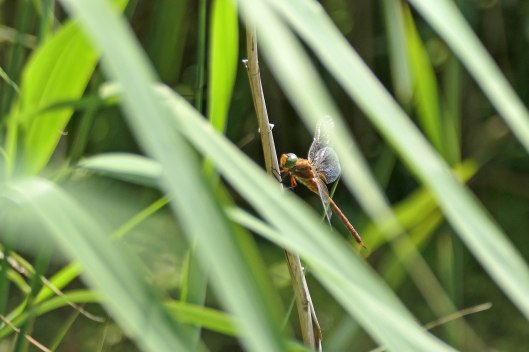
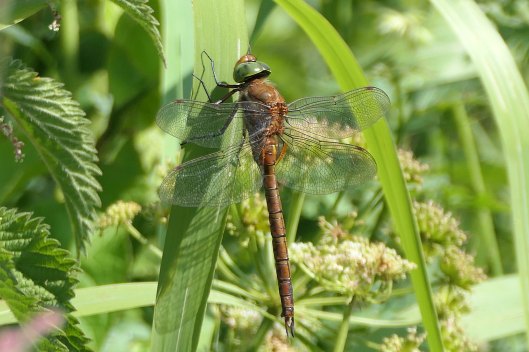
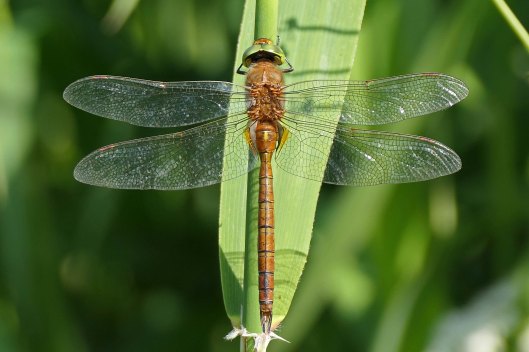
The Norfolk hawker (Aeshna isoceles) was the latter and, on my first visit to the RSPB Radipole reserve, the few times I spotted these dragonflies (easily recognisable by their brown colouring and green eyes), they stayed mostly hidden, perching – when they did actually stop flying – in obscure locations, as you can see from the photos above and below.

Finally, on my last afternoon, when there were fewer people out walking after a morning’s heavy rain and I was battling my way through the extremely overgrown vegetation along the path to the northern bird hide, one of these stunning dragons posed perfectly for me.

Although called Norfolk hawkers, these medium-sized dragonflies have been expanding their range beyond the English county of Norfolk. Their preference for reed beds in swamps and ponds, along streams and ditches, means Radipole provides the perfect location for them to thrive.

Like Loading...

274/365 Egrets and herons

01 Tuesday Oct 2019

Posted by sconzani in birds, nature

≈ 4 Comments

Tags

birding, birdwatching, British birds, Great white egret, Grey heron, Little egret, RSPB Lodmoor, RSPB Radipole

On the way to Portland last Friday our birding group stopped off at the RSPB’s Lodmoor Nature Reserve on the outskirts of Weymouth. It’s a wonderful environment for birds, with small lakes and large reedbeds, open saltmarshes and hedge-enclosed pathways, and it always turns up a good variety of birds.

191001 egrets

Now, I’ve only been in Britain four years so I don’t remember the ‘old days’ when twitchers would race across the country to see a Little egret or a Great white egret, but even I can see how much these birds have increased in number in a very short time.

191001 little egret (1)
191001 little egret (2)

At Lodmoor, there were several Little egrets (above) – I didn’t count the ones I did see, and I’m sure there were several lurking amongst the reeds that I couldn’t see and, amazingly, there were six (!) Great white egrets (below), for a time all congregated in one spot. Now, that was a sight to see.

191001 great white egret (1)
191001 great white egret (2)

I was also impressed by the large numbers of Grey herons, especially those at nearby RSPB Radipole, all lined up along the edge of the reeds, sheltering from the strong westerly winds.

191001 herons and little egret

Like Loading...

About me

sconzani

sconzani

I'm a writer and photographer; researcher and blogger; birder and nature lover; countryside rambler and city strider; volunteer and biodiversity recorder.

View Full Profile →

Follow earthstar on WordPress.com

Enter your email address to follow this blog and receive notifications of new posts by email.

Recent blog posts

  • Weevil: Mecinus pyraster January 10, 2026
  • Red in beak and claw January 9, 2026
  • Who’s watching who? January 8, 2026
  • Springtail: Orchesella cincta January 7, 2026
  • A good year for Redwings January 6, 2026

From the archives

COPYRIGHT

Unless otherwise acknowledged, the text and photographs on this blog are my own and are subject to international copyright. Nothing may be downloaded or copied without my permission.

Fellow Earth Stars!

  • Unknown's avatar
  • Unknown's avatar
  • Unknown's avatar
  • Unknown's avatar
  • Unknown's avatar
  • Unknown's avatar
  • Unknown's avatar
  • Unknown's avatar
  • Unknown's avatar
  • Unknown's avatar
  • Unknown's avatar
  • Unknown's avatar
  • Unknown's avatar
  • Unknown's avatar
  • Unknown's avatar
  • Unknown's avatar
  • Unknown's avatar
  • Unknown's avatar
  • Unknown's avatar
  • Unknown's avatar
  • Unknown's avatar
  • Unknown's avatar
  • Unknown's avatar
  • Unknown's avatar
  • Unknown's avatar
  • Unknown's avatar
  • Unknown's avatar
  • Unknown's avatar
  • Unknown's avatar
  • Unknown's avatar
  • Unknown's avatar
  • Unknown's avatar
  • Unknown's avatar
  • Unknown's avatar
  • Unknown's avatar
  • Unknown's avatar
  • Unknown's avatar
  • Unknown's avatar
  • Unknown's avatar
  • Unknown's avatar
  • Unknown's avatar
  • Unknown's avatar
  • Unknown's avatar
  • Unknown's avatar
  • Unknown's avatar
  • Unknown's avatar
  • Unknown's avatar
  • Unknown's avatar
  • Unknown's avatar
  • Unknown's avatar

Blog at WordPress.com.

Privacy & Cookies: This site uses cookies. By continuing to use this website, you agree to their use.
To find out more, including how to control cookies, see here: Cookie Policy
  • Subscribe Subscribed
    • earthstar
    • Join 669 other subscribers
    • Already have a WordPress.com account? Log in now.
    • earthstar
    • Subscribe Subscribed
    • Sign up
    • Log in
    • Report this content
    • View site in Reader
    • Manage subscriptions
    • Collapse this bar
 

Loading Comments...
 

You must be logged in to post a comment.

    %d