• ABOUT
  • BIRDING 2018
  • Birding 2019
  • BLOG POSTS
  • Butterflies 2018
  • Resources

earthstar

~ a celebration of nature

earthstar

Tag Archives: #WildWords

Wild word: aposematism

25 Wednesday Apr 2018

Posted by sconzani in insects, nature

≈ Leave a comment

Tags

#WildWords, aposematism, butterfly, Peacock, Peacock butterfly, warning coloration, warning patterns, wild words

Aposematism: noun; from the Greek ἀπό apo meaning ‘away’ and σῆμα sema meaning ‘sign’; a term developed in the 19th century, reputedly by Edward Bagnall Poulton (a British evolutionary biologist), for the bright colorations or conspicuous markings that creatures use to warn or repel predators. Typical examples are things like bright yellow frogs or orange-and-black-striped caterpillars, whose colours serve as a warning to potential predators that they taste bad or might even be poisonous, and, butterflies, like the Peacock shown here, with big bold eye-type markings that make them look larger than they really are.

180425 Aposematism Peacock butterfly

Like Loading...

Wild words: bud burst

18 Wednesday Apr 2018

Posted by sconzani in leaves, nature, spring, trees

≈ Leave a comment

Tags

#WildWords, bud burst, bud scales, new leaves, Spring has sprung, springtime, wild words

I love this little miracle that happens every spring, and I couldn’t resist having ‘bud burst’ as this week’s words after seeing many beautiful examples when I was out walking on Monday.

OLYMPUS DIGITAL CAMERA

During winter, deciduous trees look so bare and barren, yet, safely enclosed within the protective cases of their ‘bud scales’, tiny leaves are beginning to grow. Then, once temperatures start to warm up, the trees’ roots absorb more water and the sap begins to rise. The leaf buds grow and swell to the point when their scales just can’t contain them any more and then, one day …

OLYMPUS DIGITAL CAMERA

Shazam! The buds burst out and begin to expand and soak up the spring sunshine!

OLYMPUS DIGITAL CAMERA

Like Loading...

Wild words: nuptial plumage

11 Wednesday Apr 2018

Posted by sconzani in birds, nature

≈ 1 Comment

Tags

#WildWords, alternate plumage, birding, birdwatching, breeding plumage, British birds, nuptial plumage, Turnstone, wild words

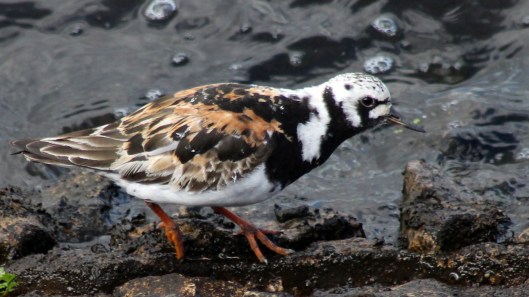
Nuptial plumage, also known as breeding plumage and alternate plumage, is the plumage assumed by adult birds prior to their annual breeding season. This plumage is generally more colourful than the bird’s usual plumage, presumably in order to attract the opposite sex. Birds achieve this change by moulting their feathers, before breeding into their nuptial ‘glad-rags’, and then afterwards, returning to their usual ‘day wear’.

180411a Turnstone in January

My photos show the change happening in the Turnstones I see so often in my local patch. The first photo (above), taken in January, shows the bird’s winter plumage. The following two photos, taken in March and April, show the moult in progress, and the final photo, taken in August, is after breeding has finished, when the bird is moulting from its nuptial plumage back to its winter, non-breeding plumage. To see these birds in their full nuptial plumage, I would have to head to their breeding grounds in Canada or Greenland, a tempting proposition but not affordable at this time!

180411b Turnstone in March180411c Turnstone in April180411d Turnstone in August

Like Loading...

Wild words: strobilus

04 Wednesday Apr 2018

Posted by sconzani in nature, plants

≈ Leave a comment

Tags

#WildWords, British flora, Equisetum arvense, Equisteum, Field horsetail, Horsetail, strobilus, wild words

Strobilus: noun; a botanical term, which came originally from the Greek strephein meaning ‘to twist’, and which is used to describe the cone of a pine, fir or other conifer; and also ‘a structure resembling the cone of a conifer, such as the flower of the hop’ (Oxford Dictionary).

180404 strobilus

I have the lovely Helen of Plantlife Cymru to thank for this word because, when I originally posted this photo on Twitter, she responded by saying that ‘the strobilus is ascending’. My photo shows the newly emerged stalks of Equisetum (possibly Field horsetail, Equisteum arvense), which is a dinosaur of the plant world, a plant that reproduces using spores rather than seeds. The spores are produced in the strobili, the cone-like structures you can see on the tips of the stems.

Like Loading...

Wild words: display

28 Wednesday Mar 2018

Posted by sconzani in birds, nature, spring

≈ 1 Comment

Tags

#WildWords, bird courtship display, bird displays, birding, birds displaying, birdwatching, British birds, Great Crested Grebe, wild words

Display: Verb; the Oxford Dictionary defines this as: ‘(of a male bird [though, from what I’ve seen, female birds also respond to and/or participate in displays], reptile, or fish) to engage in a specialized pattern of behaviour that is intended to attract a mate’. The word comes from the Anglo-French desplaier or desploier, meaning literally, ‘to unfold’.

180328 Great crested grebes displaying (1)

The birds section of the Stanford University website has a really thorough description of this behaviour, including a diagram of some of the display postures adopted by their Western Grebe. In Britain, the equivalent bird is the Great crested grebe, which also gets a mention and which has a particularly lovely display to watch, as you can see in these recent shots of local birds displaying.

180328 Great crested grebes displaying (2)180328 Great crested grebes displaying (3)

Like Loading...

Wild words: forest

21 Wednesday Mar 2018

Posted by sconzani in nature, trees

≈ Leave a comment

Tags

#WildWords, forests, International Forests Day, trees, wild words, woodland

Forest: noun; a large area covered chiefly with trees and undergrowth. The Oxford Dictionary says the word morphed from the Latin foris, meaning ‘outside’, to the late Latin forestis (silva), meaning ‘(wood) outside’, to Old French and thence to Middle English.

Today just happens to be a day to celebrate the importance of all types of forests and woodlands and trees all around the globe, so here’s wishing you a very happy International Forests Day!

180321 forest

Like Loading...

Wild words: Leucistic

14 Wednesday Mar 2018

Posted by sconzani in birds, nature

≈ 5 Comments

Tags

#WildWords, birding, birdwatching, blackbird, leucism, leucistic, leucistic blackbird, wild words

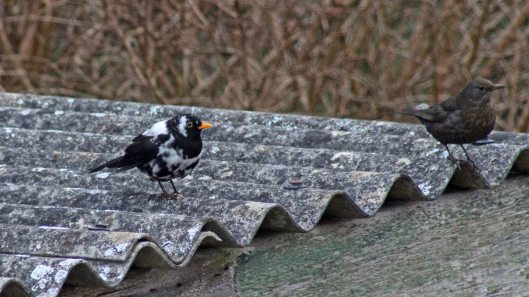
Leucistic: Adjective; (of an animal) [or other creature] having whitish fur, plumage, or skin due to a lack of pigment (Oxford Dictionary).

180314 leucistic blackbird (1)

It’s not easy being different as this leucistic black-and-white Blackbird seems to be discovering. I’ve spotted it several times in and around a neighbour’s backyard in recent days, usually sitting alone, looking a little bereft. Once it tried to approach first a male and then a female Blackbird, adopting the submissive posture a young bird would adopt to beg food from its parents, but the other birds totally rejected it and flew off.

180314 leucistic blackbird (2)
180314 leucistic blackbird (3)
180314 leucistic blackbird (4)

I’ve posted about leucistic birds before: a Crow here, and a Jackdaw was the star here.

Like Loading...

Wild words: preen

07 Wednesday Mar 2018

Posted by sconzani in birds, nature

≈ 2 Comments

Tags

#WildWords, birding, birdwatching, British birds, preen, preening, wild words

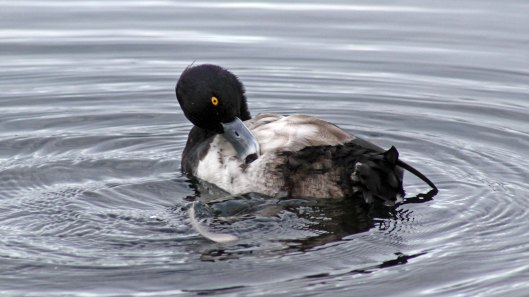
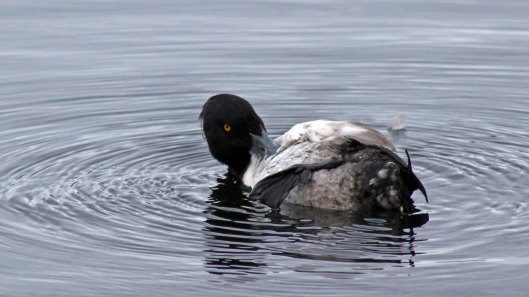
Preen: verb; (of birds) to maintain (feathers) in a healthy condition by arrangement, cleaning and other contact with the bill (Collins Concise Dictionary).
Interestingly, one dictionary said it also related to animals tidying and cleaning their fur with their tongue, but I’ve never heard the word used that way. Information as to the word’s origins varies according to which dictionary you consult – the Collins says it first appeared around the 14th century and probably comes from prunen, thence preinen, meaning to stab, pierce or prick, referring to the action of the bird’s bill when preening.

180307 preen (1)

Preening is an extremely important action for birds, to keep their feathers in the correct position for flight and for the preservation of body heat; to clear away dirt and parasites; to assist with the process of moulting; and, in those birds that have a uropygial gland, to maintain their waterproofing by spreading oil from the gland over and through their feathers.

180307 preen (2)180307 preen (3)

180307 preen (4)

‘Who’s preening?’

Like Loading...

Wild words: icicle

28 Wednesday Feb 2018

Posted by sconzani in nature, weather, winter

≈ 3 Comments

Tags

#WildWords, Cardiff Bay, Ely embankment, ice, icicle, ickel, winter chill

Icicle: noun; a hanging, tapering piece of ice formed by the freezing of dripping water (Oxford Dictionary). The word comes from the Old English word gicel, which morphed into ikyl or ikel, and later ickle, a word which is still used in parts of Yorkshire.

180228 icicle (1)

My photos were taken on the Ely embankment in Cardiff Bay yesterday, as Britain shivers its way through a blast of chilly Siberian air. The combination of freezing temperatures and the constant lapping of the water on to the branches that litter the shoreline resulted in some beautiful icicles.

180228 icicle (2)

Like Loading...

Wild words: chalk

21 Wednesday Feb 2018

Posted by sconzani in geology, nature, seaside

≈ Leave a comment

Tags

#WildWords, Birling Gap, chalk, chalk cliffs, Cuckmere Haven, limestone cliffs, Seven Sisters Country Park

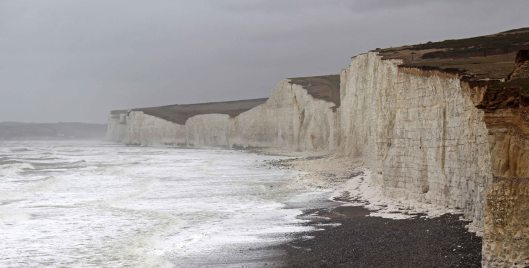
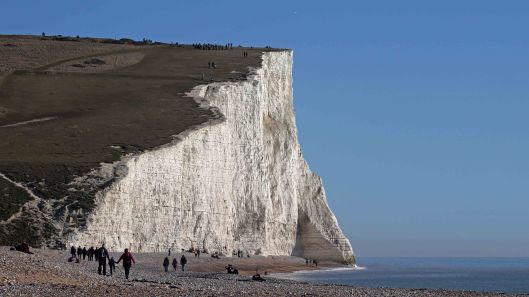
Chalk: noun; ‘a white soft earthy limestone (calcium carbonate) formed from the skeletal remains of sea creatures’, according to the Oxford Dictionary, though that seems a relatively simplistic explanation to me. I chose chalk as this week’s word as I was in East Sussex last week and had occasion twice to see the magnificent chalk cliffs known as the Seven Sisters, once at Birling Gap in a howling gale and again, at Cuckmere Haven, on a day that felt like summer had come early to southern England.

180221 chalk (1)

The Discovering Fossils website has this to say about the chalk at the Seven Sisters:

The Chalk at Seven Sisters belongs to the Upper Chalk, and was deposited during the Coniacian and Santonian stages of the Late Cretaceous epoch between 87-84 million years ago (mya). At this time Seven Sisters and much of Great Britain, along with Europe, lay beneath a relatively shallow sea around 40°N of the equator, on an equivalent latitude to the Mediterranean Sea today.

And you can read more about the fascinating process of chalk formation here.

180221 chalk (2)

Like Loading...
← Older posts
Newer posts →

About me

sconzani

sconzani

I'm a writer and photographer; researcher and blogger; birder and nature lover; countryside rambler and city strider; volunteer and biodiversity recorder.

View Full Profile →

Follow earthstar on WordPress.com

Enter your email address to follow this blog and receive notifications of new posts by email.

Recent blog posts

  • M is for mite December 18, 2025
  • L is for lepidopteran lifers December 17, 2025
  • K is for Keeled skimmers December 16, 2025
  • J is for Jersey tiger December 15, 2025
  • I is for Ichneumon December 14, 2025

From the archives

COPYRIGHT

Unless otherwise acknowledged, the text and photographs on this blog are my own and are subject to international copyright. Nothing may be downloaded or copied without my permission.

Fellow Earth Stars!

  • Unknown's avatar
  • Unknown's avatar
  • Unknown's avatar
  • Unknown's avatar
  • Unknown's avatar
  • Unknown's avatar
  • Unknown's avatar
  • Unknown's avatar
  • Unknown's avatar
  • Unknown's avatar
  • Unknown's avatar
  • Unknown's avatar
  • Unknown's avatar
  • Unknown's avatar
  • Unknown's avatar
  • Unknown's avatar
  • Unknown's avatar
  • Unknown's avatar
  • Unknown's avatar
  • Unknown's avatar
  • Unknown's avatar
  • Unknown's avatar
  • Unknown's avatar
  • Unknown's avatar
  • Unknown's avatar
  • Unknown's avatar
  • Unknown's avatar
  • Unknown's avatar
  • Unknown's avatar
  • Unknown's avatar
  • Unknown's avatar
  • Unknown's avatar
  • Unknown's avatar
  • Unknown's avatar
  • Unknown's avatar
  • Unknown's avatar
  • Unknown's avatar
  • Unknown's avatar
  • Unknown's avatar
  • Unknown's avatar
  • Unknown's avatar
  • Unknown's avatar
  • Unknown's avatar
  • Unknown's avatar
  • Unknown's avatar
  • Unknown's avatar
  • Unknown's avatar
  • Unknown's avatar
  • Unknown's avatar
  • Unknown's avatar

Blog at WordPress.com.

Privacy & Cookies: This site uses cookies. By continuing to use this website, you agree to their use.
To find out more, including how to control cookies, see here: Cookie Policy
  • Subscribe Subscribed
    • earthstar
    • Join 667 other subscribers
    • Already have a WordPress.com account? Log in now.
    • earthstar
    • Subscribe Subscribed
    • Sign up
    • Log in
    • Report this content
    • View site in Reader
    • Manage subscriptions
    • Collapse this bar
 

Loading Comments...
 

You must be logged in to post a comment.

    %d