
Tags
Exapion ulicis, gorse, Gorse weevil, insects on gorse, weevil, weevil as biological control, weevil introduced to New Zealand
It was lunchtime on our Glamorgan botany group walk and, rather than get a wet bum from sitting on the damp grass, I was eating my roll and cheese while poking around the flowers of a nearby gorse bush. I was looking for Gorse shieldbugs, of which I found not a sign, but I did find this tiny creature and, after a bit more poking, a couple of its friends.
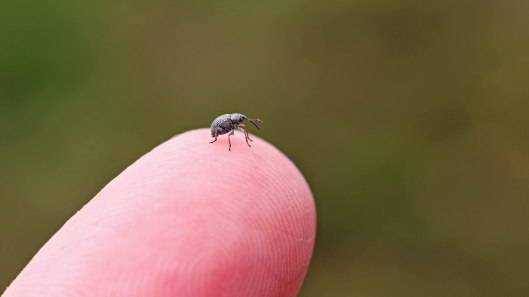
It’s a Gorse weevil (Exapion ulicis) and, as you can judge from its size relative to my finger, it’s tiny, only 2 to 3mm long. Its snout is (relatively) enormous, about half as long as its body, making it look like a cross between an elephant (without the ears) and a spider (those legs!). And that snout is its secret weapon – the weevil uses its snout to burrow into the stem and spines of the gorse bush to eat the soft tissue inside.

Apparently this little weevil was introduced to my homeland, New Zealand, back in 1931 in an effort to control the introduced (by British migrants as cheap hedging) gorse bushes that were thriving in New Zealand’s favourable climate. The weevil’s larvae live inside and eat gorse seeds, thus preventing the bushes from reproducing. The little gorse weevil has done its job well but it seems the scientists hadn’t banked on the fact that the weevil larvae only eat gorse seeds in the springtime and the gorse also flowers and seeds in the autumn.

 earthstar
Someone didn’t do their homework thoroughly enough.
LikeLiked by 1 person
Indeed! Word is they’ve now introduced a moth whose larvae will also eat the seeds. I wonder though what it and the weevil will eat once the gorse starts to die off.
LikeLiked by 1 person
Gorse is pretty tough. It takes some killing. We have a sloping field where gorse grows and it takes a lot to control it.
LikeLiked by 1 person
I didn’t realise it was a problem here – it certainly is in NZ.
LikeLiked by 1 person
I love a long snouted weevil, as you know Annie
LikeLiked by 1 person
Indeed I do know! 🙂
LikeLike