• ABOUT
  • BIRDING 2018
  • Birding 2019
  • BLOG POSTS
  • Butterflies 2018
  • Resources

earthstar

~ a celebration of nature

earthstar

Monthly Archives: August 2017

Bird’s-nests with eggs!

31 Thursday Aug 2017

Posted by sconzani in fungi, nature

≈ 4 Comments

Tags

bird's nest fungus, British fungi, Common bird's-nest fungus, Crucibulum laeve, fungus, peridiole

How cool are these?
170831 Common bird's-nest fungus (1)

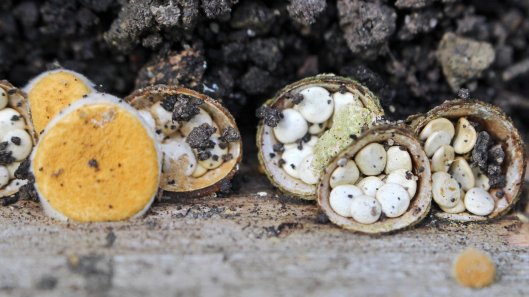
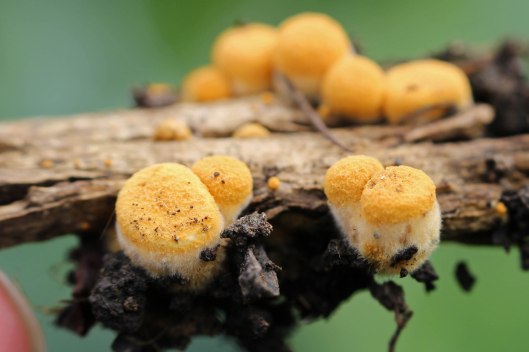
Of course, you’ve guessed it – I’m not talking about eggs in the nests of birds with feathers: these are fungi, but one of the most amazing types of fungi I know. And this was the first time I’d seen them with eggs in the nests and, indeed, it was the first time I’d seen them before the eggs were exposed. And there must have been hundreds of them, all growing along the planks of wood around a raised garden bed.

170831 Common bird's-nest fungus (3)170831 Common bird's-nest fungus (2)

This is the Common bird’s-nest fungus (Crucibulum laeve) and I think you can see where it got its common name. It starts off looking like small blobs of yellowy orange fur, then the furry membrane falls off to reveal its inner cupcake-shaped fruiting body and that’s where the eggs sit. Of course, they’re not eggs at all: the scientific name for them is peridioles. They’re effectively capsules full of spores that are activated when rain drops hit them, causing them to ‘leave the nest’ and begin the germination process. (If you’re as fascinated by these as I am, you can read more here.)

170831 Common bird's-nest fungus (5)170831 Common bird's-nest fungus (4)

Like Loading...

What’s on the teasel, 2

30 Wednesday Aug 2017

Posted by sconzani in flowers, insects, nature, wildflowers

≈ 1 Comment

Tags

6-spot Burnet moth, bees, British wildflowers, bumblebees, Six-spot burnet, Teasel

The pretty lilac of teasel flower is beginning to fade now but the mini beasts have certainly been enjoying its nectar. In my local parks and reserves it’s a favourite with the 6-spot Burnet moths and with bees of all species. And not long after those pretty little flowers fade away, the seeds will begin to form and grow, and provide food for the birds, particular the dapper little goldfinch, during the winter months. I’ll try to catch photos of them on the teasels in a couple of months’ time.

170830 whats on the teasel 6spot burnet (1)
170830 whats on the teasel 6spot burnet (2)
170830 whats on the teasel bees (1)
170830 whats on the teasel bees (2)
170830 whats on the teasel bees (3)
Like Loading...

A selection of Grass-veneers

29 Tuesday Aug 2017

Posted by sconzani in insects, nature

≈ 8 Comments

Tags

Agriphila straminella, Agriphila tristella, British moths, Chrysoteuchia culmella, Crambus lathoniellus, Crambus pascuella, Grass moths, Grass-veneer, micro moth

If you have a tendency, as I do, to wander through grassy meadows, you may have noticed small pale-looking flying creatures that are disturbed by your passing. They flit up and disappear again so quickly – their wings gathered tightly to their sides and often perched head-down on a grass stem – that they can be very hard to spot, and you may not, as I initially didn’t, realise that they’re moths. There are 39 species of Crambinae (the Grass moth family) in Britain – so far I’ve only managed to photograph these five.

170829 Agriphila straminella Straw Grass-veneer
170829 Agriphila tristella Common grass-veneer

Agriphila straminella Straw Grass-veneer (left) and Agriphila tristella Common grass-veneer (right)

170829 Chrysoteuchia culmella Garden Grass-veneer (1)
170829 Chrysoteuchia culmella Garden Grass-veneer (2)

Chrysoteuchia culmella Garden Grass-veneer

170829 Crambus lathoniellus Hook-streak Grass-veneer (1)
170829 Crambus lathoniellus Hook-streak Grass-veneer (2)

Crambus lathoniellus Hook-streak Grass-veneer

170829 Crambus pascuella Inlaid grass-veneer (1)
170829 Crambus pascuella Inlaid grass-veneer (2)

Crambus pascuella Inlaid grass-veneer

I am extremely grateful to my friends from the South Wales Butterfly Conservation Group on Facebook for their help in identifying these moths.

Like Loading...

Why I bought bins

28 Monday Aug 2017

Posted by sconzani in birds, nature

≈ 8 Comments

Tags

benefits of binoculars, birding, birdwatching, British birds, Goldfinch, Little egret, Rock pipit, Yellowhammer

I have always been a bird lover but my birding enjoyment has increased immeasurably since I finally bought myself a pair of binoculars. (I’d previously relied on using the 300mm lens on my camera to bring me closer to distant birds but I now realise how utterly inadequate that was.) From yesterday’s trip to Gileston and Aberthaw with my bird club, here’s why buying bins has been brilliant …

170828a Goldfinches

I could see these Goldfinches with the naked eye and the camera got a reasonable, though not crisp shot.

170828b Yellowhammer

This was my first sighting of a Yellowhammer this year. You can perhaps just make out a yellow dot perched on top of the hedge.

170828c Sparrowhawk

You’ll have to take my word for this one – there’s a Sparrowhawk in this photo. It was well camouflaged but I could just see it with my bins.

170828e Turnstone Dunlin Ringer plover

There were lots of waders foraging on the beach: Turnstones, Dunlins and cute little Ringed plovers. Just specks through the camera, though.

170828f Rock pipit

This one’s a little easier. Spot the Rock pipit.

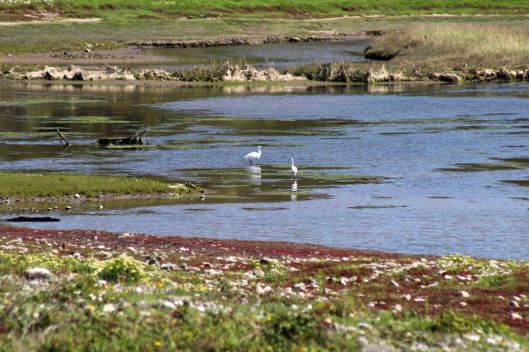
170828g Little egrets

Their bright Persil whiteness makes these two Little egrets much easier to see but with the bins I could almost see what they were catching for lunch!

Like Loading...

Dragons at Lavernock

27 Sunday Aug 2017

Posted by sconzani in insects, nature, parks

≈ 2 Comments

Tags

British dragonflies, Broad-bodied Chaser, Common Darter, dragonflies, dragonfly ovipositing, Emperor dragonfly, Lavernock Nature Reserve

There were some cracking dragonflies scooting around the pond at Lavernock Nature Reserve yesterday.

170827 Common darter male
170827 Common darter female

Both the male and the female Common darters posed very obligingly for me.

170827 Emperor male

The male Emperor kept busy patrolling the pond and indulging in occasional rapid trysts with a female. Judging by his tattered wings, he’s notched up quite a few trysts in recent days / weeks. He only stopped once, and then very briefly, so this photo doesn’t really do him justice.

170827 Emperor female

The female Emperor was then kept busy laying eggs at various spots all around the pond edges. A woman’s work is never done!

170827 Broad-bodied chaser male

The star of the show was this gorgeous male Broad-bodied chaser. Apparently, this is very late in the season for them, and he was looking pristine, so perhaps he had only recently hatched. Whatever his story, he was a stunning sight.

Like Loading...

Smiles

26 Saturday Aug 2017

Posted by sconzani in amphibian, nature

≈ 2 Comments

Tags

Common frog, frog, smiling frog

… are contagious!

170826 smiling frog

Like Loading...

Wildflowers that aren’t

25 Friday Aug 2017

Posted by sconzani in flowers, insects, nature, parks, wildflowers

≈ 8 Comments

Tags

bumblebee, Floral Friday, insects on flowers, ladybird, wildflowers, wildflowers in city parks

170825 flowers & insects (1)

I’m in two minds about the current trend amongst city councils to plant beds of wildflowers in local parks. I’m told that the seed mixes are often imported from Europe because they’re cheaper, so they’re not necessarily flower species that would grow naturally in the local area. It seems a token gesture on the part of councils rather than any kind of commitment to the environment. On the other hand, I can’t help but enjoy the colourful flowers, and the insects also seem to benefit from them. What do you think?

170825 flowers & insects (2)
170825 flowers & insects (3)
170825 flowers & insects (4)
170825 flowers & insects (5)
170825 flowers & insects (6)
170825 flowers & insects (7)
Like Loading...

Oak galls: marbles and apples

24 Thursday Aug 2017

Posted by sconzani in insects, nature, trees

≈ 4 Comments

Tags

Andricus kollari, Biorhiza pallida, gall wasps, galls on oak trees, Marble galls, Oak apple galls, Oak apples, oak galls, Oak marbles, oak tree

Though there are many more galls to be found on oak trees than the six I have covered in this and my previous two posts (knoppers and artichokes, and currants and spangles), I’ll make this the last lot for now. Otherwise, it might be just too galling for words!

170824 Andricus kollari Oak Marble gall (1)

So, to finish off this mini series, today we have Marble and Apple galls. Let’s start with the Marble galls and another tiny wasp, Andricus kollari, which lays its eggs on the twigs of any species of oak. This causes small perfectly round spheres to develop on these twigs. The spheres start off green but brown with age and will often remain on the twigs for a year or more. You can tell that the wasp has fled its larval home when you see tiny holes in the sphere. And although these do look just like brown marbles, I’m not sure you could use them to play the once-popular childhood game – they’re a little too light to shoot with.

170824 Andricus kollari Oak Marble gall (2)
170824 Andricus kollari Oak Marble gall (3)

And so to Oak apples. With their basic green colour and pink tinges, these do resemble immature apples but their surface texture and spongy feel are all wrong. The wasp Biorhiza pallida is the culprit this time, and these ‘apples’ contain several larvae, not just one.

170824 Biorhiza pallida Oak apple gall (3)
170824 Biorhiza pallida Oak apple gall (2)

Like many such wasps, both the Marble gall wasp and the Apple gall wasp have a sexual and an agamic (asexual) reproduction cycle. I have not seen the sexual galls produced by Andricus kollari which, interestingly, are produced only on Turkey oak (Quercus cerris) – the Marble galls are produced by the agamic (all female, no mating required) generation. Oak apple galls are produced by the sexual generation of Biorhiza pallida: the agamic generation lay their eggs on the roots of oak trees, so I haven’t seen those yet either.

170824 Biorhiza pallida Oak apple gall (1)

I find the whole concept of two different types of reproduction and, indeed, the way these wasps can cause such galls to form very intriguing!

Like Loading...

Oak galls: knoppers and artichokes

23 Wednesday Aug 2017

Posted by sconzani in insects, nature, trees

≈ 4 Comments

Tags

Andricus foecundatrix, Andriscus quercuscalicis, Artichoke gall, galls caused by wasps, galls on oak trees, Knopper gall, oak galls, Oak hop gall, oak tree, Pedunculate Oak, Quercus petraea, Quercus robur, Sessile oak

Following quickly on from yesterday’s oak galls, part 1, we have oak attack, part 2, a sorry tale of knoppers and artichokes – and, no, you can’t eat them!

170823 Andricus quercuscalicis Oak knopper gall (2)
170823 Andricus quercuscalicis Oak knopper gall (1)

First the knoppers, which are caused by Andriscus quercuscalicis, a wasp with chemical weapons. The wasp lays its eggs in buds on oak trees and the larvae, when they hatch, secrete a chemical that causes the developing acorn to distort into a knobbly lump, thus forming a home for themselves. The galls are structurally interesting but not so good for the oak tree, as the acorn is no longer a viable seed for the tree and I presume the knopper gall also makes the acorn unsuitable as food for wildlife as well. Apparently, this wasp only arrived in Britain in the 1960s but its spread has been rapid, with the galls now found throughout Wales and England and in southern Scotland, though only on the Pedunculate oak (Quercus robur).

170823 Andricus foecundatrix Oak artichoke gall (1)
170823 Andricus foecundatrix Oak artichoke gall (2)
170823 Andricus foecundatrix Oak artichoke gall (3)

Artichoke galls – also known as hop galls due to their resemblance to flower of the hop plant – are also the result of chemical distortion by a wasp. This time it’s Andricus foecundatrix that does the damage. Using its sharp ovipositor, it lays its eggs in the leaf buds of both the Pedunculate oak and the Sessile oak (Quercus petraea). Like yesterday’s Spangle-causing wasp, Andricus foecundatrix also has both a sexual and an asexual generation. The asexual wasp hatches from her artichoke home in the springtime and lays her eggs in oak catkins, causing a small oval-shaped gall to develop – I don’t yet have any photos of these galls but you can see images here.

Like Loading...

Oak galls: Currants and spangles

22 Tuesday Aug 2017

Posted by sconzani in insects, leaves, nature, trees

≈ 7 Comments

Tags

Common spangle gall, Currant gall, galls on oak, Neuroterus quercusbaccarum, Oak gall, Oak gall wasp, oak tree, Spangle gall

This is part one of the story of Oak galls – there will be a sequel (possibly two) because the poor old oak tree, one of the most iconic of British trees, the one almost everyone can identify, is also one of the trees most attacked by galls (though, in this case, the galls do little, if any, damage to the actual tree). This first Oak attack story is a bit like the chicken and the egg – which came first? – as Neuroterus quercusbaccarum, a wasp so tiny that only expert spotters ever actually see it, has the ability to reproduce both sexually and asexually, producing two types of gall on oak trees: the sexual generation is produced inside the Currant galls and the asexual generation develops inside the Common spangle galls.

170822 Neuroterus quercusbaccarum Oak Currant gall (1)
170822 Neuroterus quercusbaccarum Oak Currant gall (2)
170822 Neuroterus quercusbaccarum Oak Currant gall (3)

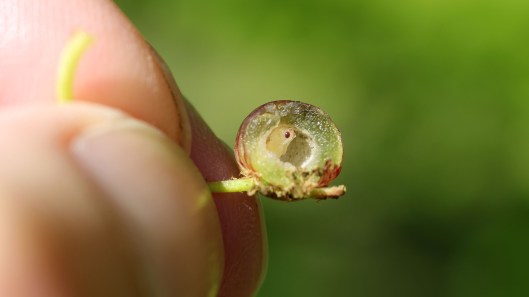
Let’s start with the Currants. As their name suggests, they look a little like currants or berries, maturing in colour from yellow and green to red and purple. In spring, you can find these attached to an Oak’s catkins or to the undersides of leaves.

170822 Neuroterus quercusbaccarum Oak Currant gall

Inside, tiny larvae develop, emerging as adult wasps in June. These wasps are either male or female, they mate soon after emerging, then lay their eggs within the epidermis on the undersides of oak leaves.

170822 Neuroterus quercusbaccarum Spangle gall (1)
170822 Neuroterus quercusbaccarum Spangle gall (2)
170822 Neuroterus quercusbaccarum Spangle gall (3)

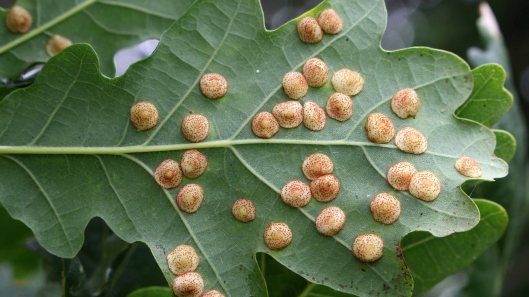
Now to the Spangles. When the eggs of the Currant gall generation hatch and their larvae begin to develop within the oak leaves, they create Spangle galls on the undersides of those leaves. The galls look a little like inverted saucers, with a slight hump in the middle. They are hairy and often quite a bright pinkish red to begin with, maturing eventually to a dull brown. Once mature, in late summer, the spangles detach and fall to the ground to be covered by the leaves of the oak, when they fall in autumn. The larvae overwinter in their cosy spangles, hatching in the spring when, without the need to mate, they lay their eggs on the oak’s leaves and catkins, thus producing the alternate generation of Currant galls. And so the cycle continues …

170822 Neuroterus quercusbaccarum Spangle gall (4)

Like Loading...
← Older posts

About me

sconzani

sconzani

I'm a writer and photographer; researcher and blogger; birder and nature lover; countryside rambler and city strider; volunteer and biodiversity recorder.

View Full Profile →

Follow earthstar on WordPress.com

Enter your email address to follow this blog and receive notifications of new posts by email.

Recent blog posts

  • The Fox and the crow May 2, 2026
  • More Green tigers May 1, 2026
  • Cute cootlet April 30, 2026
  • Blood bees April 29, 2026
  • Nesting material April 28, 2026

From the archives

COPYRIGHT

Unless otherwise acknowledged, the text and photographs on this blog are my own and are subject to international copyright. Nothing may be downloaded or copied without my permission.

Fellow Earth Stars!

  • Unknown's avatar
  • Unknown's avatar
  • Unknown's avatar
  • Unknown's avatar
  • Unknown's avatar
  • Unknown's avatar
  • Unknown's avatar
  • Unknown's avatar
  • Unknown's avatar
  • Unknown's avatar
  • Unknown's avatar
  • Unknown's avatar
  • Unknown's avatar
  • Unknown's avatar
  • Unknown's avatar
  • Unknown's avatar
  • Unknown's avatar
  • Unknown's avatar
  • Unknown's avatar
  • Unknown's avatar
  • Unknown's avatar
  • Unknown's avatar
  • Unknown's avatar
  • Unknown's avatar
  • Unknown's avatar
  • Unknown's avatar
  • Unknown's avatar
  • Unknown's avatar
  • Unknown's avatar
  • Unknown's avatar
  • Unknown's avatar
  • Unknown's avatar
  • Unknown's avatar
  • Unknown's avatar
  • Unknown's avatar
  • Unknown's avatar
  • Unknown's avatar
  • Unknown's avatar
  • Unknown's avatar
  • Unknown's avatar
  • Unknown's avatar
  • Unknown's avatar
  • Unknown's avatar
  • Unknown's avatar
  • Unknown's avatar
  • Unknown's avatar
  • Unknown's avatar
  • Unknown's avatar
  • Unknown's avatar
  • Unknown's avatar

Blog at WordPress.com.

Privacy & Cookies: This site uses cookies. By continuing to use this website, you agree to their use.
To find out more, including how to control cookies, see here: Cookie Policy
  • Subscribe Subscribed
    • earthstar
    • Join 643 other subscribers
    • Already have a WordPress.com account? Log in now.
    • earthstar
    • Subscribe Subscribed
    • Sign up
    • Log in
    • Report this content
    • View site in Reader
    • Manage subscriptions
    • Collapse this bar

Loading Comments...

You must be logged in to post a comment.

    %d